
Let's be honest with you from the start: we are not a travel blog run by someone who visited Iran once and wrote about it from a café in London. We are Heritage Persia — a team of Iranians who live here, guide tours year-round, and have spent fifteen years watching thousands of travellers arrive from every corner of the world. We know what September feels like in the alleys of Yazd. We know what happens to a group of French tourists when they first see the Imam Mosque at 6am in October. We know which months our phones don't stop ringing, and which months we tell people to come because the crowds have gone home.
Here is the truth about when to come to Iran — told by the people who are here when you arrive.
September, October, and November are Heritage Persia's peak months — the period when we run the most tours, receive the most bookings, and when Iran is, in our honest opinion, at its most magnificent. March, April, and May run a close second, with the added spectacle of Nowruz and the rose harvest. Everything in between has its own character — and we'll tell you about all of it.
📌 From our booking data: September through November accounts for our highest volume of tours each year — followed closely by March through May. This isn't marketing. It's what fifteen years of running tours in Iran looks like in practice.
Month by Month — The Complete Guide
Iran is a country the size of Western Europe with the geographic range to match. The temperature in Tehran in July bears no relationship to the temperature in Ramsar on the Caspian coast on the same day. What follows is our honest, city-by-city, month-by-month assessment — the kind of guide we wish existed when we started.
← Scroll to see all cities →
| Month | Tehran °C | Isfahan °C | Shiraz °C | Yazd °C | Kashan °C | Tabriz °C | Mashhad °C | Rating | Key Events |
|---|---|---|---|---|---|---|---|---|---|
| January | 1–8 | −3–10 | 0–13 | 1–13 | 0–11 | −5–4 | −2–8 | ❄️ Dizin Skiing | |
| February | 3–11 | 0–14 | 2–16 | 4–17 | 2–14 | −3–6 | 0–11 | ⛷️ Peak Ski Season 📅 22 Bahman Holiday | |
| March | 7–16 | 5–18 | 5–20 | 8–22 | 7–20 | 1–12 | 4–16 | 🎊 Nowruz (Mar 20–21) ⚠️ Book ahead | |
| April | 13–22 | 10–23 | 9–25 | 14–27 | 12–26 | 6–18 | 10–22 | 🌿 Sizdah Bedar (Apr 2) 🌸 Gardens Peak | |
| May | 18–28 | 14–29 | 14–31 | 19–33 | 17–32 | 11–24 | 14–28 | 🌹 Rose Harvest (Kashan) 🏔️ Mountain Passes Open | |
| June | 22–34 | 19–35 | 18–37 | 24–38 | 22–38 | 16–30 | 19–33 | 🌊 Caspian Coast 🏕️ Alborz Hiking | |
| July | 25–37 | 22–38 | 21–39 | 26–40 | 25–41 | 20–34 | 21–35 | 💰 Lowest Prices 🌌 Desert Nights | |
| August | 25–36 | 20–36 | 19–38 | 24–38 | 24–40 | 20–34 | 19–34 | 💰 Lowest Prices ⛰️ Mountain Resorts | |
| September | 21–32 | 15–32 | 15–34 | 20–35 | 19–35 | 15–29 | 14–30 | 🧡 Golden Light Season 🌾 Pre-Saffron | |
| October | 15–25 | 10–26 | 10–28 | 14–28 | 13–28 | 9–22 | 8–23 | 💜 Saffron Harvest 🎉 Mehregan Festival | |
| November | 8–16 | 3–17 | 5–20 | 7–20 | 6–18 | 2–12 | 4–16 | 🍎 Pomegranate Season 🏝️ South Iran Peak | |
| December | 3–10 | −1–12 | 1–15 | 3–15 | 1–12 | −3–6 | 0–11 | 🍉 Yalda Night (Dec 21) ❄️ Ski Season Opens |
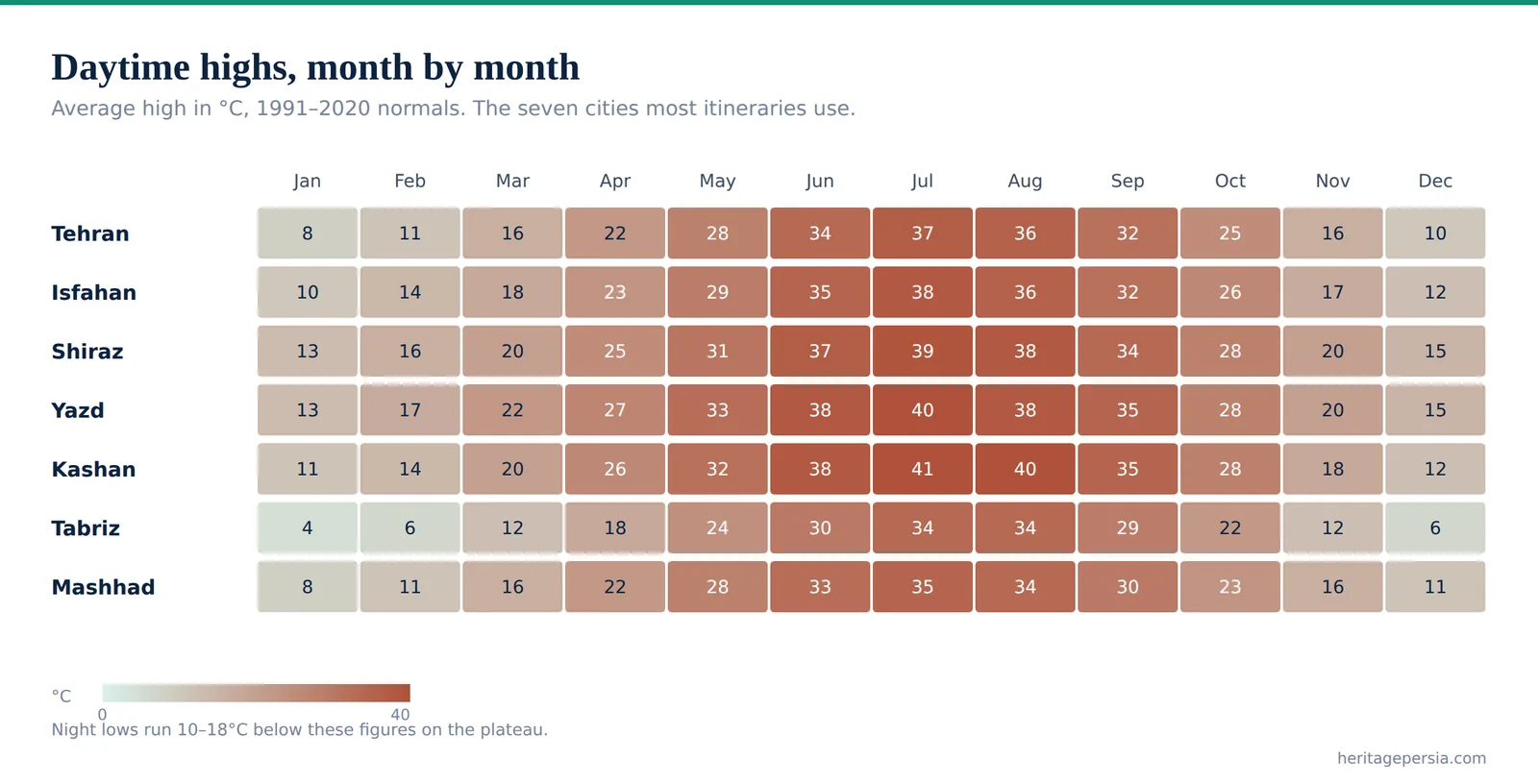
Average daily low–high, rounded, from the 1991–2020 climate normals for each city. Ratings and event notes come from fifteen years of Heritage Persia tour operations. Note the spread: Isfahan in April swings from 10°C before dawn to 23°C at noon, so pack for both.
January (Dey — دی)
Cold in the north, mild in the south. Tehran is 2–8°C with occasional snow that turns the Alborz Mountains into something from a film set. Isfahan can drop below freezing at night, but its beauty in winter light — frost on the Si-o-se-pol bridge, the Imam Mosque against a steel-grey sky — is something few international travellers have ever seen. Meanwhile, Shiraz and Bandar Abbas in the south are 15–20°C: warm, uncrowded, and extraordinary. Dizin ski resort above Tehran is fully operational — world-class slopes, almost no foreigners, prices that will make you laugh if you've skied in the Alps.
February (Bahman — بهمن)
The coldest month in most of Iran, but the skiing is at its peak. Kerman is mild and uncrowded. The ancient caravanserai hotels of Yazd are quiet — you can stand alone in a 600-year-old courtyard at sunset and hear nothing but wind. The 22 Bahman national holiday (February 11th) sees some closures but also genuine street life worth witnessing. Budget travellers: February prices for hotels and tours are among the lowest of the year.
March & April (Esfand / Farvardin — اسفند / فروردین) ★★★★★
The Persian New Year — Nowruz — falls on the spring equinox, usually March 20th or 21st. In the ten days before and after, Iran transforms. Families travel, bazaars fill with colour and noise, and the country celebrates with a joy that is entirely its own. The Kashan rose gardens are beginning to wake. The valleys around Isfahan are turning green.
A word of warning that other guides don't give you: during Nowruz itself (roughly March 20 – April 2), hotels and transport must be booked months in advance. Domestic tourism is at its absolute peak — domestic flights and intercity buses sell out weeks ahead. Prices rise. If you haven't planned ahead, come in April instead — the energy has settled, the weather is perfect, and you have the country largely to yourself.
💡 Heritage Persia tip: Sizdah Bedar (Nature Day) falls on April 2nd — the thirteenth day of Nowruz. Every Iranian family goes outdoors. Parks are full of picnics, laughter, music. It's one of the most joyful days of the year to be in Iran, and almost no international tourist knows about it.
| City | March Avg | April Avg | Condition |
|---|---|---|---|
| Tehran | 12°C | 18°C | Mild, some rain |
| Isfahan | 11°C | 17°C | Ideal — gardens blooming |
| Shiraz | 12°C | 18°C | Orange blossom season |
| Yazd | 15°C | 21°C | Perfect desert weather |
| Kashan | 13°C | 19°C | Rose harvest begins late April |
| Tabriz | 7°C | 12°C | Cool but clear |
May (Ordibehesht — اردیبهشت) ★★★★★
Our second favourite month. The Nowruz crowds have gone. The weather is warm but not yet hot. The Kashan rose harvest is in full swing — the distillation of rosewater in the villages around Kashan (Qamsar, Niasar, Barzok) is one of the most extraordinary sensory experiences in travel anywhere. The air literally smells different. The mountain passes above Tehran are green and clear. The ancient gardens of Shiraz are at their peak.
May is also when we see our largest number of European travellers — particularly from France, Germany, and Italy — who have done their research and chosen wisely. If you are planning your first trip to Iran and have flexibility, May is the month we recommend most often.
Heritage Persia · May Tours Rose Harvest Tours — Kashan, May 2027 Copper stills, dawn fields, the scent of a thousand Damask roses. Our most requested tour — limited places each season. Book Now →June (Khordad — خرداد)
The heat is arriving in the central plateau. Tehran and Isfahan begin to push 35°C. But June is not impossible — it's the month to think strategically. The Caspian coast (Rasht, Ramsar, Lahijan) is lush, green, and 25°C. The Alborz mountains above Tehran are perfect for hiking. The ancient village of Masouleh in Gilan, clinging to a mountain at 1,050 metres, is one of the most beautiful places in Iran and is perfectly cool in June. If you come in June, come for the north.
July & August (Tir / Mordad — تیر / مرداد)
We will be straight with you: July and August in Tehran, Isfahan, and Shiraz are genuinely hot. 38–42°C in the cities. The good news: Iranian cities know how to cope with heat in ways that Europeans do not. Shade is everywhere. Bazaars are cool. Air conditioning is universal. Restaurants stay open late. And the desert — paradoxically — is extraordinary at night. The stars above Dasht-e Kavir on a summer night, when the heat has broken and the temperature drops to a perfect 22°C, are among the most spectacular sights on earth.
📌 Budget travellers: July and August offer the lowest prices of the year for international tourists. Hotels that cost €80 in October cost €45 in August, and hostel beds fall further still. Tour guides have availability. Popular sites — the Imam Mosque, Persepolis, the Nasir al-Mulk Mosque — are significantly less crowded. If you can handle the afternoon heat (and most people can, with the right approach), summer offers extraordinary value.
September (Shahrivar — شهریور) ★★★★★
This is when Heritage Persia gets busy. September is our month — the month our guides are fully booked, our partner hotels are filling up, and our phones ring from morning to night. And for good reason.
Early September still carries some summer warmth (28–32°C in most cities), but by mid-September the heat has broken and what replaces it is something photographers travel across the world to find: that particular quality of late-afternoon light that turns every surface in Isfahan into gold. The crowds of spring are long gone. Prices are beginning to rise from their summer lows, but haven't yet reached October peaks. The pomegranates are ripening. The persimmon trees are heavy with fruit. The saffron fields around Khorasan are preparing for harvest.
If we could send every first-time visitor to Iran in a single month, September would be a very strong contender.
October (Mehr — مهر) ★★★★★
October is, in our honest experience, the finest month to visit Iran. Temperatures across the country are perfect: 18–24°C in most cities, cool evenings, warm days, cloudless skies. The saffron harvest is underway in Khorasan — the fields around Torbat-e Heydarieh are purple with crocus flowers at dawn, each one picked by hand before sunrise because the flowers close in the heat of the day.
The Mehregan festival (the ancient Persian festival of autumn, love, and friendship) fills the country with a quiet celebratory energy that most foreign visitors don't know to look for — but feel nonetheless. In Isfahan, the evening call to prayer echoes across Naqsh-e Jahan Square in October light that is unlike any other month. We have watched hundreds of travellers stand in that square and go completely silent.
💡 Photography tip from our guides: October light in Isfahan is extraordinary between 4pm and 6pm. If you're visiting the Imam Mosque, plan your visit for late afternoon. The tiles change colour as the light shifts — turquoise becomes cobalt, gold becomes amber. Plan an hour and bring your best lens.
| City | September Avg | October Avg | November Avg |
|---|---|---|---|
| Tehran | 26°C | 20°C | 12°C |
| Isfahan | 24°C | 18°C | 10°C |
| Shiraz | 25°C | 20°C | 12°C |
| Yazd | 27°C | 21°C | 13°C |
| Mashhad | 22°C | 16°C | 9°C |
| Tabriz | 22°C | 15°C | 7°C |
November (Aban — آبان) ★★★★
November is underrated and we actively recommend it to travellers who have flexibility. The north gets cold (Tehran drops to 10–15°C, Tabriz to 5–8°C), but the south is perfect: Shiraz at 14°C, Bandar Abbas at 25°C, the island of Hormuz in turquoise water under clear skies. The dates are in season in the palm oases of Kerman province. The pomegranate festival (Yalda preparations begin) fills bazaars with deep crimson fruit.
International tourist numbers drop in November, which means quieter sites, more available guides, and hotels offering better rates. For travellers who dislike crowds, November in the south of Iran is close to perfect.
December (Azar — آذر)
Yalda Night falls on December 21st — the winter solstice and one of the most important nights in the Persian calendar. Families gather to read Hafez, eat pomegranates and watermelon, and stay up until midnight. It is a beautiful night to be in an Iranian home. If you have any connection to an Iranian family — through your guide, your host, anyone — this is the night to ask for an invitation. You will remember it for the rest of your life.
Tehran in December is cold and occasionally magical (snow on the mountains, the city lit up against the Alborz). The south remains warm. The ski season is opening.
Best Time by Nationality
This is a section no other guide offers — because no other guide is run by people who actually see which nationalities come in which months and what they report back.
| Nationality | Best Time | Why |
|---|---|---|
| 🇨🇳 Chinese | Oct–Nov, Apr–May | Visa-free entry since 2019 · Mandarin-speaking guides · Dry, mild weather |
| 🇷🇺 Russian | Sep–Nov, Mar–May | Simplified entry — confirm current rules before booking · Russian-speaking guides in most cities |
| 🇩🇪 German / 🇫🇷 French | Apr–May, Oct | Ideal weather · European summer avoided · Photography at its best |
| 🇦🇺 Australian | Sep–Nov | Northern hemisphere autumn = Australian spring · Opposite of Australian summer |
| 🇬🇧 British / 🇺🇸 American / 🇨🇦 Canadian | Apr, Oct | Guided itinerary required by law — allow 6–8 weeks · visa assistance |
| Budget Travellers | Jun–Aug, Jan–Feb | Lowest prices · Fewest tourists · hostels and day tours at their cheapest |
| Photographers | Oct–Nov, Apr | Golden light · Clear skies · Manageable crowds at sites |
| History / Culture | Apr–May, Sep–Oct | Full days at sites without heat · Classic Persia route |
| Desert Experience | Oct–Mar | Cool nights · Clear stars · desert and mountain itineraries |
| Skiing | Dec–Mar | Dizin, Tochal, Shemshak — world-class slopes |
Best Time by Interest
Rose Harvest (Kashan)
Late April through mid-May. The villages of Qamsar, Niasar, and Barzok around Kashan. Rosewater distillation begins at dawn — copper stills, the scent of a thousand roses, women in colourful chadors moving through the fields. This is one of the most extraordinary sensory experiences in travel anywhere in the world, and almost no one outside Iran knows it exists. Heritage Persia runs dedicated rose harvest tours in May — book early, they fill quickly.
Heritage Persia · Free Consultation Not Sure When to Come? Ask Us Directly Fifteen years of running tours means we've seen every combination of dates, interests, and budgets. Tell us yours — we'll give you an honest answer. Free Tour →Late October through mid-November. Around Torbat-e Heydarieh and Qaen. The crocus fields are harvested before sunrise — purple flowers against the dark earth, lanterns moving through the rows. Iran produces over 90% of the world's saffron. Watching it harvested by hand, in the cold before dawn, is humbling. Contact us if you want to arrange a visit.
Nowruz (Persian New Year)
March 20–21 through April 2. Book everything months in advance. Expect higher prices and domestic crowds. Also expect joy, colour, and a version of Iran that very few international travellers ever see.
Yalda Night
December 21st. The Persian winter solstice. Families gather, Hafez is read aloud, pomegranates and watermelon fill the table. Ask your guide to arrange an invitation to a local home. It is worth travelling to Iran for this alone.
Spring Detail (March–May)
Farvardín (March 21 – April 20) and Ordibehesht (April 21 – May 21) in the Persian calendar. This is the season when Iran's famous hospitality seems to expand even further — perhaps because the country itself is in a good mood. The light is soft. The temperatures are forgiving. The gardens are full. If you can only come once and spring is available to you, come in spring.
Autumn Detail (September–November)
Shahrivar (late August – September 22), Mehr (September 23 – October 22), and Aban (October 23 – November 21). This is Heritage Persia's peak season — fifteen years of booking data don't lie. The combination of perfect weather, extraordinary light, and the country's harvest season creates conditions that we have never heard a traveller complain about. The only thing to book in advance for autumn is your accommodation: our partner hotels fill up in October, sometimes weeks ahead.
Summer (June–August)
Not for everyone — but for the right traveller, extraordinary. If you can handle heat, come in June or early July. Come for the desert nights. Come for the mountain resorts above Tehran. Come because hotel prices are at their annual low and popular sites are half-empty. Come because the Iranian families you meet at a chelo kababi at 10pm, eating in the cool of the evening, will be the most welcoming people you've encountered anywhere.
Winter (December–February)
The most underrated time to visit Iran, and the one we most often recommend to travellers who ask us to be honest rather than safe. Isfahan in frost is extraordinary. Yazd in winter is mild, quiet, and labyrinthine in a way that summer crowds never allow. The south — Shiraz, Bandar Abbas, Hormuz, Qeshm — is warm and uncrowded. And Dizin ski resort, 2,650m above Tehran in the Alborz, is genuinely world-class and genuinely unknown to almost every non-Iranian in the world.
✉️ Still not sure when to come? Contact us and we'll give you an honest answer based on your specific interests, budget, and available dates. We've been doing this for fifteen years. We know the answer. Talk to us →
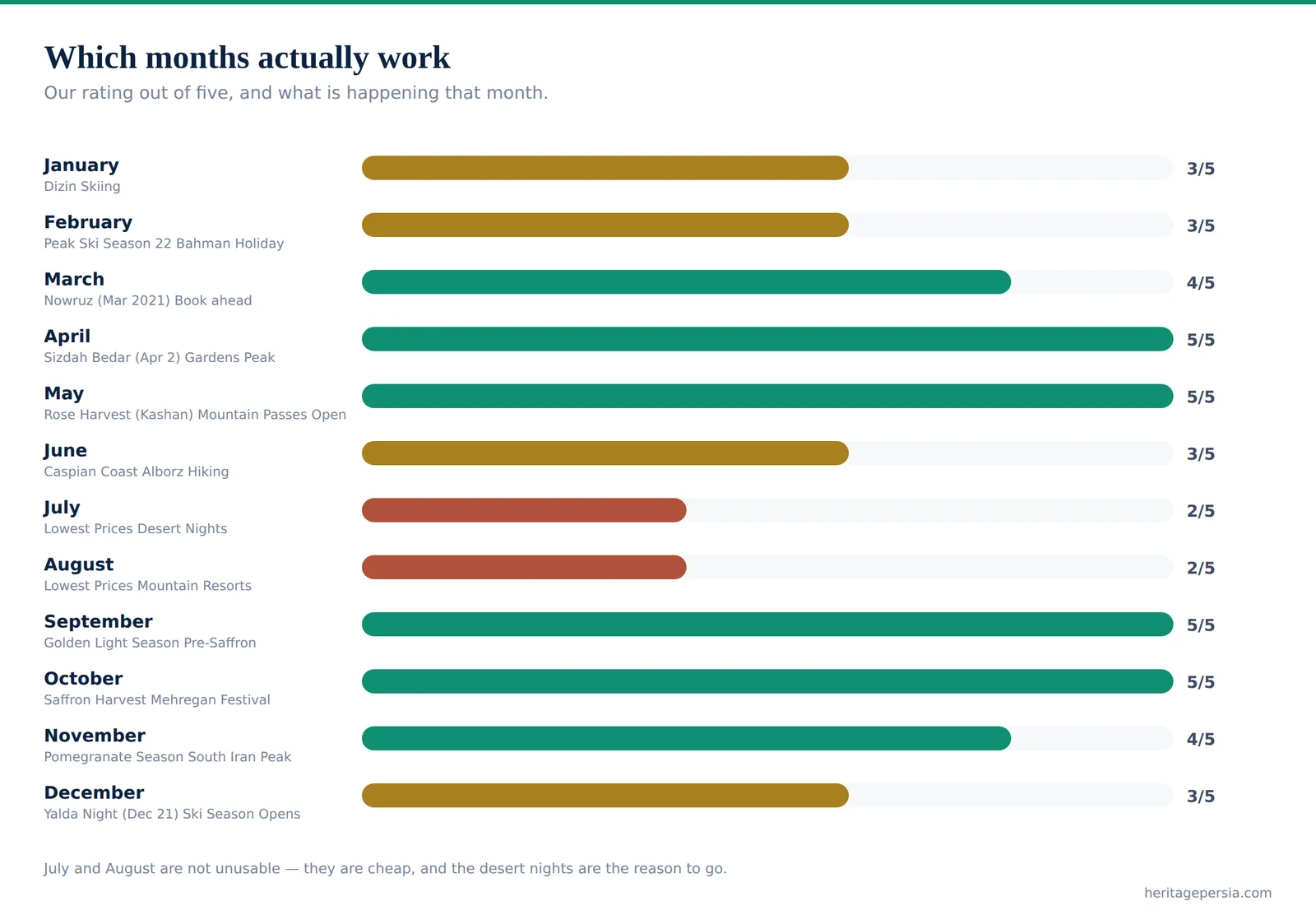
Continue reading
Frequently Asked Questions
Fifteen years of running tours across Iran means we've heard every question. Here are the ones travellers ask us most — answered honestly.
Ready to Discover Iran?
Let Heritage Persia craft your perfect journey — tailor-made, fully supported, unforgettable.
Explore Our Tours →