
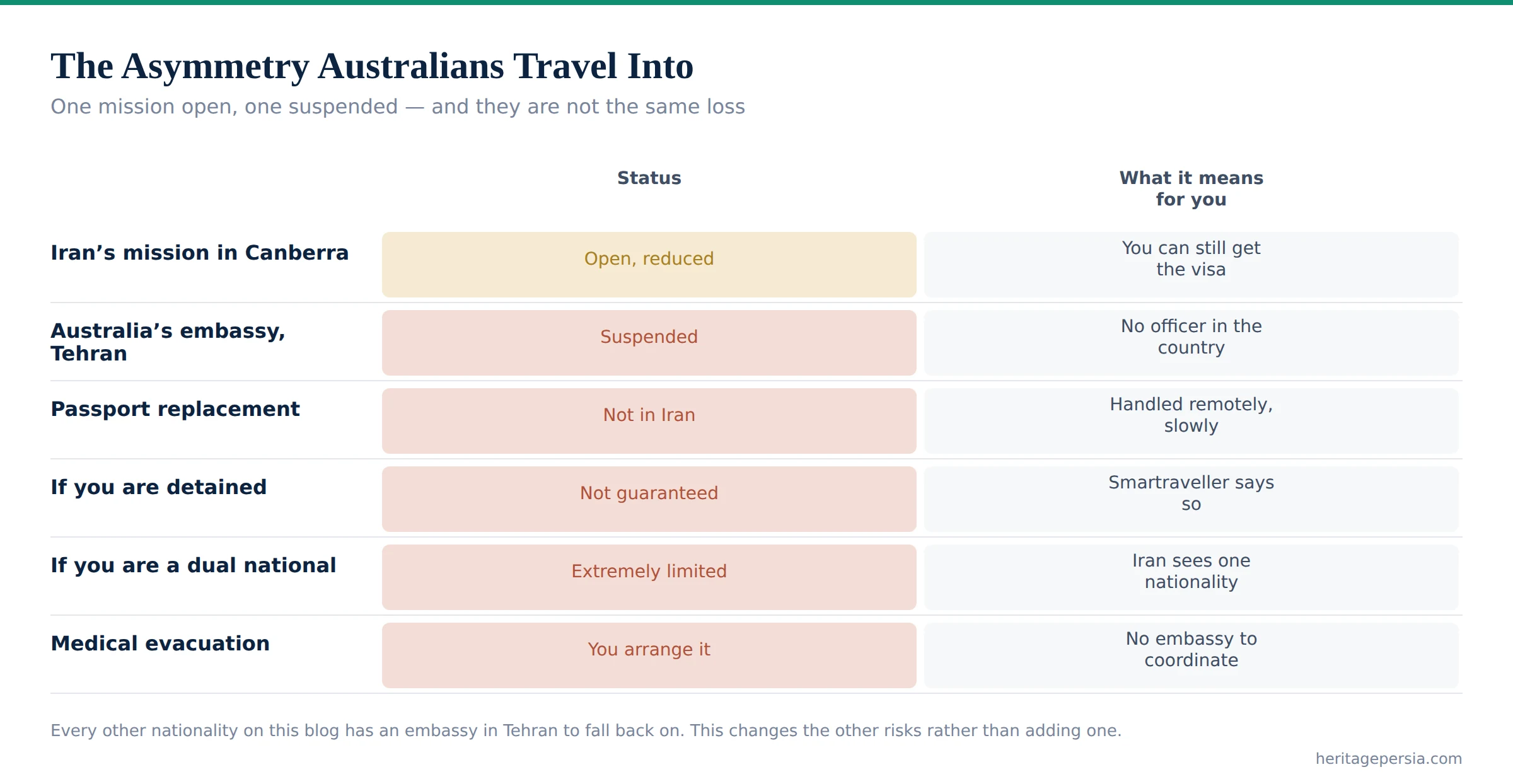
The Australian situation has an asymmetry in it that no other nationality faces, and it is the reason this page exists. Iran’s embassy in Canberra is still open, running under a chargé d’affaires since Australia expelled the ambassador on 26 August 2025. So the visa is still obtainable in Australia.
Australia’s own embassy in Tehran, opened in 1968, is suspended. There is no Australian diplomatic presence in Iran at all. You can get in; there is nobody from your government there if it goes wrong. That asymmetry is the fact to plan around, and the 2,500-word competitor guides do not mention it.
This page is reviewed monthly and was last checked on 12 September 2026. Advisories and diplomatic arrangements change faster than travel guides do. Read Smartraveller yourself before acting on anything here, and see our situation report for every advisory side by side.
What Smartraveller Actually Says
The advice is do not travel, Australia’s highest level, for the whole country. The stated grounds are the risk of arbitrary detention and a volatile regional security situation.
Three sentences from it do most of the work. Australians, including dual nationals, are at high risk of arbitrary detention or arrest. Foreign nationals including Australians have been arrested or detained without due process of law. And Australians in Iran are advised to leave as soon as possible, if it is safe to do so.
On what help is available, the wording is unusually blunt for a government page: consular access to any Australian detained or arrested cannot be guaranteed, and neither can access to legal representation.
What “No Embassy” Actually Means
This is the part worth slowing down for, because most travellers have never tested what an embassy is for.
On 26 August 2025 Australia expelled Iran’s ambassador after its domestic intelligence agency concluded that Iran had directed antisemitic attacks on Australian soil. Australia suspended the operations of its own embassy in Tehran at the same time. Iran downgraded relations in response, and its Canberra mission has run under a chargé d’affaires since.
In practice that means: no Australian consular officer in the country; no passport replacement in Tehran if yours is lost or taken; no local embassy contact in a medical emergency; no one to attend an Australian who is detained; and any consular matter handled remotely from another post, slowly, if at all.
Every other nationality on this blog has an embassy in Tehran to fall back on. Australians do not, and that changes the arithmetic of every other risk on the page rather than adding one more to the list.
The Visa, Step by Step
If you still need the procedure, this is it accurately.
| Step | What happens | How long | Watch for |
|---|---|---|---|
| 1. Passport check | Ordinary passport, six months’ validity beyond entry | Same day | Diplomatic and service passports are excluded from the on-arrival route |
| 2. Pre-register online | evisa.mfa.ir produces the confirmation document | Minutes | Registration is not approval. Do not book flights against it |
| 3. Authorisation code | Requested through a licensed Iranian agency on your behalf | 1–3 working days, often longer for Australians | Reported processing has run to about a week. Allow two |
| 4. Canberra, or on arrival | The Iranian mission in Canberra, or the airport counter at one of seven airports | Days to weeks | The mission runs at reduced staffing. Confirm before travelling to it |
| 5. Pay | Australian passports sit at the top of Iran’s per-nationality range; around €145 has been the reported on-arrival figure | — | Fees are set per nationality and change. Confirm the current one when you apply |
| 6. Insurance certificate | An Iranian policy is required and is sold at the airport | Minutes | It satisfies the requirement and very little else |
Thirty days on entry, extendable twice by thirty days inside Iran. Australians are not on the restricted list that forces an embassy-only application, which is why the on-arrival route remains open despite the state of relations.
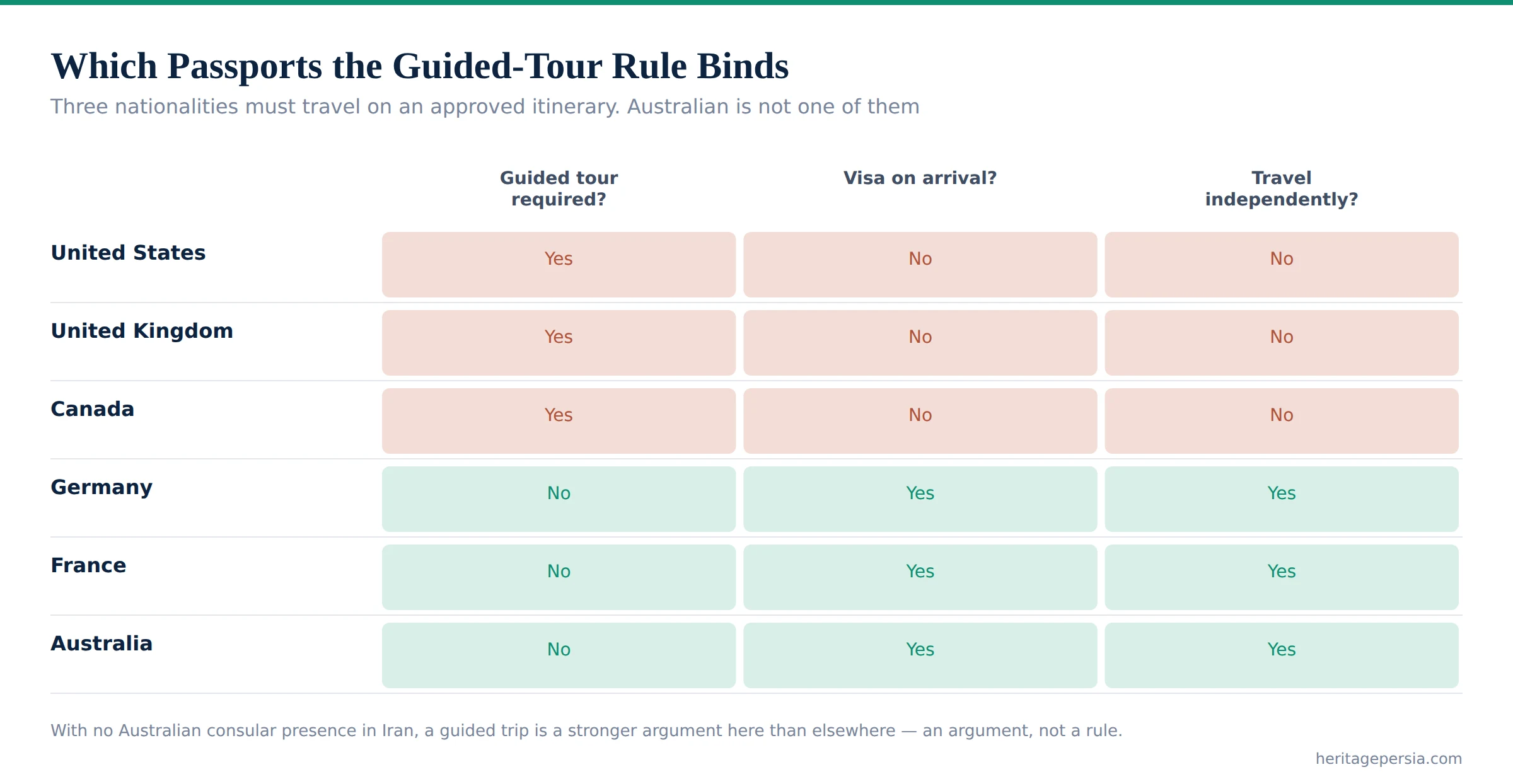
The Guided-Tour Rule Does Not Apply to You
Three nationalities must travel on an approved itinerary with a licensed guide: American, British and Canadian. Australians are not among them and may travel independently.
Given the absence of consular backup, a guided trip is a more defensible choice for an Australian than for a German or a French traveller — because a local operator who knows where you are is the closest thing to a safety net available. That is an argument, and we are the ones making it, so weigh it accordingly. It is not a rule. The visa guide has all five routes.
If You Hold Both Passports
Smartraveller singles out dual nationals and the wording is the sharpest on the page: if you are a dual Australian-Iranian national and are detained in Iran, Australia’s ability to provide consular support is extremely limited.
With the Tehran embassy suspended, “extremely limited” should be read closer to its literal meaning than it would have been two years ago. Iran does not recognise dual nationality; exit bans and military-service obligations apply as they do to other dual nationals; and there is no Australian officer in the country to raise any of it.
This is a matter for Smartraveller and for a lawyer who handles these cases, and not for a tour operator.
What the Advice Does to Your Cover
A do not travel rating is the standard exclusion trigger in Australian policy wordings. The policy remains in force and simply does not respond to a claim arising in Iran.
The Iranian policy sold with the visa carries roughly ten thousand euro of medical cover and limited repatriation. An air ambulance out of Iran costs a multiple of that, and with no embassy to coordinate one the practical question is not only who pays but who organises it. Our insurance guide covers what a policy that actually applies looks like.
Getting There
There are no direct flights between Australia and Iran, so Australians connect through a Gulf hub. European and American operators are avoiding Iranian airspace under EASA and FAA instructions, which reshapes schedules across the region and changes them at short notice.
Build a spare day around the connection and keep the onward leg refundable. A long-haul itinerary with a tight Iranian segment is the one that strands people.
Before You Pay Anyone
Ask who your operator contacts if you are detained. There is no Australian embassy to call. If they have not thought about the answer, that is the answer.
Ask for the insurance advisory clause in writing. Before the deposit.
Ask what happens to your money if the advice hardens. It hardened within the last year.
Ask where your itinerary is lodged and with whom. Leave it with someone at home who is not travelling with you, and agree a check-in schedule. This is the sort of precaution that sounds excessive until the paragraph above is re-read.
✉️ Weighing a trip rather than booking one? We will tell you what we tell our own Australian travellers, including when the answer is to wait. Talk to our team →
Continue reading
Frequently Asked Questions
What travellers ask our guides, answered on the ground.
Ask Before You Commit
We answer visa questions from people with no intention of booking with us — including when the answer is to wait.
Ask a Question →