
Your bank card does not work in Iran. Not your Visa, not your Mastercard, not American Express, not Revolut, not Apple Pay — nothing issued outside the country connects to anything inside it. There is no ATM you can use, no shop that will take the card, and no workaround at the airport. This is the single most important sentence in this guide, and the one most travellers only half believe until they land.
What follows is how money actually works here: the currency that is printed and the different one people speak in, how much cash to carry, where to change it, and what a prepaid card in your own name can and cannot do. Everything is dated, because in an economy running at this rate of inflation an undated number is worthless.
Before you plan anything: this is a guide to how money works, written to be useful whenever you are able to use it. Whether to travel to Iran at present is a separate question with a different answer — see our current situation report, reviewed 10 September 2026.
Why This Is Harder Than Anywhere Else You Have Been
Iran is disconnected from the international banking system. SWIFT access is restricted, the card networks do not operate here, and no foreign bank will settle a transaction with an Iranian one. The practical consequence for a visitor is total: you arrive with the money you will spend, or you do not spend it.
Layered on top of that is an inflation rate that makes any price quoted in local currency go stale within months. Iran’s overall inflation stood at 47.5% in February 2026 and food inflation at 105% over the same period. The central bank has been issuing progressively larger notes to keep up — a five-million-rial note early in 2026, and a ten-million-rial note that entered circulation in March 2026 and is worth roughly seven US dollars.
This is why every price in this guide is in euros. A guide that tells you a museum ticket costs a number of rials is telling you what it cost on the day it was written, which is not the same as telling you anything useful.
Every Payment Method, and Whether It Works
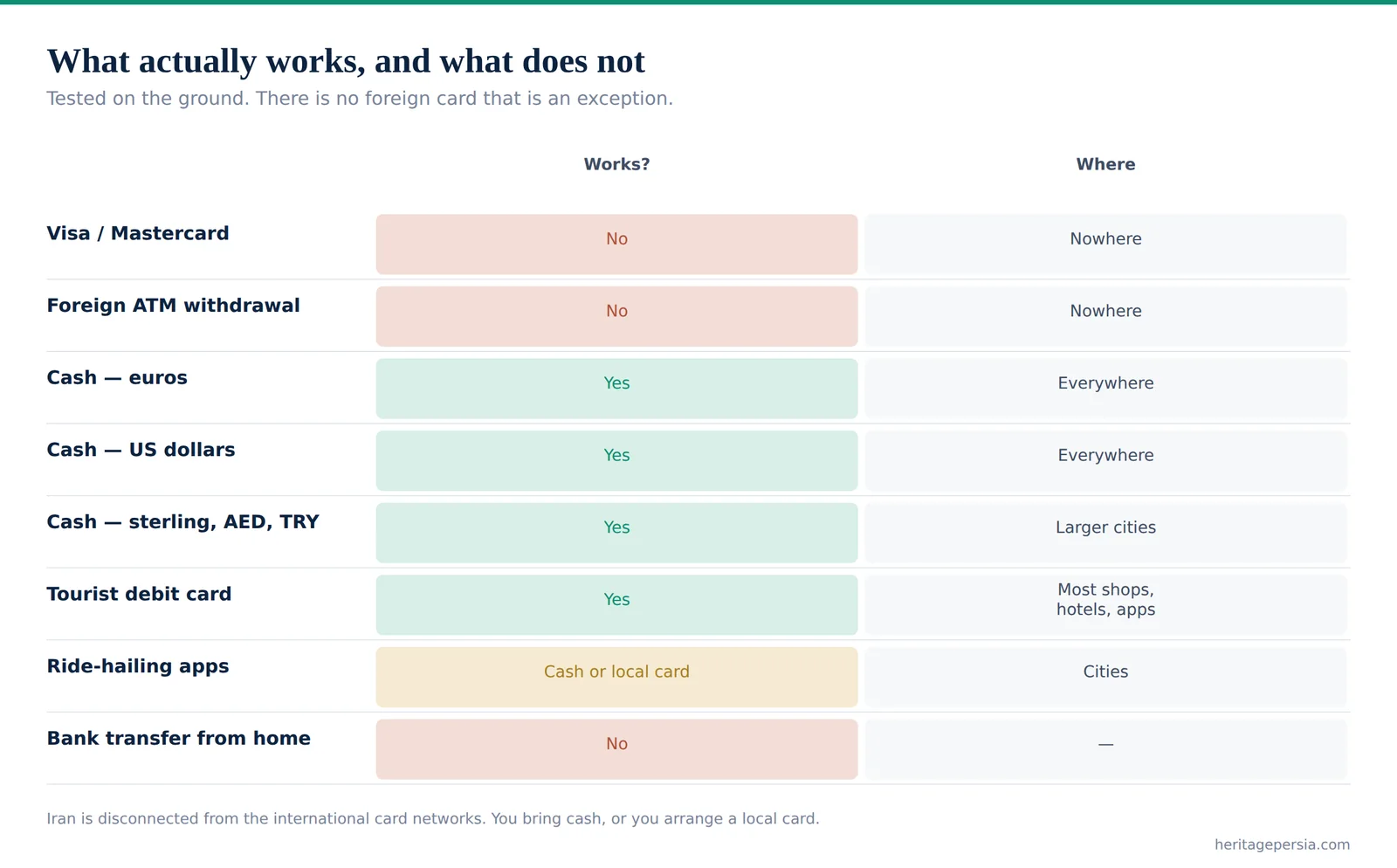
Tested on the ground, not copied from a bank’s website.
| Method | Works? | Where | Typical cost | What to know |
|---|---|---|---|---|
| Visa / Mastercard Any foreign bank | No | Nowhere | — | There is no exception, no premium tier and no bank that is different. Do not plan around one |
| Foreign ATM withdrawal | No | Nowhere | — | Iranian ATMs are on a domestic network only. Your card will not be read |
| Cash — euros | Yes | Everywhere | Spread at exchange | The most widely accepted foreign currency and usually the best rate |
| Cash — US dollars | Yes | Everywhere | Spread at exchange | Equally accepted. Notes must be post-2013, unmarked and uncreased |
| Cash — sterling, AED, TRY | Yes | Larger cities | Wider spread | Changeable but at a worse rate. Bring euros or dollars instead |
| Tourist debit card Loaded in rial before arrival | Yes | Most shops, hotels, apps | Small issue fee | The practical answer to carrying bricks of cash. Covered in full below |
| Ride-hailing apps Snapp · Tapsi | Cash or local card | Cities | Fare only | Cash on arrival works; the in-app payment needs an Iranian card |
| Bank transfer from home | No | — | — | No route exists. Money moves in a suitcase or not at all |
Exchange rates move daily and sometimes hourly. The figures below are dated for that reason — treat them as a scale, not a quote, and check on the day.
Rial and Toman — the Thing Nobody Explains Properly
The rial is the official currency and it is what is printed on every banknote. The toman is what everybody actually says. One toman is ten rial, so a note printed “1,000,000 rial” is called a hundred thousand toman.
It gets one step worse. In conversation, Iranians often drop the word “thousand” as well. A taxi driver who says panjāh — fifty — for a short ride means fifty thousand toman, which is five hundred thousand rial. He is not asking for fifty of anything printed.
💡 The rule that gets you through the first week: when a price is spoken, assume toman. When a price is written on a note or a receipt, assume rial. To convert a spoken price to the notes in your hand, add a zero. To read a note, drop a zero to get toman. Say the number back to the person before you pay — nobody minds, everybody does it, and it is how Iranians themselves avoid the confusion.
A reform is coming, on paper. Parliament approved removing four zeros from the currency on 5 October 2025, which would make the toman the printed unit and match speech to paper at last. It went back for final review and has not reached your pocket: what has actually happened since is the opposite, with larger and larger notes issued to keep pace with prices. Assume the old system until you see a new note.
The Tourist Debit Card
Carrying three weeks of spending in cash means carrying a genuinely awkward brick of notes. The alternative is a prepaid debit card issued in your name by an Iranian bank through a licensed agency — the same Shetab network the domestic cards use, so it works in shops, restaurants, hotels and the ride-hailing apps.
How it works in practice. You apply before you fly or on the first day, hand over cash or transfer funds through the agency, and collect a card loaded in rial. You top it up in person during the trip. At the end you cash out whatever is left, minus a small fee.
What it solves: the bulk, the daily risk of carrying everything on you, paying in places that dislike large notes, and paying inside apps.
What it does not solve: it is not linked to your own bank, so it cannot be reloaded from abroad, and an unspent balance has to be cashed out before you leave. Treat it as a wallet you fill, not an account.
We arrange these for travellers on our own trips; any licensed agency can, and you should use one that is licensed. If you would rather not, plan for cash and read the next two sections carefully.
Which Notes to Bring, and What Gets Refused
Bring euros or US dollars. Both are accepted everywhere that changes money, and the spread between them is small enough not to matter.
The condition of the notes matters more than travellers expect. Exchange offices refuse, or discount, notes that are torn, marked, written on, heavily creased or simply old. For dollars specifically, bring the newer large-format design — notes issued before about 2013 are frequently turned away or changed at a lower rate. Ask your bank at home for clean, new, high-denomination notes: 100-euro and 100-dollar bills get the best rate, and small denominations get the worst.
💡 Count the notes before you leave home. Once you are in Iran there is no topping up. Work out your budget, add a third, and bring that. The most common money mistake we see is not theft or a bad rate — it is a traveller running short in the second week and having no mechanism at all to fix it.
Where to Change It
Change money at a licensed exchange office — a sarrafi. They cluster on particular streets in each city, they display the day’s rate, they are used to foreigners, and they give a far better rate than a hotel front desk. Ferdowsi Street in Tehran is the best known of them, and every large city has its own equivalent.
Three practical points. Take your passport. Change a few days at a time rather than the whole trip at once, both for the security of it and because the rate moves. And count the notes in front of the clerk before you leave the counter — this is normal behaviour, not an insult.
Avoid changing money with someone who approaches you on the street, however good the rate sounds. Avoid the airport counters for anything beyond your first taxi. And ignore any figure you read online for the “official” rate — the rate you will actually be offered is the open-market one, and in early 2026 that sat between roughly 1.5 and 1.66 million rial to the dollar, having moved by more than ten per cent inside a single month.
How Much to Budget
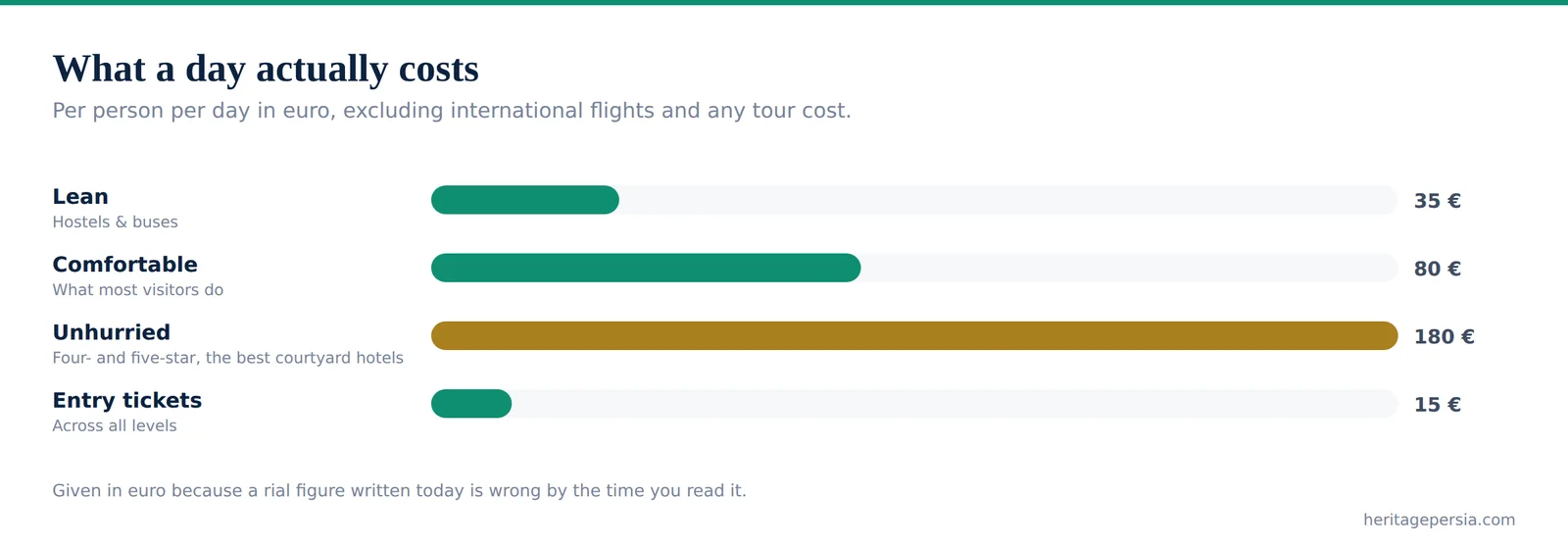
Iran is inexpensive for a foreign visitor and has become more so as the currency has fallen. What follows is what our travellers actually spend per person per day, excluding international flights and the tour itself.
| Level | Per day | Sleeping | Eating | Moving |
|---|---|---|---|---|
| Lean Hostels & buses | €25–35 | Dorm or simple guesthouse | Street food and local restaurants | Intercity buses, metro, shared taxis |
| Comfortable What most visitors do | €55–80 | Restored courtyard house or three-star hotel | Proper restaurants, one good meal a day | Private car between cities, some flights |
| Unhurried | €120–180 | Four- and five-star, the best courtyard hotels | Anywhere you like | Private car and driver throughout |
| Entry tickets Across all levels | €8–15 | — | — | Foreigner pricing applies at most monuments |
Figures are per person per day in euro, reviewed September 2026. They are deliberately not given in rial, because a rial figure written today is wrong by the time you read it.
Practical Money
Tipping. Not obligatory and not expected in restaurants, where service is usually included. Round up for taxis. For a private driver or guide on a multi-day trip, tipping is customary and genuinely appreciated — think in terms of a day rate rather than a percentage.
Bargaining. Expected in the bazaar for carpets, handicrafts and souvenirs. Not expected in shops with marked prices, in restaurants or for transport. See our guide to buying for how it actually goes.
Taking money out. The export limit is €5,000 or the equivalent. Plan the last day so you are not holding a large unspendable rial balance — spend it, or cash out your tourist card before the airport.
Keeping it safe. Iran has a low rate of street crime and we have had no traveller robbed in fifteen years. The real risk is your own carelessness with a large sum. Split the cash, leave the bulk in the hotel safe, and carry the day’s money only.
What money cannot buy you. Some services simply do not exist for a foreign card — international booking sites, most online payments, app stores. Sort out what you need before you fly; our connectivity guide covers the rest of that problem.
✉️ Want the card arranged before you land? Tell us your dates and we will have a prepaid rial card waiting, loaded to whatever you want to start with. Talk to our team →
Continue reading
Frequently Asked Questions
What travellers ask our guides, answered on the ground.
Have the Card Waiting
A prepaid rial card ready on arrival, loaded to whatever you want to start with.
Arrange It →