
A third of Iran is desert, and the two that matter to a visitor are entirely different propositions. Maranjab is ninety minutes from Kashan on the classic route and can be done as an afternoon. The Lut is a UNESCO natural World Heritage site in the far south-east that holds the highest land surface temperature ever recorded on Earth, and reaching it costs you two days.
Both are worth doing and only one of them fits a normal itinerary. This page is about which, when, and the single thing that makes either of them memorable — which is not the landscape in daylight but the night you spend in it.
Before you plan anything: this is a destination guide, written to be useful whenever you are able to use it. Whether to travel to Iran at present is a separate question with a different answer — see our current situation report, reviewed 10 September 2026.
Two Deserts, Compared
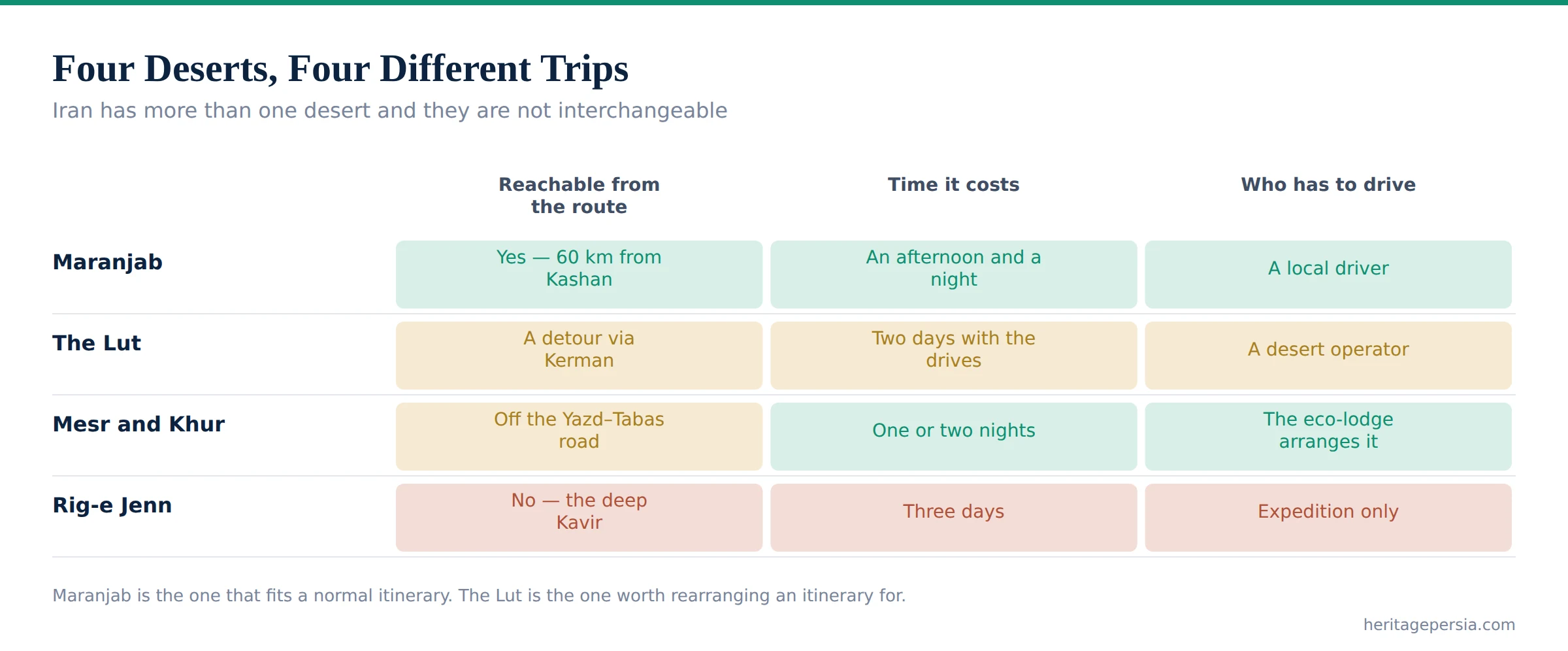
The last two columns decide it for most travellers, because one of these is free with a route you are already taking and the other is a deliberate detour.
| Desert | Where | What it is | Costs you | Season |
|---|---|---|---|---|
| Maranjab Dasht-e Kavir fringe | Aran-o Bidgol, about 60 km from Kashan | A 1603 Safavid caravanserai, dunes to 70 m, and a salt lake on the northern edge | An afternoon and evening, or one night | Oct–Apr, and bearable in the shoulder months |
| The Lut Dasht-e Lut | South-east, reached from Kerman or Shahdad | UNESCO 2016. The world’s best-expressed yardang field, kaluts to 155 m | Two days, including a long drive each way | Oct–Apr only. Genuinely hazardous in summer |
| Mesr and Khur central Dasht-e Kavir | Isfahan province, off the Yazd–Tabas road | Oasis villages with eco-lodges, dunes and a working date palmery | One or two nights, on a detour | Oct–Apr |
| Rig-e Jenn the deep Kavir | Between Semnan and Isfahan | Genuinely remote sand sea with a reputation in Persian folklore | Three days and a serious operator | Nov–Mar, expedition only |
For almost every traveller the answer is Maranjab on a ten-day trip and the Lut on a fourteen-day one with Kerman attached. The other two are for people who have done those and want more.
The Lut, and Why It Is Inscribed
The Lut became Iran’s first natural World Heritage site in 2016, on the two criteria that cover outstanding natural beauty and active geological process. The inscribed property runs to 2,278,015 hectares with a buffer zone of nearly 1.8 million more, which makes it one of the larger natural properties on the list.
What it is famous for is the yardangs — wind-carved bedrock ridges, called kaluts locally, that UNESCO describes as the world’s best examples of the landform. The largest reach 155 metres high and run in parallel ridges for over forty kilometres, aligned with the seasonal winds that cut them between June and October. They are visible from orbit. Standing between two of them at ground level is the closest thing to walking in a city that was never built.
The temperature is the other headline. A land surface temperature of 70.7 °C has been recorded within the property, among the highest measured anywhere on Earth. That figure is the ground rather than the air, which is the distinction most articles blur — but it is also the reason the season is not negotiable.
Beyond the kaluts the property holds sand seas with dunes to 475 metres, stony desert pavement, salt flats, and nebkhas — mounds of sand accumulated around vegetation — up to twelve metres, arguably the highest such features in the world. It is a catalogue of arid landforms rather than one landscape.
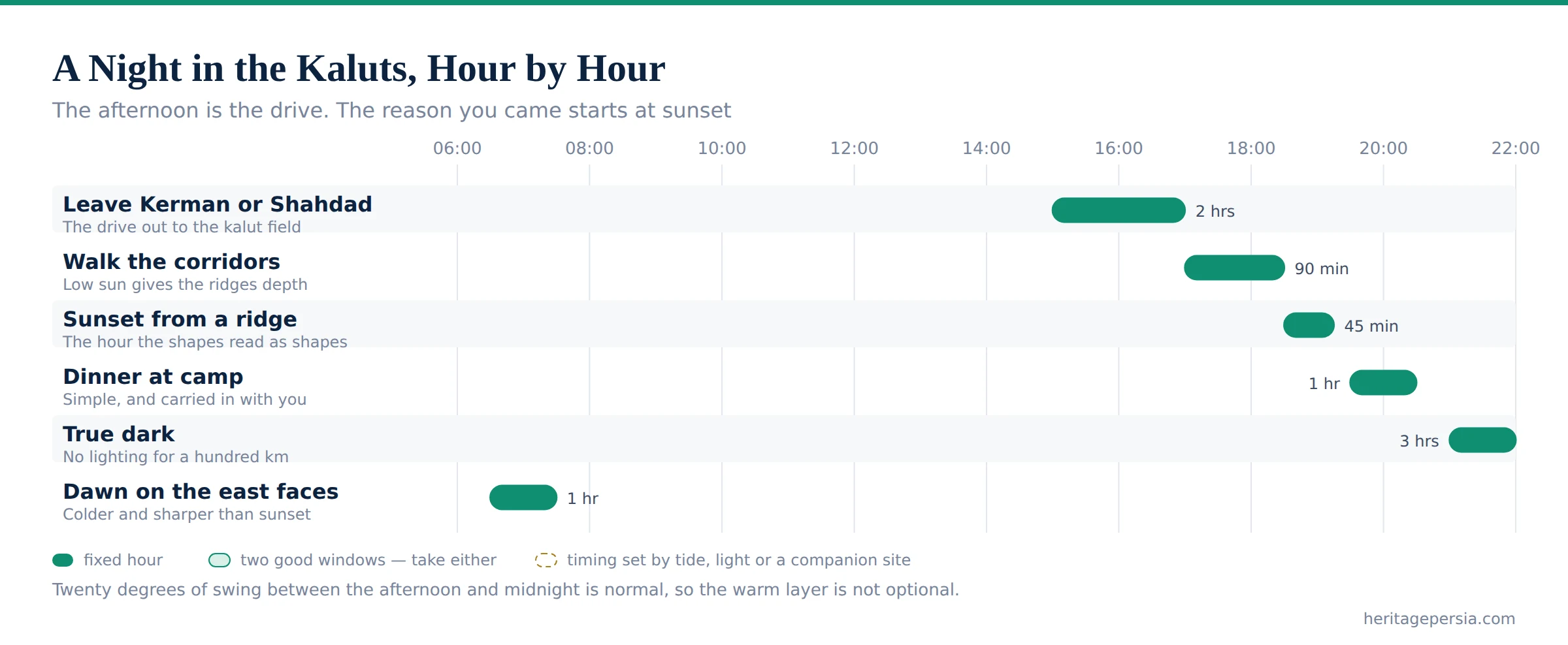
The two hours that matter: arrive at the kaluts about two hours before sunset and stay until the light has entirely gone. The ridges are flat and uninteresting at noon and become architecture in the last hour, and the temperature drops far enough that a warm layer is needed within twenty minutes of the sun going down.
Maranjab, and the Caravanserai
Maranjab is the accessible one, and the reason it is worth a page rather than a paragraph is the building in the middle of it.
The caravanserai was built under Shah Abbas I in 1603 as a stop on the route north, square, about 3,500 square metres, with twenty-nine rooms around a courtyard. It is not a ruin: it functions, you can sleep in it, and it is the one place in Iran where you can stay in a Safavid caravanserai in the desert it was built to serve. That is a considerably better proposition than a tented camp.
The landscape around it does three things in a short distance. Dunes to about seventy metres to the south, which is where the sunset is. The Masileh salt lake on the northern edge, a flat white plain that fills partially after rain and produces the reflections and the so-called Wandering Island that appear in every photograph of the place. And in between, a scrubby gravel plain with the tracks of the old route still legible.
Getting there needs the right vehicle. The road from Aran-o Bidgol deteriorates into sand and salt track and a normal saloon car will not make it reliably; this is a trip for a four-wheel drive with a driver who knows the route, which is how it is almost always sold. Our getting around guide covers the arrangement.
The Night Is the Point
Every traveller we have taken into either desert has said some version of the same thing afterwards, and it is never about the dunes.
Iran’s deserts are among the darkest accessible places in the northern hemisphere. There is no settlement within tens of kilometres of the Maranjab caravanserai and none at all around the kaluts, the air is dry to the point of being optically empty, and the Milky Way is not a smudge but a structure with visible dust lanes. People who have never seen an unpolluted sky tend to be quiet for a while.
The second thing is the temperature swing. A desert day at twenty-five degrees becomes a desert night at five, and in midwinter it goes below freezing. This catches people out constantly because the daytime figure is the one they packed for. A warm layer is not optional in any month.
The third is the silence, which is genuinely unlike quiet anywhere with vegetation in it. There is nothing to rustle.
So the recommendation is simple: do not do either desert as a day trip if you can avoid it. One night in the caravanserai at Maranjab, or a night at a Shahdad camp near the kaluts, converts an interesting landscape into the part of the trip people describe first.
The Season Is Not Negotiable
October to April, and we mean it more firmly here than anywhere else on this blog.
The Lut in July is not uncomfortable, it is dangerous. Surface temperatures in the range that has made the property famous, no shade of any kind, no water, no settlement, and a mobile signal that disappears within a few kilometres of the road. Operators do not run it and we would decline the booking. Maranjab in high summer is less extreme and still a poor idea — the dunes at forty degrees and more are an endurance exercise rather than a pleasure.
The good months are November through March for the Lut, with clear air and cold nights, and October through April for Maranjab, which sits further north and higher. March and April add wildflowers on the gravel plains after rain, which is brief and worth timing for if you can. The month-by-month guide has the figures.
One weather note specific to these places: rain is rare and consequential. The salt lake at Maranjab becomes impassable after it, and the tracks in the Lut can wash out. A forecast worth checking is one of the few reasons a desert plan changes at short notice.
What to Bring, and What to Expect
| Item | Why |
|---|---|
| A warm layer, every month | Twenty degrees of swing between afternoon and midnight is normal, and winter nights go below zero |
| More water than you think | There is none out there. Four litres per person per day is the operating figure, not two |
| A wide hat and high-factor sunscreen | No shade exists in either desert. Sunscreen is thinly stocked in Iran — see the packing list |
| Closed shoes | Salt crust cuts, and the gravel plains are sharp. Sandals are for the caravanserai courtyard |
| A torch | There is no lighting anywhere, which is the whole point, and it means true darkness at the edge of camp |
| Cash | No card works anywhere in Iran and certainly not here — see the money guide |
| Downloaded maps | Signal disappears within a few kilometres of the main road. The connectivity guide covers offline apps |
| A driver who works the route | This matters more here than anywhere else in Iran. Tracks are unmarked and the salt lake is genuinely hazardous after rain |
What you do not need is camping equipment. The caravanserai has rooms, the Shahdad camps have tents and bedding, and neither expects you to arrive self-sufficient — the accommodation guide covers what a desert camp costs.
How They Fit a Trip
On the classic ten days, Maranjab is an afternoon and evening out of Kashan and the only desert you will reach. It costs you nothing except an early night somewhere else, and we would take it.
On fourteen days with Kerman, the Lut is the reason to go to Kerman at all — the city is a base rather than a destination, and the kaluts are ninety minutes to two and a half hours out depending on the route. Our fourteen-day guide puts it on day eleven.
On a winter trip, the deserts move from optional to central, because they are at their best in exactly the months when the cities are at their coldest and the air is at its worst. The winter guide builds a route around that.
What we would not do is add a desert to a summer itinerary because it appears on a list of highlights. Between May and September the honest answer is to come back in November.
✉️ Want a desert night in your route? Tell us your dates and which cities you have, and we will say whether Maranjab or the Lut fits, and which camp or caravanserai we would book. Talk to our team →
Continue reading
Frequently Asked Questions
What travellers ask our guides, answered on the ground.
A Desert Night in Your Route
Tell us your dates and cities and we will say which desert fits and which camp we would book.
See Desert Routes →