
British passport holders have one thing Americans and Canadians do not: a second route. The Iranian Embassy has told the Foreign Office that a British applicant must either apply as part of an organised tour or have a sponsor in Iran. That second option genuinely exists and this page explains it.
It also explains, before anything else, what the Foreign Office says about making the journey at all — which includes a sentence about the death penalty. We are an Iranian tour operator, so you might reasonably expect us to skip past that. We are not going to. The procedure is set out fully below because you searched for it and deserve an accurate answer; the warning comes first because it is the more important of the two.
Read this first: the process described below exists and works. That is a separate question from whether the journey is advisable, and the Foreign Office’s answer to the second question is not ambiguous. See also our current situation report, which reads nine advisories side by side, reviewed 12 September 2026.
What the Foreign Office Says
The FCDO advises against all travel to Iran. Its entry-requirements guidance was last updated on 31 August 2026, and the sentence that matters most is short: “You are at risk of arrest, detention and a death sentence if you travel to Iran.”
That is unusual language even among advisories for countries at the top of the scale, and it is not a general statement about the region. It is addressed to British nationals specifically. The same guidance warns that you may face “increased scrutiny, questioning or detention because of your connection to the UK” — the connection itself is described as the risk factor.
We reproduce this rather than paraphrase it because paraphrase softens it. Everything below assumes you have read this section.
The Two Routes
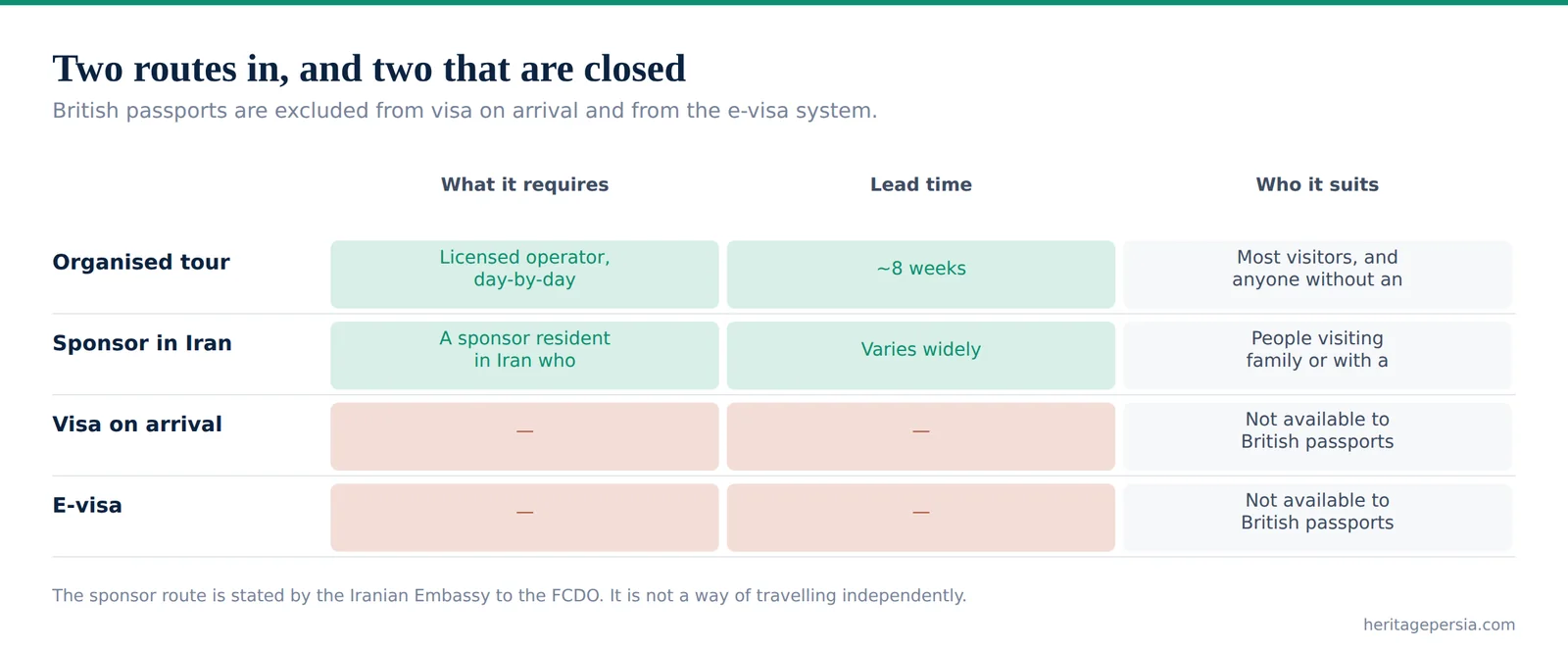
British applicants are not eligible for visa on arrival or for the e-visa system. A visa is obtained in advance by one of two routes, and the difference between them is substantial.
| Route | What it requires | Lead time | Freedom of movement | Who it suits |
|---|---|---|---|---|
| Organised tour The usual route | Licensed operator, day-by-day itinerary approved in advance, accommodation booked before issuance | ~8 weeks | The approved itinerary, with a licensed guide throughout | Most visitors, and anyone without an established connection in Iran |
| Sponsor in Iran The route people do not know about | A sponsor resident in Iran who accepts formal responsibility for your visit | Varies widely | Broader, but the sponsor carries the obligation | People visiting family or with a genuine institutional host |
| Visa on arrival | — | — | — | Not available to British passports |
| E-visa | — | — | — | Not available to British passports |
The sponsor route is real and is stated by the Iranian Embassy to the FCDO. It is not a loophole, and it is not a way of arranging a tourist trip without a tour — a sponsor is a person in Iran taking on a responsibility, not a form to be filled.
The Tour Route in Detail
This is the route almost every British visitor takes, and it works as follows.
The itinerary is a document before it is a trip. You and a licensed Iranian operator fix the route day by day, naming the cities and the accommodation. That document is filed with the foreign ministry for approval, and the approval is what generates the authorisation code. Accommodation is booked before the visa exists, which means money is committed before the outcome is known.
Approval is the slow part. Four to six weeks is normal and it sits outside anyone’s control. An operator promising to accelerate it is describing something they cannot do.
A licensed guide accompanies you. Not at each monument — throughout. British, American and Canadian passport holders cannot travel independently in Iran, and the guide is the condition on which the visa rests rather than a service you may decline.
The approved itinerary is the permitted itinerary. Deciding on the second morning to add a city is not a small local matter.
💡 Before you commit money. Check that the operator is licensed by the Ministry of Cultural Heritage, Handicrafts and Tourism — an unlicensed agency cannot file an itinerary at all, whatever it tells you. Ask what happens to your deposit if the visa is refused, and get the answer in writing before you pay. Refusals happen and they are rarely explained.
If You Are a Dual British-Iranian Citizen
The position is materially different and worse, and this is the section to read twice.
Iran does not recognise dual nationality. The FCDO states that Iranian authorities will treat you as Iranian only, and that they are “highly unlikely to accept any requests made by the UK government on your behalf”. In Iranian law the obligations of an Iranian citizen attach to you, including military service for men of the relevant age.
A claim to Iranian citizenship can pass through a parent even if you have never held an Iranian passport, never lived in Iran and have never thought of yourself as Iranian. It does not lapse through disuse. If any part of that describes you, the people to consult are an immigration solicitor and the FCDO, not a tour operator — and we will say the same if you write to us.
What Consular Support Actually Means Here
The United Kingdom does have an embassy in Tehran, which distinguishes British travellers from American and Canadian ones. What that embassy can do is narrower than the fact of its existence suggests.
In its August 2026 guidance the FCDO describes the support available to British nationals in Iran as extremely limited, and states that face-to-face consular assistance is not possible. An embassy that cannot meet you is a materially different proposition from one that can, and it is the specific reason the advisory language is as strong as it is.
For ordinary problems — a lost passport, illness, a missed connection — your operator and your insurer handle matters locally and handle them routinely. It is the serious category where the limitation bites, and where you should understand the position before you travel rather than after.
Insurance
Most UK travel policies exclude destinations the FCDO advises against travelling to, and Iran is one. That exclusion is usually absolute rather than a matter of paying more: if you travel against FCDO advice, a standard policy is void, including its medical and repatriation cover.
Specialist insurers exist and cost considerably more. Read the exclusions rather than the summary, confirm in writing that travel against FCDO advice is covered, and check medical evacuation specifically. Iranian law also requires locally recognised cover, sold at the airport for a small sum — that is a formality to satisfy, not protection to rely on.
Documents and Practicalities
Passport validity. Two separate requirements, and applicants miss the second. Your passport must be valid for at least six months from the date you arrive, and for at least six months from the date you submit the visa application. A passport with seven months left when you apply can fail the first test by the time you fly.
Photographs. Standard format, and women’s photographs must show a headscarf. The rules that apply to the photograph are stricter than the ones that apply on the street — our dress code guide sets out the difference.
Israeli stamps. Evidence of travel to Israel in your passport will result in refusal.
Journalists and public figures. A separate and more complex process applies and the tourist route is not open to you. If you write publicly about Iran or work in media, take specialist advice.
Money. No British card works anywhere in Iran. Whatever you decide about the visa, read the money guide before you plan a budget, because the constraint is absolute rather than inconvenient.
What we will tell you. We answer visa questions from people with no intention of booking with us, and we will tell you when we think the answer is to wait. A booking taken from someone who has not read the first section of this page is not one we want.
✉️ Want the process explained rather than sold? Ask us anything about the routes, the timings or the paperwork — including whether we think you should go at all. Talk to our team →
What the Trip Actually Looks Like
The paperwork above describes a set of restrictions. It is worth saying plainly what they feel like from inside, because the gap between the two surprises people in both directions.
A typical day begins with the guide meeting you at the hotel and ends when they drop you back. In between you are together — at the monuments, in the car between cities, and usually at lunch. You are not followed; you are accompanied, and after the second day most travellers stop noticing the distinction. Evenings are generally your own within the city you are in, and walking to dinner or through a bazaar alone is normal.
What the structure costs you is spontaneity. You cannot decide over breakfast to spend the day somewhere else, skip a city, or extend a stay because you liked it. For travellers who plan carefully anyway, that changes very little. For travellers whose best trips have all been improvised, it changes the nature of the holiday, and it is better to know that now than in the second week.
What it gives you in return is a good guide, which in Iran is worth more than it is in most countries. At Persepolis, Tchogha Zanbil or a Safavid mosque, what survives is a plan and a set of reliefs rather than furnished rooms — someone who can read them is the difference between looking and understanding. Our guide to the thirty World Heritage Sites says which ones are close to meaningless without one.
Questions to Ask Before You Pay
Six questions, and the answers you should insist on in writing. An operator who is evasive about any of them is telling you something more useful than their brochure is.
| Ask this | What a good answer sounds like | What should worry you |
|---|---|---|
| Are you licensed, and by whom? | A licence number from the Ministry of Cultural Heritage, Handicrafts and Tourism, given without hesitation | Vagueness, or a licence that turns out to belong to a different company |
| What happens to my deposit if the visa is refused? | A written refund policy naming the amount and the timescale | “That never happens”. It does happen, and it is rarely explained |
| Who is my guide and are they licensed? | A name, a licence, and a language you both actually speak | A guide assigned on arrival, or a driver described as a guide |
| What is in the price and what is not? | An itemised list — entries, meals, transfers, the guide, the domestic flights | A single figure with “standard inclusions” and no detail |
| What happens if I need to cancel? | A tiered schedule by date, written down before you pay anything | A policy that appears only after the deposit has cleared |
| What do you do if the situation changes? | A named person, a plan, and a position on postponement rather than forfeiture | Silence, or an answer that treats the question as impolite |
We would rather you took this list to a competitor than booked with anyone — including us — who cannot answer it in writing.
Continue reading
Frequently Asked Questions
What travellers ask our guides, answered on the ground.
Ask Before You Commit
Tell us which route fits your situation and we will say so plainly — including when the answer is to wait.
Ask a Question →