
Iran has three winters at once. The north is genuinely cold and under snow, the plateau is crisp and bright with freezing nights, and the Gulf coast sits at twenty degrees and is at its best. Almost nobody plans around that, because winter is the season no operator advertises — including, historically, us.
It deserves advertising, with one honest caveat that this page puts near the top rather than burying: winter is when city air is at its worst, and that is a real consideration rather than a footnote. What follows is the case for and the case against, and then the route we would run if you came in January.
Before you plan anything: this is a seasonal guide, written to be useful whenever you are able to use it. Whether to travel to Iran at present is a separate question with a different answer — see our current situation report, reviewed 10 September 2026.
Three Different Winters
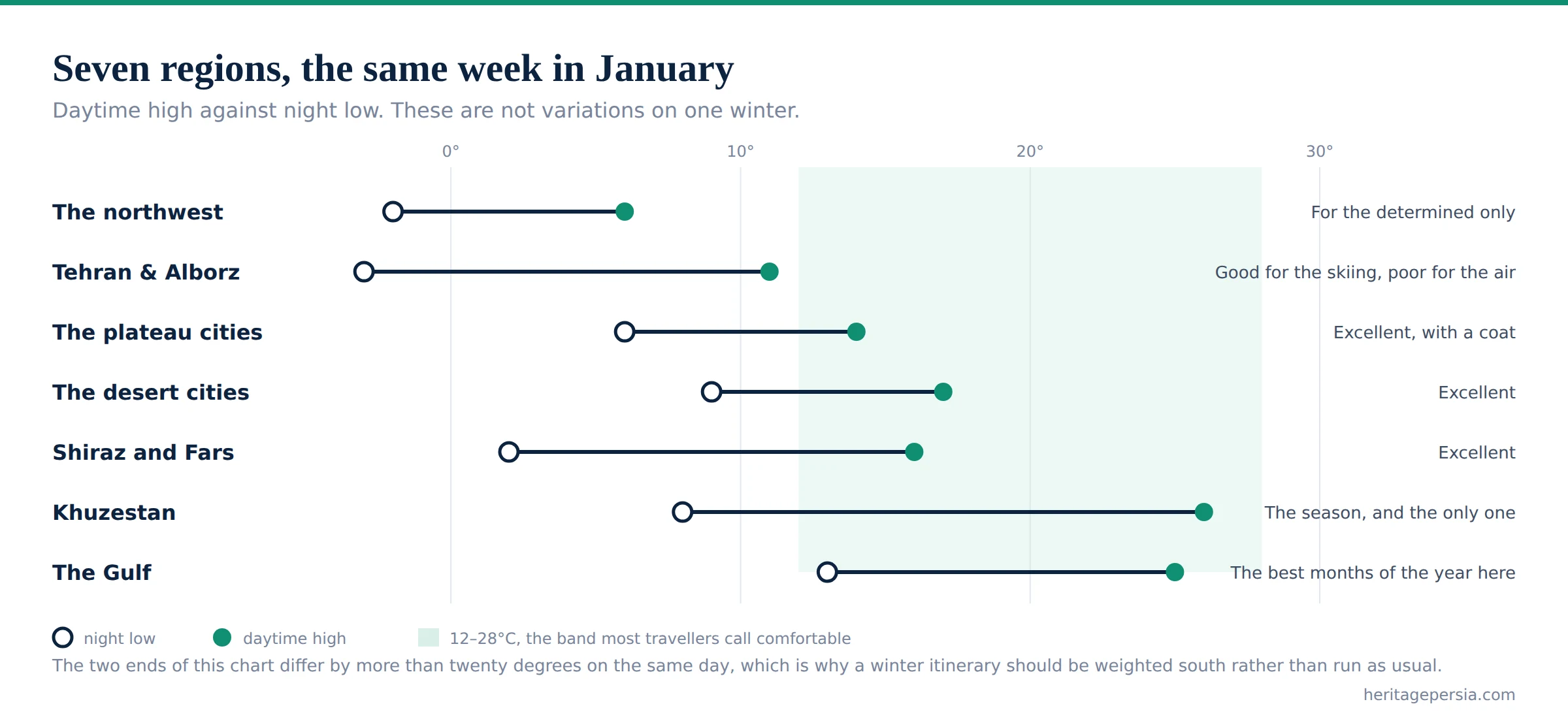
The country spans nineteen degrees of latitude and four thousand metres of altitude, so “Iran in winter” is not one condition. Treat these as three separate destinations that happen to share a border.
| Region | Dec–Feb high | Night | What it is like | Verdict |
|---|---|---|---|---|
| The northwest Tabriz, Ardabil | −3 to 6 °C | Well below freezing | Properly cold, snow on the ground, some mountain roads closed. The bazaar is warm and working | For the determined only |
| Tehran and the Alborz | 1 to 11 °C | −3 to 3 °C | Snow on the mountains straight out of the northern suburbs. Skiing an hour and a half away | Good for the skiing, poor for the air |
| The plateau cities Isfahan, Kashan | 0 to 14 °C | Around freezing | Bright, dry and very clear. Cold in the mornings, pleasant by noon, empty everywhere | Excellent, with a coat |
| The desert cities Yazd, Kerman | 3 to 17 °C | Near or below freezing | The best desert season. The Lut becomes usable, the courtyard hotels are quiet | Excellent |
| Shiraz and Fars | 1 to 16 °C | 2 to 5 °C | Mild days, occasional rain, and the flattest light of the year on Persepolis | Excellent |
| Khuzestan Susa, Shushtar | 18 to 26 °C | 8 to 10 °C | The only season the province is open at all. Wettest months, still barely 50 mm | The season, and the only one |
| The Gulf Qeshm, Hormuz, Bandar Abbas | 20 to 25 °C | 13 to 17 °C | Warm, dry and blue. Swimming weather, and the islands at their peak | The best months of the year here |
The figures are the December-to-February range from the climate normals in our month-by-month guide. Note that the two ends of the table differ by more than twenty degrees on the same day.
What Winter Actually Buys You
The light. This is the argument we would lead with and the one nobody makes. Achaemenid and Sassanid relief is shallow carving, and shallow carving needs raking light to read at all. In June the sun is overhead by mid-morning and the Apadana stairway at Persepolis goes flat; in January it never gets high enough to do that, and the whole day is the good hour. The same is true of the stucco in Kashan’s merchant houses and the brickwork at Tchogha Zanbil.
Empty sites. Foreign arrivals are at their annual low and domestic travel largely stops between the new-year holidays. You can stand alone inside the Sheikh Lotfollah dome, walk the Yazd old city at dusk without meeting anyone, and photograph Naqsh-e Rostam without waiting.
Prices. Courtyard hotels that need booking four months ahead in April are available in January at lower rates, and guides and drivers have open diaries. The saving is real without being the main point.
Snow on the mountains. The Alborz above Tehran and the Zagros behind Shiraz under snow are a version of Iran that almost no foreign visitor has seen, and they change what the landscape between cities looks like entirely.
Yalda. The winter solstice on 21 December is one of the warmest nights in the Persian year, and it happens in houses rather than in public — which means it is available to you only if someone invites you in, which in Iran is likelier than you expect.
The Honest Case Against
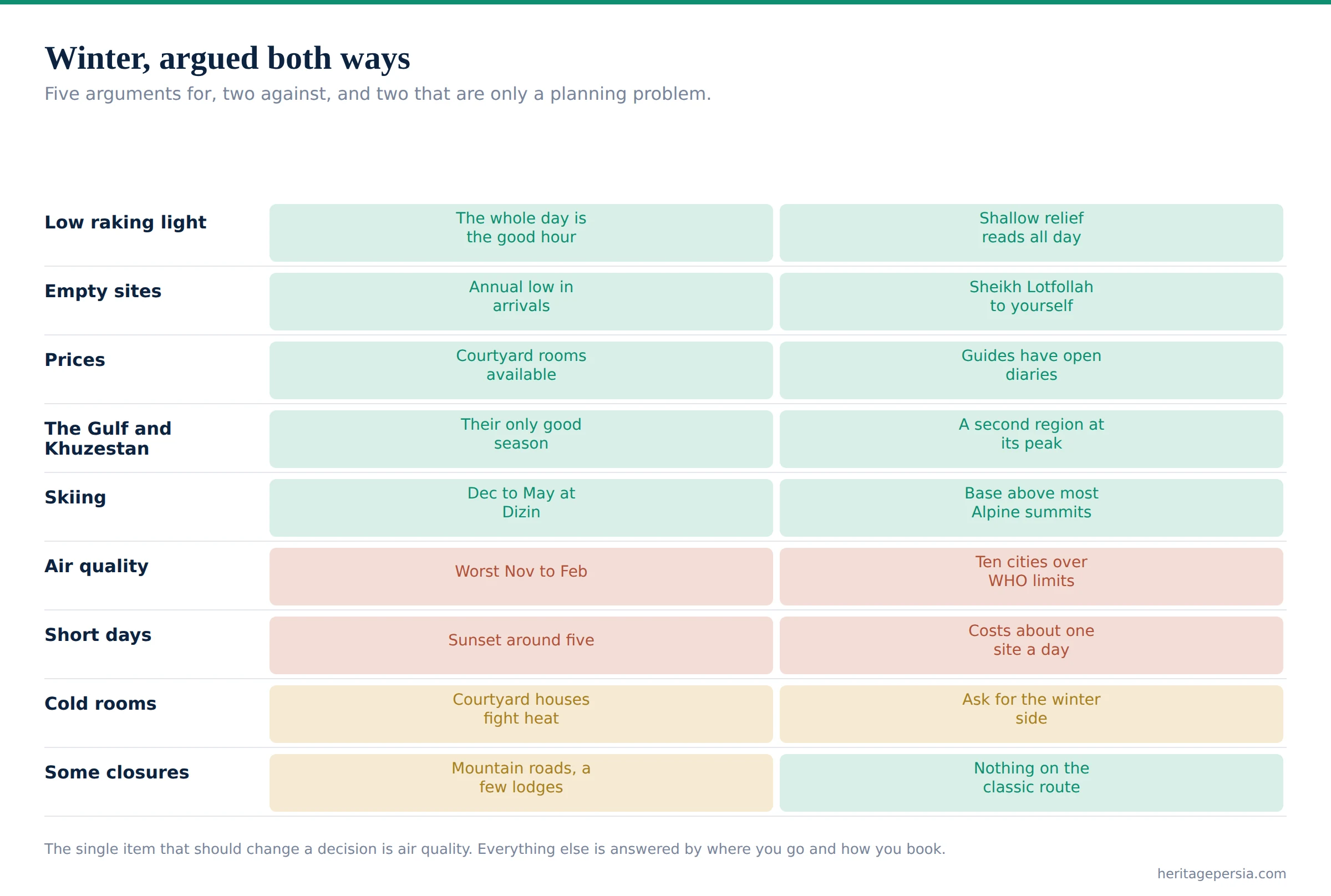
There is one serious drawback and three manageable ones, and we would rather you heard them here.
Air quality, which is the serious one. Cold air sits trapped under the mountains and the index climbs through November, December and January. Ten major Iranian cities exceed WHO limits for fine particulates on hundreds of days a year, and the worst episodes close schools and offices. Tehran is the worst of them, Isfahan, Tabriz, Ahvaz and Mashhad follow, and Yazd, Shiraz and the desert are consistently better. Our health guide has the figures and what to do about them; the short version is to weight the route away from Tehran and check the index on the day.
Short days. Sunset is around five o’clock, and with sites closing earlier the usable day is perhaps seven hours rather than eleven. That costs you roughly one site per day, which over ten days is a real amount.
Cold nights in buildings not built for it. Courtyard houses are climate machines designed to defeat summer heat, and in January the summer range is a cold room. Ask for the winter side — the shallow, south-facing rooms glazed to catch low sun — and any decent house will move you. Our accommodation guide explains why the sides differ.
Some things close. High mountain roads in the northwest, some village eco-lodges, and desert camps in the far north of the Lut. Nothing on the classic route closes.
Skiing, Which Is the Genuine Secret
Iran has serious mountains — the Alborz runs to 5,610 metres at Damavand — and the resorts above Tehran are about two hours from a city of nine million. Dizin, the largest, has its base at 2,650 metres, which is higher than the top of a great many European resorts and the reason its season runs from December into May.
Two things surprise visiting skiers. The snow is dry and light because the whole range is high and continental, and the lift queues are short outside Iranian weekends, which fall on Thursday and Friday. A day pass costs around thirty dollars.
Skiing also combines badly with a cultural itinerary and well with a short trip. Two days at Dizin bolted onto a week elsewhere works; trying to fit the mountains into a ten-day classic route means losing Kashan or Yazd, which we would not do.
Our skiing guide has every resort with its altitude and season, what a day actually costs, how the dress code is applied on the slopes, and the month-by-month picture.
The Other Half — the Gulf in Winter
The part of this page that changes trips. While Tabriz is below freezing, the Persian Gulf is at twenty to twenty-five degrees, dry and clear, and the islands are in their only comfortable season.
Qeshm is the largest island in the Gulf and a UNESCO Global Geopark, with the Valley of the Stars, the Hara mangroves and Chahkooh canyon. Hormuz, an hour further, is the one with the coloured earth — red ochre beaches, rainbow-banded hills and a landscape that does not look like anywhere else. Both are effectively unvisitable from May to September and excellent from November to March.
Khuzestan belongs in the same sentence. Tchogha Zanbil, Susa and the Shushtar hydraulic system are three UNESCO inscriptions within ninety minutes of each other, and the province is open only in these months — the Khuzestan guide has the month-by-month heat that explains why.
Put those together and a winter trip has an option a spring trip does not: a genuine second region that is at its peak precisely when the corridor is quiet.
Yalda, and the Winter Calendar
Yalda Night falls on 21 December, the longest night of the year, and it is one of the oldest continuously observed festivals anywhere. Families stay up past midnight with pomegranates, watermelon, nuts and dried fruit, and someone opens a volume of Hafez at random and reads the poem that falls open as a kind of augury.
It is a private festival rather than a public one, so there is nothing to attend and no square to stand in. What there is, if you are in the country on the night, is a very high chance of being invited to someone’s house — and our taarof guide is the page to read before you answer.
Ramadan now falls in winter too — 8 February to 9 March in 2027 — and our Ramadan guide sets out what shortens and what does not. The other winter date is 22 Bahman, 11 February, the anniversary of the 1979 revolution, which brings marches and closures in city centres. It is a working day for most purposes but not a day to plan around central Tehran. Our culture guide has the full calendar.
Nowruz, the new year at the March equinox, sits at the far edge of winter and is an entirely different proposition — domestic travel peaks, rates double and courtyard hotels are gone by January. The Nowruz guide covers that fortnight in detail.
A Winter Route That Is Not the Classic One
The standard ten days runs Tehran, Kashan, Isfahan, Yazd, Shiraz. In winter we would change it, for two reasons: Tehran is where the air is worst, and the south is where the season is best.
| Days | Where | Why in winter |
|---|---|---|
| 1 | Land Tehran, move on the same day | Minimise the Tehran nights. The National Museum is worth a morning, the air is not worth three days |
| 2–3 | Kashan | Merchant houses in raking light, and a courtyard hotel on the winter side of the courtyard |
| 4–6 | Isfahan | Clear, cold and empty. Stand alone under the Sheikh Lotfollah dome, which is not possible in April |
| 7–8 | Yazd | The best air in the country and the old city to yourself at dusk |
| 9–10 | Kerman and the Lut | The desert is usable only October to April. This is the window |
| 11–12 | Shiraz and Persepolis | Flat winter light on shallow relief, and no queue at Naqsh-e Rostam |
| 13–14 | Khuzestan or Qeshm | The addition that exists only in these months. Three UNESCO sites, or the islands at their peak |
Fourteen days rather than ten, because winter’s short days cost you roughly a site each day and the southern addition is what makes the season worth choosing. The fourteen-day guide has the general version.
Practical Notes
Pack for two climates. A real coat and gloves for the plateau mornings, and a shirt for the Gulf afternoons, in the same case. The packing list has the winter additions, and an inhaler belongs in it if you use one.
Book the winter side of the courtyard. Say it explicitly when you reserve. It is the difference between a beautiful room and a cold one.
Start later, finish earlier. Sites open around eight but the light does not arrive until nine, and everything closes by four or five. A winter day is planned backwards from sunset.
Expect rain rather than snow on the plateau. Isfahan and Shiraz get their annual rainfall in these months, and it is measured in tens of millimetres rather than hundreds. A shell is enough; an umbrella is unnecessary.
Check the air index on the morning. If it is bad in Isfahan, that is a museum and bazaar day rather than a Naqsh-e Jahan day, and the square will still be there tomorrow.
Watch the mountain roads. The Tehran–Chalus road and the passes in the northwest close in heavy snow. Nothing on the classic corridor does, but a driver who works those roads is worth having — see getting around Iran.
✉️ Thinking about a winter trip? Tell us your dates and we will tell you which weeks are the clearest, where the air is likely to be worst, and whether the south or the skiing is the better addition for you. Talk to our team →
Continue reading
Frequently Asked Questions
What travellers ask our guides, answered on the ground.
A Winter Trip, Planned Properly
Tell us your dates and we will say which weeks are clearest and whether the south or the skiing suits you.
See Desert & Mountain Routes →