
Iran is one of the last countries where the thing in the bazaar was made near the bazaar. The marquetry in Isfahan is cut in workshops a few streets from where it is sold, the saffron in Mashhad is grown in the province around it, and the carpet in Tabriz was woven in a tradition that city has kept for six hundred years. Buying here is a different activity from buying souvenirs somewhere that imports them.
This guide does three things. It says what each city is genuinely known for, so you buy the right thing in the right place. It explains how to buy a carpet without being taken for a fool. And — the part almost nobody writes about until it is too late — it sets out what Iranian customs will actually let you carry out of the country.
Before you plan anything: this is a guide to buying, written to be useful whenever you are able to use it. Whether to travel to Iran at present is a separate question with a different answer — see our current situation report, reviewed 10 September 2026.
Buy in One Place, Not Everywhere
The commonest mistake is buying the same souvenir in every city. Iranian crafts are regional in a way that has survived industrialisation, and the difference between buying saffron in Khorasan and buying it in a Tehran airport shop is the difference between the real thing at a fair price and a small box of something paler for four times as much.
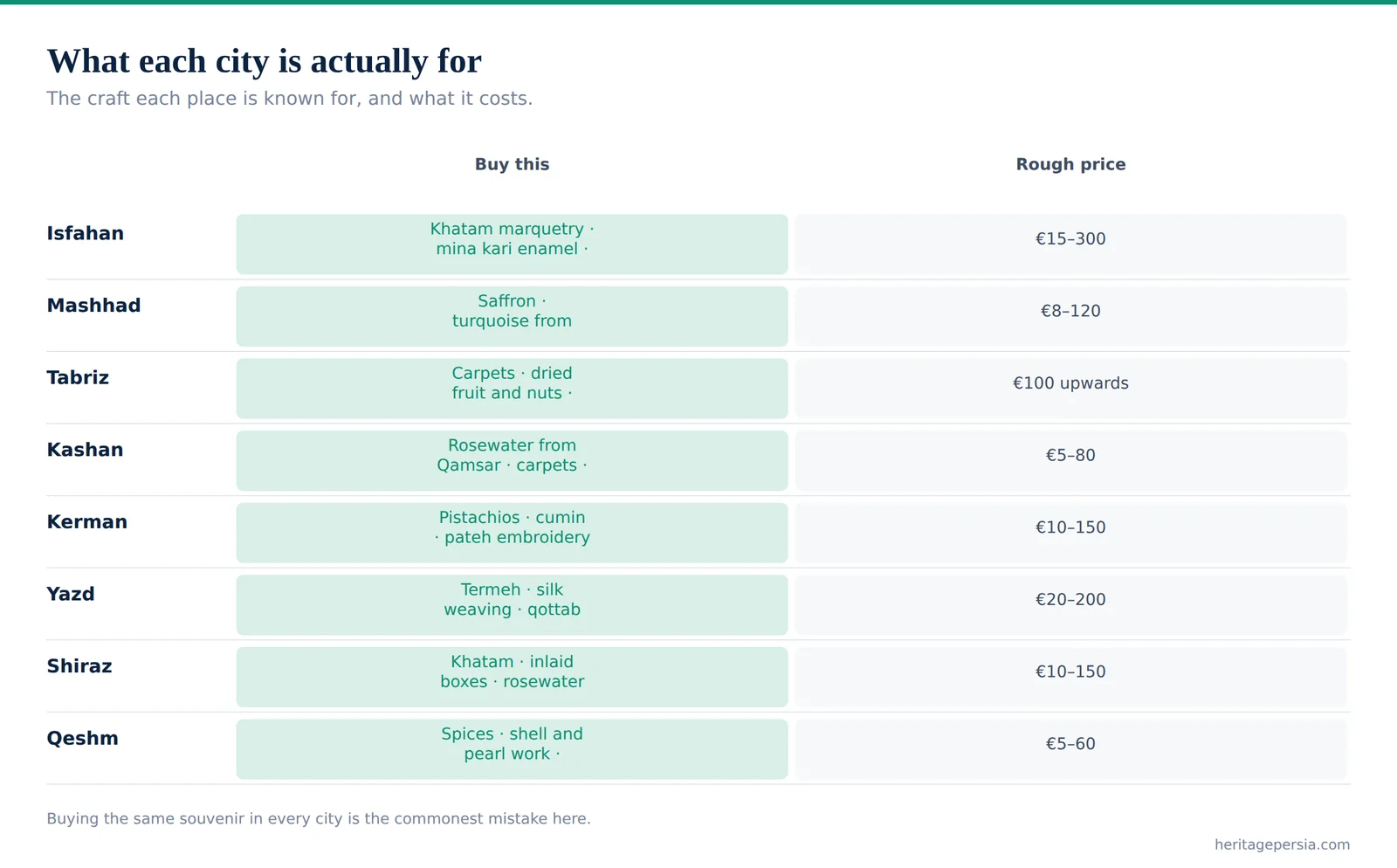
So plan purchases against your route rather than against your mood. If Mashhad is on the itinerary, buy the saffron there. If it is not, buy it in a serious spice shop in a large bazaar and expect to pay more. The table below is the map.
What Each City Is For
The craft each place is known for, what it costs, and whether it survives the flight home.
| City | Buy this | Rough price | Travels well? | What to check |
|---|---|---|---|---|
| Isfahan | Khatam marquetry · mina kari enamel · qalamzani engraving · gaz | €15–300 | Yes, with care | Khatam should show fine, even tessellation; painted imitations exist |
| Mashhad | Saffron · turquoise from Nishapur · barberries | €8–120 | Yes | Buy threads, never powder. A sealed box with a stated weight |
| Tabriz | Carpets · dried fruit and nuts · silverwork | €100 upwards | Carpets ship | A working market, not a tourist one. Prices start more honestly |
| Kashan | Rosewater from Qamsar · carpets · copper | €5–80 | Yes | Rosewater in glass, distilled in spring. Ask for the year |
| Kerman | Pistachios · cumin · pateh embroidery | €10–150 | Yes | Pateh is hand-embroidered wool felt and is barely sold elsewhere |
| Yazd | Termeh · silk weaving · qottab and baklava | €20–200 | Yes | Termeh is judged by the density of the weave, not the pattern |
| Shiraz | Khatam · inlaid boxes · rosewater · poetry editions | €10–150 | Yes | The Vakil bazaar is the place; the streets around it are not |
| Qeshm | Spices · shell and pearl work · Bandari textiles | €5–60 | Yes | A free trade zone, so much is imported. Ask what is local |
Prices are a range for something worth owning rather than the cheapest version. A serious carpet sits far above the top of this table and is dealt with in its own section below.
Carpets, Without Being Taken
The Persian carpet is the thing most visitors think about buying and the thing most likely to go wrong. The trade is old, sophisticated and entirely legitimate; it is also a trade in which an unprepared foreigner is an obvious opportunity. Three rules get you most of the way.
Never the first shop, and never the first day. Look at twenty carpets across several shops before you discuss a price on any of them. Dealers expect this and respect it. Anyone who tries to close you on a first visit is telling you something.
Learn the two things that set the price. Knot density — count the knots along a centimetre on the back, where the pattern is sharper than on the front — and whether the pile is wool, silk, or wool with silk highlights. Everything else is taste. A dealer who will not turn the carpet over is not a dealer you want.
Know the regions. Tabriz, Kashan, Isfahan, Qom, Nain and Kerman each weave differently, and a dealer naming a region is making a claim you can check against the piece in front of you. Qom is silk and fine; Nain is characteristically pale with silk outlining; Kerman runs to open floral fields.
💡 The certificate trap. A dealer who offers you an official government certificate of authenticity is describing something that does not exist in the form he is implying. What does exist is a customs and export document for the piece you have bought, which a reputable dealer will arrange as a matter of course and which matters at the airport. If the sales pitch leans on the certificate rather than the carpet, walk.
On shipping: established dealers ship internationally and it is usually the sane choice for anything over a couple of square metres. Get the shipping cost, the insurance and the customs paperwork in writing before money changes hands, and pay attention to the import duty your own country will charge at the other end — that, not the Iranian side, is what surprises people.
Saffron, and the Things That Are Not Saffron
Khorasan province around Mashhad produces the overwhelming majority of the world’s saffron, and buying it here at source is one of the genuine bargains of the trip. It is also the item most often adulterated.
Buy threads, never powder — powder is where safflower, turmeric and dyed corn silk go to hide. Good saffron is deep red with a slightly paler tip, smells unmistakably of itself through the packaging, and colours water slowly and gold rather than instantly and orange. Buy from a shop that weighs it in front of you and seals the box with the weight stated.
Quantities are small and the export limit is real: 150 grams per person, which is far more saffron than any household uses in a year. Nobody needs to test that ceiling.
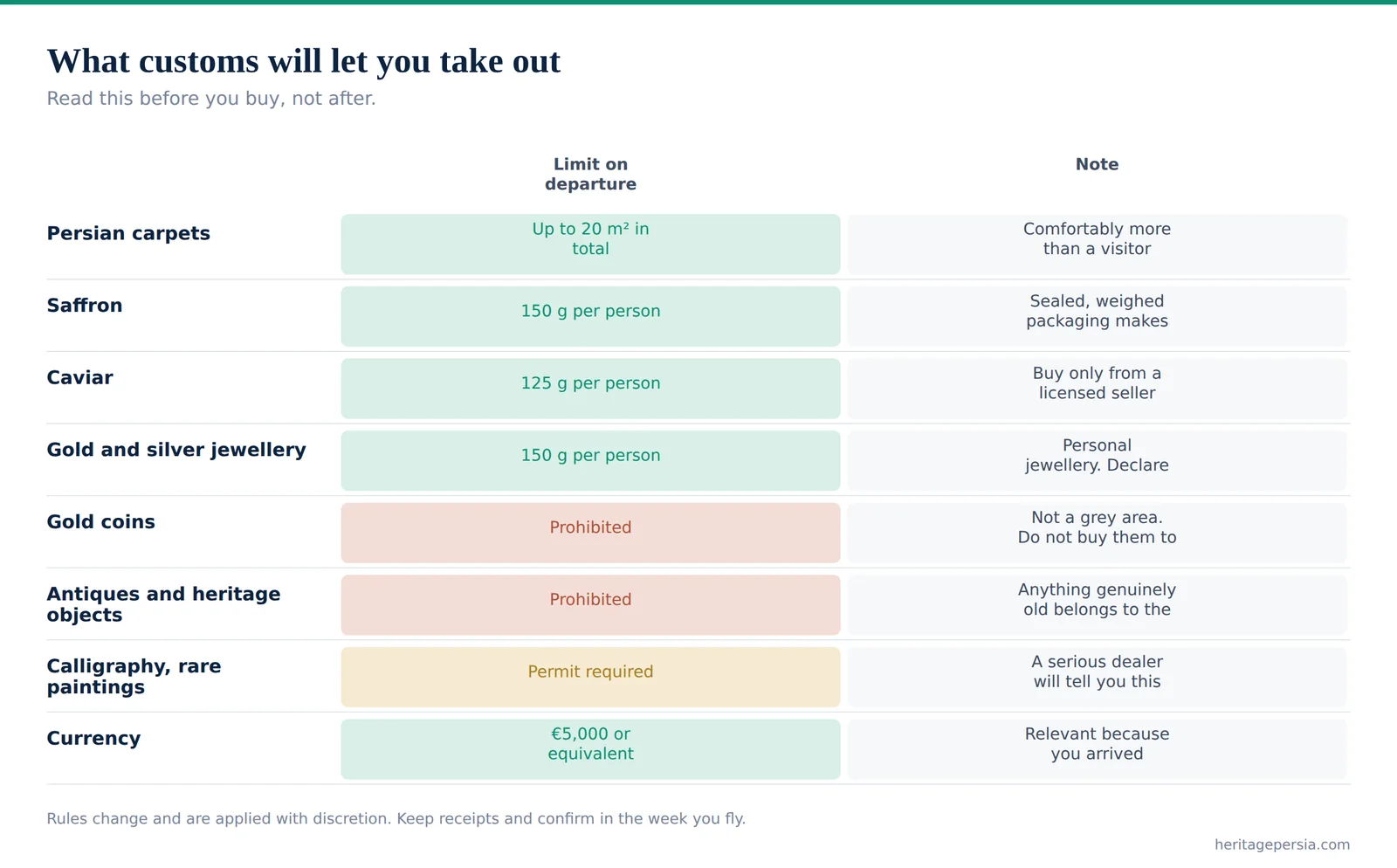
What You Can Take Out
This is the section to read before you buy, not after. Iranian customs applies limits on the way out, and a few categories are prohibited outright.
| Item | Limit on departure | Note |
|---|---|---|
| Persian carpets | Up to 20 m² in total | Comfortably more than a visitor buys. Keep the dealer’s paperwork |
| Saffron | 150 g per person | Sealed, weighed packaging makes the conversation short |
| Caviar | 125 g per person | Buy only from a licensed seller with a receipt |
| Gold and silver jewellery | 150 g per person | Personal jewellery. Declare anything substantial on the way in too |
| Gold coins | Prohibited | Not a grey area. Do not buy them to take out |
| Antiques and heritage objects | Prohibited | Anything genuinely old belongs to the state and cannot leave |
| Calligraphy, rare paintings | Permit required | A serious dealer will tell you this before you ask |
| Currency | €5,000 or equivalent | Relevant because you arrived carrying cash — see the money guide |
Customs rules change and are applied with some discretion. Treat this as the shape of the regime rather than a guarantee, keep receipts for anything valuable, and ask your dealer or your operator to confirm the position on the week you fly.
The prohibition on antiques deserves a sentence of its own, because it is the rule most likely to be tested by a persuasive seller. If a dealer tells you a piece is two hundred years old and also that you will have no trouble taking it home, one of those two statements is false. Genuinely old objects are heritage property. What you can buy freely is contemporary work in an old tradition, which is what almost everything in the bazaar actually is.
Bargaining, Properly
Expected for carpets, handicrafts and anything in a bazaar without a price on it. Not expected in shops with marked prices, in food shops, in restaurants or for transport, where attempting it reads as rude rather than shrewd.
The mechanics are gentler than the stereotype. Tea usually appears. The first price is an opening rather than an insult, your counter should be serious rather than theatrical, and the settlement lands somewhere in the middle after a conversation that is partly about the object. Walking away is a legitimate move and is not taken personally; coming back the next day is completely normal.
What does not work is treating it as a contest. The dealer does this every day and you do not, and the version where everyone is pleased at the end costs about the same as the version where you think you won.
Where to Buy, and Where Not
Buy in the bazaar. Every city’s historic bazaar is a working market rather than a tourist attraction, and prices there start closer to reality. Tabriz’s is a UNESCO site and still entirely commercial; Isfahan’s Qeysarieh, Shiraz’s Vakil and Kerman’s Ganjali Khan are all genuine markets.
Buy from workshops where you can. In Isfahan the khatam and enamel workshops sell directly, and watching a piece being made is both the best guarantee of what it is and the better memory.
Do not buy at the airport beyond something forgotten. Do not buy from a shop your driver takes you to unprompted — commission arrangements are normal and the price carries them. And be sceptical of anything described as an antique, for the reason set out above.
Practical Notes
Payment. Cash, in rial. No foreign card works anywhere in the country, including in the large carpet showrooms — read the money guide before you plan a large purchase, because it changes how much you carry into the trip.
Packing. Glass rosewater, ceramics and enamel need real protection; ask the shop to pack for flight, which they do routinely. Keep saffron and spices in hand luggage where the temperature is stable.
Receipts. Keep them for anything valuable. They matter at Iranian customs on the way out and at your own on the way in.
Gifts that always land. Saffron, pistachios, a small khatam box and a tin of good tea. None of them break, all of them are unmistakably from here, and together they cost less than one bad carpet.
✉️ Planning a serious purchase? Tell us what you are looking for and we will point you at dealers we have used for years and sit with you while you look. Talk to our team →
Continue reading
Frequently Asked Questions
What travellers ask our guides, answered on the ground.
Buy Well, Not Twice
We will point you at dealers we have used for years and sit with you while you look.
Talk to a Guide →