
Every guide to Iran written for foreign travellers describes the same five cities. Mashhad, which receives more visitors every year than all five combined, is rarely among them. Around thirty million pilgrims come here annually to the shrine of Imam Reza, and the complex they come to covers roughly 1.2 million square metres — a walled district with its own courtyards, libraries, museums, hospitals and streets, and by covered prayer area the third largest mosque in the world.
This makes Mashhad a different kind of visit from Isfahan or Shiraz. You are not looking at a monument that has become a museum; you are standing inside the most active religious site in the country while it is working. Whether that is the most interesting day of your trip or an uncomfortable one depends entirely on what you want from Iran, and this guide is written to help you decide before you buy the flight.
Before you plan anything: this is a guide to the city, written to be useful whenever you are able to use it. Whether to travel to Iran at present is a separate question with a different answer — see our current situation report, reviewed 10 September 2026.
Why the Shrine Is Not a Monument
The shrine holds the tomb of Ali al-Ridha, the eighth Imam of Twelver Shi'ism, who died in 818 CE. The complex grew around it for twelve centuries and is still growing: seven courtyards covering some 331,578 square metres between them, a capacity of around 700,000 people, and a footprint of about 1.2 million square metres in total. The city's name means the place of martyrdom, and the city exists because the tomb does.
What that adds up to on the ground is a scale that does not photograph. You pass through a security check into a courtyard the size of a football pitch, walk through an arcade into another one larger than the first, and keep going. Everyone around you is there for a reason that has nothing to do with architecture. Families have travelled three days by bus. People are weeping, eating, sleeping on the marble, reading, queuing, greeting relatives they have arranged to meet under a particular iwan.
Travellers who come expecting the experience of Naqsh-e Jahan find something quite different and are usually glad of it. Travellers who are uncomfortable in dense crowds, or who would rather look at buildings than at people, generally find the day long.
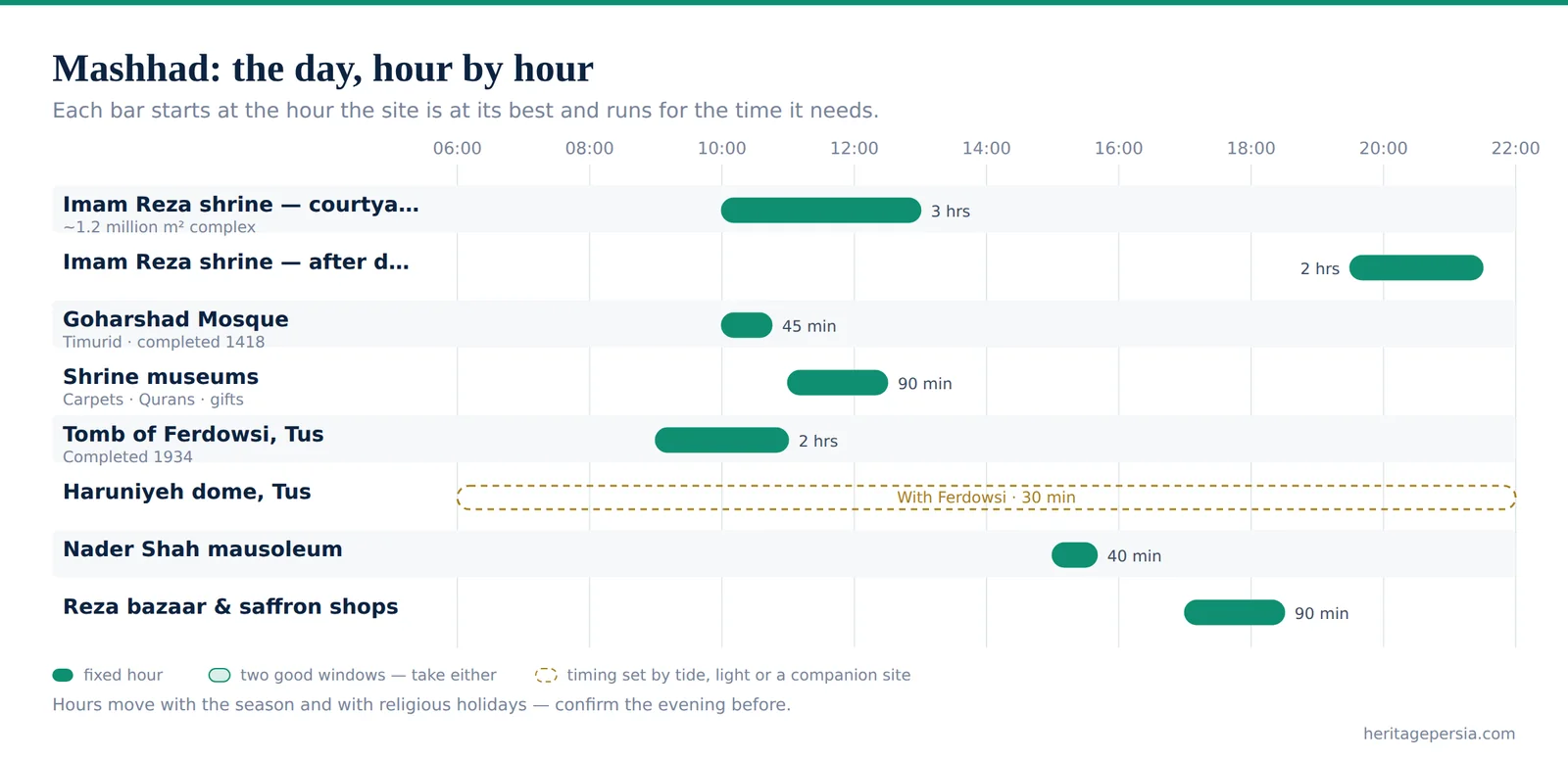
Every Site, With the Hour to Arrive
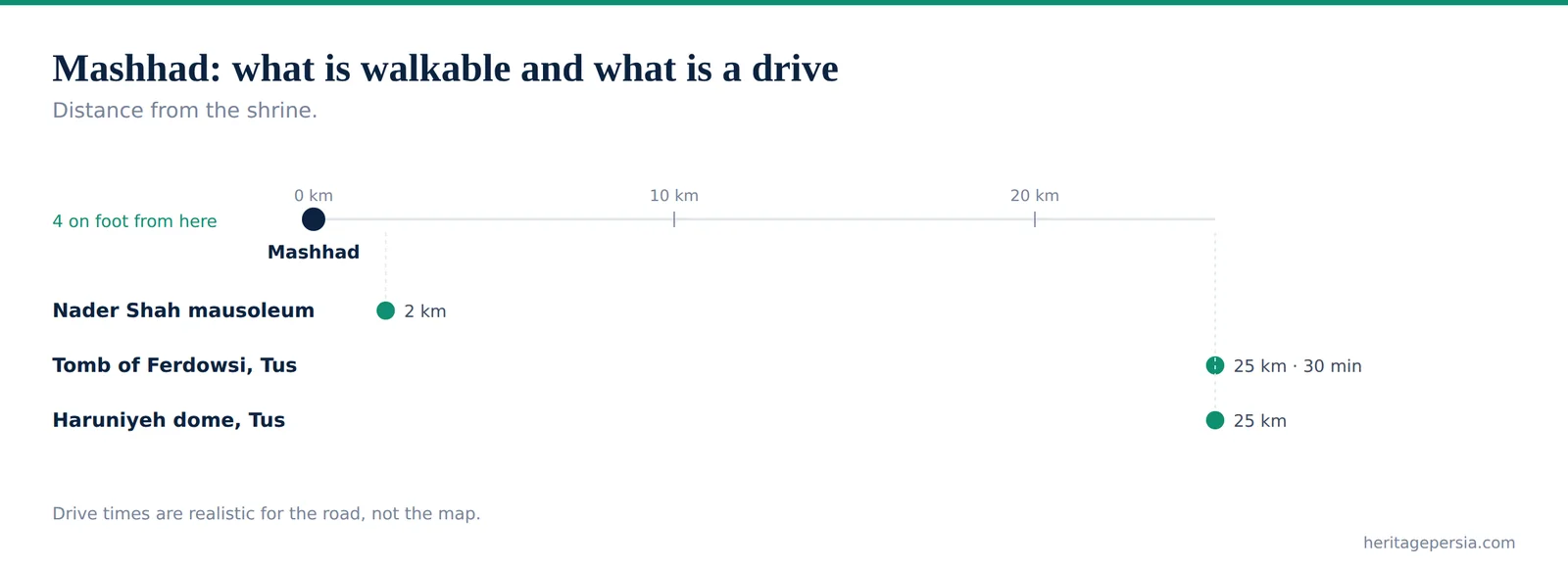
Distances are from the shrine complex, which is the centre of the city in every sense.
| Site | Time needed | Best hour | From the shrine | Why that hour |
|---|---|---|---|---|
| Imam Reza shrine — courtyards ~1.2 million m² complex | 3 hrs | 10:00 | You are in it | Museums and libraries are open and the courtyards are navigable |
| Imam Reza shrine — after dark | 2 hrs | After sunset | — | The iwans are lit, the dome carries the light, and the crowd is the point |
| Goharshad Mosque Timurid · completed 1418 | 45 min | Mid-morning | Inside the complex | Morning light on the courtyard tilework; same access rules as the shrine |
| Shrine museums Carpets · Qurans · gifts | 90 min | Late morning | Inside the complex | Closed around prayer times and in the evening |
| Tomb of Ferdowsi, Tus Completed 1934 | 2 hrs | Morning | 25 km · 30 min | Garden setting, best before the light hardens; pair with Tus itself |
| Haruniyeh dome, Tus | 30 min | With Ferdowsi | 25 km | Ten minutes from the tomb — always done as one trip |
| Nader Shah mausoleum | 40 min | Afternoon | 2 km | Open garden; pleasant when the afternoon cools |
| Reza bazaar & saffron shops | 90 min | 17:00 | Walkable | The evening is when the city shops and the shrine quarter is busiest |
Opening hours around the shrine move with the prayer calendar and with religious anniversaries, and the whole city fills during Nowruz, Ramadan and the Imam's own commemorations. Confirm at your hotel the night before rather than trusting a published schedule.
Getting In: Access, Dress and Etiquette
Non-Muslim visitors are generally admitted to the courtyards and the outer halls. The inner sanctum immediately around the tomb is for Muslims. International visitors are usually directed to the office for foreign pilgrims, where a guide is assigned to accompany them — this is normal, free, and the smoothest way in; the guides are used to questions and most speak good English.
Because this is a working shrine with thirty million visitors a year rather than a site with a ticket desk, arrangements are made on the day and shift with the calendar. Have your hotel telephone in the morning.
💡 What to expect at the entrance: men and women enter separately and both are searched. Women must wear a chador — the loose full-length cloth held closed at the front, worn over your ordinary clothes and headscarf — and one is issued at the gate if you do not have your own. This is stricter than anywhere else in Iran, where a headscarf and a long coat suffice; see our dress code guide for the national rules. Men need long trousers and sleeves. Cameras and large bags go into free lockers; phones are generally allowed in the courtyards, but photograph the architecture rather than people at prayer.
Two further points of manners. Do not walk in front of someone who is praying, and give the shrine porters — the men in the courtyards with feather dusters — a wide berth when they are working; they are performing a service, not clearing a path. And if someone starts a conversation with you, which they will, they are almost certainly being hospitable rather than proselytising. Mashhad is used to strangers, just not usually to yours.
The Goharshad Mosque
Inside the complex stands the building that brings architectural historians to Mashhad: the Goharshad Mosque, completed in 1418 and named for the woman who paid for it. Goharshad was the wife of Shah Rukh, the Timurid ruler, and one of the most consequential patrons of architecture in Iranian history — the mosque that bears her name is the finest surviving statement of what Timurid builders could do with a courtyard and four iwans.
The tilework is the period at its best: deep cobalt, turquoise and white in tight geometric fields, with the great southern iwan carrying the weight of the composition. It sits within the shrine complex, so the same access and dress arrangements apply, and it is easy to miss entirely in a building of this size — ask your guide for it by name.
Tus and the Tomb of Ferdowsi
Half an hour from the city, at Tus, stands the thing that many non-Muslim travellers end up calling the best part of the trip. Ferdowsi wrote the Shahnameh — the Book of Kings, sixty thousand lines of epic verse completed around the year 1010, which carried the Persian language and its pre-Islamic memory through four centuries when the administration of the country was conducted in Arabic. Every Iranian can quote from it. Its influence on the survival of Persian as a literary language is difficult to overstate.
The tomb you visit is modern. It was built in the early 1930s and completed in 1934, deliberately in an Achaemenid style modelled on the tomb of Cyrus at Pasargadae — a white stone block roughly thirty metres square at the base, set in a formal garden, with reliefs from the epic around it. The choice of style was itself a statement about where the poem belongs in Iranian history, and reading it that way makes the visit far more interesting than a plain tomb would be.
Ten minutes away, the brick dome known as the Haruniyeh stands in a field — a twelfth- or thirteenth-century structure whose original purpose is still argued over. The two are always visited together and a morning covers them comfortably.
Who Should Actually Come
We will be direct, because Mashhad is nine hundred kilometres from Tehran and the flight is a real cost in a fixed itinerary.
Come if
- You are interested in how a living religion organises itself at scale — nothing on the classic route resembles this
- Timurid architecture matters to you, and Goharshad is a gap in what Isfahan and Shiraz show
- You care about Persian literature, and Ferdowsi's tomb is a pilgrimage of a different kind
- This is a second visit and you want the Iran that Iranians actually travel to
- You have eighteen days or more and the classic cities are already covered
Leave it if
- This is a first trip of ten to fourteen days — the five classic cities will already be tight
- Dense crowds are difficult for you; the shrine is the densest place in the country
- You want gardens, palaces and bazaars, which Isfahan, Shiraz and Kashan do better
- Your dates fall in Nowruz or Ramadan and you have not booked months ahead
- You are counting flights, because there is no sensible way to reach Mashhad by road
The City Around the Shrine
Mashhad outside the complex is a large modern Iranian city of wide avenues and recent building, and it is not where you will spend your interest. Two things are worth the time. The bazaar quarter around the shrine is where the pilgrim economy lives — prayer stones, rosewater, turquoise, and above all saffron, because Khorasan grows most of the world's supply and this is where Iranians buy it. Ask for the grade by name, buy threads rather than powder, and expect a sealed box with a weight on it.
The other is the mausoleum of Nader Shah, the eighteenth-century conqueror who took Delhi and brought back the Peacock Throne, set in a garden two kilometres from the shrine with a small museum of arms beside it. It is a half-hour visit and a useful corrective, because Nader belongs to a quite different Iran from the one the shrine represents.
For eating, Mashhad's own dish is shishlik — lamb chops grilled over charcoal, done best in the hill villages outside the city — and the saffron ice cream near the shrine is a local institution rather than a tourist item. Our food guide covers the national repertoire.
Practical Mashhad
Getting there. By air, in almost every case — Mashhad has the busiest airport in Iran after Tehran, with frequent domestic flights from Tehran, Isfahan and Shiraz, and about ninety minutes in the air from the capital against roughly nine hundred kilometres by road. Overnight trains from Tehran are comfortable, popular with pilgrims, and a good experience in their own right if you have the night to spend.
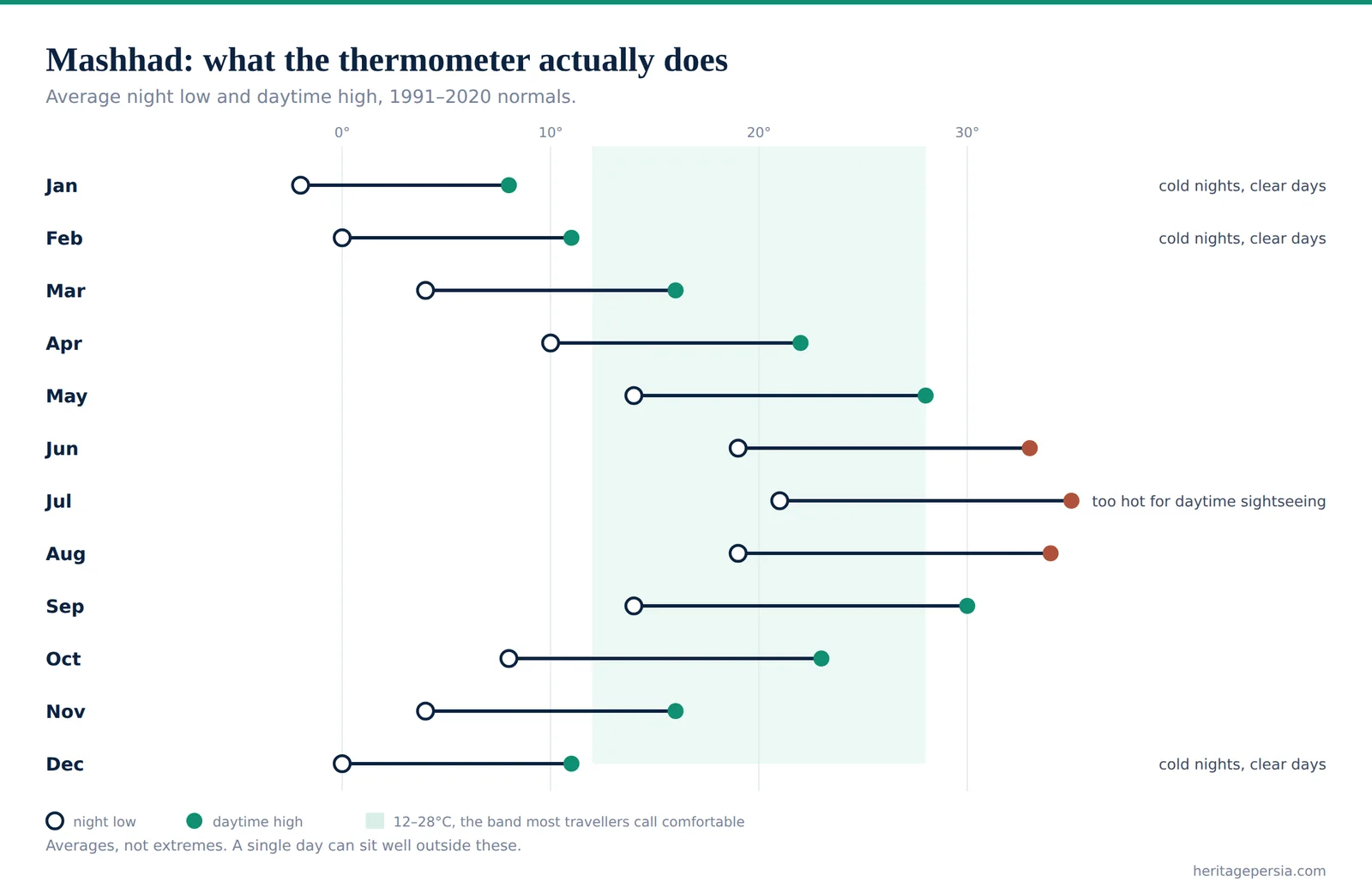
When to come. April to early June and September to October. January runs roughly from −1.8°C at night to 8.5°C by day and July from 20.9°C to 35.3°C, so the summer is hot and the winter genuinely cold. The calendar matters more than the weather: Nowruz, Ramadan and the religious anniversaries fill the city completely and move hotel prices sharply.
Where to stay. Near the shrine, and walk to it. The quarter around the complex has the greatest concentration of hotels in Iran at every level, from pilgrim guesthouses to international five-star, and being able to return after dark without arranging a car is worth more than a quieter street.
Getting around. The shrine quarter is walkable and the metro reaches it. Tus and the outlying sites need a car for half a day.
What to buy. Saffron, turquoise from the Nishapur mines two hours west, and barberries. If turquoise interests you, Nishapur itself makes a good third day, along with the tomb of Omar Khayyam.
✉️ Not sure whether Mashhad earns its two days? Tell us your dates and what you want from Iran, and we will give you the honest answer rather than the one that sells a longer tour. Talk to our team →
Continue reading
Frequently Asked Questions
What travellers ask our guides about Mashhad, answered on the ground.
Mashhad, With a Guide Who Knows the Gates
Shrine access arranged, the Goharshad found, and Tus in the morning light.
Eastern Itineraries →