
We are an Iranian company. Our guides live in Shiraz and Isfahan, our income depends on visitors arriving, and for fifteen years the honest answer to "is Iran safe?" was a confident yes with a short list of caveats about traffic and taxi fares. Ordinary crime against foreign visitors was, and remains, unusually low. That is not the question in front of you today.
What follows is the current position stated plainly, with every claim attributed to the authority that made it and the date it was made, followed by the durable safety picture that will matter again when this passes. We would rather lose a booking than have a traveller arrive on the strength of something we wrote.
The Short Answer
Two different questions hide inside "is Iran safe", and conflating them is how travel pages mislead people.
The first is about ordinary risk — street crime, food, taxis, whether a woman travelling alone is harassed, whether anyone will resent your nationality. On that question Iran has long performed better than most destinations that carry no warning at all, and nothing in the past year has changed the character of Iranian hospitality. Our guides still describe strangers paying for tourists' lunches.
The second is about political and military risk — armed conflict, airspace, detention, and whether your own government can help you if something goes wrong. On that question the position today is unambiguous and it overrides everything in the first paragraph. A country can be full of kind people and still be somewhere you should not fly into.
📌 The distinction that matters: the risk to a visitor in Iran right now is not that someone will rob you. It is that the conflict escalates while you are inside a country your embassy cannot reach you in, on an airspace that carriers are avoiding, with an insurance policy that has already lapsed because you travelled against advice.
What Each Government Actually Says
These are the current positions, quoted and dated. We link to each source so you can check it yourself — advisories change, and this page will be behind them at some point.
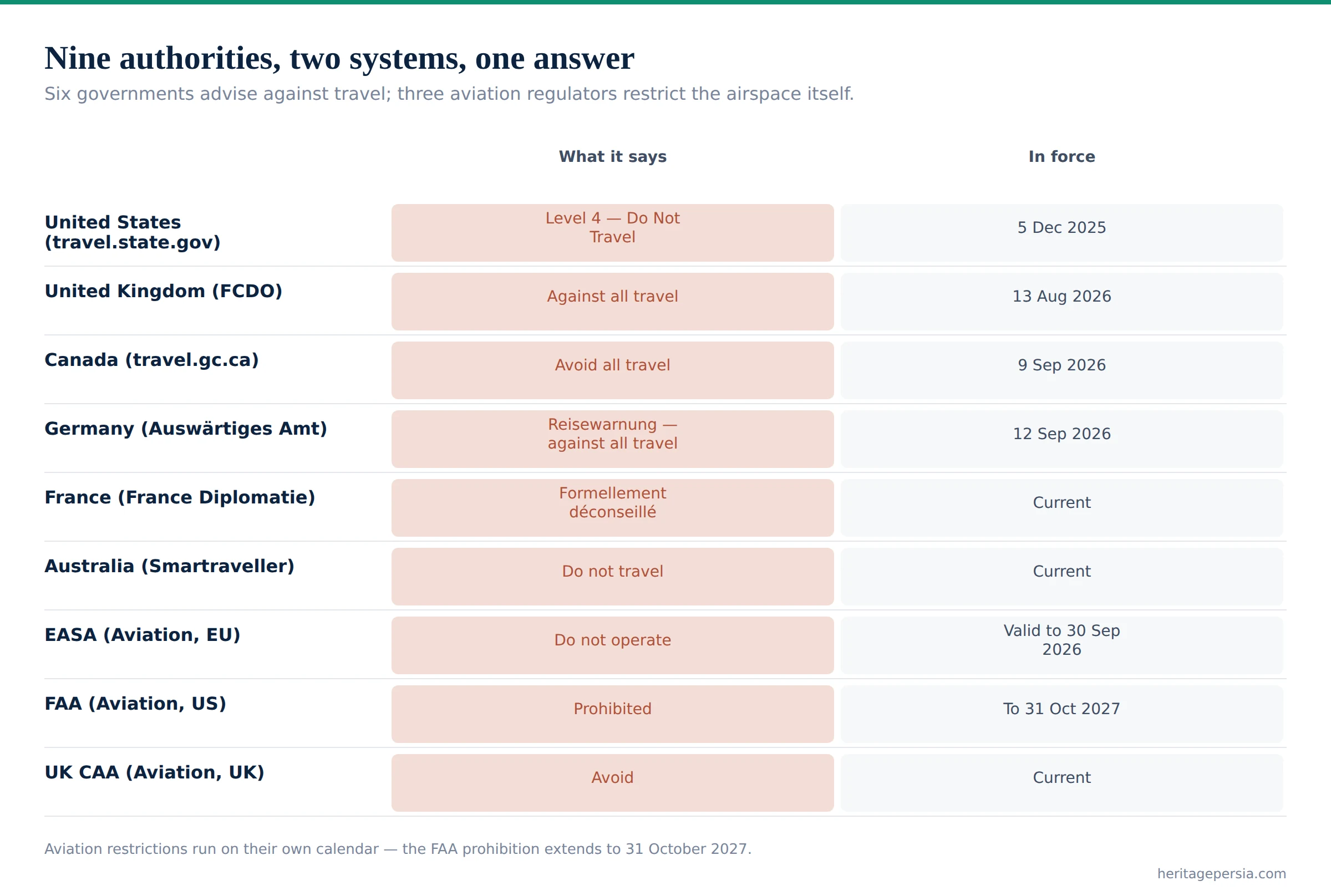
| Authority | Level | Updated | What it says |
|---|---|---|---|
| United States travel.state.gov | Level 4 — Do Not Travel | 5 Dec 2025 | "Do not travel to Iran for any reason." Cites terrorism, civil unrest, kidnapping and wrongful detention. US citizens in Iran are told to leave. |
| United Kingdom FCDO | Against all travel | 13 Aug 2026 | Warns of strikes and retaliatory attacks since 8 July and the risk of further escalation. States that UK support is "extremely limited" and no face-to-face consular assistance is possible. |
| Canada travel.gc.ca | Avoid all travel | 9 Sep 2026 | Cites the volatile regional security situation. Canada has no embassy in Iran; the nearest consular office is in Ankara. |
| Germany Auswärtiges Amt | Reisewarnung — against all travel | 12 Sep 2026 | Warns against all travel and asks German nationals to leave the country. Names a concrete risk of arbitrary arrest, interrogation and long prison sentences for German citizens. |
| France France Diplomatie | Formellement déconseillé | Current | The strongest French category, applied to the whole territory with no province rated lower. Cites an extremely volatile regional security situation and advises registration with the embassy. |
| Australia Smartraveller | Do not travel | Current | Describes the security situation as "extremely volatile", notes airspace closures, flight cancellations and a telecommunications blackout, and advises Australians in Iran to leave when it is safe to do so. |
| EASA Aviation, EU | Do not operate | Valid to 30 Sep 2026 | Instructs operators not to fly within Iranian airspace "at all altitudes and flight levels" (CZIB 2026-04-R1). |
| FAA Aviation, US | Prohibited | To 31 Oct 2027 | Prohibits US operators from the Tehran flight information region, citing "significant unacceptable safety-of-flight risks". |
| UK CAA Aviation, UK | Avoid | Current | Recommends UK operators do not enter the Tehran region, citing risk from anti-aircraft weaponry. |
France, Germany, Italy and Canada have issued comparable aviation warnings. Advisory levels are set by governments for their own citizens and are not identical in meaning — a British "against all travel" and an American "Level 4" carry different consular and insurance consequences, which is why the practical effects are set out separately below.
The Airspace Question, and Why It Decides the Rest
Most travellers read a government advisory and weigh it against their own appetite for risk. The airspace instructions are a different kind of fact, because they do not depend on your judgement at all.
Iranian airspace is currently classified at the highest risk level by the bodies that track this, and it is only partially open — very few international operators are using it, and most Europe-to-Asia traffic is routed around the region entirely, either south through Egypt and Saudi Arabia or north through the Caucasus. The stated concern is the misidentification of a civil aircraft by air-defence systems during a period of heightened tension. Everyone in aviation has one specific precedent in mind, and it is the reason these instructions are written in the language they use.
Practically, this means the routes into Iran are fewer and less predictable than they look when you search for flights, that a cancellation can strand you on either side, and that the assumption underpinning ordinary travel — that you can leave when you want to — does not currently hold.
Insurance — the Part Travellers Discover Too Late
Two separate things are happening, and both matter.
First, insurers are withdrawing. Several international providers have scaled back or stopped covering trips to Iran altogether, classifying it as high-risk, and operators are struggling to find underwriters willing to write the evacuation and political-risk cover that group travel requires. Where cover still exists, premiums are higher and benefits are thinner.
Second, and more important, a policy that does exist is generally void if you travel against your government's advice. The FCDO states this plainly. It means that a British or Australian traveller who enters Iran today is, in almost every case, uninsured for everything — a broken ankle in Yazd as much as an evacuation. Iranian hospitals will treat you, and they will expect payment in cash from a traveller whose cards do not work.
Who Faces the Greatest Risk
The risk in Iran is not evenly distributed, and the people most likely to be reading a page like this are among those it falls on hardest.
Iran does not recognise dual nationality. Anyone born in Iran, and anyone with an Iranian father, is treated as an Iranian citizen whatever other passport they hold — which also means that the embassy of their other country has no standing to intervene on their behalf. The British, American, Canadian and Australian advisories all now state that dual nationals face a heightened risk of questioning, arrest or detention, and Canada's adds that passports may be confiscated and departure prevented pending military-service obligations. The United States advises that Swiss consular access, which normally covers American citizens in Iran, is denied in these cases.
Journalists, researchers, academics and anyone whose work touches Iranian politics fall into a related category. If any of this describes you, the calculation is not the same as it is for an ordinary tourist, and it should not be made on the basis of a travel blog. Speak to your own foreign ministry.
If You Have a Booking With Us
Our position, in plain terms
We have suspended departures and we are not accepting new bookings for this period. Where a trip cannot go ahead, we hold your deposit against a future departure with no expiry, or return it — your choice, and you do not need to argue for it.
If you are holding a booking, or you are already in Iran and want help, write to us and we will answer the same day. Contact the team →
Heritage Persia — please confirm or amend the wording of this block before publishing, so that it matches your actual deposit and refund policy.
The Safety Picture That Will Matter Again
When this period ends — and our view is that it will, because previous ones have — the questions travellers ask about Iran will go back to being ordinary ones. This is the honest answer to those, written now so it is here when it is useful.
Crime
Violent crime against foreign visitors is rare in Iran, and rarer than in most European capitals that carry no warning at all. Pickpocketing exists in the Tehran metro and in the crowded parts of the Grand Bazaar, at roughly the level you would guard against in Rome. The realistic risks are financial rather than physical — an unmetered taxi charging four times the fare, a carpet shop's "government certificate", a currency exchange that counts fast. None of these harm you; all of them are avoided by agreeing prices first.
Roads
In ordinary times the single largest physical danger to a visitor in Iran is the traffic, and it is not close. Intercity driving at night, in particular, is the risk our guides refuse on behalf of clients rather than negotiate. Use trains and internal flights for long distances, insist on seat belts, and treat a driver who takes phone calls at speed as a reason to change vehicle rather than a quirk to tolerate.
Women Travelling in Iran
Women travel in Iran independently and report low levels of harassment, frequently lower than they expect. The genuine constraints are legal rather than social — dress requirements apply to foreign visitors as well as Iranian women, and the enforcement of those requirements has fluctuated considerably over the past few years, which is precisely the kind of detail on which a page written a year ago will mislead you. Any woman planning a trip should check the current position close to departure rather than rely on an account from a previous season.
Regions to Avoid Even in Calm Periods
Some parts of the country carry elevated risk independently of the wider situation, and this has been true for many years. The border areas with Afghanistan and Pakistan, particularly in the south-east, and the immediate border zones with Iraq are the standing examples in every advisory that has ever been written about Iran. No reputable itinerary goes near them; the classic route between Tehran, Kashan, Isfahan, Yazd and Shiraz does not come close.
How We Maintain This Page
A safety page is worth exactly as much as its last review date, which is why ours sits at the top of the article rather than buried at the bottom. We check the five advisories quoted above whenever one of them changes and re-date this page each time, including the times when the change is in the direction we would prefer.
If you want to be told when our departures resume rather than checking a page, write to us and we will add you to the list. We will not use it for anything else.
✉️ Questions we can actually answer: what conditions are like in a specific city, what our guides are reporting this week, what happens to a booking you are holding. Ask us directly — we will tell you what we know and say so when we do not know. Talk to the team →
Continue reading
Frequently Asked Questions
The questions we are asked most often at the moment, answered as we would answer them on the phone.
Sources
- US Department of State, Iran Travel Advisory — Level 4, Do Not Travel, 5 December 2025. travel.state.gov
- UK Foreign, Commonwealth & Development Office, Iran travel advice, updated 13 August 2026. gov.uk/foreign-travel-advice/iran
- Government of Canada, Iran travel advice — Avoid all travel, updated 9 September 2026. travel.gc.ca/destinations/iran
- Australian Government, Smartraveller — Iran, Do not travel. smartraveller.gov.au
- EASA Conflict Zone Information Bulletin 2026-04-R1, valid to 30 September 2026. easa.europa.eu
- US Federal Aviation Administration, Tehran FIR prohibition to 31 October 2027. faa.gov
- UK Civil Aviation Authority guidance on the Tehran flight information region. caa.co.uk
Advisories change. Each is linked to the issuing authority so you can check the live position rather than trust our summary of it.