
Tehran is a city built up a mountainside. It starts at about 1,100 metres in the south and climbs past 1,700 in the north, roughly six hundred metres of rise across twenty kilometres, and almost everything that confuses a visitor follows from that single fact — why the north is cooler and cleaner and richer, why the old city is at the bottom, why a taxi ride can change the weather.
The other thing to know is that most itineraries give Tehran the wrong amount of time. It is the city everybody lands in and nobody plans for, so it gets a jet-lagged afternoon and a reputation for being a traffic jam with museums in it. Two properly used days is the honest figure, and this page is about how to use them.
Before you plan anything: this is a city guide, written to be useful whenever you are able to use it. Whether to travel to Iran at present is a separate question with a different answer — see our current situation report, reviewed 10 September 2026.
The Fact That Organises Everything
Tehran is not an old city in the way Isfahan or Yazd are. It was a modest town until 1786, when the Qajars made it their capital because it sat conveniently between their tribal base and the centre of the country, and almost everything you will see was built after that. What it has instead of antiquity is the collected antiquity of everywhere else — the National Museum holds the objects excavated from Susa, Persepolis and Tchogha Zanbil, which is why we send people here first rather than last.
The altitude gradient does the rest. The south is the old city: Golestan, the Grand Bazaar, the nineteenth-century streets, the dense and hot and interesting part. The north is where the money went in the twentieth century: the Shah's palaces at Sa'dabad and Niavaran, the galleries, the cafés, and air that is measurably better because it sits above the layer that collects under the inversion.
Practically, that means the sensible shape of a Tehran day is to sleep high and work low. You come downhill into the sights in the morning and back uphill in the evening, which is also the direction the traffic is not going.
Every Site, With the Hour to Arrive
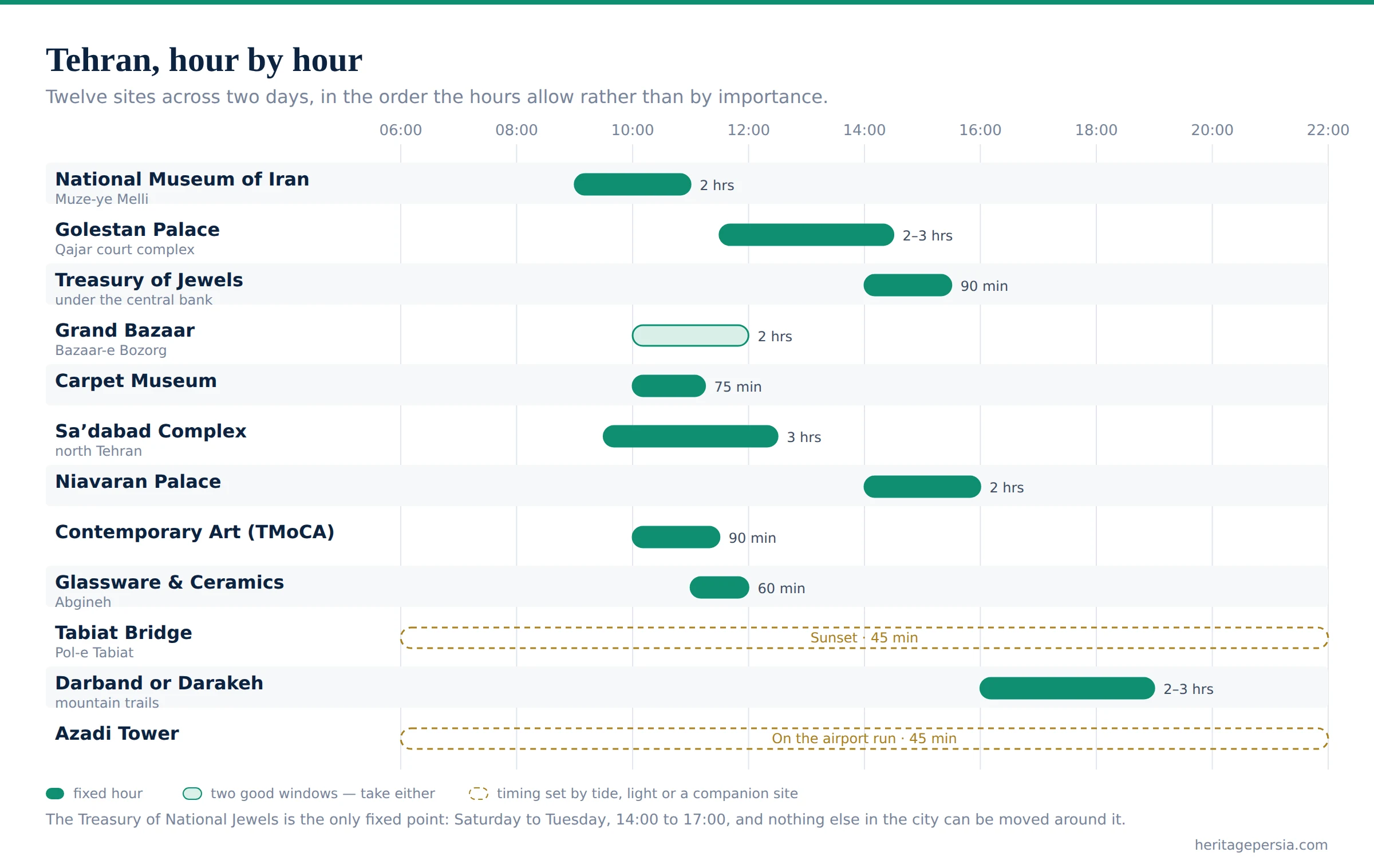
Ordered as a two-day route rather than by importance. The hours matter more here than in any other Iranian city, for one reason that appears in the third row.
| Site | Status | Time | Arrive | Why then |
|---|---|---|---|---|
| National Museum of Iran Muze-ye Melli | The country’s collection | 2 hrs | 09:00 | Do this before anything else in the country, not just in Tehran. The Persepolis and Susa material here is the context for everything you will see later |
| Golestan Palace Qajar court complex | UNESCO 2013 | 2–3 hrs | 11:30 | Tickets are sold per hall rather than as one entry. Decide which three you want at the gate, or you will pay for eleven and rush all of them |
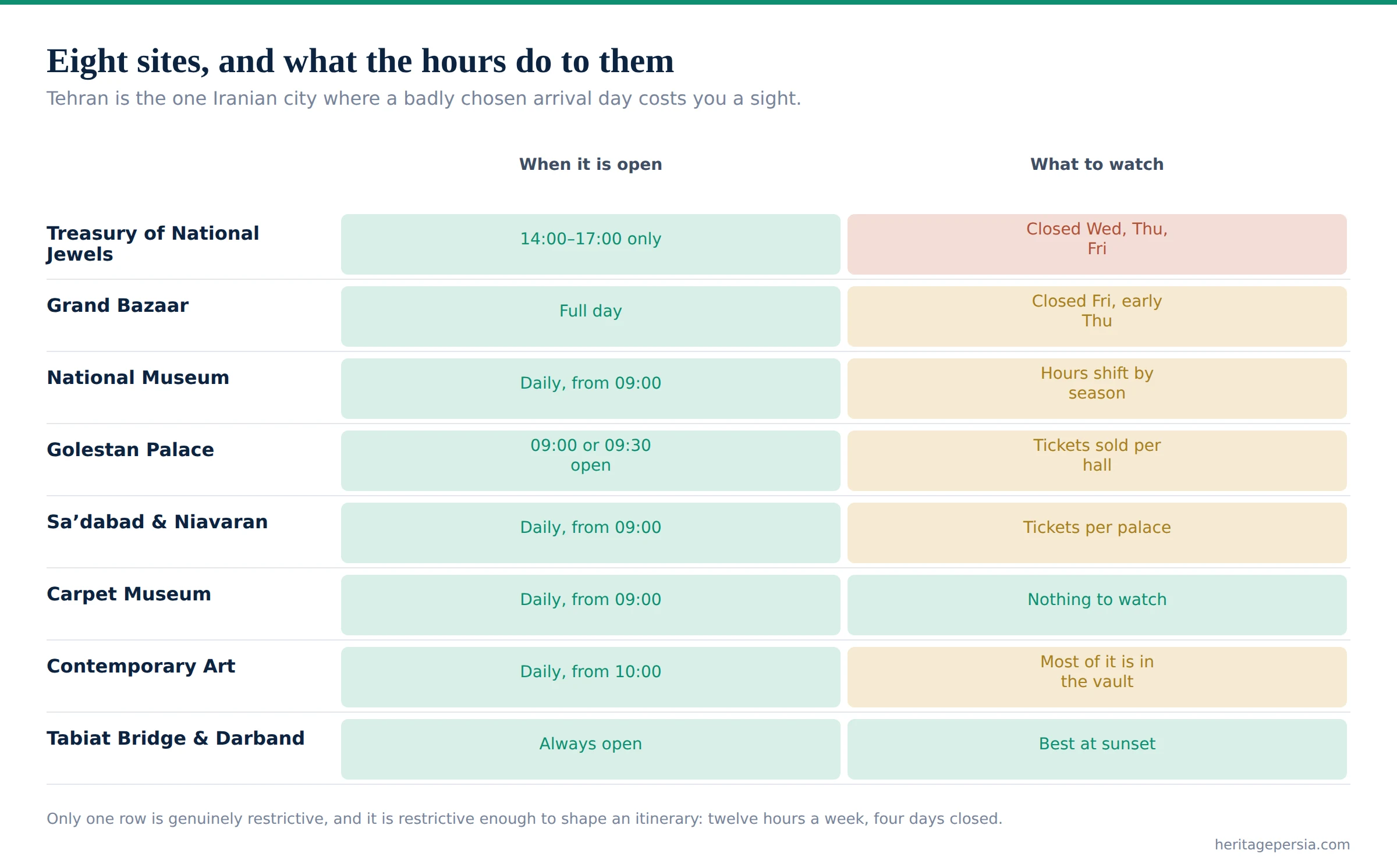
| Treasury of National Jewels under the central bank | Sat–Tue only | 90 min | 14:00 | Open twelve hours a week — Saturday to Tuesday, 14:00 to 17:00. No bags, phones, cameras or watches, and no under-twelves. Plan the whole trip around this |
| Grand Bazaar Bazaar-e Bozorg | Working market | 2 hrs | 10:00 or 16:00 | Closed Fridays and shut early on Thursdays. Ten kilometres of corridors — go with a destination rather than to wander |
| Carpet Museum | Purpose-built, 1976 | 75 min | 10:00 | The best single explanation of what you will be offered in every bazaar for the next two weeks. Worth it before you buy anything |
| Sa’dabad Complex north Tehran | 18 palaces in a park | 3 hrs | 09:30 | Separate tickets per palace again. The White and Green palaces are the two; the rest is a pleasant wooded walk at 1,700 metres |
| Niavaran Palace | The last royal residence | 2 hrs | 14:00 | More interesting than Sa’dabad if you only do one, because it was lived in until 1979 and looks it |
| Tehran Museum of Contemporary Art | Modernist, 1977 | 90 min | 10:00 | Holds one of the most valuable collections of Western modern art outside Europe and America. Most of it is in the vault; check what is hung before going |
| Glassware & Ceramics Museum Abgineh | Qajar house | 60 min | 11:00 | Small, superb and almost empty. The building is as good as the collection |
| Tabiat Bridge Pol-e Tabiat | 2014, three levels | 45 min | Sunset | The city’s best piece of modern architecture and where Tehranis actually go in the evening. Free |
| Darband or Darakeh mountain trails | Teahouses on a stream | 2–3 hrs | 16:00 | A stepped path up a gorge lined with teahouses, at 1,700 m and climbing. Thursday evenings are the local institution |
| Azadi Tower | 1971 | 45 min | On the airport run | Genuinely fine architecture and on the road to the airport, which is where it fits rather than as a separate trip |
Museum hours in Iran shift with the season and over holidays, and Tehran’s vary more than most. Confirm the day’s hours at your hotel desk the night before — except the Jewels, which do not vary and which nothing else can be moved around.
The Twelve-Hour Museum
The Treasury of National Jewels deserves its own section because it is the one thing in Tehran that can defeat an otherwise well-planned trip.
It sits in a vault under the Central Bank on Ferdowsi Street and it opens Saturday to Tuesday, from two o’clock until five. Not Wednesday, not Thursday, not Friday. That is twelve hours a week, and it closes on public holidays on top of that. A traveller who arrives on a Wednesday and leaves on a Friday cannot see it at all, and the number of itineraries that fail on this detail is large.
Security is airport-grade and then some. Bags, phones, cameras, smartwatches, keys and lighters all go into lockers before you reach the stairs; children under twelve are not admitted; and there is no step-free access. You go in with your pockets empty and you take nothing away except the memory, which is the intended effect.
What is inside justifies it. The Darya-ye Nur is a pink diamond of about 182 carats, one of the largest in the world. The Peacock Throne carries something over twenty-six thousand stones. There is a globe, made in 1869, with fifty-one thousand gems set into it — emeralds for the seas, rubies for the land. It is not a museum in the ordinary sense so much as a national reserve that happens to be visible, and it is the single most concentrated collection of objects in Iran.
How to plan around it: pick your Tehran days first, before the rest of the itinerary, and make at least one of them a Saturday, Sunday, Monday or Tuesday. Then build the afternoon of that day around a two o’clock entry. Everything else in this city can be moved; this cannot.
Why the National Museum Comes First
This is our strongest recommendation about Tehran and the one most often ignored.
Iran’s great sites are, for the most part, architecture with the objects removed. Persepolis is a terrace of carved stone whose portable contents are elsewhere. Susa is a set of mounds. Tchogha Zanbil is a ziggurat with nothing inside it. What was excavated from all three is largely in one building on Si-e Tir street in south Tehran.
Which means the National Museum is not a Tehran attraction. It is the index to the rest of the trip, and seeing it on day two rather than day nine changes what the other sites mean. Go and look at the Persepolis reliefs and the foundation tablets here, and the terrace a week later stops being scenery and becomes a building whose accounts you have already read.
The museum is two buildings — ancient Iran in one, the Islamic period in the other, on one ticket. Two hours covers it properly and the ancient wing is the one to do first if you are short.
Getting Around
Tehran traffic is as bad as its reputation and the metro is much better than its reputation, and most visitors discover the second fact too late.
| Mode | Good for | What to know |
|---|---|---|
| Metro | Anything on a line, at any hour | Seven lines, cheap, air-conditioned and fast. Women-only carriages at each end of every train; you may use either — see the solo travel guide |
| Snapp or Tapsi | Everything the metro does not reach | The right default. Fare fixed in advance, route logged, no negotiation. Needs a local SIM, which takes twenty minutes |
| Shared taxi savari | Fixed routes along main avenues | Cheap and efficient once you know the route. Shout your destination at the window; if the driver nods, get in |
| Walking | Within the bazaar and Golestan quarter | The old city is genuinely walkable. North Tehran is not — the blocks are long and the gradient is real |
| Private car and driver | The palaces, the airport, a full day | What we use for guests. See getting around Iran |
| The airport | IKA is 50 km south-west | 45 to 90 minutes depending on traffic, and the two airports are different places — Mehrabad handles domestic flights and is inside the city |
The two-airport trap catches people every year: international arrivals land at Imam Khomeini in the far south-west, domestic departures usually leave from Mehrabad in the west of the city, and moving between them in traffic can take ninety minutes.
Air, Altitude and When to Come
Tehran’s air is a real consideration rather than a grumble. Cold air sits trapped under the Alborz through the winter and the index climbs through November, December and January; the worst episodes close schools and government offices. Ten major Iranian cities exceed WHO limits for fine particulates on hundreds of days a year and Tehran is the worst of them, which our health guide sets out with the figures.
Two things follow. First, if you are travelling in winter, weight your nights away from Tehran — arrive, take a day, and move on, which our winter guide builds a whole route around. Second, within the city, going north is going up and out of the layer: Sa’dabad and Darband at 1,700 metres are frequently clear on days when the bazaar is not.
The best months here are April, May, late September and October, when the city is warm and dry and the mountains are still visible from the street, which they are not for much of the year. The month-by-month guide has the figures for seven cities.
Where to Stay, and What to Eat
Tehran is the one Iranian city where we would not chase charm. There is almost no tradition of converted courtyard houses here — that is Kashan and Yazd — so buy location, a working lift and clean air instead, and spend the saved money further south. Around Valiasr is the practical compromise: central enough for the museums, high enough to be out of the worst of the air. The accommodation guide has the price bands.
Eating is where Tehran genuinely beats the rest of the country, because it is the only city with everything. Every regional cuisine in Iran has a restaurant here, which is not true anywhere else — Gilani food from the Caspian, Azerbaijani from Tabriz, the fish and tamarind cooking of the south. The traditional tea houses under the bazaar are an institution, and north Tehran has a café culture that would not be out of place in southern Europe. Our food guide covers the regional map and the vegetarian guide covers the part that is harder here than it looks.
Two Days, Used Properly
| When | What | Note |
|---|---|---|
| Day 1 · 09:00 | National Museum | Ancient wing first. Two hours |
| Day 1 · 11:30 | Golestan Palace | Choose three halls at the gate. Mirror Hall, Marble Throne, Shams ol-Emareh |
| Day 1 · 14:00 | Treasury of National Jewels | Only if the day is Sat–Tue. This is the fixed point of the whole itinerary |
| Day 1 · 16:00 | Grand Bazaar | Not Friday. Enter from Sabze Meydan and have a destination |
| Day 2 · 09:30 | Sa’dabad or Niavaran | Niavaran if only one. Cooler, cleaner and 1,700 m up |
| Day 2 · 13:00 | Carpet Museum | Before you buy anything anywhere in Iran |
| Day 2 · 15:00 | Contemporary Art or Abgineh | Check what is actually hung at TMoCA before committing |
| Day 2 · 17:00 | Tabiat Bridge, then Darband | Sunset on the bridge, dinner up the gorge. The local evening, and the best one |
If you have only one day, it is the National Museum, Golestan and the bazaar, and you skip the north entirely. If you have three, add a day trip — Alamut, the Alborz, or Qom on the road south towards Kashan.
✉️ Arriving in Tehran and not sure how to shape it? Tell us your arrival day and we will build the two days around the Jewels, which is the only fixed point in the city. Talk to our team →
Continue reading
Frequently Asked Questions
What travellers ask our guides, answered on the ground.
Two Days Built Around the Jewels
Tell us your arrival day and we will shape Tehran around the only fixed point in the city.
See All Destinations →