
Persepolis is a terrace. That sounds like a small thing to say about the ceremonial capital of the largest empire the world had yet seen, but it is the fact that organises a visit: everything is on one raised platform of 450 by 300 metres, you enter at one corner, and the order you walk it decides whether you see carving or glare.
Most guides tell you the history and leave you to work out the morning. This one does both, because after twenty years of taking people up those steps we have learned that the difference between a good visit and an exhausting one is about ninety minutes of timing.
Before you plan anything: this is a site guide, written to be useful whenever you are able to use it. Whether to travel to Iran at present is a separate question with a different answer — see our current situation report, reviewed 10 September 2026.
What You Are Actually Standing On
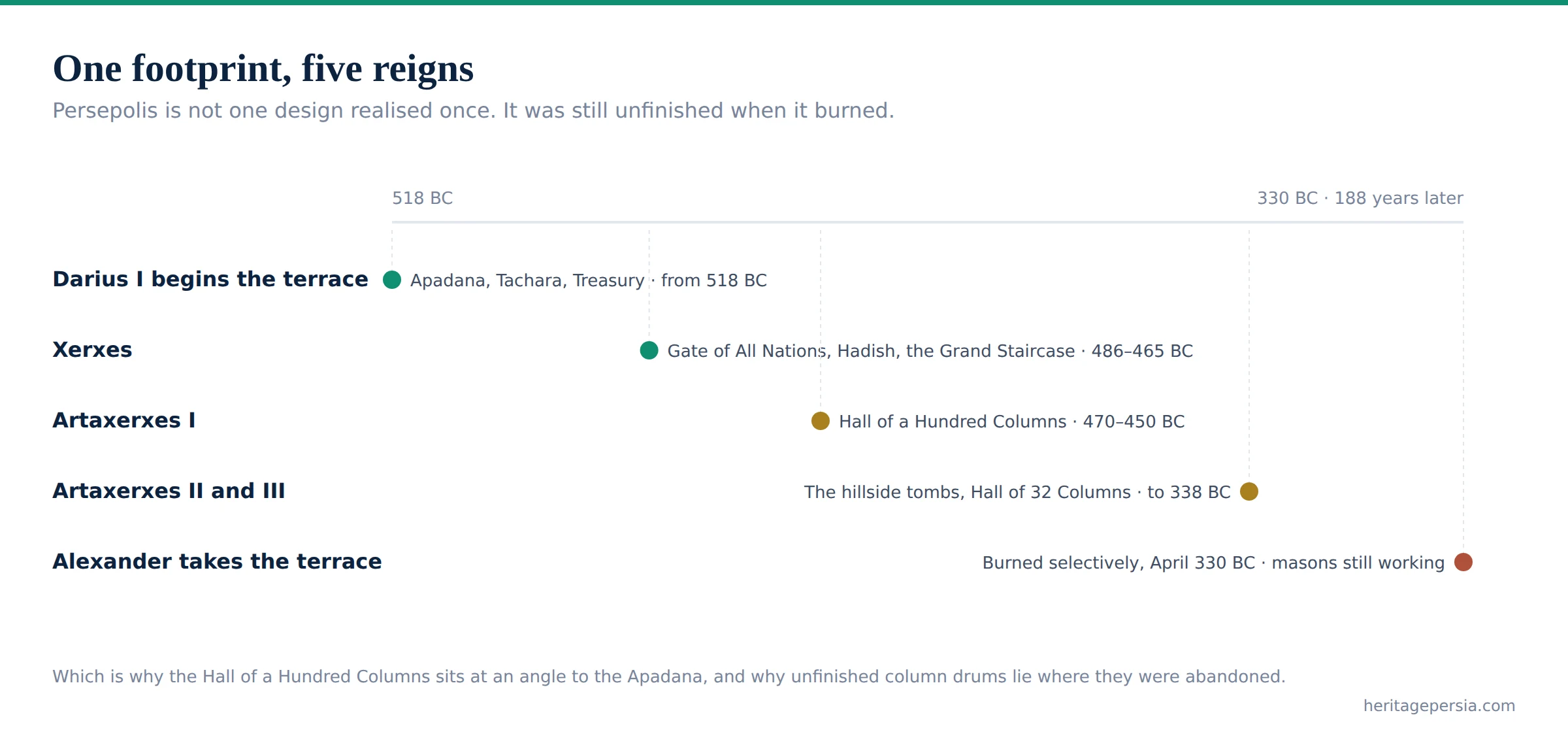
Darius I began the terrace in 518 BC, cutting it half out of the rock of Kuh-e Rahmat and half building it up with fill, then walling it to a single level. Every king after him added to the same platform for roughly a hundred and eighty years — Xerxes, Artaxerxes I, down to Artaxerxes III — and none of them finished it. When Alexander arrived in the first weeks of 330 BC, masons were still working.
That matters for what you see. Persepolis is not one design realised once; it is five reigns of building on a fixed footprint, which is why the Hall of a Hundred Columns sits at a slight angle to the Apadana and why unfinished column drums lie where they were abandoned. The inscribed property is 12.5 hectares and you can walk the whole of it, which is unusual for a site of this rank.
It was also never a capital in the administrative sense. Susa and Babylon ran the empire; Persepolis received it. What happened here was ceremonial and fiscal — the arrival of tribute, the housing of treasure, the keeping of accounts — and the reliefs on the Apadana stairways are a picture of exactly that.
Every Structure, With the Hour to See It
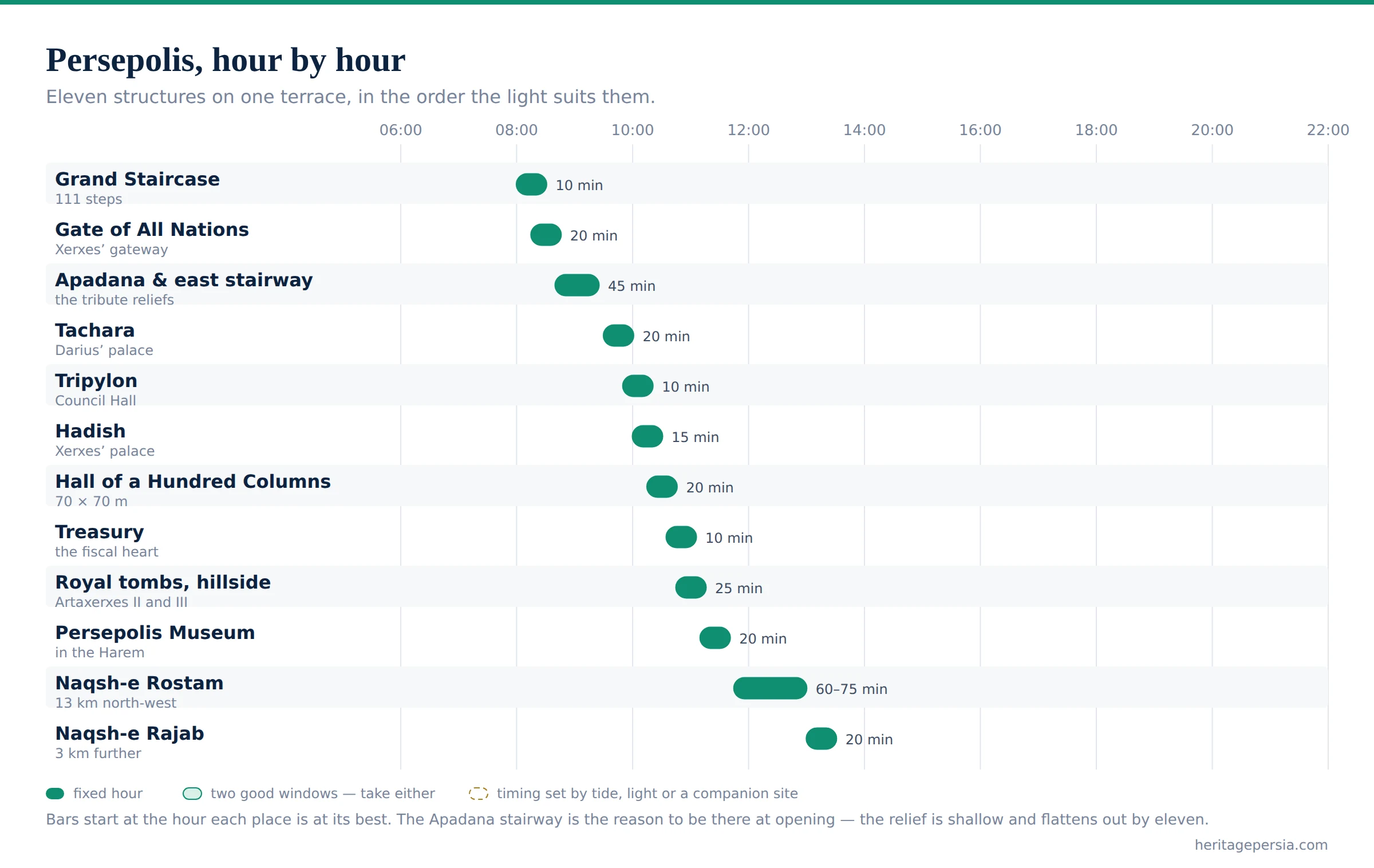
The terrace in walking order. The hours assume an 08:00 arrival, which is the only arrival time we recommend between April and October.
| Structure | Built by | Time | Arrive | Why then |
|---|---|---|---|---|
| Grand Staircase 111 steps | Xerxes c. 486–465 BC | 10 min | 08:00 | Deliberately shallow — cut so that guests could ride up without dismounting. Look at the tread depth before you climb |
| Gate of All Nations Xerxes’ gateway | Xerxes c. 475 BC | 20 min | 08:15 | The lamassu face east and west, so early sun rakes the eastern pair. The nineteenth-century graffiti includes Stanley of Africa fame |
| Apadana & east stairway the tribute reliefs | Darius I, finished by Xerxes 518–490 BC | 45 min | 08:40 | The single reason to come early. The stairway faces north-east and the relief reads only in low sun — by eleven it is flat |
| Tachara Darius’ palace | Darius I c. 490 BC | 20 min | 09:30 | The stone here was polished to a mirror and still holds it. Also the least burnt building on the terrace, which is a clue about 330 BC |
| Tripylon Council Hall | Xerxes c. 470 BC | 10 min | 09:50 | Small, central, and the hinge of the whole plan — the passage between the public terrace and the private palaces |
| Hadish Xerxes’ palace | Xerxes c. 480–470 BC | 15 min | 10:00 | Twice the size of Darius’ palace and the most thoroughly burnt structure here. That is not a coincidence |
| Hall of a Hundred Columns 70 × 70 m | Artaxerxes I 470–450 BC | 20 min | 10:15 | The second-largest building on the terrace and the emptiest. Stand at the north door and count the column bases |
| Treasury the fiscal heart | Darius I, extended later from 518 BC | 10 min | 10:35 | Foundations only, but this is where the Treasury tablets were found and where the empire’s silver sat |
| Royal tombs above the terrace Artaxerxes II and III | 4th century BC | 25 min | 10:45 | The climb up the hillside. Do it for the plan of the whole site from above, which no photograph gives you |
| Persepolis Museum in the Harem | Xerxes; rebuilt 1931 by Herzfeld | 20 min | 11:10 | Roofed and cool, which is why it belongs at the end. The building is itself Herzfeld’s reconstruction and his dig house |
| Naqsh-e Rostam 13 km north-west | Achaemenid and Sassanid 5th c. BC – 3rd c. AD | 60–75 min | 11:45 | Four royal tombs cut into a cliff that faces west, with seven Sassanid reliefs beneath them. Late morning lights the reliefs |
| Naqsh-e Rajab 3 km further | Sassanid 3rd century AD | 20 min | 13:00 | Four reliefs in a rock alcove, almost always empty, and the investiture of Ardashir I is the clearest of them anywhere |
Three hours on the terrace, an hour at Naqsh-e Rostam, twenty minutes at Naqsh-e Rajab. That is a full morning and it puts you back in Shiraz for a late lunch — which is the shape of the day we run.
The Three-Hour Walk, in Order
The site has one entrance and no loop, so the sequence above is close to forced. What is not forced, and what most visitors get wrong, is where they spend their first forty minutes.
The instinct is to stop at the Gate of All Nations, because it is the first monumental thing and the lamassu are photogenic. Resist it slightly. The Apadana eastern stairway is the most important carved surface in Iran and it is legible for about two hours after opening — the relief is shallow, it faces north-east, and once the sun is high the shadows that make twenty-three tribute delegations readable simply disappear. Give the gate fifteen minutes and move.
On the stairway itself, work along the delegations rather than photographing the whole panel. Each carries what its region actually produced — Armenians with a horse and a vessel, Indians with axes and gold dust, Ethiopians with an okapi, Arabs with a dromedary, Lydians with bowls — and read together they are a map of the empire drawn in goods rather than borders. The Persian and Median guards separating them are the only figures shown holding hands, which is the sort of detail a guide is worth having for.
One thing to do before you leave the terrace: climb to the tombs. It is fifteen minutes of steps and nearly everyone skips it, and it is the only place from which the plan makes sense — you can see the Apadana's footprint, the angle of the Hundred Columns, and the line of the fortification wall where the tablets came from.
Naqsh-e Rostam, and the One After It
Thirteen kilometres from the terrace, four Achaemenid kings are cut into a cliff face a dozen metres above the ground: Darius I, and by strong inference Xerxes, Artaxerxes I and Darius II. Only Darius I's is inscribed, which is why the other three are attributed rather than identified.
What makes the cliff worth the extra hour is not the tombs but the eight centuries underneath them. Seven Sassanid reliefs were cut beneath the Achaemenid tombs between the third and fourth centuries AD — deliberately, as a claim of descent — and one of them shows the Roman emperor Valerian kneeling before Shapur I after his capture at Edessa in 260. A Persian king, a Roman emperor, carved into a rock face below tombs that were already seven hundred years old when the carving was made.
Three kilometres further is Naqsh-e Rajab, which most tours skip and which takes twenty minutes. Four reliefs in a small alcove, including the investiture of Ardashir I and a rare portrait of the high priest Kartir, and you will usually have it to yourself.
The Thirty Thousand Tablets
In 1933 Ernst Herzfeld's team, clearing the north fortification wall, found an archive of roughly thirty thousand clay tablets written in Elamite cuneiform. They are not royal inscriptions. They are receipts — rations issued, workers paid, travel authorised, sheep counted — covering the years around 500 BC.
They are the reason we know that the people who built Persepolis were paid, in barley and wine and silver, at rates that differed by skill and not by origin; that women workers received rations, including extra rations after childbirth; and that the labour force included Greeks, Egyptians, Bactrians and Indians alongside Persians. The empire's self-image is on the stairway. Its actual administration is in the tablets.
The archive left Iran in 1936 on loan to the Oriental Institute in Chicago for study and decipherment, and it stayed there for eight decades. In 2018 the US Supreme Court ruled unanimously that the collection could not be seized to satisfy a judgment against Iran in the Rubin litigation, and the institute began returning the material; about 1,800 pieces went back in September 2019, with further returns since, and a selection is now on display at the National Museum in Tehran.
We mention this because the National Museum is on the standard ten-day route, usually on day two, and almost nobody visiting it knows that the small clay objects in the Achaemenid room are the accounts of the site they will stand on a week later. Seen in that order, the terrace stops being scenery.
What Happened in 330 BC
Alexander took Persepolis in the first weeks of 330 BC and burned part of it in April. The ancient sources disagree about why — Arrian says it was deliberate policy, retaliation for Xerxes' burning of Athens; Diodorus and Curtius tell a story of a drunken banquet and the courtesan Thaïs — and the sources are late enough that neither version can be checked.
What the archaeology says is narrower and more interesting. The burning was selective. Hadish, Xerxes' own palace, is the most comprehensively destroyed building on the terrace; the Tachara, Darius', is the least. Ash layers are heavy in the Treasury and the palaces and light elsewhere. Fire that starts by accident does not choose between two palaces sixty metres apart.
The other thing the fire did was preserve. Cedar roofs collapsing onto clay tablets baked them, which is why an archive that would otherwise have dissolved in twenty-five centuries of winter rain is legible today. The destruction of Persepolis is the reason we can read Persepolis.
Practical Notes
| Question | Answer |
|---|---|
| Where it is | 60 km north-east of Shiraz near Marvdasht, about an hour by road each way |
| Opening | From 08:00. Closing moves with the season — around 17:00 in winter, 19:00 or later in high summer. Hours extend over Nowruz |
| Entry | 3,500,000 rial for the terrace including the museum; 2,500,000 for Naqsh-e Rostam and the same for Pasargadae. Roughly €2 and €1.50 at the open rate — see the money guide, since the rate moves |
| Time needed | Three hours on the terrace. Four and a quarter with Naqsh-e Rostam; four and three-quarters with Naqsh-e Rajab as well |
| Shade | None. The terrace is fully exposed stone and it radiates heat back at you from mid-morning. This is the single practical fact that decides the visit |
| Water | Two litres per person in summer, carried up. There is a kiosk at the entrance and nothing above it |
| Footing | Uneven cut stone throughout and unrailed drops at the terrace edge. Closed shoes, and the tomb climb is not for anyone unsteady |
| Getting there | A car with driver from Shiraz is the usual way and lets you add Naqsh-e Rostam without negotiating. Buses reach Marvdasht but not the site — see getting around Iran |
| Guides | Licensed guides wait at the entrance. Worth it here more than almost anywhere, because the Apadana relief is a text and an unread text is just stone |
| Dress | Standard Iranian code applies, plus sun. A wide hat matters more than it does in the cities — see what to wear |
| Phone signal | Reliable at the entrance, patchy on the terrace. Download the map before you leave Shiraz — the connectivity guide explains why offline maps matter here |
Entry prices were current in 2026 and are set in rial, so they drift with the currency rather than with policy. Assume the figure and not the euro conversion.
When to Go
Late March to mid-May, or late September to early November. Marvdasht sits at about 1,600 metres, which softens the summer slightly compared with the plains, but the terrace itself is unshaded stone and July afternoons on it are genuinely punishing.
Winter is the underrated option. December to February brings cold mornings, occasional rain, very low visitor numbers and the flattest, longest light of the year on the reliefs — which is exactly what shallow carving wants. Take a coat, accept that the tomb climb may be slippery, and you will have the Apadana stairway largely to yourself. The month-by-month guide has the figures for Shiraz.
The two weeks of Nowruz are the exception in the other direction. Persepolis is the single most visited monument in Iran during the new-year holiday, domestic crowds are heavy, and the 08:00 rule becomes a 07:30 rule.
✉️ Going to Persepolis and want the morning to work? Tell us your date and we will tell you the opening hour in that month, the order we would walk it, and whether Pasargadae fits the same day. Talk to our team →
Continue reading
Frequently Asked Questions
What travellers ask our guides, answered on the ground.
Persepolis, With the Morning Planned
Tell us your date and we will tell you the opening hour that month and the order we would walk it.
See Our Day Tours →