
There is no office of the Government of Canada in Iran. Not a reduced one, not a consulate with limited hours — none. The nearest is the embassy in Ankara, more than two thousand kilometres away, which provides limited consular services to Canadians inside Iran. That single fact shapes everything else on this page and it is the first thing a Canadian considering this trip should absorb.
The second is that Global Affairs Canada advises against all travel, and singles out Canadians — dual citizens above all — as being at high risk of arbitrary arrest and detention. We are an Iranian tour operator and we are telling you this at the top rather than in a footnote. The visa process is then set out in full below, accurately, because you searched for it and a correct answer is more use to you than a sales page.
Read this first: the process below exists and works. Whether the journey is advisable is a separate question, and Global Affairs Canada’s answer to it is not ambiguous. See also our current situation report, which reads nine advisories and the aviation restrictions side by side, reviewed 12 September 2026.
What Global Affairs Canada Says
The current advice is Avoid all travel, last updated on 9 September 2026, and the stated reason is the volatile security situation in the region.
Two further passages matter more than the headline level. On detention, the advice states that Canadians “including those with dual Canadian-Iranian citizenship, are at high risk of arbitrary arrest and detention in Iran”, and separately that Canadians “particularly dual Canadian-Iranian citizens, are at risk of being arbitrarily questioned, arrested or detained”.
On consular access it is equally direct: Iranian authorities “may refuse to grant you access to Canadian consular services”. Read alongside the absence of any Canadian office in the country, that is the substance of the warning rather than a formality attached to it.
The Process, Step by Step
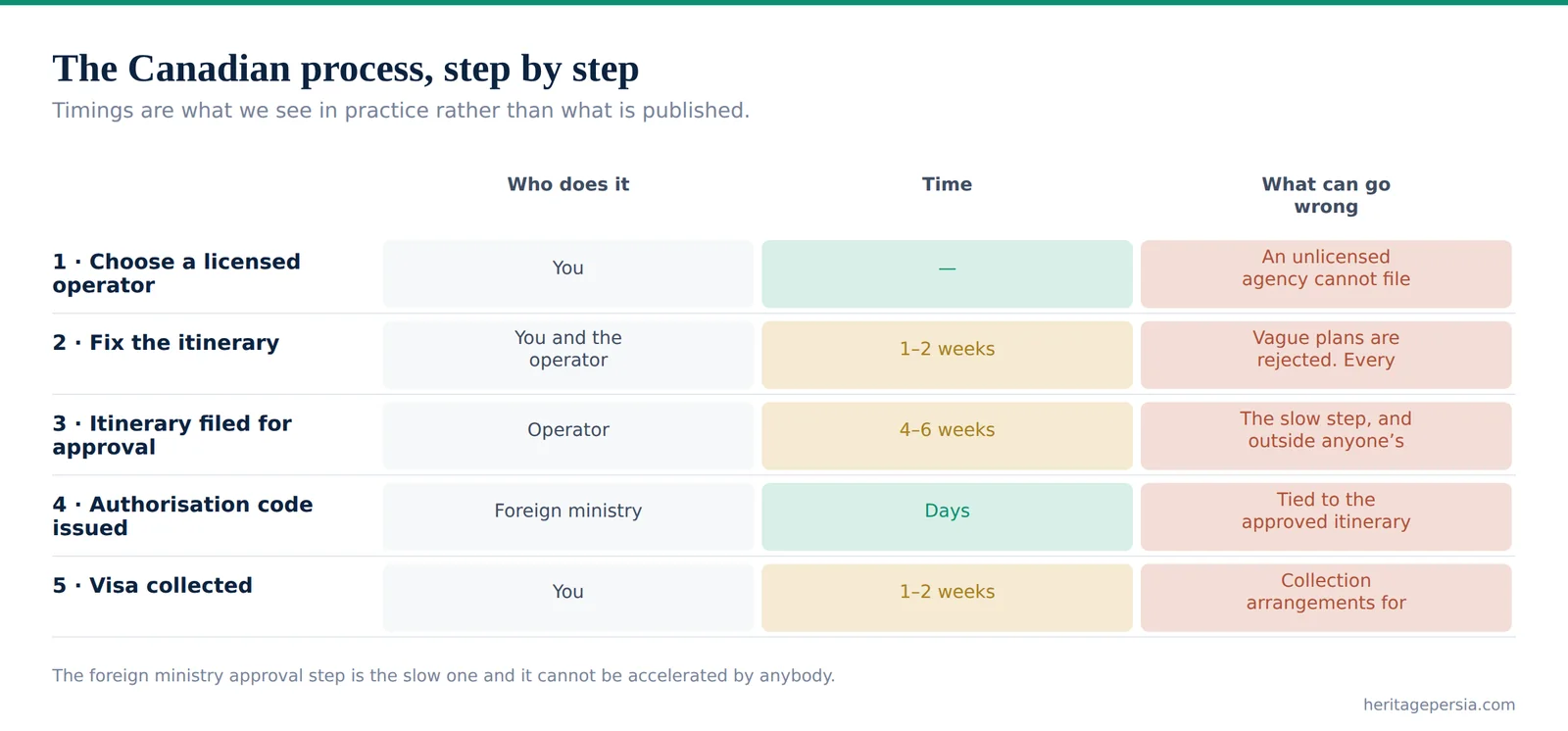
If you proceed, this is what happens. Timings are what we see in practice.
| Step | Who does it | Typical time | What can go wrong |
|---|---|---|---|
| 1 · Choose a licensed operator | You | — | An unlicensed agency cannot file an itinerary at all. Verify the licence before paying |
| 2 · Fix the itinerary Day by day, hotels named | You and the operator | 1–2 weeks | Vague plans are rejected. Every night and city must be specified |
| 3 · Itinerary filed for approval | Operator | 4–6 weeks | The slow step, and outside anyone’s control. It cannot be accelerated |
| 4 · Authorisation code issued | Foreign ministry | Days | Tied to the approved itinerary and to one collection point |
| 5 · Visa collected At a designated consulate | You | 1–2 weeks | Collection arrangements for Canadian applicants are not domestic |
About eight weeks in total. Accommodation is booked before the visa exists, so money is committed before the outcome is known — ask what happens to your deposit on refusal, and get the answer in writing.
Guided Travel Is the Condition, Not a Service
Canadian passport holders cannot travel independently in Iran. The visa is granted on the basis of an approved plan and an accompanying guide, and those are conditions rather than options.
The itinerary is approved as a document before any visa exists — day by day, with the cities and the accommodation named.
A licensed guide accompanies you throughout, not merely at the monuments. This is the part most often misunderstood by people who read that Canadians “need a guide”.
The approved itinerary is the permitted itinerary. Adding a city mid-trip is not a matter to be settled locally.
💡 What it means for the trip. You cannot have an unplanned day. Travellers who like structure often find the guide becomes the best part of the trip; travellers whose idea of a holiday is deciding at breakfast where to go should know this before committing eight weeks and a deposit to finding out.
If You Are a Dual Canadian-Iranian Citizen
This is the most consequential section on the page, and Canada’s guidance contains a concrete instruction the other advisories do not.
Iran does not recognise dual nationality. Global Affairs Canada states that dual citizens “must enter and exit Iran using your Iranian passport”. That is not advice about which document is smoother; it is how Iranian law treats you, and it means that inside the country you are an Iranian citizen with the obligations that attach — including military service for men of the relevant age.
The consular consequence follows directly. Iranian authorities may refuse access to Canadian consular services, and there is no Canadian office in the country to request it. Canada itself describes dual citizens as being at high risk of arbitrary arrest and detention.
A claim to Iranian citizenship can pass through a parent even if you have never held an Iranian passport or set foot in the country, and it does not lapse through disuse. If that describes you, this is a question for an immigration lawyer and for Global Affairs Canada before it is a question for a tour operator — and it is the answer we will give you if you write to us.
Ankara, and What It Can Do
Canada’s consular responsibility for Iran sits with the embassy in Ankara. It provides limited services to Canadians in Iran, and the limitation is geographic before it is anything else: the nearest Canadian official is in another country.
In practice this divides problems into two categories. Ordinary ones — a lost passport, illness, a missed connection, a dispute with a hotel — are handled locally by your operator and your insurer, routinely and without drama. Serious ones are where the absence matters, and where the support a Canadian would expect in almost any other destination is not available in the way or at the speed it would be elsewhere.
Register your travel with Global Affairs Canada before you go, and leave a copy of the itinerary with someone at home. Neither costs anything and both matter more here than they would elsewhere.
Insurance
Most Canadian travel policies exclude destinations under an “avoid all travel” advisory, and the exclusion is usually absolute rather than a matter of a higher premium — travelling against the advisory can void the policy entirely, including medical and repatriation cover.
Read the exclusions rather than the summary. Confirm in writing that travel to Iran is covered, and check medical evacuation specifically, because that is the cover that matters most in a country your government cannot reach you in. Iranian law separately requires locally recognised insurance, sold at the airport for a small sum; treat that as a formality you satisfy rather than protection you rely on.
Documents and Practicalities
Passport. Valid for at least six months beyond the date you expect to leave Iran. A tourist visa is required; there is no exemption and no arrival option.
Photographs. Standard format, and women’s photographs must show a headscarf. The photograph rules are stricter than the ones that apply on the street — our dress code guide explains the difference.
Israeli stamps. Evidence of travel to Israel in your passport will result in refusal.
Journalists and public figures. A separate and more complicated process applies; the tourist route is not open to you. Take specialist advice.
Money. No Canadian card works anywhere in Iran — not for cash, not in shops, not online. Read the money guide before you budget, because the constraint is absolute and it changes how much you carry in.
What we will tell you. We answer visa questions from people who have no intention of booking with us, and we say so when we think the answer is to wait. We would rather lose the enquiry than take a booking from someone who has not read the top of this page.
✉️ Want the process explained rather than sold? Ask us about the routes, the timings or the dual-citizenship position — including whether we think you should go at all. Talk to our team →
What the Trip Actually Looks Like
The paperwork above describes a set of restrictions. It is worth saying plainly what they feel like from inside, because the gap between the two surprises people in both directions.
A typical day begins with the guide meeting you at the hotel and ends when they drop you back. In between you are together — at the monuments, in the car between cities, and usually at lunch. You are not followed; you are accompanied, and after the second day most travellers stop noticing the distinction. Evenings are generally your own within the city you are in, and walking to dinner or through a bazaar alone is normal.
What the structure costs you is spontaneity. You cannot decide over breakfast to spend the day somewhere else, skip a city, or extend a stay because you liked it. For travellers who plan carefully anyway, that changes very little. For travellers whose best trips have all been improvised, it changes the nature of the holiday, and it is better to know that now than in the second week.
What it gives you in return is a good guide, which in Iran is worth more than it is in most countries. At Persepolis, Tchogha Zanbil or a Safavid mosque, what survives is a plan and a set of reliefs rather than furnished rooms — someone who can read them is the difference between looking and understanding. Our guide to the thirty World Heritage Sites says which ones are close to meaningless without one.
Questions to Ask Before You Pay
Six questions, and the answers you should insist on in writing. An operator who is evasive about any of them is telling you something more useful than their brochure is.
| Ask this | What a good answer sounds like | What should worry you |
|---|---|---|
| Are you licensed, and by whom? | A licence number from the Ministry of Cultural Heritage, Handicrafts and Tourism, given without hesitation | Vagueness, or a licence that turns out to belong to a different company |
| What happens to my deposit if the visa is refused? | A written refund policy naming the amount and the timescale | “That never happens”. It does happen, and it is rarely explained |
| Who is my guide and are they licensed? | A name, a licence, and a language you both actually speak | A guide assigned on arrival, or a driver described as a guide |
| What is in the price and what is not? | An itemised list — entries, meals, transfers, the guide, the domestic flights | A single figure with “standard inclusions” and no detail |
| What happens if I need to cancel? | A tiered schedule by date, written down before you pay anything | A policy that appears only after the deposit has cleared |
| What do you do if the situation changes? | A named person, a plan, and a position on postponement rather than forfeiture | Silence, or an answer that treats the question as impolite |
We would rather you took this list to a competitor than booked with anyone — including us — who cannot answer it in writing.
Continue reading
Frequently Asked Questions
What travellers ask our guides, answered on the ground.
Ask Before You Commit
We answer visa questions from people who are not booking with us, and we say so when we think the answer is to wait.
Ask a Question →