
Alamut is the castle of the Assassins, and almost everything you have heard about it comes from a thirteenth-century travel book by a man who was not there. The garden of paradise, the drugged recruits, the hashish — none of it appears in the account written by the one contemporary who actually walked into the fortress, and modern scholarship treats the lot as legend.
What is true is better. A sect took an unassailable rock in 1090 by talking its way in, held a state from it for a hundred and sixty-six years against every power in the region, kept one of the great libraries of the medieval world there, and lost all of it to the Mongols in a single season. That happened, and you can stand on the rock where it happened, two hours from Tehran, almost always alone.
Before you plan anything: this is a site guide, written to be useful whenever you are able to use it. Whether to travel to Iran at present is a separate question with a different answer — see our current situation report, reviewed 10 September 2026.
What Actually Happened
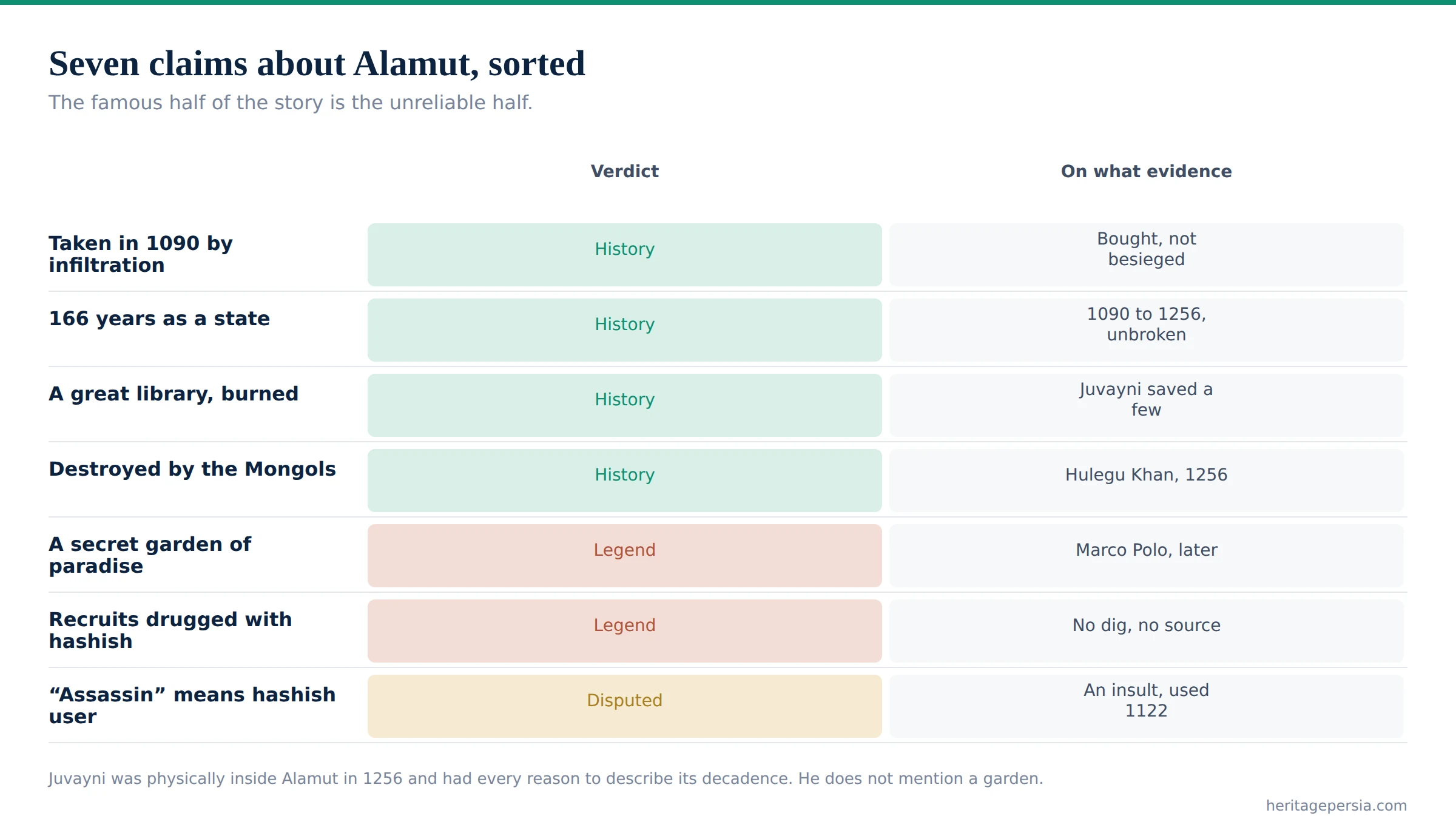
Hassan-i Sabbah took Alamut in 1090, and the manner of it tells you what the next century and a half would look like. He did not besiege it. He sent followers to live in the valley and take service in the castle until enough of the garrison was his, then walked in and presented the lord with a draft for the purchase price. The commander left. Nobody died.
From that rock the Nizari Ismailis ran something that was not quite a state and not quite a movement — a network of mountain fortresses from northern Iran into Syria, holding territory no army could take, surrounded by empires that vastly outnumbered them. Their answer to that asymmetry was the targeted killing of individual commanders and ministers, carried out in public and usually at the cost of the killer’s life, which is the practice that gave the English language a word.
It lasted a hundred and sixty-six years. In 1256 Hulegu Khan arrived with the Mongol army, and Alamut surrendered after a short siege. The fortresses were slighted and the library — which by every account was extraordinary — was burned. The historian Juvayni, who was travelling with the Mongols, was allowed to walk through it first and pick out what he judged worth saving. He saved a few volumes and watched the rest go up.
The Nizaris retook the rock briefly in 1275 and lost it again in 1282, after which it stops mattering. The community itself did not end: the Nizari Ismailis exist today and their imam is the Aga Khan.
The Part That Is Not True
Marco Polo passed through the region a generation after the castle fell and recorded a story he had been told: that the Old Man of the Mountain kept a secret garden of paradise, drugged young men and carried them into it so that they would believe they had seen heaven, then offered to send them back if they killed on command.
It is a wonderful story and there is no evidence for it. Juvayni, who was physically inside Alamut in 1256 and had every reason to describe its decadence, does not mention a garden. The archaeologist Peter Willey, who surveyed the Nizari castles across decades, concluded these were legends. No excavation has found one.
The word has a similar history. Hashishi appears as an insult aimed at the Syrian Nizaris by the Fatimid caliph al-Amir in 1122 — a term of abuse meaning something like rabble, of the sort used about people one considers beneath argument. The nineteenth-century orientalist Silvestre de Sacy connected it to hashish and the drug story hardened into fact. The connection is disputed and most likely wrong.
We put this near the top rather than the bottom because the legend is the reason most visitors come, and it is better to arrive knowing which half of the story the ruins belong to. The real history — a small sect holding a mountain against the Seljuks, the Crusader states and finally the Mongols for six generations — does not need the embellishment.
If you want to read one book: Freya Stark walked these valleys in 1930 and wrote The Valleys of the Assassins, which remains the best account of the landscape and is honest about how little was known. She went largely alone, on a mule, with a bad map.
What There Is to See
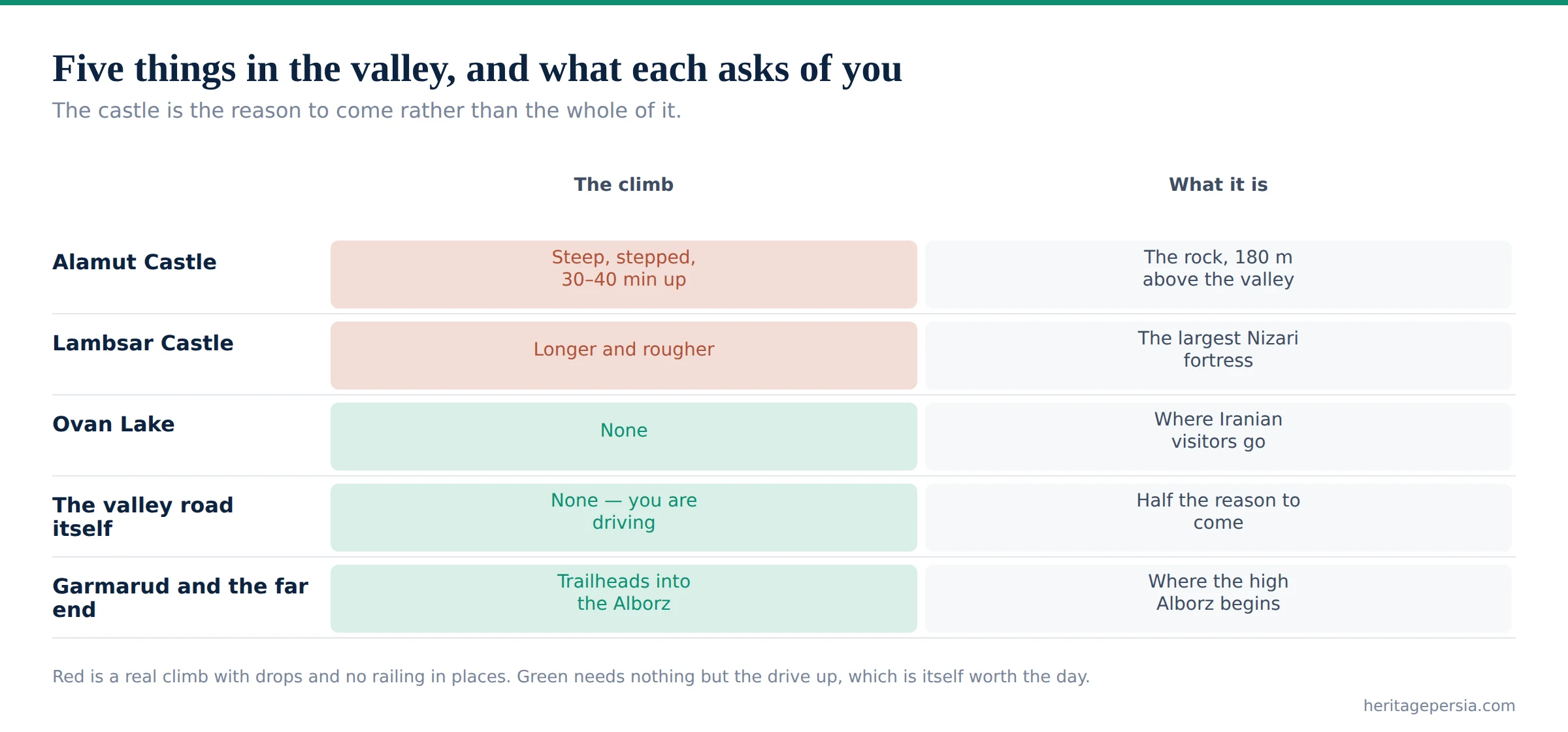
Alamut is a valley rather than a single site, and the castle is the reason to come rather than the whole of it.
| Site | Time | The climb | What it is |
|---|---|---|---|
| Alamut Castle Qal’eh-ye Hasan | 2 hrs | Steep, stepped, about 30–40 min up | The rock itself, standing roughly 180 m above the valley floor. Foundations, cisterns, defensive walls and the view that explains why it was never taken by force |
| Lambsar Castle | 2–3 hrs | Longer and rougher | The largest of the Nizari fortresses and far less visited. For those who want the archaeology rather than the name |
| Ovan Lake Evan | 1 hr | None | A small mountain lake in the valley, and where Iranian visitors go. Picnics rather than solitude at weekends |
| The valley road itself | 2–3 hrs driving | — | Red gorges, cherry and walnut orchards, and villages at 1,800–2,200 m. This is genuinely half the reason to come |
| Garmarud and the far end | Half a day | Trailheads | Where the valley meets the high Alborz and the trekking routes over towards the Caspian begin |
The castle is a ruin and has been restored in parts, with scaffolding present in recent years. Come for the position and the story rather than expecting standing rooms — this is closer to Susa than to a palace.
Getting There
Alamut is about two hours from Qazvin and four to five hours from Tehran by road, and the sensible shapes are a long day trip or an overnight.
| From | How | Shape of the day |
|---|---|---|
| Qazvin | Car with driver, about 2 hrs each way | The standard version. Leave at eight, castle late morning, valley in the afternoon, back for dinner |
| Tehran | 4–5 hrs each way | Possible in a very long day and better as an overnight. Twelve hours of driving for two hours on a rock is a poor trade |
| Staying in the valley | Village guesthouses and eco-lodges | What we would do. The valley at dusk and at first light is the part a day trip misses entirely |
| Public transport | Shared taxis from Qazvin to Gazorkhan | Possible and slow. Fine if you are staying the night; awkward as a day trip |
| On a longer route | Qazvin sits between Tehran and Tabriz | The natural way to include it — a stop on the way northwest rather than an out-and-back |
Qazvin itself is worth the night it costs: a Safavid capital before Isfahan, with a good bazaar and the Chehel Sotoun pavilion. Our getting around guide covers the driver question, which matters more here than on the main corridor.
When to Go
Late April to October, and the shoulder months are the good ones.
The valley sits between roughly 1,800 and 2,200 metres and the passes hold snow well into spring, so winter access is unreliable and sometimes closed outright. May and June are the best of it — orchards in blossom and then in fruit, meltwater in the streams, and the high ridges still white. September and October give you clear air and the walnut harvest. July and August are warm but far cooler than the plains, which is why Tehranis come.
Two practical notes on the season. The climb is exposed and there is no shade on it, so an early start matters in summer. And the valley road is narrow, unfenced in places and shared with agricultural traffic — a driver who works it regularly is worth more here than on any road in the classic corridor.
Practical Notes
The climb is real. Thirty to forty minutes of steep stepped path from the car park to the summit, with drops and no railing in places. Closed shoes, water, and an honest assessment of knees. It is not technical and it is not trivial.
There is very little at the top. Cisterns, foundations, stretches of wall, and an enormous view down the valley. If you arrive expecting a castle in the European sense you will be disappointed; if you arrive understanding that the rock is the fortification, it lands.
Bring lunch. Gazorkhan village at the foot has a few simple places and the valley has teahouses, but nothing is guaranteed to be open midweek out of season.
Signal is patchy through most of the valley. Download maps before you leave Qazvin — the connectivity guide covers what works offline.
It does not fit the classic route, and we would rather say so. Alamut is a two-day addition in the north for travellers who want the Alborz, the history or the walking, and it competes for time with Kashan and Isfahan rather than complementing them. On a fourteen-day trip with the northwest as the added region it makes complete sense; on ten days it does not.
✉️ Thinking about Alamut? Tell us how long you have and we will say honestly whether it fits — and if it does, whether to do it from Qazvin or sleep in the valley. Talk to our team →
Continue reading
Frequently Asked Questions
What travellers ask our guides, answered on the ground.
Does Alamut Fit Your Trip?
Tell us how long you have and we will say honestly whether it does — and how to do it.
See Mountain Routes →