
Booking accommodation in Iran is the first point at which a traveller discovers the country does not work the way the rest of the internet works. Booking.com shows nothing. Airbnb does not operate. Your card is declined by every Iranian site that accepts cards at all. This is not a glitch to route around; it is the shape of the problem, and it changes what you book as well as how.
What follows is every category of bed available to a foreign visitor, with the nightly range we pay as an operator rather than a range copied from an aggregator that cannot see the market. Then the three ways booking actually works, and the handful of rules nobody puts in writing.
Before you plan anything: this is a practical guide to accommodation, written to be useful whenever you are able to use it. Whether to travel to Iran at present is a separate question with a different answer — see our current situation report, reviewed 10 September 2026.
The Booking Problem Comes First
Every other decision on this page follows from one fact: no card issued outside Iran works anywhere inside it, which means no international platform can take your money for an Iranian room. Booking.com, Expedia, Agoda and Airbnb are absent from the market — not restricted, absent. The money guide explains the mechanics; what matters here is the consequence.
The consequence is that accommodation in Iran is either arranged in advance by someone inside the country on your behalf, or paid in cash at the door. There is no third option, and this is why Iranian travel is still an agency market in a way that almost nowhere else is. It is also why the usual traveller instinct — turn up, look at three places, take the best one — works better here than it does in most countries, because you are paying cash at the door anyway.
The one exception is the two-week window in spring and autumn when the courtyard towns genuinely sell out. Kashan and Yazd have a few dozen restored houses between them and April, May and October fill four months ahead. That is the only part of an Iranian itinerary where turning up does not work.
Every Kind of Bed, With What It Costs
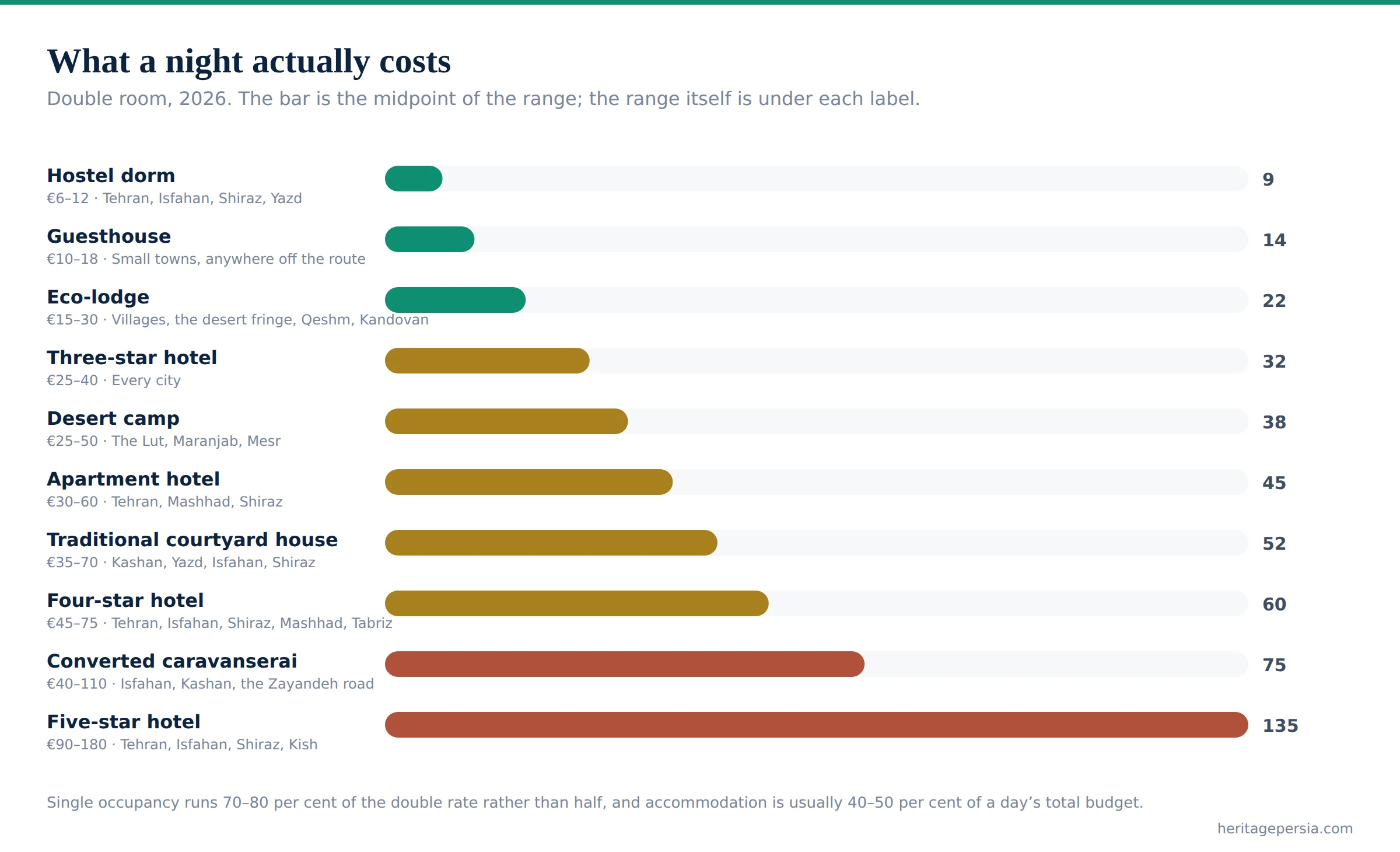
Nightly rates are what we pay as an operator in 2026 for a double room, and they are in euros because rial figures date within weeks. Single occupancy usually runs 70 to 80 per cent of the double rate rather than half.
| Type | Per night | Best in | What you get | What to know |
|---|---|---|---|---|
| Hostel dorm mosaferkhaneh-e javan | €6–12 | Tehran, Isfahan, Shiraz, Yazd | Four to eight beds, shared bathroom, usually a courtyard and a kitchen | A real and growing scene, almost entirely aimed at foreign backpackers. Segregated dorms are the norm |
| Guesthouse mosaferkhaneh | €10–18 | Small towns, anywhere off the route | A private room, often a shared bathroom, no English | The Iranian budget standard. Clean and safe as a rule, and frequently the only thing in town |
| Eco-lodge boumgardi | €15–30 | Villages, the desert fringe, Qeshm, Kandovan | A room in a village house, floor mattresses, two meals usually included | An official Ministry category, not a marketing word. The best value in the country and the one most travellers never try |
| Three-star hotel | €25–40 | Every city | Private bathroom, breakfast, air conditioning, a lift more often than not | The workhorse. Functional rather than charming, and entirely adequate |
| Traditional courtyard house khaneh-ye sonnati | €35–70 | Kashan, Yazd, Isfahan, Shiraz | A restored Qajar merchant house, rooms off a central pool courtyard, breakfast on the terrace | The reason to plan ahead. Rooms vary enormously inside one house — ask which side of the courtyard |
| Four-star hotel | €45–75 | Tehran, Isfahan, Shiraz, Mashhad, Tabriz | A proper restaurant, reliable hot water, a business desk, sometimes a pool | The gap between three and four star is larger here than the one star suggests |
| Desert camp | €25–50 | The Lut, Maranjab, Mesr | A tent or a mud room, dinner, and the sky | Seasonal and limited. October to April only in the Lut, and worth a night of any itinerary |
| Five-star hotel | €90–180 | Tehran, Isfahan, Shiraz, Kish | International standard, mostly. The Abbasi in Isfahan is a converted caravanserai and is its own category | Good value against the equivalent anywhere else, and the only tier where you are paying for the name |
| Converted caravanserai | €40–110 | Isfahan, Kashan, the Zayandeh road | A seventeenth-century trading inn with rooms in the merchants’ cells | A handful exist and they are the most interesting buildings you can sleep in anywhere in the country |
| Apartment hotel hotel apartment | €30–60 | Tehran, Mashhad, Shiraz | A kitchenette and a sitting room, cleaned weekly rather than daily | Built for domestic pilgrim families. Excellent for a group of four and poor value for two |
Breakfast is included almost everywhere above three stars and in every courtyard house. A day’s total budget — bed, food, entries and transport — is in the money guide; accommodation is usually 40 to 50 per cent of it.
The Courtyard House, Which Is the Point
If there is one argument this page is making, it is this one. A restored merchant house is not a more atmospheric version of a hotel room. It is a different building type, and staying in one is the only way to understand the architecture that the rest of your itinerary is made of.
The plan is always the same. Rooms face inward onto a rectangular courtyard with a pool and trees, sunk a metre or two below street level so the air sits cooler. The north-facing side is the summer range, deep and shaded; the south-facing side is the winter range, shallow and glazed to catch low sun. A wind tower pulls air down across the water. None of this is decoration — it is a climate machine, and you feel it working when you walk in from a forty-degree street into a courtyard that is fifteen degrees cooler with no mechanism running.
The practical consequence is that rooms in the same house are not equivalent, and the price often does not distinguish them. A summer-range room in January is cold and dark. A winter-range room in June is the wrong side of the courtyard. Ask which side you are on and in which month, and any decent house will move you.
Kashan is where this style began. The great Qajar merchant houses — Tabatabaei, Borujerdi, Ameri — are in Kashan, and several of the second-rank houses in the same quarter are now hotels. Yazd does the type at greater scale and with better rooftops; Yazd is where we would spend the second night of this kind if you only take two.
How Booking Actually Works
Three routes, and which one suits you is mostly a question of how much of the trip is already fixed.
| Route | How it works | Costs | Suits |
|---|---|---|---|
| Through an agency | An Iranian operator books and pays in rial; you settle in cash on arrival or by transfer before you fly | Usually the same rate or better, because agencies hold contracted rates | Fixed dates, the courtyard towns, anything in April, May or October |
| Cash at the door | Walk in, look at the room, agree a price, pay in rial | The lowest rate available, and it is negotiable off-season | Independent travel outside the peak weeks, small towns, hostels and guesthouses |
| An Iranian platform | Domestic sites take Iranian cards only, so somebody inside the country has to pay for you | Domestic rates, which are the lowest of the three | Travellers with a friend or a fixer in Iran, and nobody else |
A tourist debit card loaded with euros at the airport can pay some hotels directly — the money guide covers what it does and does not reach. Do not assume it reaches a guesthouse in a village.
Deposits are unusual, cancellation is informal, and a booking made by an agency is generally held on the agency’s word rather than on your card. That cuts both ways: it is easy to change plans, and it is also true that a room held for you on a phone call is a room held on a phone call.
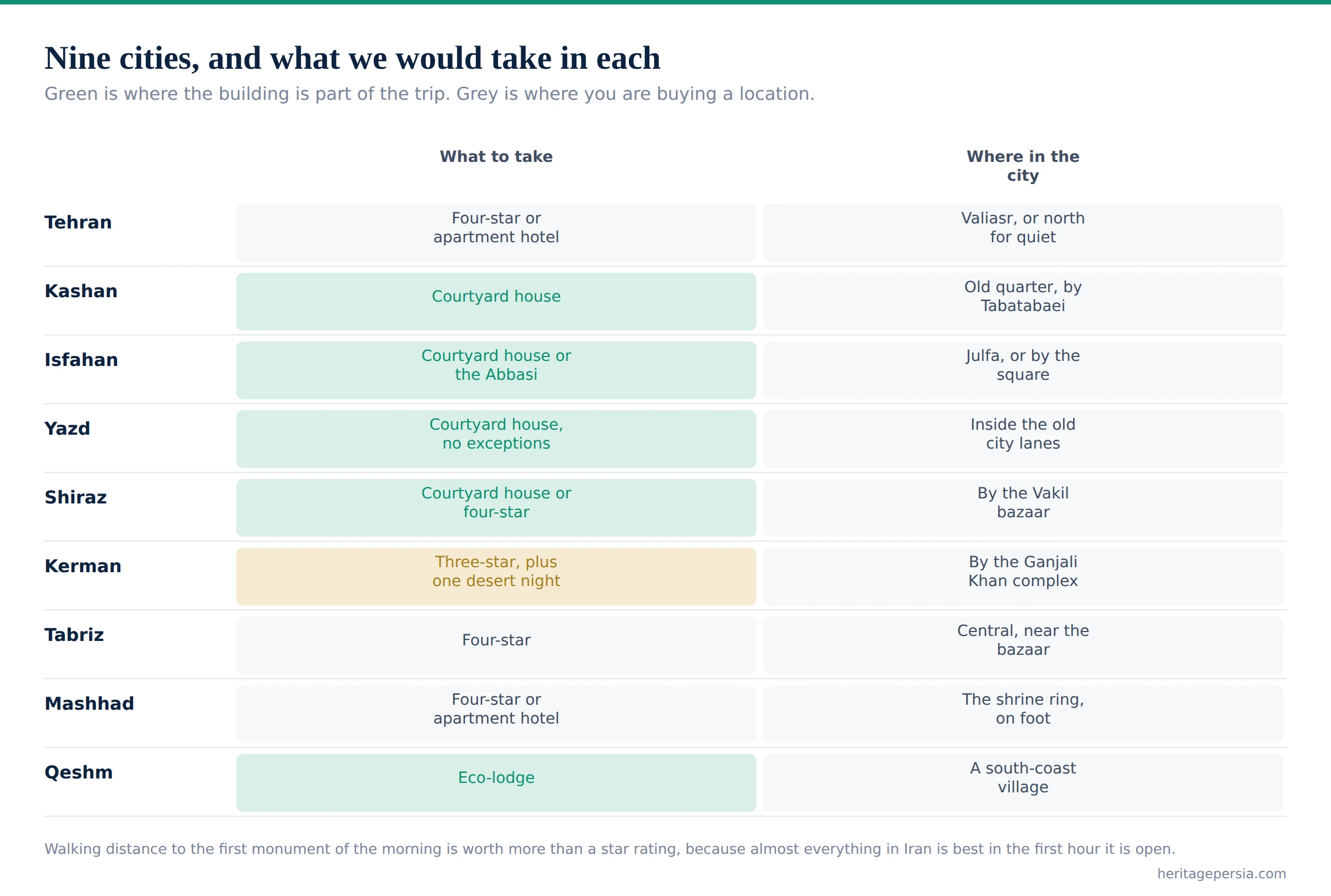
City by City, What We Would Take
| City | Take | Where | Why |
|---|---|---|---|
| Tehran | Four-star or apartment hotel | Around Valiasr, or the north for quiet | Charm is not on offer here. Buy location and a working lift, and spend the money elsewhere |
| Kashan | Courtyard house | The old quarter near the Tabatabaei House | This is where the type began and the town has more of them per street than anywhere in Iran |
| Isfahan | Courtyard house or the Abbasi | Julfa for evenings, near the square for the monuments | The only city where the five-star is a genuine sight in itself. Julfa if you want cafés and a walk home after dinner |
| Yazd | Courtyard house, no exceptions | Inside the old city, within the lanes | Yazd does this better than any city in Iran, and the rooftop at sunset is half of what you came for |
| Shiraz | Courtyard house or four-star | Near the Vakil bazaar and Zand street | Walkable to the bazaar, the Pink Mosque and Shah Cheragh, which is most of the city’s early-morning list |
| Kerman | Three-star, plus one desert night | Near the Ganjali Khan complex | The town is a base rather than a destination. Spend the accommodation budget on the night in the Lut instead |
| Tabriz | Four-star | Central, near the bazaar | Few traditional houses have been converted here. Take comfort and use the money on the day trips |
| Mashhad | Four-star or apartment hotel | The shrine ring, within walking distance | Twenty million pilgrims a year means enormous supply and real prices. Walking distance to the shrine is the only criterion |
| Qeshm | Eco-lodge | A village on the south coast | The island’s hotels are dull and its village lodges are not. This is the clearest case in the country |
Whichever city you are in, walking distance to the first monument of the morning is worth more than a star rating, because almost everything in Iran is best in the first hour it is open.
The Rules Nobody Writes Down
Your passport is taken at check-in and held while it is registered, usually for an hour. This is normal and universal, and it is why the passport goes in the safe rather than the day bag afterwards.
Unmarried foreign couples share rooms without difficulty in practice. Iranian law restricts unrelated men and women being alone together and hotels apply that to Iranian guests, who are asked for a marriage document. Foreign visitors are not generally asked. If one of you holds an Iranian passport as well, carry a marriage certificate — that is the case where it is asked.
A woman travelling alone checks in alone, with no male relative, no permission and no documentation beyond a passport. There is no mahram requirement in Iran and there never has been; the idea is imported from somewhere else. Our solo female travel guide covers this properly.
No alcohol is sold or served anywhere, including the five-star hotels, and bringing your own into a hotel is a bad idea rather than a discreet one.
Breakfast is Iranian, which means flatbread, feta, walnuts, honey, cucumber, tomato and tea, with eggs to order in the better places. It is a good breakfast and it is the same one everywhere.
Shoes come off on carpeted floors in traditional houses and always in a village lodge. Slip-ons rather than laces, for the whole trip and not only for the mosques.
Eco-Lodges, and Why We Push Them
The boumgardi is an official Ministry of Cultural Heritage category rather than a marketing term, created to license village households to take paying guests. There are now well over two thousand of them, concentrated in the desert villages, the Zagros, the Caspian forest and the Gulf islands.
What you get is a room in a family house — floor mattresses rather than beds, a shared bathroom, dinner and breakfast cooked by the household — for fifteen to thirty euros. What you actually get is the only accommodation in Iran where the building and the meal and the conversation are the same thing, and it is the category most likely to be the part of the trip a traveller talks about afterwards.
The honest caveats: no English in most of them, floor sleeping that not every back tolerates, and a bathroom down a courtyard in winter. None of that is a reason to skip all of them. One night in a lodge inside a two-week trip is a decision we have never seen regretted.
What We Would Not Book
Anything sight-unseen in the €15–25 band in a big city. That is the range where the photographs and the room diverge most, and it is also the range where walking in and looking costs you nothing.
Couchsurfing and informal home stays. Hosts are required to register foreign guests, and an unregistered stay creates a problem for the household rather than for you. The hospitality is real and the invitations are genuine; accept the dinner and sleep at the hotel.
A five-star in a town that has no four-star. The rating is domestic and a provincial five-star is frequently a city three-star with a larger lobby.
Anything booked through a site that took your international card. If the payment went through, something unusual has happened — verify the reservation directly before you fly.
When to Book, and How Far Ahead
| What | Lead time | Why |
|---|---|---|
| Courtyard houses, Apr/May/Oct | 4–5 months | Kashan and Yazd have a few dozen houses between them and they fill first |
| Courtyard houses, other months | 3–6 weeks | Comfortable, and you can still choose your side of the courtyard |
| Anything over Nowruz | 5–6 months | Domestic travel peaks and rates roughly double. This is the hardest fortnight of the year |
| City hotels, normal weeks | 1–2 weeks, or walk in | Supply is ample everywhere except the two peak windows |
| Desert camps | 6–8 weeks | Few operators, small capacity, and October to April only |
| Mashhad during pilgrimage peaks | 2–3 months | Twenty million visitors a year arrive in waves rather than evenly |
Everything here moves with the calendar rather than with demand from foreign visitors, which is a small fraction of the market. Read the month-by-month guide before fixing dates, not after.
✉️ Want the courtyard houses held before they go? Tell us your dates and cities and we will say which towns are tight in that month and which rooms we would take in each house. Talk to our team →
Continue reading
Frequently Asked Questions
What travellers ask our guides, answered on the ground.
The Rooms Worth Holding
Tell us your dates and we will say which towns are tight that month and which room we would take.
See Traditional Hotels →