
Ten days is the length most people have and the length most itineraries handle badly. The published ones tend to do one of two things — cram in eleven cities and hand you a coach schedule, or list five destinations with no distances at all, as though Yazd and Shiraz were adjacent.
The route below is the one we actually run. It has five bases, about 1,100 kilometres of driving, every major UNESCO site on the central corridor, and one genuinely hard day that we have flagged rather than hidden. It also has a section on what ten days cannot include, because a guide that pretends otherwise is selling you a disappointment.
Before you book anything: this is a route plan, written to be useful whenever you are able to use it. Whether to travel to Iran at present is a separate question with a different answer — see our current situation report, reviewed 10 September 2026.
Four Rules That Make a Ten-Day Trip Work
Before the day-by-day, the decisions that matter more than which sites you pick.
Fly into one city and out of another. Tehran in, Shiraz out. A return ticket to Tehran costs you a full day driving or flying back up the country, and a day is ten per cent of this trip. Open-jaw tickets on the same airline usually cost little or nothing extra.
Count half days honestly. Most flights from Europe land at Imam Khomeini between two and five in the morning. Day one is a shower and a sleep, and day ten ends at an airport. You have eight real days, and an itinerary built on ten will run late from the first morning.
Move in the morning, arrive by mid-afternoon. Every drive on this route is between three and five hours. Leaving after breakfast means you arrive while the light is still good and get an evening in the new city rather than a hotel check-in in the dark.
Three nights in one place beats three cities. The single most common regret we hear is not having stayed longer in Isfahan. If something has to give, cut Tehran rather than a night on the plateau.
The Ten Days, With Every Distance
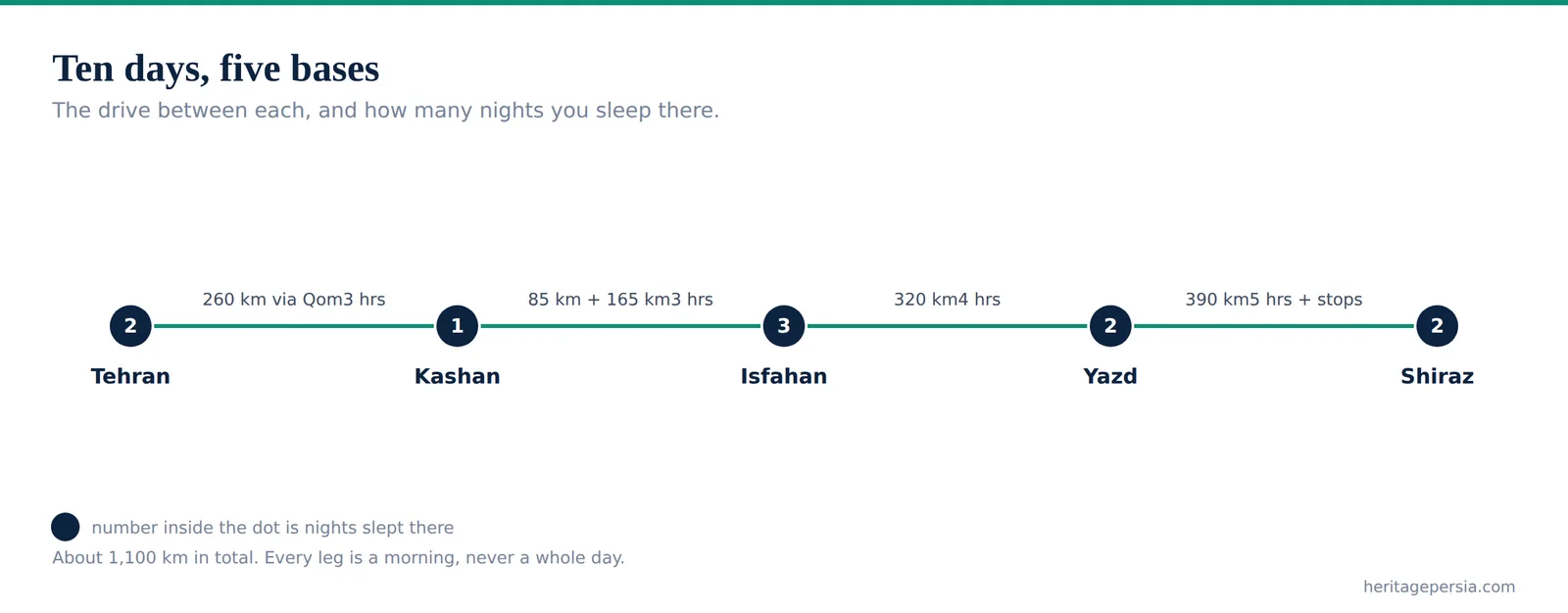
This is the table to plan against. Drive times are realistic door-to-door figures including a stop, not optimistic map estimates.
| Day | Sleep in | Leg & drive | What you do | Book ahead |
|---|---|---|---|---|
| Day 1Arrive in Tehran | Tehran | IKA airport → city45–90 min | Land, transfer, sleep. Most flights from Europe arrive before dawn, so treat this as a half day and do nothing ambitious with it. | Airport transfer |
| Day 2Tehran | Tehran | —— | National Museum for the Achaemenid context you will need all week, then the Golestan Palace and the Grand Bazaar. Finish at a rooftop looking at the Alborz. | — |
| Day 3Tehran → Kashan | Kashan | 260 km via Qom3 hrs | Drive south in the morning. Kashan in the afternoon: the Fin Garden, and one of the great merchant houses — Tabatabaei or Borujerdi, not all three. | Traditional hotel |
| Day 4Kashan → Abyaneh → Isfahan | Isfahan | 85 km + 165 km3 hrs | Abyaneh, the red-mud village on the mountainside, mid-morning. Into Isfahan by late afternoon, and walk out to Naqsh-e Jahan after dark for the first sight of it lit. | Isfahan hotel |
| Day 5Isfahan — the square | Isfahan | —— | Imam Mosque at 08:00, Sheikh Lotfollah at 11:00 for the light, lunch, Ali Qapu terrace at 16:00, the bazaar until it closes. | — |
| Day 6Isfahan — the rest of it | Isfahan | —— | Masjed-e Jāmé at 09:00, the old city, Chehel Sotoun after lunch, Vank Cathedral and the Armenian quarter, dinner in Julfa, Khaju Bridge after dark. | — |
| Day 7Isfahan → Yazd | Yazd | 320 km4 hrs | Leave after breakfast, stop at Na'in or Meybod on the way, arrive in Yazd mid-afternoon. First walk through the old city as the heat drops. | Traditional hotel |
| Day 8Yazd | Yazd | —— | Towers of Silence at first light, the Friday Mosque and the Zoroastrian fire temple, the wind-tower rooftops, and a night out in the desert if you want one. | Desert night |
| Day 9Yazd → Persepolis → Shiraz | Shiraz | 390 km5 hrs + stops | The long day. Leave at seven, reach Persepolis by midday, Naqsh-e Rostam after it, and arrive in Shiraz for dinner. | Driver & guide |
| Day 10Shiraz, then home | Shiraz | City → airport20 min | Nasir al-Mulk at 07:30 while the light lasts, the Vakil bazaar, Hafez's tomb if your flight is late enough. Fly from Shiraz or up to Tehran. | Onward flight |
Total driving is about 1,100 km across four travel days. Distances are road distances; the Yazd to Shiraz leg is quoted via Persepolis rather than direct.
Day Nine, and Why We Flag It
Every honest ten-day Iran itinerary has one uncomfortable day, and this is ours. You leave Yazd at seven, drive about four hours across the plain, walk Persepolis in the middle of the day, add Naqsh-e Rostam thirteen kilometres further on, and reach Shiraz in time for a late dinner. It is a genuinely long day and there is no way to avoid it inside ten days without dropping something.
Two ways to soften it. The first is to give up Naqsh-e Rostam, which we would not do — four Achaemenid kings cut into a cliff with Roman emperors kneeling beneath them is not the thing to cut. The second is to add Pasargadae and accept a ten-hour day, which is what we do for travellers whose interest is really the Achaemenids; it sits on the road between Yazd and Persepolis, so it costs about ninety minutes rather than a detour.
💡 What our guides do on day nine: a proper breakfast in Yazd, then straight through with one stop for tea. Persepolis at midday is hot and shadeless but the alternative is arriving at four when the site closes. Take hats, take more water than you think, and plan a slow morning in Shiraz on day ten to recover.
Three Versions of the Same Ten Days
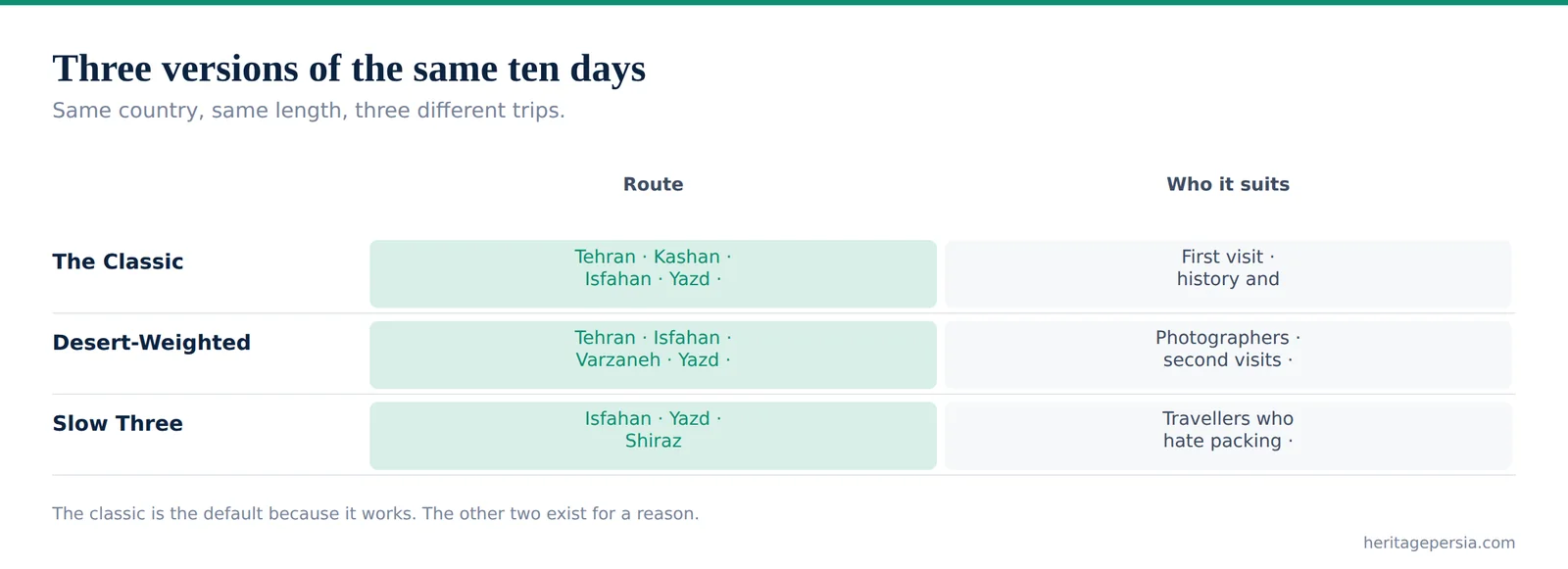
The classic route suits a first visit. These two do not, and they are the ones we build more often than people expect.
| Version | Route | What changes | Who it suits |
|---|---|---|---|
| The Classic | Tehran · Kashan · Isfahan · Yazd · Shiraz | The route above. Five bases, about 1,100 km of driving, and every UNESCO site on the central corridor. | First visit · history and architecture |
| Desert-Weighted | Tehran · Isfahan · Varzaneh · Yazd · Kharanaq · Shiraz | Trade one Tehran day and the Kashan night for two desert nights — Varzaneh's dunes and salt lake, and the abandoned mud village of Kharanaq. | Photographers · second visits · anyone who wants silence |
| Slow Three | Isfahan · Yazd · Shiraz | Fly into Isfahan or Tehran and out of Shiraz, three bases only, three nights in each. Half the driving and twice the depth. | Travellers who hate packing · families · returning visitors |
The Slow Three deserves a word. Travellers resist it because it looks like less, and the ones who choose it consistently report the best trips. Three nights in Isfahan means the Friday Mosque on a quiet morning and a workshop visit in the afternoon rather than a march between monuments. If you have been to Iran before, or you travel with children, or you simply dislike packing, this is the version to take.
What Ten Days Cannot Include
Iran is the size of Western Europe. The central corridor from Tehran to Shiraz is roughly the distance from Amsterdam to Milan, and it is one of four or five distinct countries inside the borders. Here is what you are leaving out, so that you leave it out deliberately.
- Tabriz and the northwest
- Two days minimum from the classic corridor, and a different country in feel. Needs its own trip or a 14-day plan.
- The Caspian coast
- Rasht and Masuleh are a full day north of Tehran through the mountains. Beautiful, wet, and impossible to bolt on.
- The Gulf islands
- Qeshm and Hormuz are a flight south and a minimum of three nights to be worth it.
- Mashhad
- Twelve hours by road or a flight, and a pilgrimage city that deserves proper time rather than a stopover.
- Kerman and the Lut Desert
- Two days beyond Yazd, for the UNESCO desert and the garden at Mahan. A second-visit region.
- The Sassanid sites of Fars
- Firuzabad and Sarvestan need a full day from Shiraz. The first thing we add when a trip stretches to twelve days.
None of this is a reason to stay home. It is a reason to plan the trip you can actually take, and to know before you go that Iran will need a second visit — which, in our experience, about a third of our clients end up making.
What to Book Ahead, and When
Very little needs booking far in advance, with three exceptions that catch people out.
- Your visa comes first and its lead time depends entirely on your passport — one to three working days for most nationalities, six to eight weeks if you hold a US, UK or Canadian passport, which also requires a guided itinerary. Read the visa guide before you book flights, not after.
- Traditional hotels in Kashan and Yazd are converted courtyard houses with eight or ten rooms. The good ones fill months ahead in April, May and October. This is the single most common booking failure on this route.
- Nowruz, 20 March to 2 April. The entire country travels. Book three to four months ahead or choose different dates.
- Domestic flights and intercity buses can be arranged a few days out in most seasons — see flights and bus tickets.
- Nothing else. Restaurants do not take reservations, sites do not sell timed tickets, and a driver can be arranged the evening before.
What a Ten-Day Trip Costs
Iran is inexpensive by European or East Asian standards and the shape of the bill surprises people. Accommodation and food are very cheap; the two real costs are your international flight and a private car with driver, which on this route is the difference between a trip and a series of bus stations.
Everything inside the country is a cash business, because no foreign bank card works anywhere in Iran — not in hotels, not in restaurants, not at cash machines. Bring the full budget in euros or dollars in cash and change it as you go. Our note on paying for things in Iran covers the mechanics, and it is the single most important practical page on this site for a first-time visitor.
When to Run This Route
April and May, October and early November. The plateau cities in this itinerary sit between 1,200 and 1,600 metres, which produces hot dry summers and cold nights in winter — Yazd averages 26–40°C in July, and Isfahan drops below freezing on January nights. Both extremes are travellable with adjustment, and neither is the trip you are imagining.
Two dates to plan around rather than into: Nowruz from 20 March, when domestic travel peaks and prices with it, and the month of Muharram, when the mood of the country changes and music venues close. Both are extraordinary to witness if you go deliberately. Our month-by-month guide sets out temperatures for nine cities and the crowd pattern across the year.
Packing for This Route Specifically
The itinerary crosses a 1,600-metre plateau, a desert and a warmer southern city in ten days, which means layers rather than a single climate's worth of clothes. Nights in Yazd and Isfahan are cold from October to April even when the days are warm. Add a scarf for women — required at religious sites throughout, and the shrines at Shiraz lend a chador at the door. Our dress code guide has the setting-by-setting detail and a seasonal packing table.
✉️ Want this route built around your dates? Send us your arrival and departure days and what you care about most — ruins, gardens, craft workshops, desert nights — and we will send back a day-by-day plan with the hotels named and the drives timed, including the parts we would cut. Talk to our team →
Continue reading
Frequently Asked Questions
The planning questions we answer by email every week.
Have This Route Built Around Your Dates
Send your arrival and departure days. We send back the ten days timed, the hotels named, and the parts we would cut.
See Our Itineraries →