
Most people who visit Iran on a standard route see five UNESCO World Heritage gardens and do not realise it, because the nine Persian Gardens are inscribed as one property rather than nine and nobody tells you which ones they are.
That is the useful thing about this page. Not that the Persian garden is beautiful, which you will work out unaided, but that it is a single designed object repeated across the country for twenty-five centuries, and that recognising the repetition changes what you are looking at. Fin in Kashan and Shazdeh in Mahan are eighteen hundred kilometres and two hundred years apart, and they are the same garden.
Before you plan anything: this is a site guide, written to be useful whenever you are able to use it. Whether to travel to Iran at present is a separate question with a different answer — see our current situation report, reviewed 10 September 2026.
All Nine, and Whether You Will See Them
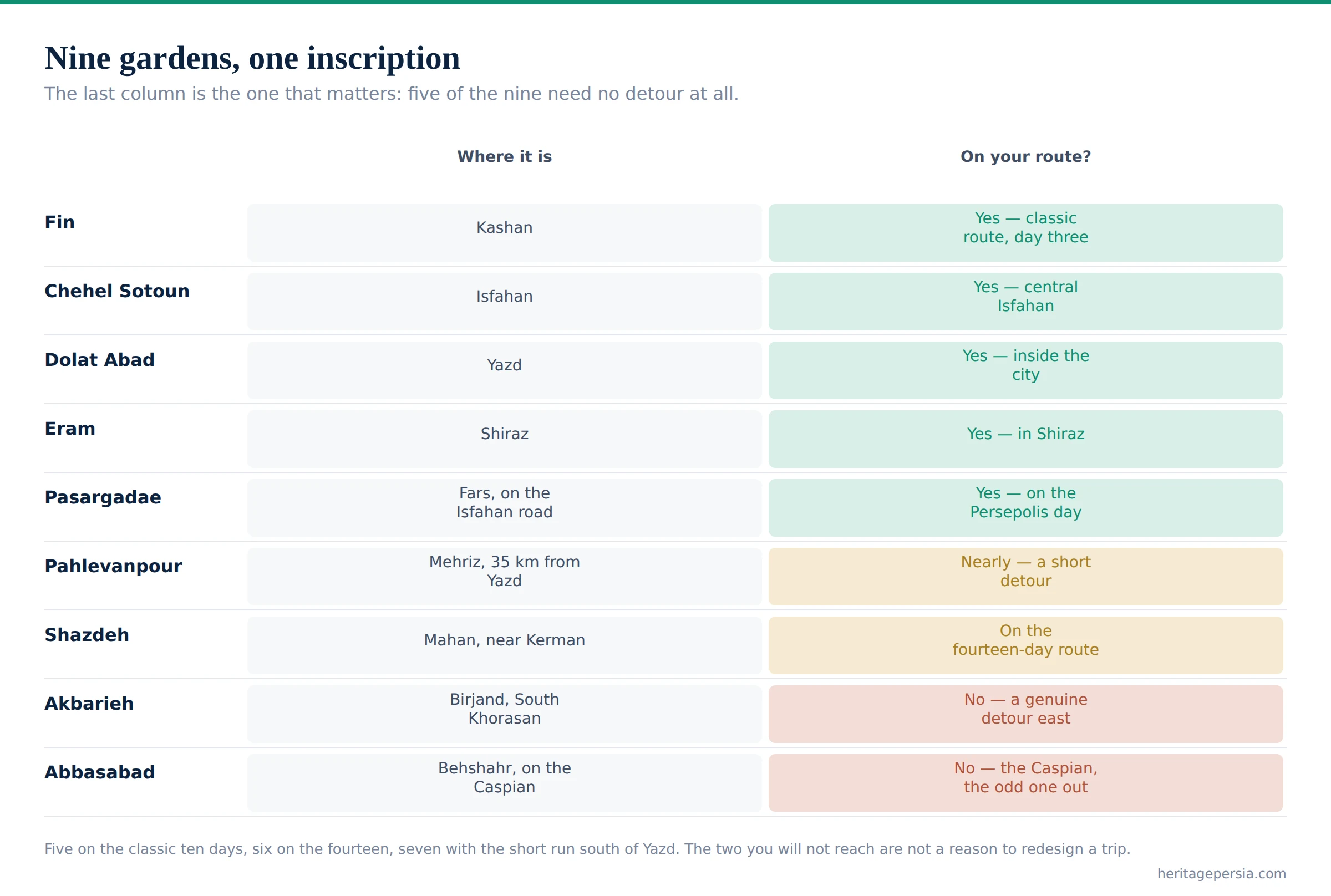
The last column is the one that matters, because it turns a list of monuments into a decision about your itinerary.
| Garden | Where | Period | Time | On your route? |
|---|---|---|---|---|
| Fin Bagh-e Fin | Kashan | Safavid, rebuilt Qajar | 75 min | Yes — on the classic route, day three |
| Chehel Sotoun Forty Columns | Isfahan | Safavid, 17th c. | 60 min | Yes — in the centre of Isfahan |
| Dolat Abad tallest badgir in Iran | Yazd | Zand, 18th c. | 45 min | Yes — inside the city |
| Eram Bagh-e Eram | Shiraz | Qajar | 60 min | Yes — in Shiraz |
| Pasargadae the first of them all | Fars, on the Isfahan road | Achaemenid, c. 540 BC | 30 min | Yes — on the Persepolis day, if the day holds |
| Pahlevanpour | Mehriz, 35 km south of Yazd | Qajar | 45 min | Nearly — a short detour from Yazd |
| Shazdeh the Prince’s Garden | Mahan, near Kerman | Qajar, 1850s | 90 min | On the fourteen-day route, not the ten |
| Akbarieh | Birjand, South Khorasan | Qajar | 45 min | No — a genuine detour east |
| Abbasabad | Behshahr, Mazandaran | Safavid, 17th c. | 60 min | No — the Caspian, and the odd one out |
Five on the classic ten days, six on the fourteen, seven if you take the short run to Mehriz. The two you will not reach are in Birjand and on the Caspian, and neither is a reason to redesign a trip.
What You Are Actually Looking At
The Persian garden is one design, and once you can see it you cannot stop seeing it.
Four quarters. The chahar bagh — literally four gardens — divides a walled rectangle into quadrants with water channels along the axes. UNESCO’s citation puts it plainly: the garden is always divided into four sectors, with water playing a role in both irrigation and ornament, and it was conceived to symbolise Eden. The four quarters have been read as the four elements and the four rivers of paradise, and the reading is old enough to be part of the thing rather than an interpretation of it.
A pavilion on the long axis. Usually at one end, sometimes in the middle, and always positioned so that the water runs towards you as you sit in it. Chehel Sotoun is the demonstration case: twenty columns reflected in a long pool to make forty, which is where the name comes from.
Water that arrives from somewhere else. This is the part visitors miss. These are gardens in a desert, and the water is delivered by qanat — a tunnel cut from an aquifer in the hills, running underground for kilometres at a gradient of a metre or two per thousand, emerging exactly where the garden needs it. The garden is the visible end of a piece of hydraulic engineering that is mostly invisible, and the qanat system is itself a separate UNESCO inscription.
Shade, and the sound of water. Cypress and plane for structure, fruit trees for the quarters, and a channel narrow enough to be audible. In a country where summer runs to forty degrees, the garden is a climate device before it is an aesthetic one — the same logic as the courtyard houses in Kashan and Yazd, at a larger scale.
The test that makes it click: stand at the pavilion end and look down the main axis. If the far wall is lower than you expect and the garden seems to run downhill, that is deliberate — the fall is what moves the water, and almost every Persian garden is built on a slope you were not meant to notice.
Twenty-Five Centuries of the Same Idea
The chronology is the reason the inscription covers nine gardens rather than one.
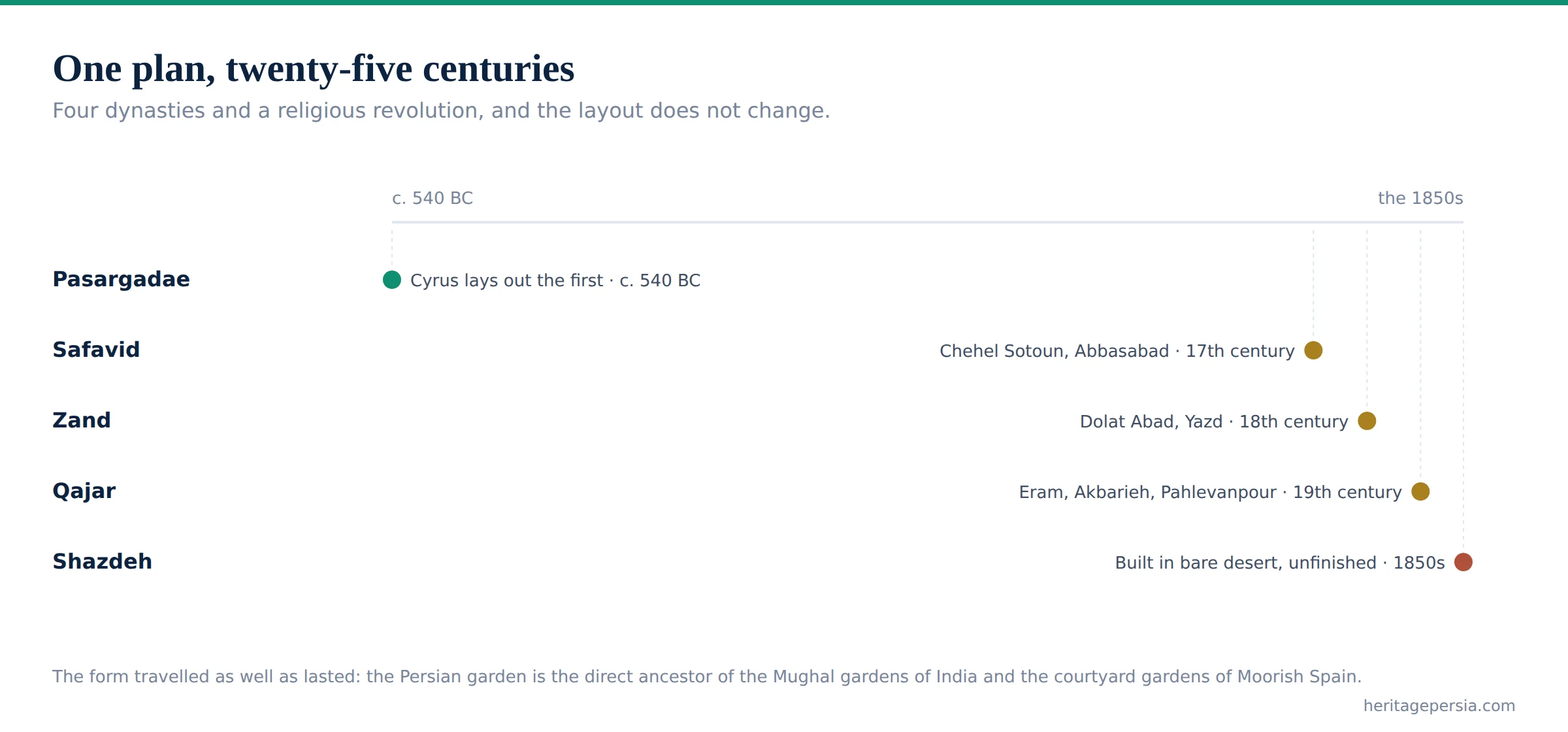
Pasargadae, around 540 BC. Cyrus laid out a walled royal garden with stone water channels and pavilions on the axes, and the ground plan is still legible. It is the oldest surviving example of the form anywhere and the reason the garden is dated from the Achaemenid period rather than the Islamic one.
Safavid, seventeenth century. The imperial version. Chehel Sotoun in Isfahan and Abbasabad on the Caspian belong to the period when the garden became a setting for the state — receptions, audiences, the paintings on the pavilion walls that show them happening.
Zand and Qajar, eighteenth and nineteenth. The domestic and provincial flowering — Eram, Dolat Abad, Akbarieh, Pahlevanpour, and Shazdeh in the 1850s, built by a governor in the desert outside Mahan and, according to the story, never finished because he died first. Shazdeh is the one that makes the point about water most vividly, because you come over a rise in bare desert and there it is, terraced and green and entirely improbable.
What is remarkable is the continuity. Twenty-five centuries, four dynasties and a religious revolution, and the plan does not change. The form travelled too: the Persian garden is the direct ancestor of the Mughal gardens of India, of the Taj Mahal’s setting, and of the courtyard gardens of Moorish Spain.
Which Ones Are Actually Worth Your Time
They are not equal, and an honest guide says so.
Shazdeh is the best of them, and it is the hardest to reach. Terraced down a desert slope outside Mahan with water falling the whole length, and the contrast with the ground around it is the entire argument for the Persian garden in one view. Worth the detour from Kerman; it is on our fourteen-day route for this reason.
Chehel Sotoun is the most refined, and the pavilion paintings are worth as long as the garden. It is also five minutes from Naqsh-e Jahan, so there is no argument against it.
Fin is the most complete, with its qanat still running visibly through the garden, a Safavid bath house, and the darkest story — Amir Kabir, the reforming chancellor, was murdered in that bath house in 1852, and the room is shown.
Dolat Abad is the most useful, because it carries the tallest wind tower in Iran at about thirty-three metres and demonstrates in one building what the whole of Yazd is doing.
Eram is the prettiest and the least interesting, which is a defensible thing to say. It is a lovely Qajar garden attached to a university botanical collection, it is full of roses in April, and it will not teach you anything the others have not.
Pasargadae is a plan rather than a garden. Go for Cyrus’s tomb and read the garden as an outline in the ground, which is what it is — and knowing it is the origin of the other eight is most of the pleasure.
When to Go, and at What Hour
These are gardens, so the season matters more than for the architecture around them.
April and May are the peak — roses in Eram and Fin, everything in leaf, water at its fullest after the winter rains. Late September to early November is the second window, with the plane trees turning and fewer people. Winter is bare and often beautiful, particularly Shazdeh under snow, and the pools are frequently drained. July and August are the point: the gardens are the only comfortable place in a forty-degree city, which is precisely what they were built for, and a Persian garden at four in the afternoon in August is an argument you will not need explained.
The hour is late afternoon, without much competition. The light rakes along the water channels, the heat drops, and Iranian families arrive with picnics — which is the garden being used as intended rather than viewed as a monument. Our month-by-month guide has the climate figures city by city.
Practical Notes
| Question | Answer |
|---|---|
| Are they one ticket? | No. The inscription is a single UNESCO property but the gardens are separately owned and separately ticketed, in different cities |
| How long for each? | 45 to 90 minutes. Shazdeh deserves the longest; Pasargadae’s garden is 30 minutes on top of the tomb |
| Hours | Roughly 08:00 or 09:00 to sunset, extended in summer. They stay open later than museums, which is part of why late afternoon works |
| Entry | Modest and set in rial, so treat any euro figure as approximate — see the money guide |
| Shade | Abundant, unlike almost every other site in Iran. A garden is the right place to put the hot part of a summer day |
| Dress | Standard Iranian code, with no additional requirement — see what to wear |
| The other UNESCO sites | The qanat system that feeds them is separately inscribed. Our guide to all thirty has the full list |
If you are collecting UNESCO inscriptions rather than gardens, note that the Persian Garden counts once however many of the nine you visit — which is either a relief or a disappointment depending on how you travel.
✉️ Want the gardens threaded through your route? Tell us your itinerary and we will say which of the nine it already passes, which needs an hour’s detour, and which to see at what time of day. Talk to our team →
Continue reading
Frequently Asked Questions
What travellers ask our guides, answered on the ground.
The Gardens, Threaded Through Your Route
Tell us your itinerary and we will say which of the nine it already passes and which needs an hour.
See All Destinations →