
A spring rises inside a hill in the mountains of West Azerbaijan and has been rising for so long that the minerals it carries have built the hill underneath it. The result is an oval platform sixty metres above the plain with a deep lake at its centre — and on that platform the Sasanians put the principal fire temple of their state religion.
Takht-e Soleyman is the grandest Zoroastrian site in Iran and one of the least visited World Heritage properties in the country. Getting there is the whole reason for that, and this page is about whether the detour is worth it.
Before you plan anything: this is a destination guide, written to be useful whenever you are able to use it. Whether to travel to Iran at present is a separate question with a different answer — see our current situation report, reviewed 12 September 2026.
The Lake Built the Hill
Start with the geology, because everything else here follows from it.
An artesian spring — water under pressure from below — surfaces at this spot and has done for a very long time. The water is saturated with dissolved minerals, and as it overflows and evaporates it leaves them behind. Over millennia those deposits built upward and outward until the spring found itself at the top of a mound of its own making, with a deep pool of clear, still, faintly mineral water at the centre.
That is a rare enough thing anywhere. To an Iranian religion in which water and fire are the two sacred elements, a bottomless pool on a hill that made itself was not a curiosity but a site, and it is why the Sasanians built their state sanctuary here rather than somewhere convenient.
The lake is about a hundred metres across and its depth has been reported at over sixty. Local names for the site — the Throne of Solomon, and the Prison of Solomon for the volcanic crater nearby — arrived much later and have nothing to do with either the geology or the Sasanians.
What Is on the Platform
| Element | What it is | Period | Time | Note |
|---|---|---|---|---|
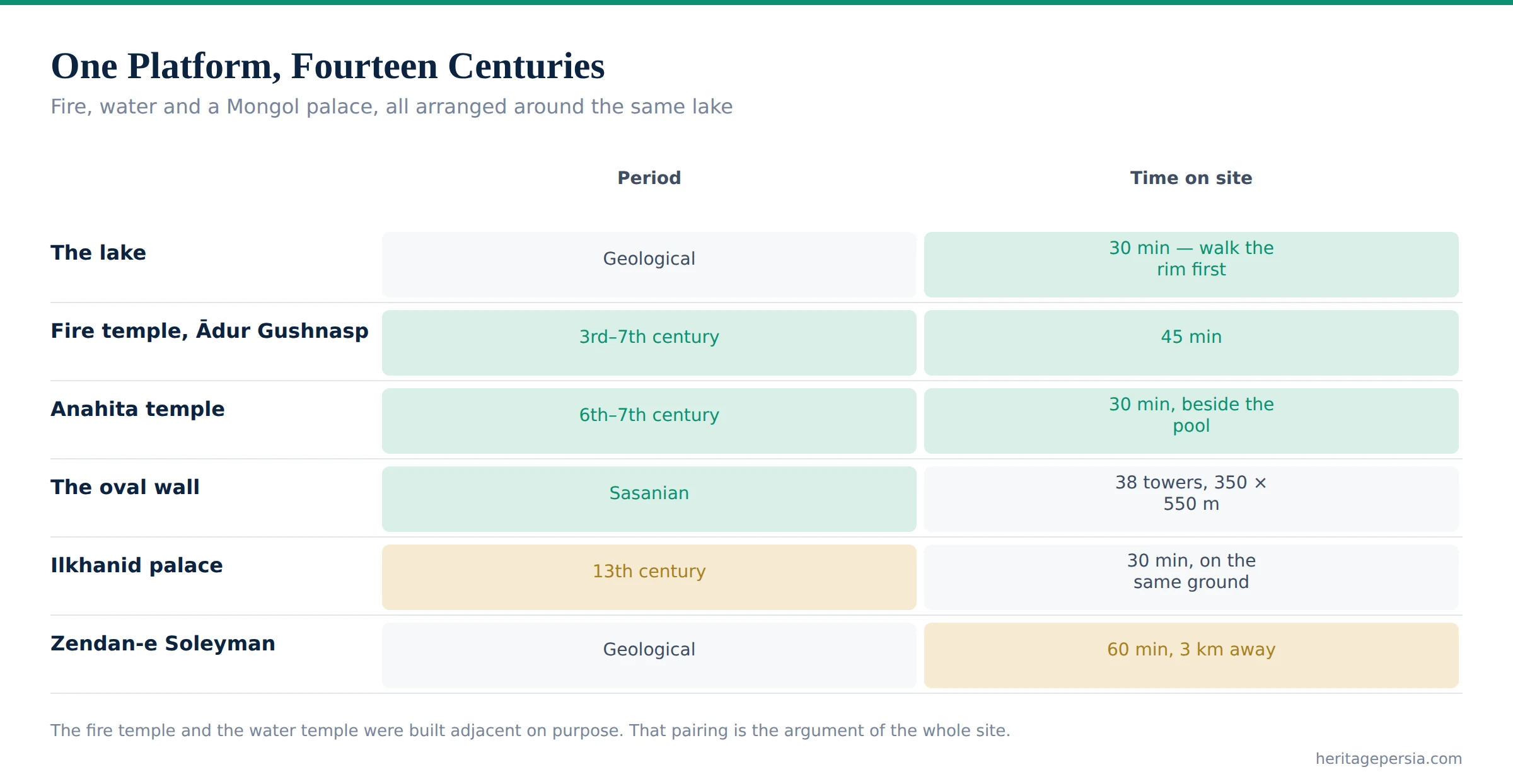
| The lake | An artesian pool at the centre of the platform, its own mineral deposits beneath it | Geological | 30 min | Walk the rim first. Everything on site is arranged around it |
| The fire temple Ādur Gushnasp | The principal sanctuary of the Sasanian state religion, one of three great royal fires | 3rd–7th c. | 45 min | The chamber is identifiable; the fire itself has been out since the 7th century |
| The Anahita temple | A companion sanctuary to the divinity of water, beside the pool that justified it | 6th–7th c. | 30 min | Fire and water, deliberately adjacent. This is the argument of the whole site |
| The oval wall | A fortified enclosure with thirty-eight towers around the platform | Sasanian | Within the walk | 350 by 550 metres, and the reason the site reads as a citadel |
| The Ilkhanid palace | A Mongol summer residence built into the ruins in the 13th century | Ilkhanid | 30 min | Six centuries after the Sasanians, and on the same platform. Continuity, not coincidence |
| Zendan-e Soleyman | A hollow volcanic cone about 3 km away, its crater around 80 m deep | Geological | 60 min | The same mineral process, older and now dry. Worth the extra hour if you have it |
Half a day covers the platform properly and there is nothing to hurry for — this is not a site with queues. Take a guide: the layout only becomes legible when someone explains which walls are 5th-century and which are 13th.
Why the Sasanians Chose It
Ādur Gushnasp was one of the three great fires of the Sasanian empire, and the one associated with warriors and kings. By tradition a new king walked here from Ctesiphon, several hundred kilometres away, to be confirmed before it.
The site was sacked by the Byzantine emperor Heraclius in 624 and never recovered as a working sanctuary. Within two decades the empire itself was gone. What survives is the plan rather than the building: the enclosure, the foundations, the relationship of fire to water and both to the lake.
If you have read our Zoroastrian Iran guide, this is where the state religion looked its most imperial — a different register entirely from the working fire temple in Yazd, which is small, domestic and still alight.
Getting There, Which Is the Problem
There is no way to make this easy and we will not pretend otherwise.
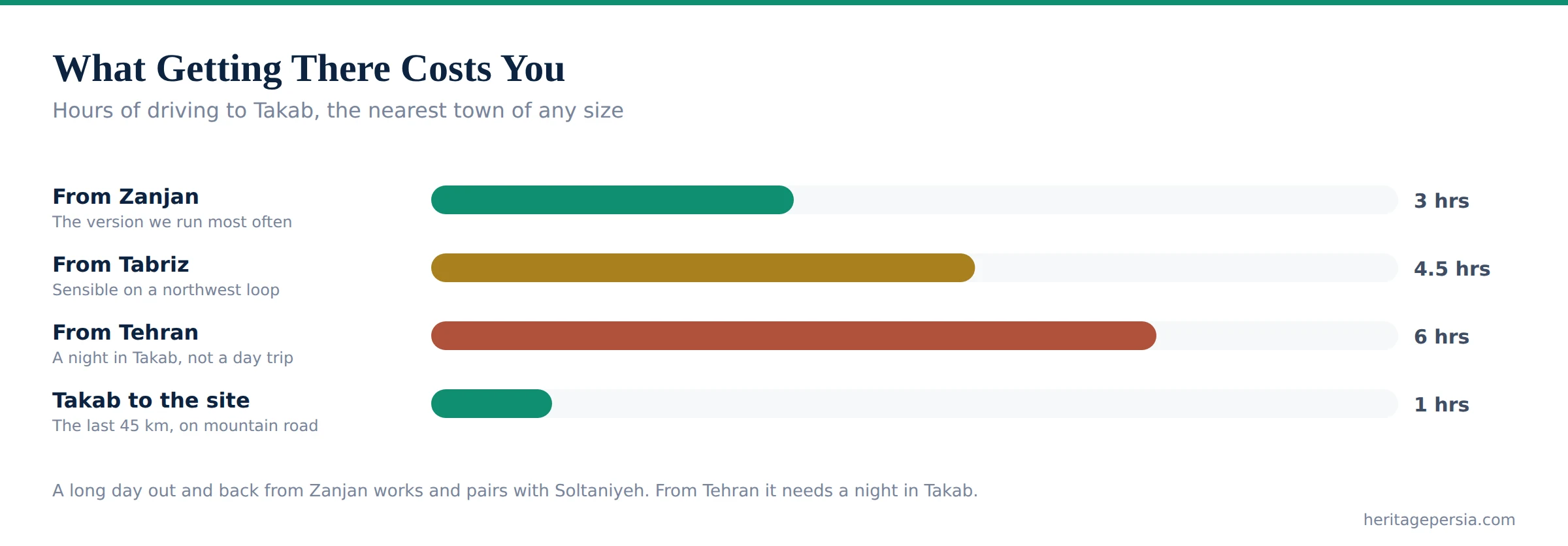
The site is in a mountain valley in West Azerbaijan, roughly forty-five kilometres from Takab, the nearest town of any size. Takab is about three hours from Zanjan, four and a half from Tabriz, and around six from Tehran. Most of that is good road and the last stretch is mountain road.
The honest options are three. Drive out and back from Zanjan in a long day, combining it with Soltaniyeh, which is the version we run most often. Stay a night in Takab, which is a modest town with modest hotels and turns the day into a comfortable one. Or fold it into a northwest loop between Tabriz and Tehran, which is the best use of it and needs a fortnight.
When to Come
May to October. The site is at altitude in a mountain valley and the winter is severe — snow closes the approach roads and the platform is exposed in a way that makes a January visit an endurance exercise rather than a visit.
Late spring is best: the valley is green, the lake is clear, and the light is long. Autumn is the second answer and drier. This is firmly a warm-season destination, which is why it appears on the warm version of our 21-day itinerary and nowhere on the winter one.
Is It Worth the Detour?
Honestly, it depends on what kind of traveller you are, and we would rather say so than sell it to everyone.
Yes, if you care about the Sasanians or about Zoroastrianism. There is nothing else like it, and the fire-and-water arrangement around a self-made lake is the single most articulate thing the state religion left behind.
Yes, if you are doing the northwest anyway. Between Tabriz and Zanjan it is a detour rather than an expedition, and it pairs with Soltaniyeh into a strong two-day archaeological block.
No, on a first ten-day visit. The driving cost is too high against Kashan or Yazd, and our ten-day guide explains that arithmetic.
No, if you need standing architecture. This is foundations, walls and a landscape. A visitor who wants Persepolis will not find it here.
Practical Notes
There is almost nothing on site. A small museum, limited shade, and no meaningful facilities. Bring water and food for the half day.
It is high and exposed. Sun protection in summer and a serious layer in any other month — the packing list covers what is hard to buy locally.
Takab is the only accommodation. Modest and adequate; our accommodation guide sets out what the provincial categories mean in practice.
A driver who knows the road matters more than usual here, because the last stretch is mountain road and the signage is thin.
Cash only, as everywhere in Iran — see the money guide.
✉️ Planning the northwest? Tell us your days and we will say whether Takht-e Soleyman works as a day from Zanjan or wants a night in Takab. Talk to our team →
Continue reading
Frequently Asked Questions
What travellers ask our guides, answered on the ground.
The Northwest, Properly
Tell us your days and we will say whether this works as a day from Zanjan or wants a night in Takab.
See Northern Routes →