
Kashan is the town everyone drives through. It sits three hours south of Tehran on the road to Isfahan, most itineraries give it an afternoon, and the result is that visitors see one merchant house, photograph a courtyard, and leave with the impression of a pleasant stop between the places that matter.
What they have missed is a town with a ziggurat older than anything in Mesopotamia, four of the finest domestic buildings in Iran, a garden that Shah Abbas built and a prime minister was murdered in, and — for about three weeks each spring — hillside villages where the air smells so strongly of roses that people stop talking about it because there is nothing left to say.
Give Kashan a night. This guide is about what that night buys you.
Before you plan anything: this is a guide to the town, written to be useful whenever you are able to use it. Whether to travel to Iran at present is a separate question with a different answer — see our current situation report, reviewed 10 September 2026.
Why an Afternoon Is Not Enough
Kashan's problem is its position. It is the natural lunch stop between Tehran and Isfahan, so that is what it became, and a town that deserves two days gets three hours and a queue outside the Tabatabaei House.
The case for staying the night is simple. Almost everything worth seeing here is at its best early or late — the merchant houses need low sun across their plaster to show what the craftsmen did, the bathhouse roof works at sunset, the rose fields are picked before dawn and finished by nine. A visitor who arrives at two and leaves at five gets the one hour of the day when every one of those things is at its worst.
There is also the town itself. Kashan is quiet, low, dusty and pleasant to walk in the evening, and its old quarter has almost no traffic. It is the least demanding place on the classic route, which after Tehran is worth something.
Every Site, With the Hour to Arrive
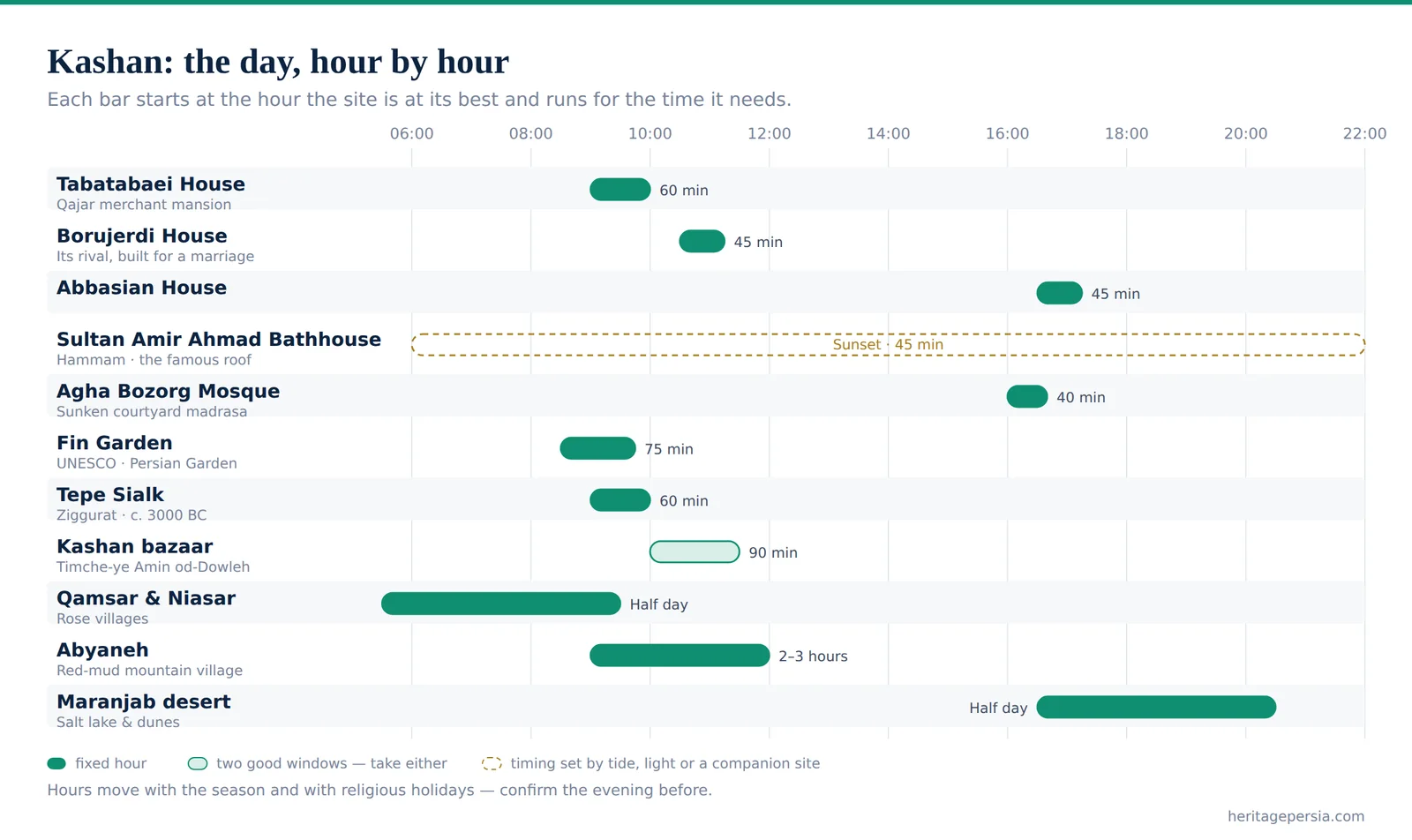
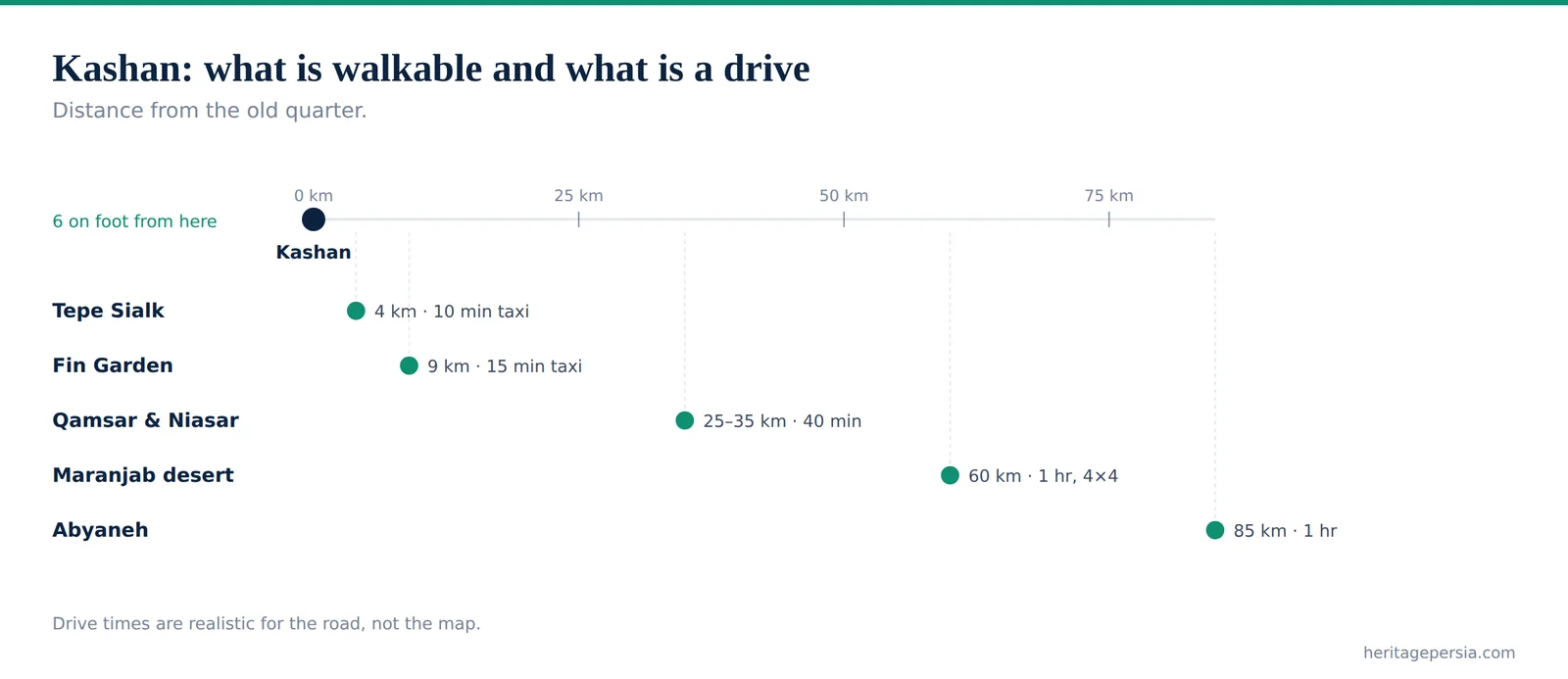
Times assume you look rather than tick off. Distances are from the old quarter around the Tabatabaei House, where most of the courtyard hotels are.
| Site | Time needed | Best hour | From the old quarter | Why that hour |
|---|---|---|---|---|
| Tabatabaei House Qajar merchant mansion | 60 min | 09:00 | On the doorstep | Low sun rakes the carved plaster; by noon the courtyards are flat and full |
| Borujerdi House Its rival, built for a marriage | 45 min | 10:30 | 5 min walk | The domed reception hall needs overhead light to show the painted work |
| Abbasian House | 45 min | Late afternoon | 10 min walk | Six courtyards on different levels — the most complex plan of the four |
| Sultan Amir Ahmad Bathhouse Hammam · the famous roof | 45 min | Sunset | 5 min walk | The roof of domes and glass lenses is the photograph, and it needs low sun |
| Agha Bozorg Mosque Sunken courtyard madrasa | 40 min | 16:00 | 10 min walk | Shadow falls into the sunken court in the afternoon and the section reads |
| Fin Garden UNESCO · Persian Garden | 75 min | 08:30 | 9 km · 15 min taxi | Opens early, empties of tour groups before ten, and the water is the point |
| Tepe Sialk Ziggurat · c. 3000 BC | 60 min | Morning | 4 km · 10 min taxi | Unshaded mound with a small museum. Go before the heat, and go at all |
| Kashan bazaar Timche-ye Amin od-Dowleh | 90 min | 10:00 or 17:00 | 10 min walk | Shut over the long lunch. The domed caravanserai hall is the thing to find |
| Qamsar & Niasar Rose villages | Half day | 05:30, in season | 25–35 km · 40 min | Picking starts before dawn and distillation runs through the morning |
| Abyaneh Red-mud mountain village | 2–3 hours | Morning | 85 km · 1 hr | Cooler at altitude and the ochre walls take morning light best |
| Maranjab desert Salt lake & dunes | Half day | Late afternoon | 60 km · 1 hr, 4×4 | Sunset over the salt flat, and the stars afterwards. Needs a driver who knows it |
Opening hours in Iran move with the season and with religious holidays. We give the hour that makes each place best rather than a schedule that will be wrong by the time you read it — confirm at your hotel the night before.
The Merchant Houses — Choose Two
In the eighteenth and nineteenth centuries Kashan grew rich on carpets, silk and copper, and its merchants spent the money on houses. Four of them are open, they are among the finest domestic buildings anywhere in Iran, and visitors who try to see all four in one day stop being able to tell them apart by the third.
The architecture is the same argument Yazd makes, in a wealthier register. Courtyards are sunk below street level so cold air settles into them. Wind towers drive air down into the rooms. Pools sit in the middle for evaporative cooling and for the look of the thing. Winter quarters face south to catch the low sun and summer quarters face north into the shade, so the family moved around its own house twice a year.
Tabatabaei is the most famous, built for a carpet merchant, with the finest carved stucco and the most photographed courtyard. Borujerdi was built, the story goes, by a bridegroom to satisfy the Tabatabaei family he was marrying into, and its domed reception hall with painted ceilings is the single best room. Abbasian is the largest and strangest, six courtyards stepping down across different levels. Ameri is now partly a hotel, which is the most enjoyable way to see one of these buildings at all.
💡 What our guides do: Tabatabaei at nine and Borujerdi at half past ten, and that is enough. Spend the time you saved on the bathhouse roof at sunset and on a slow walk through the old quarter, which is what people remember anyway. If you are staying in a converted house yourself, you have already seen a fourth one from the inside.
Fin Garden
Nine kilometres outside town, the Fin Garden was completed in 1590 under Shah Abbas I and is one of the nine gardens in the Persian Garden UNESCO inscription of 2011. It is the oldest surviving garden of its kind in Iran and the one that explains the form.
The thing to understand here is the water. Fin is fed by the Soleymaniyeh qanat, whose mother well sits two kilometres away, and it arrives with enough natural pressure to run the fountains without a pump — which is why the channels and basins here are full and moving when so many Persian gardens are dry. Cypress avenues, turquoise-tiled channels, a Safavid pavilion, and the sound of water everywhere in a town on the edge of a desert. That contrast is the entire idea of a Persian garden, stated more plainly here than anywhere else.
The garden also carries a darker association that every Iranian visitor knows. Amir Kabir, the reforming chancellor of the Qajar state, was murdered in the garden's bathhouse in 1852 on the order of Naser al-Din Shah. The room is shown to visitors, and Iranians stand in it quietly.
The Rose Harvest
For about three weeks between late April and mid-May, the hillside villages above Kashan — Qamsar, Niasar and Barzok — harvest Damask roses and distil them into rosewater. It is one of the most extraordinary sensory experiences in travel anywhere, and almost no international visitor knows it happens.
The practicalities are unromantic and matter. Picking begins before dawn, because the oil content of the flower falls as the sun rises, and the fields are finished by about nine. The petals go straight into copper stills, and the distillation runs through the morning in workshops that are open, informal and happy to have you standing in the doorway. Arriving at eleven means arriving after it is over.
Two notes. The season moves with the weather by a week or two in either direction, so confirm before committing dates. And Qamsar rosewater has a particular standing — it is the water used to wash the Kaaba in Mecca, which is a fact the people distilling it will tell you within four minutes of meeting you, with justified pride.
Our month-by-month guide sets the harvest against the rest of the Iranian year, and our May departures are built around it.
Tepe Sialk — the Site Nobody Visits
Four kilometres from the centre, on the edge of a suburb, two mounds hold the remains of a settlement occupied from around 6000 BC. On the southern one stands a ziggurat built around 3000 BC from roughly 1.25 million mud bricks — arguably the oldest structure of its kind in the world, and older than the Mesopotamian ziggurats that usually get the credit.
What is actually there is a large eroded mound, some exposed brickwork, a small museum and almost no other visitors. It will not overwhelm you the way Persepolis does. It is worth an hour for what it means rather than for what it looks like — that people were building monumentally on this spot five thousand years ago, long before the Achaemenids, and that the town you slept in last night has been continuously inhabited ever since.
The Night That Works
Arrive from Tehran mid-afternoon. Check in, then the Agha Bozorg Mosque at four and the bathhouse roof at sunset. Dinner in a courtyard.
Next morning: Fin Garden at half past eight before the coaches, Tepe Sialk at ten, Tabatabaei House at eleven, and on the road to Isfahan after lunch with Abyaneh on the way.
In rose season add a night and put the villages first: out at half past five, back for breakfast, and the town's monuments across the rest of the day. Our ten-day itinerary shows where the extra night comes from.
Where to Stay
Kashan is where the restored courtyard hotel began in Iran, and the old quarter now has a dozen of them — sunken courtyards, pools, wind towers, and rooms off the arcades where the family once lived. They are less austere than Yazd's and more decorated, and staying in one is genuinely the fourth merchant house on your list.
Two practical points. Rooms are few, and in April, May and October they are gone months ahead — the rose season fills this town completely. And the old quarter's lanes are unnamed and unnumbered, so send your driver the hotel's own location pin rather than an address. See traditional hotels for the type, and standard hotels if you would rather have a lift and a reliable shower.
Practical Kashan
Getting there. About 260 km and three hours from Tehran, usually with Qom on the way, and 165 km and two hours on to Isfahan with Abyaneh as the stop. It is the first night of most classic-route itineraries and the natural place to break the drive south.
Getting around. The old quarter is walkable. Fin, Sialk and the villages all need a taxi or a driver, and for Maranjab you need a 4×4 and someone who knows the track — this is not a self-drive destination.
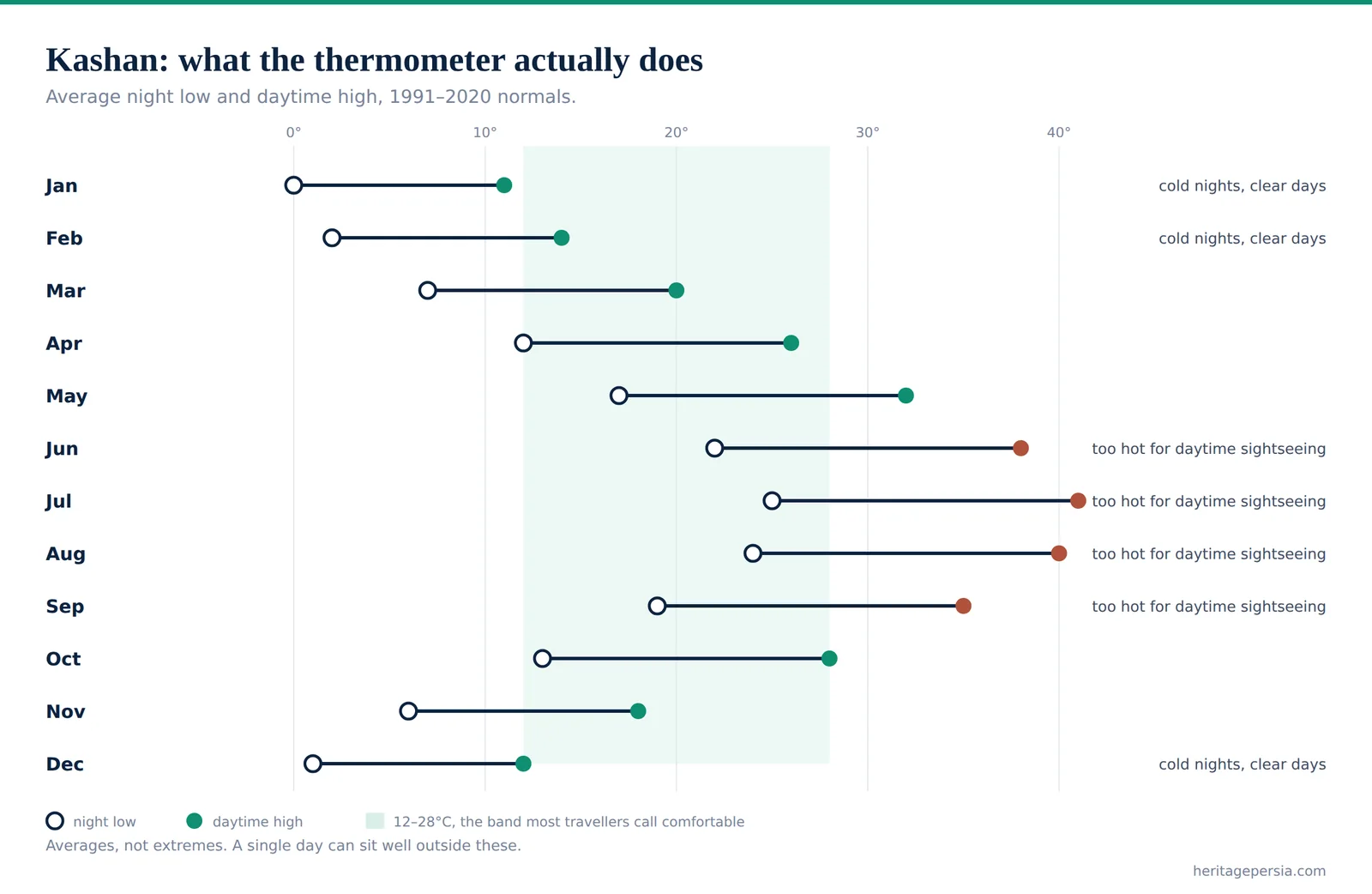
When to come. April and May for the roses and the weather, October for the light. Kashan is hot: July runs from about 25°C before dawn to 41°C at noon. Winter is mild in the day and near freezing at night.
What to buy. Rosewater, obviously, and buy it in Qamsar rather than in a town shop. Kashan is also a carpet and textile centre of long standing, and the bazaar is a good deal calmer to negotiate in than Isfahan's — see our notes on buying crafts for how that conversation goes.
✉️ Travelling in rose season? The harvest window moves each year with the weather. Tell us your dates and we will tell you honestly whether they will land inside it, and which village to be in at dawn. Talk to our team →
Continue reading
Frequently Asked Questions
What travellers ask our guides about Kashan, answered on the ground.
Kashan, Properly
Two houses, the garden before the coaches, and a dawn in the rose fields.
Our Spring Departures →