
Every tour operator in Iran is asked this question between November and February, and most of them give the same answer, which is yes, come, it is wonderful. It is wonderful. It is also the single hardest fortnight of the year to travel here, and a traveller who arrives expecting a festival laid on for visitors will spend two weeks looking at closed shutters wondering where everybody went.
The honest answer has a shape. There is a window before Nowruz that is the best time to be in Iran all year. There is a window during it that is difficult and expensive and, for the right traveller, unforgettable. And there is a window immediately after that we recommend more often than either — which is the sort of advice that costs us bookings in March and earns them in April.
Before you plan anything: this is a guide to a festival and its travel implications, written to be useful whenever you can use it. Whether to travel to Iran at present is a separate question with a different answer — see our current situation report, reviewed 10 September 2026.
What Nowruz Actually Is
Nowruz is the Persian new year, and calling it a holiday understates it in the way that calling Christmas a bank holiday would. It is the turn of the solar year, celebrated for more than three thousand years, marked at the exact astronomical instant of the spring equinox rather than at midnight — which means the new year arrives at a different time every year and families gather around a table to wait for it, watching the second hand on television.
It is not a religious festival, and this is the thing most visitors misunderstand. Nowruz predates Islam by well over a millennium, survives in a form the Zoroastrians would recognise, and is observed by Iranians of every faith and none. More than three hundred million people mark it across Iran, Central Asia, the Caucasus, Turkey, Afghanistan, the Balkans and the diaspora. The United Nations proclaimed 21 March the International Day of Nowruz in 2010, and UNESCO's Representative List of Intangible Cultural Heritage carries it as a shared inscription, extended in 2016 to cover twelve countries.
The haft-sin table
In every Iranian home, hotel lobby, office and shop window, a table is laid with seven items whose names begin with the Persian letter س — sin. You will see hundreds of them, no two alike, and asking about the one in your hotel is the fastest way into a conversation with anybody in the country.
- Sabzeh سبزه — Sprouted wheat or lentils — rebirth
- Samanu سمنو — Sweet wheat pudding, cooked overnight — affluence
- Senjed سنجد — Dried Persian olive — love
- Serkeh سرکه — Vinegar — patience and age
- Seeb سیب — Apple — health and beauty
- Seer سیر — Garlic — medicine and protection
- Somaq سماق — Sumac — the colour of sunrise
Around the seven sit the additions each family chooses: a mirror, candles, painted eggs, a bowl with a goldfish, a book of Hafez or the Quran, and coins. The sabzeh is grown at home in the weeks beforehand, which is why every windowsill in Iran sprouts wheat in early March.
The Key Dates
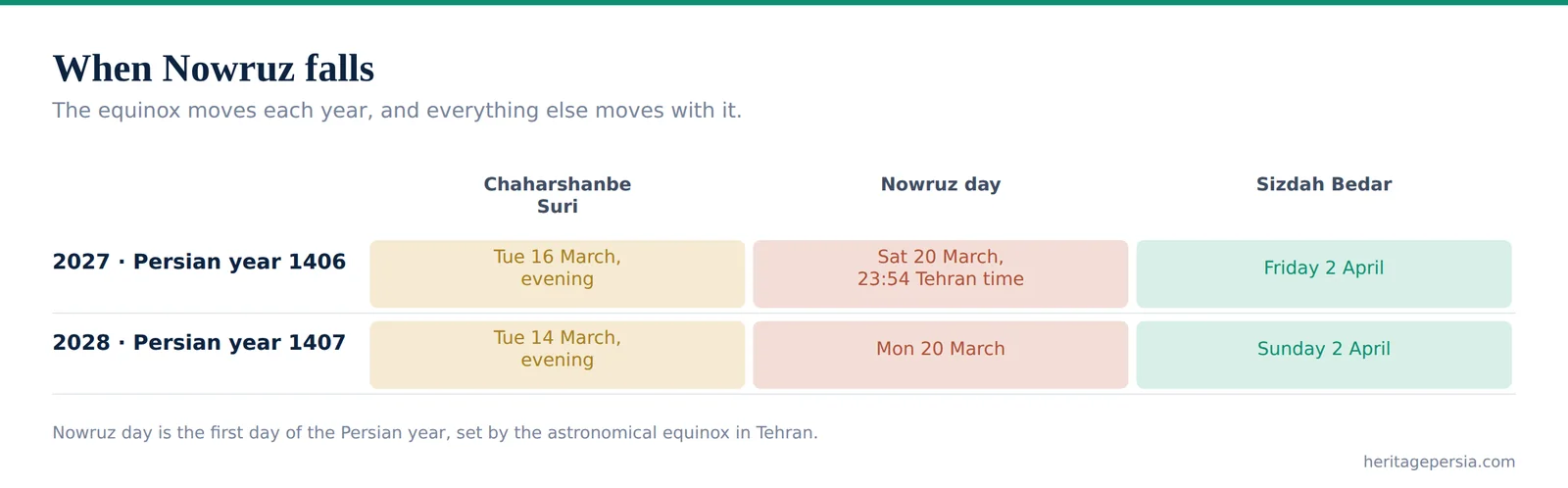
Nowruz moves with the equinox, so the calendar shifts each year. These are the dates to plan against.
| Year | Chaharshanbe Suri | Equinox | Nowruz day | Persian year | Sizdah Bedar |
|---|---|---|---|---|---|
| 2027 | Tue 16 March, evening | Sat 20 March, 23:54 Tehran time | Sunday 21 March | 1406 | Friday 2 April |
| 2028 | Tue 14 March, evening | Mon 20 March | Monday 20 March | 1407 | Sunday 2 April |
The rule is astronomical: if the March equinox falls before noon Tehran time, that day is Nowruz; if after noon, Nowruz is the following day. In 2027 the equinox lands at 23:54 on Saturday night, which pushes new year's day to Sunday 21 March and begins Persian year 1406.
The Fortnight, and What Is Actually Open
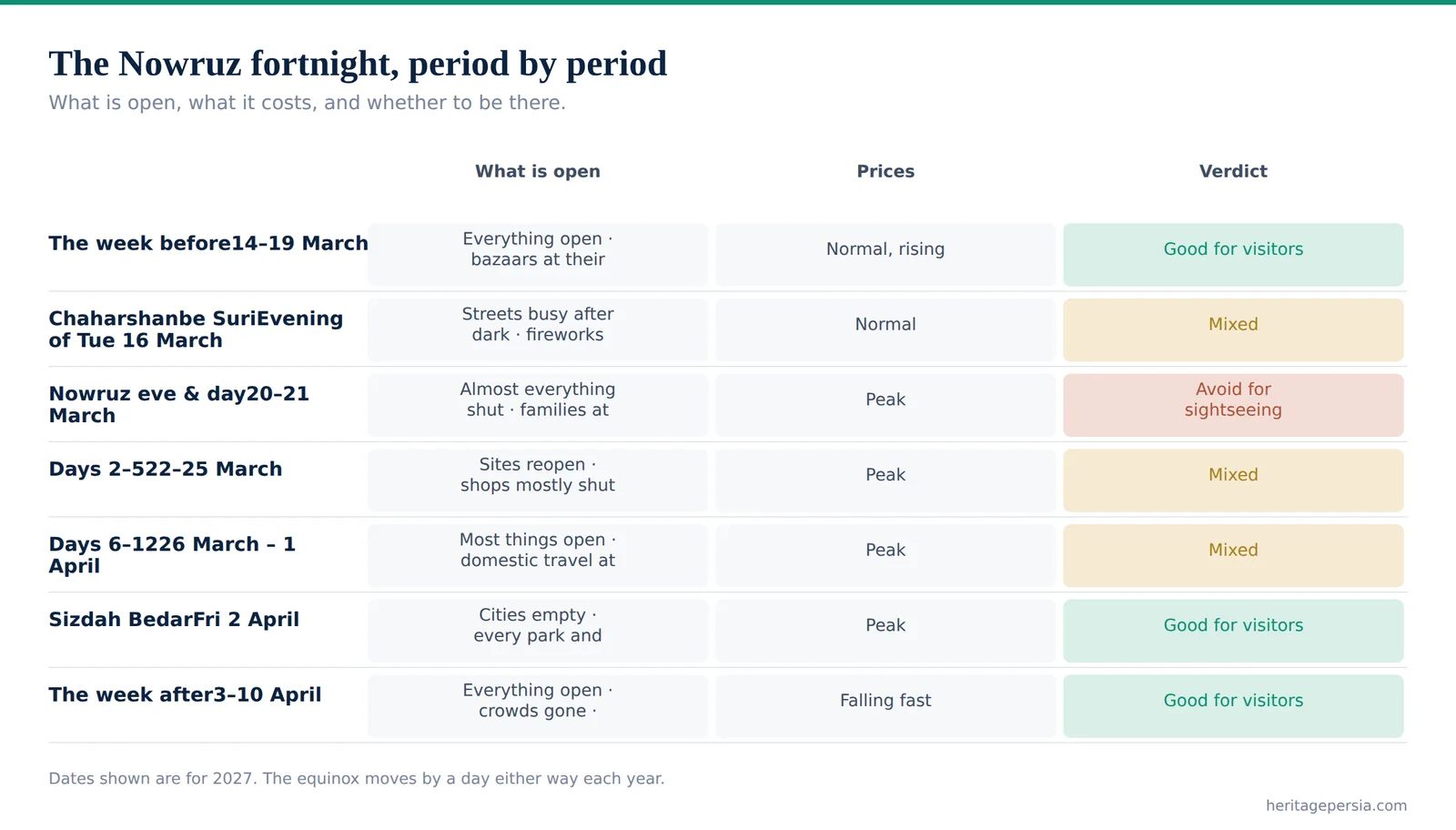
This is the table nobody publishes, and it is the whole practical answer to the question in the title. The Iranian new year holiday is thirteen days, but its texture changes completely from one block of days to the next.
| Period | What is open | Prices | What it is like | Verdict |
|---|---|---|---|---|
| The week before14–19 March | Everything open · bazaars at their busiest of the year | Normal, rising | The best window of the whole period. The city is decorating, the markets are electric, and nothing has closed yet. | Good for visitors |
| Chaharshanbe SuriEvening of Tue 16 March | Streets busy after dark · fireworks everywhere | Normal | Extraordinary to witness and genuinely rowdy. Watch from a distance rather than joining a crowd around a bonfire. | Mixed |
| Nowruz eve & day20–21 March | Almost everything shut · families at home | Peak | The quietest day of the Iranian year in public and the warmest in private. Useless for sightseeing. | Avoid for sightseeing |
| Days 2–522–25 March | Sites reopen · shops mostly shut · roads full | Peak | Monuments are open and packed with Iranian families. Restaurants are hit and miss. Hotels are full. | Mixed |
| Days 6–1226 March – 1 April | Most things open · domestic travel at its maximum | Peak | Workable if you booked months ago. Isfahan and Shiraz are at their most crowded of the year. | Mixed |
| Sizdah BedarFri 2 April | Cities empty · every park and roadside full | Peak | The whole country picnics outdoors. Sites are quiet, roads are chaos, and the atmosphere is unrepeatable. | Good for visitors |
| The week after3–10 April | Everything open · crowds gone · weather ideal | Falling fast | Our actual recommendation. Nowruz decorations still up, the country in a good mood, and you have it to yourself. | Good for visitors |
Prices reflect domestic demand rather than foreign visitors. Hotel rates on the classic route commonly reach their annual maximum between 20 March and 2 April, and rooms in the small courtyard hotels of Kashan and Yazd are gone months before that.
The Case for Coming During Nowruz
Everything below is true, and it is why perhaps a fifth of our clients choose these dates deliberately.
You see the country as it sees itself. Iran during Nowruz is a version of the place that no amount of sightseeing in October will show you — the whole population on the move, visiting family, in a good mood, dressed up, and spending thirteen days doing exactly what they want. The generosity for which Iranians are famous runs at maximum.
Invitations happen. A foreigner alone in a park during Nowruz will be fed. This is not an exaggeration and it is not hospitality performed for a guest; it is what a family does when they see somebody without a table to sit at. Several of our clients have ended up in living rooms on new year's day and describe it as the reason they came back to Iran.
The country is decorated and green. Spring arrives with the equinox in the south and a fortnight later on the plateau. Shiraz is in orange blossom, the gardens are planted, and the light is soft.
Chaharshanbe Suri and Sizdah Bedar are two of the great public spectacles anywhere, and both are covered below.
The Case Against
Also true, and stated more plainly than you will find it elsewhere.
Everything costs more and much of it is unavailable. Hotels reach their annual maximum, domestic flights and intercity buses sell out weeks ahead, and the small traditional hotels that make this route special are booked out months in advance. A trip planned six weeks before Nowruz will be a worse trip in worse rooms at higher prices.
The roads are the worst of the year. Millions of people drive between cities in the same fortnight. Journeys that take four hours in October take six or seven, and the accident rate rises accordingly — this is the single practical reason our guides dislike the period.
Nowruz day itself is a closed country. On 20 and 21 March almost nothing opens. Museums, most restaurants, shops, offices — all shut, everybody at home with their family. If those are two of your ten days, you have lost two of your ten days.
Sites are crowded in a way they never otherwise are. Persepolis and Naqsh-e Jahan in the first week of Farvardin hold more people than at any other point in the year, almost all of them Iranian. Whether that is atmosphere or ruin depends entirely on what you came for.
The Verdict — Who Should and Who Should Not
Come during Nowruz if
- You want the culture more than the monuments
- You can book three to four months ahead
- You have been to Iran before and seen the sites
- You are travelling with Iranian friends or family
- Photography of people, not buildings, is your reason
If you fall in the second column, the answer is not to avoid March. It is to arrive on about the third of April, when the holiday ends, the country goes back to work, the decorations are still up and the rates collapse. Our month-by-month guide makes the same argument with the temperature data behind it.
Chaharshanbe Suri — the Fire Festival
On the last Tuesday evening before Nowruz — 16 March in 2027 — Iranians light bonfires in streets and courtyards and jump over them, calling out zardi-ye man az to, sorkhi-ye to az man: my yellowness to you, your redness to me. Give the fire your pallor and sickness, take its warmth and health. The custom is Zoroastrian in origin and it has survived every attempt to suppress it.
What actually happens on the night is louder than that description suggests. Cities fill with fireworks from late afternoon, much of it homemade and none of it regulated, and the noise continues past midnight. It is genuinely one of the most extraordinary nights to be in Iran.
💡 Practical, from our guides: watch rather than participate, and watch from a courtyard, a rooftop or a quiet residential street rather than a main road. Iranian hospitals treat thousands of firework injuries on this night every year, and a visitor standing in the middle of a crowd of teenagers with improvised explosives is in the wrong place. Ask your hotel where their own family goes.
Sizdah Bedar — the Thirteenth Day
On the thirteenth day of the new year — 2 April in 2027 — every household in Iran goes outdoors. Staying inside on Sizdah Bedar is considered unlucky, and the result is a country-wide picnic: every park, every roadside verge, every patch of grass beside a motorway occupied by families with carpets, samovars, food and portable stereos.
The sabzeh from the haft-sin table, having absorbed the household's misfortune over thirteen days, is thrown into running water. Unmarried women knot blades of grass and make a wish. Nobody works.
For a visitor it is the most purely enjoyable day of the entire period. The monuments are quiet because everyone is outdoors, the roads are congested, and if you spend the day in a park rather than a museum you will be invited to sit down within about twenty minutes. Almost no international visitor knows to look for it, which is the recurring theme of this festival.
If You Come — How to Do It Properly
- Book three to four months ahead. Not six weeks. The traditional courtyard hotels in Isfahan, Kashan and Yazd have eight or ten rooms each and they go first.
- Stay put. Pick two cities and stay in each for four or five nights rather than moving every second day. The roads are the problem; minimise your exposure to them.
- Plan around 20 and 21 March. Put them in a city where you are happy to walk and eat at your hotel — Shiraz or Isfahan, not a village.
- Say yes to invitations. The whole value of this period is the part that is not on any itinerary.
- Learn two words. Eid-e shoma mobarak — happy new year to you. It will be returned with delight every single time.
- Bring small gifts. If you are invited into a home, something from your own country, however modest, is the correct response. Flowers or pastries work if you have nothing.
The Alternative We Recommend Most
Arrive on about 3 April. The thirteen days are over, the country returns to work, and for another fortnight the haft-sin tables are still standing in hotel lobbies and the decorations are still up. Rates fall back to normal within about forty-eight hours of Sizdah Bedar. The weather in April is the best of the year — Isfahan runs from about 10°C before dawn to 23°C at noon — and every site on the classic route is open, uncrowded and staffed by people in a good mood.
You will not have seen the new year arrive. You will have seen a country that has just had a fortnight off, which is a version of Iran worth meeting in its own right, and you will have paid a third less for it.
✉️ Thinking about March or April? Tell us your dates and we will tell you honestly which side of Nowruz they fall on and what that means for what you will see. If your dates are inside the fortnight and we think you should move them, we will say so. Talk to our team →
Continue reading
Frequently Asked Questions
What travellers ask us between November and February every year.
March or April? Ask Us Honestly
Send your dates and we will tell you which side of Nowruz they fall on, and whether we would move them.
See Spring Tours →