
Every guide to Iran, ours included, tells you to come in spring or autumn. That advice is right, and it is also useless to the very large number of people whose holiday falls in July or August and is not moving.
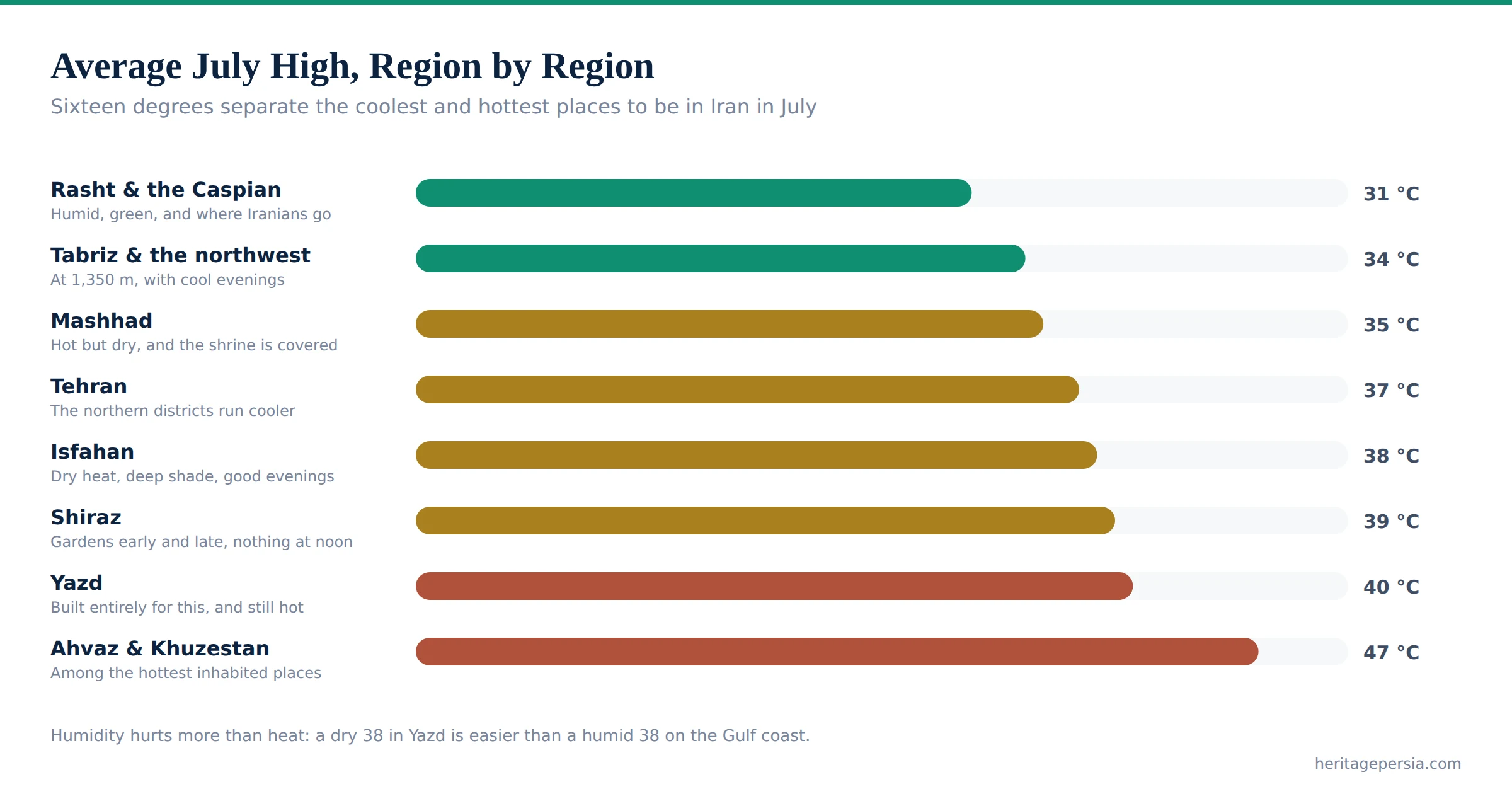
So this page assumes the dates are fixed. The useful fact is that Iran in summer is not one climate but several, and the spread between them is enormous: an average July high of thirty-one degrees on the Caspian against forty-seven in Ahvaz. Sixteen degrees is not a matter of preference. It is the difference between a good trip and an ordeal, and it is entirely under your control.
Before you plan anything: this is a seasonal guide, written to be useful whenever you are able to use it. Whether to travel to Iran at present is a separate question with a different answer — see our current situation report, reviewed 12 September 2026.
Where Summer Is, and Is Not, Survivable
These are average July and August daily highs, which is the number that decides a trip. Records are higher everywhere and irrelevant to planning.
| Where | July–Aug high | Verdict | What summer does to it |
|---|---|---|---|
| Rasht & the Caspian Gilan, Mazandaran | 30–31 °C | Go | The coolest inhabited region in the country and the one Iranians themselves escape to. Humid and green, with rice terraces and forest. The trade is rain and haze |
| Tabriz & the northwest | 33–34 °C | Go | At 1,350 m the evenings are genuinely cool. This is the region’s own season, and Kandovan and the mountain valleys are only open now |
| The Alborz above Tehran | Below 25 °C at altitude | Go | The ski resorts run as summer hill stations. Dizin’s base is at 2,650 m and the air is thin, dry and cold at night |
| Mashhad | 34–35 °C | Workable | Hot but dry, and the shrine complex is largely covered and air-conditioned. Pilgrim numbers peak, which cuts both ways |
| Tehran | 36–37 °C | Workable | The city climbs 600 m from south to north, so the northern districts run several degrees cooler. Air quality is better than in winter |
| Isfahan | 36–38 °C | Workable, restructured | Dry heat, deep shade in the bazaar and the mosques, and evenings on the square that are among the best hours of the Iranian year |
| Shiraz | 37–39 °C | Workable, restructured | Hot and dry. The gardens are the point, early and late. Persepolis in July is a genuine test and needs an 07:00 start |
| Yazd | 38–40 °C | Hard | The architecture is built entirely for this — wind towers, qanats, thick walls — which makes it the most interesting place to be hot, and still hot |
| The Gulf islands Qeshm, Hormuz | 37–39 °C with 60–68% humidity | No | The combination is among the worst in the world. The number understates it badly and the islands empty for the season |
| Khuzestan Ahvaz, Susa, Shushtar | 46–47 °C | No | Among the hottest inhabited places on earth. The UNESCO sites are open and standing in them in July is not a holiday |
| The Lut | Beyond measurement | No | The property holds the hottest land-surface temperature ever recorded. Operators do not run it and that is the whole answer |
The pattern is simple: altitude and latitude both help, and humidity hurts more than heat. A dry thirty-eight in Yazd is more comfortable than a humid thirty-seven on the coast, which is why the Gulf is a harder no than the desert.
Rebuild the Day, Not the Itinerary
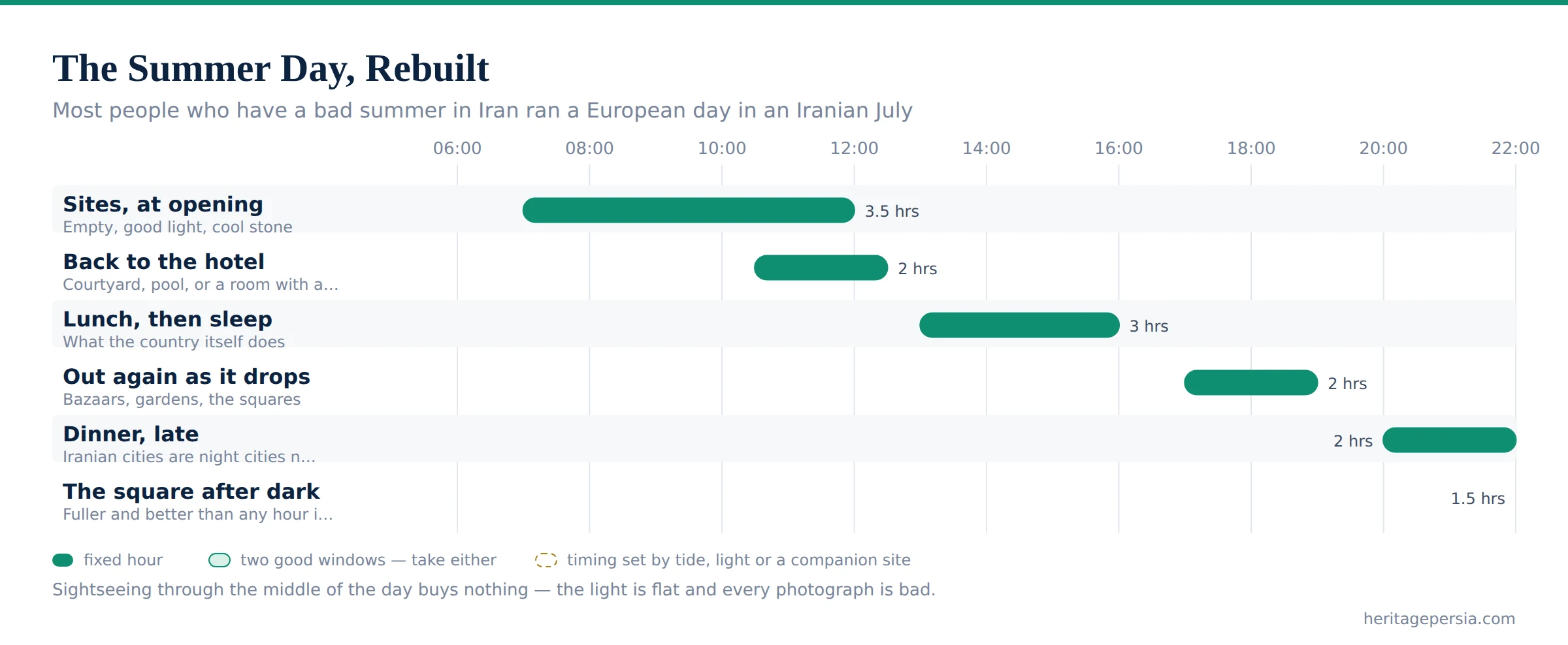
Most people who have a bad summer in Iran had an ordinary itinerary run on European hours. Iranians do not do this, and the solution is theirs rather than ours.
Sites open at seven and you should be there. Between 07:00 and 10:30 the light is good, the stone has not yet absorbed the day, and the sites are empty. This is the best part of a summer trip and most visitors sleep through it.
Then stop. From 12:00 to 17:00 do what the country does: eat, sleep, sit in a courtyard, use the hotel pool if there is one. Trying to sightsee through the middle of the day is what ruins people, and it buys nothing — the light is flat and every photograph is bad.
Restart at five and go late. Bazaars, gardens, the squares and the bridges all come alive after the heat drops, and Iranian cities in summer are night cities. Naqsh-e Jahan at ten at night in July is fuller and better than at any hour in April.
Build in one rest day per week. Heat accumulates, and the trip that fails in summer fails in its second week.
The one structural change worth making: book accommodation with a courtyard or a pool rather than the best-located room. In spring the location wins; in summer the five hours you spend in the building matter more than the ten minutes you save walking. Our accommodation guide covers which kinds have them.
What Summer Actually Buys You
The case for coming is not only that the dates are fixed.
The sites are empty. Persepolis at seven in the morning in July has tens of people on it rather than hundreds. Nasir al-Mulk, which has a queue in April, does not.
It is the cheapest season of the year. Courtyard hotels that are gone six months ahead for April have rooms in July, and the rates are the lowest on the calendar.
The northwest and the Caspian are only open now. Tabriz, Kandovan, the Armenian monasteries and the mountain valleys close in winter. A summer trip is the one that can have them, and they are the half of the country most visitors never see.
Fruit. This sounds trivial and is not. Iranian summer produce — melons, peaches, figs, mulberries, sour cherries — is among the best anywhere, and it is the season the food is at its peak.
A Summer Route That Works
If you have a fortnight in July or August, invert the usual trip.
| Days | Where | Why in summer |
|---|---|---|
| 1–2 | Tehran | Stay in the north of the city where it is cooler. Museums are indoors and the evenings are pleasant |
| 3–5 | Tabriz & the northwest | The region’s own season. The UNESCO bazaar, Kandovan, and a landscape that is green now and shut in January |
| 6–8 | The Caspian — Masuleh, Rasht | Thirty degrees, forest and rice terraces, and the best regional food in the country |
| 9–11 | Isfahan | On the summer schedule: mornings, a long middle, and the square at night. Three nights rather than two |
| 12–14 | Shiraz & Persepolis | Gardens early and late, Persepolis at opening. Fly rather than drive to save the hot hours |
This is the reverse of our standard fortnight, which adds Kerman and the Lut. Those are winter regions; in July they are replaced by the north, which is the trade summer offers rather than a compromise.
Check Ramadan Before Anything Else
Two calendars run in Iran at once. The solar one carries the seasons; the Islamic lunar one carries Ramadan and moves about eleven days earlier each year, so it drifts through all four seasons over a 33-year cycle.
In 2027 Ramadan falls in February and March, which keeps it clear of summer — but it will move back into the summer months within a decade, and a summer Ramadan is the hardest combination in the Iranian calendar, because the fasting day is at its longest and the heat at its worst. Our Ramadan guide sets out what actually closes and what a traveller is expected to do.
Practical Notes for the Heat
Four litres of water per person per day is the operating figure, not two. Bottled water is everywhere and cheap.
The dress code does not relax in summer, which is the part visitors find hardest. Loose long-sleeved cotton and linen is what Iranians wear and it works better than less fabric — the clothing guide has the settings.
Sunscreen is thinly stocked. Bring high factor with you; the packing list covers what you cannot buy there.
Air conditioning is near-universal in hotels and cars and unreliable in older buildings. Ask rather than assume.
Heat illness is the real medical risk of a summer trip, ahead of anything exotic — see our health guide.
✉️ Stuck with summer dates? Tell us your weeks and we will build the version that goes north rather than the one that fights the heat. Talk to our team →
Continue reading
Frequently Asked Questions
What travellers ask our guides, answered on the ground.
A Summer Route, Built North
Tell us your weeks and we will build the version that goes north rather than the one that fights the heat.
See Summer Routes →