
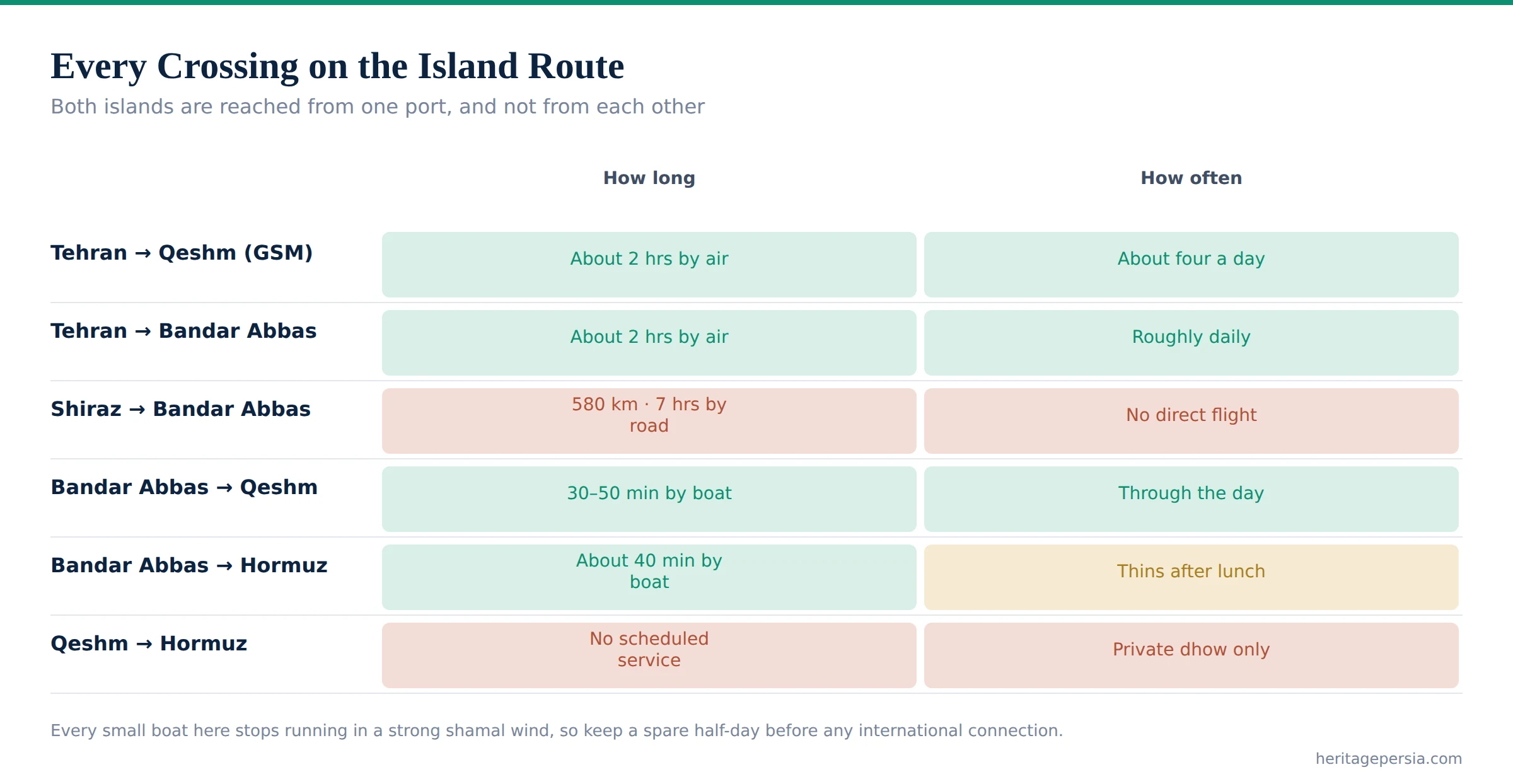
There is no scheduled boat from Qeshm to Hormuz. The two islands sit twenty kilometres apart and every crossing between them goes back through Bandar Abbas on the mainland, which means the route is a wheel with a hub rather than a chain of stops. Almost every itinerary published in English gets this wrong, and the ones that get it wrong lose a day.
The second fact worth knowing before anything else is that Qeshm has its own airport with roughly four flights a day from Tehran. You can fly straight onto the island and skip Bandar Abbas entirely on the way in — which is the difference between a comfortable week and a week with two mainland nights in it.
Before you plan anything: this is a route guide, written to be useful whenever you are able to use it. Whether to travel to Iran at present is a separate question with a different answer — see our current situation report, reviewed 10 September 2026.
The Shape of the Route
Three places carry this trip and they relate to each other in a particular way.
Qeshm is the large one — Iran’s biggest island, a UNESCO Global Geopark, a salt cave of about 6.6 kilometres, mangrove channels, a fluted gorge and the eroded badlands of Stars Valley. It takes three days and it has its own airport.
Hormuz is the small one — a salt dome about forty square kilometres across with more than seventy mineral colours in the ground, a Portuguese fortress of 1507, and a red soil the islanders cook with. It takes two days and has no airport.
Bandar Abbas is neither a destination nor avoidable. It is the port both islands are reached from, both crossings leave from Shahid Haqani in the middle of the city, and you will pass through it at least twice. One night there is usually unavoidable; two means the route was planned backwards.
Because there is no island-to-island boat, the correct order is the one that touches the hub least: fly into Qeshm, do the big island first, cross to the mainland once, cross to Hormuz, and fly out of Bandar Abbas. That is one mainland night rather than two.
Every Crossing, With Its Time
| Leg | How | Time | What to know |
|---|---|---|---|
| Tehran → Qeshm | Direct flight to Dayrestan (GSM) | ~2 hrs | About four a day, and by far the busiest route to the island. Isfahan, Mashhad and Tabriz also fly it a couple of times a week |
| Tehran → Bandar Abbas | Direct flight (BND) | ~2 hrs | Roughly daily. The alternative entry if the Qeshm flights are full |
| Shiraz → Bandar Abbas | Road | 580 km · 7 hrs | There is no dependable direct flight. If you are coming from Shiraz, it is a full driving day or a connection through Tehran |
| Bandar Abbas → Qeshm | Speedboat, motorboat or ferry from Shahid Haqani to Bahman port | 30–50 min | Three grades of boat at almost the same price. Frequent through the day |
| Bandar Abbas → Hormuz | Open speedboat from Shahid Haqani | ~40 min | Frequent in the morning, much thinner after lunch. Be at the port before 15:00 for the return |
| Qeshm → Hormuz | No scheduled service | — | Back to Bandar Abbas and out again. A private dhow can be hired but must be arranged in advance |
| On Qeshm | Hired car with driver | — | The salt cave alone is 95 km from Qeshm town. A car is not optional here and the sites are at opposite ends |
| On Hormuz | Motorbike taxi, bicycle or tuk-tuk | — | The loop road is about an hour. No hire cars in the ordinary sense and none needed |
Every crossing here is weather-dependent and small boats are cancelled in a strong shamal wind. That is the argument for keeping a spare half-day at the end rather than connecting straight onto an international flight.
Six Days, Planned
| Day | Sleep in | Leg | What you do |
|---|---|---|---|
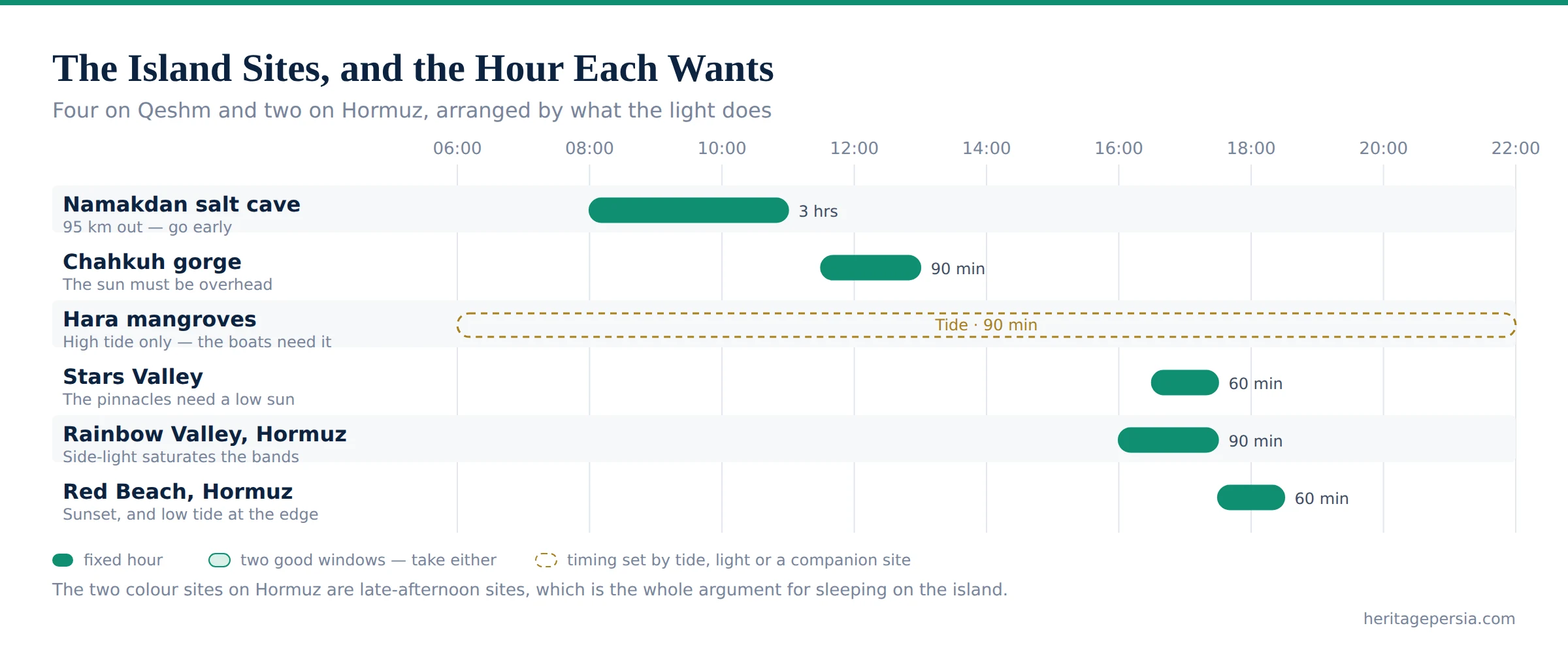
| 1 | Qeshm | Fly Tehran → GSM | Arrive, take the car, and go to the Hara mangroves if the tide is in — the boats cannot enter the channels at low water, so the tide decides this one, not the clock |
| 2 | Qeshm | 190 km round trip | Namakdan salt cave early — it is 95 km out and the drive eats the day otherwise. Stars Valley in the last hour of light, 15 minutes from town |
| 3 | Qeshm | ~130 km | The lenj shipyards at Guran early, while the men are still there. Chahkuh gorge between 11:00 and 14:00, because the sun has to be overhead to reach the floor. The Portuguese castle when the heat drops |
| 4 | Hormuz | Boat to Bandar Abbas, then boat to Hormuz | Cross in the morning. Arrive in time for Rainbow Valley at 16:00 and the Red Beach at sunset |
| 5 | Hormuz | The island loop | Statue Valley at first light, the salt caves and Silver Beach in the flat midday light, the fortress in the late afternoon |
| 6 | — | Boat to Bandar Abbas, fly out | Leave on a morning boat. Fly from BND, and keep the afternoon loose in case the wind is up |
The single thing that decides whether this works is sleeping on Hormuz rather than day-tripping to it. The island’s two best hours are the last two of daylight and the dependable boats back have gone by mid-afternoon, so a day trip buys you the island in exactly the light that does not suit it.
The Season Is the Whole Point
November to March, and the window is firmer here than anywhere else in Iran.
In those months the islands sit at roughly twenty to twenty-eight degrees, dry and clear, and this is genuinely the best weather in the country — swimming weather, while Tabriz is below freezing and the plateau cities are cold and grey. From May to September the average high sits near thirty-eight degrees with humidity of sixty per cent and above, which is a different order of unpleasant from dry desert heat and worse than the number suggests, and peaks touch forty-five, and the islands empty.
That inversion is the strategic reason to know this route exists. It runs well in exactly the months the classic corridor runs worst, which gives a winter trip an option a spring trip does not have — and it is why the Gulf appears on the winter version of our 21-day itinerary and nowhere on the warm-season one.
How It Bolts On
As six days at the end of a fortnight. The most common shape. Finish the classic corridor in Shiraz, fly Shiraz–Tehran–Qeshm, and fly home from Bandar Abbas. It adds a connection but no backtracking.
As four days, Qeshm only. If the time is not there, drop Hormuz rather than rushing both. Qeshm alone is a complete short trip and it has the airport.
As two days, Hormuz only. The reverse also works and is the better choice for photographers, because the colour is the reason people come south at all.
Not as a day trip from anywhere. Bandar Abbas is two hours’ flying from Tehran and seven hours’ driving from Shiraz. Whatever you have read, this is not a detour that can be taken lightly.
Practical Notes
Bring the cash for the whole trip. No foreign card works anywhere in Iran, and on the islands even the usual workarounds thin out. The money guide has the sums.
Accommodation is guesthouses and eco-lodges. Qeshm has a few conventional hotels and Hormuz has none — where to stay in Iran covers what each kind of bed is actually like.
The dress code applies on the beach. These are not resort islands and swimming happens fully covered or not at all for women. The clothing guide has the detail.
The food is Gulf cooking, not Persian cooking. Fish, tamarind, turmeric, chilli and dates. Anyone who has eaten their way through Isfahan and Shiraz will not recognise it — see the food guide.
Leave the soil where it is. Industrial extraction of Hormuz’s red ochre damages exactly the landscape visitors come for. Buy the meal, not the mineral.
✉️ Planning a winter trip? Tell us your dates and where you finish on the mainland, and we will say whether the six-day version or the four-day one fits, and which flight to aim for. Talk to our team →
Continue reading
Frequently Asked Questions
What travellers ask our guides, answered on the ground.
A Winter Route South
Tell us your dates and where you finish on the mainland, and we will fit the islands to them.
See Southern Routes →