
Two things about Iran are true at once, and a guide that gives you only one of them is useless. A woman can travel this country alone with no male relative, no permission and no paperwork beyond a passport — that has always been the case and it is not in question. And a legal dress requirement applies to her that does not apply to a man, enforced unevenly, by a state that says openly it would enforce it harder if conditions allowed.
Most articles on this subject pick one of those sentences. What follows keeps both, states each with its source and date, and then gets specific about the situations where being alone and being a woman actually changes what you do.
Before you plan anything: this guide is about travelling as a woman, written to be useful whenever you are able to use it. Whether to travel to Iran at present is a separate question with a different answer, and as of 10 September 2026 our answer is no — see our current situation report. Nothing on this page should be read as an argument for going now.
What the Law Requires, and What It Does Not
Start with what is not required, because this is where most of the confusion sits.
There is no male guardian requirement in Iran. No mahram, no letter, no permission. A foreign woman enters alone, checks into a hotel alone, boards a domestic flight or an intercity bus alone, hires a car and driver alone and buys a museum ticket alone. The idea that she cannot is imported from a different country's rules and it has never applied here. Iranian women themselves travel domestically alone as a matter of routine.
What is required is covering the hair in public, and it applies to foreign visitors exactly as it applies to Iranians. Iran's judiciary confirmed in October 2025 that the existing hijab laws remain in force. The much harsher Hijab and Chastity legislation — heavy fines, long prison terms, a citizen-reporting mechanism — passed parliament and was then blocked by the Supreme National Security Council before it took effect. It has not been implemented, and conflating the two is the single most common error in English-language writing on this.
Enforcement is a separate question from the law. As of September 2026, officials state publicly that they are holding back from enforcing mandatory hijab as widely as they would like because of war conditions, and that the approach has shifted from street enforcement to business closures, judicial warnings and campus restrictions. Meanwhile a large proportion of women in Tehran, Isfahan and Shiraz no longer cover their hair at all in daily life.
For a visitor the calculation is different from an Iranian woman's, because she is the one who lives with the consequences and you are not. Carry a scarf, wear it where it matters — shrines, government buildings, small towns, any official interaction — and follow the room in the cities. Our what to wear guide has the setting-by-setting detail and the packing lists.
Three other restrictions are real and worth knowing: women are barred from most stadium football matches, with intermittent exceptions; a woman may not sing solo in public performance; and public swimming is segregated. None of these will affect a two-week itinerary, and all three are frequently reported as though they were.
Situation by Situation
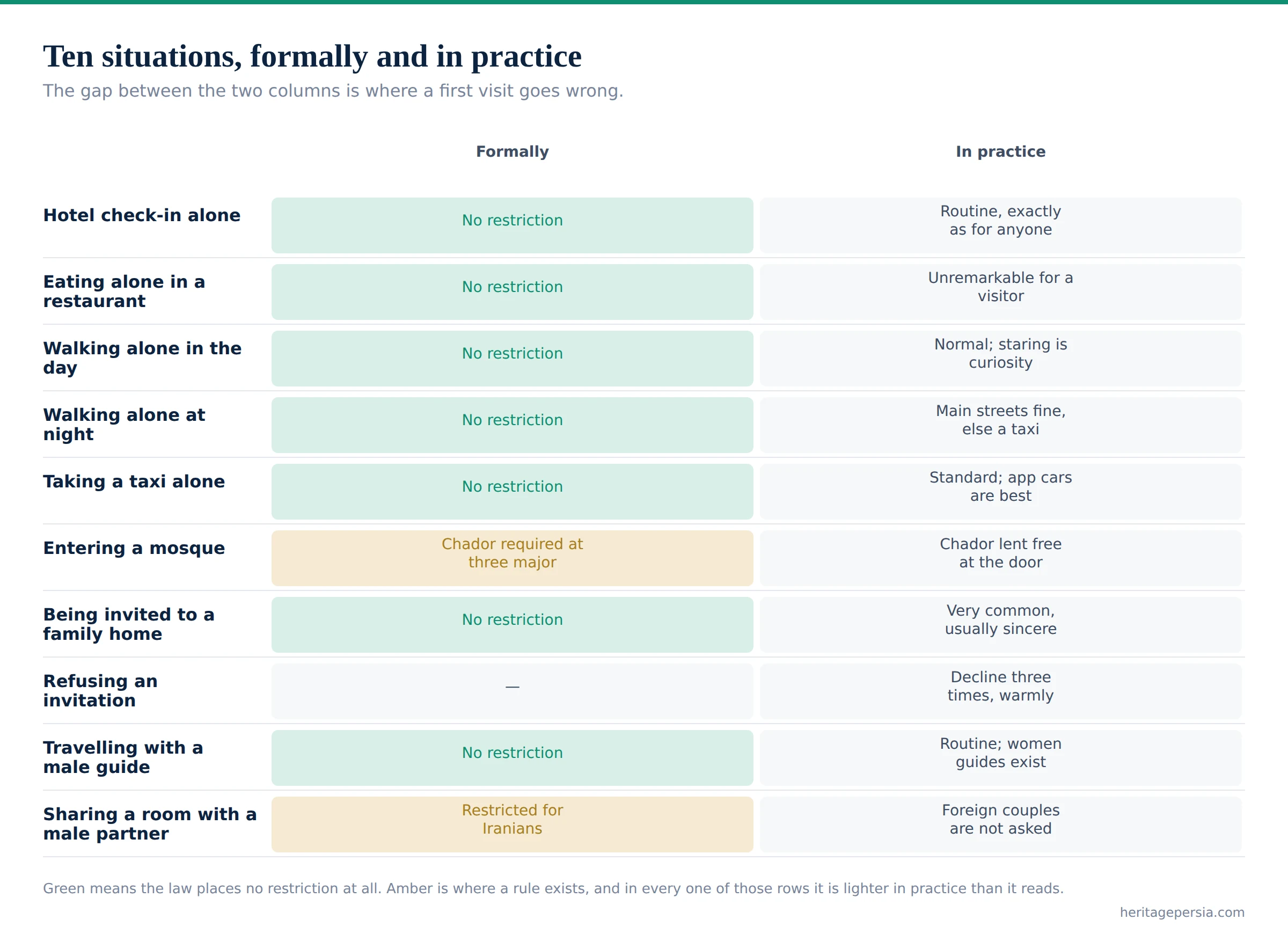
The column that matters is the last one. The gap between what is formally expected and what actually happens is where a first visit goes wrong.
| Situation | Formally | In practice | What we would do |
|---|---|---|---|
| Hotel check-in alone | No restriction whatever | Routine. Passport taken and registered, as for everyone | Nothing different. Take a courtyard house with an inward-facing courtyard rather than a street-facing room |
| Eating alone in a restaurant | No restriction | Uncommon for Iranian women in some settings, and entirely unremarkable for a visitor | Lunch anywhere. For dinner alone, hotel restaurants and the teahouse-style places are the easiest rooms |
| Walking alone in the day | No restriction | Normal everywhere. Staring is common and is usually curiosity | Walk. This is how you see the cities and there is no reason not to |
| Walking alone at night | No restriction | City centres stay busy late and feel safe; quiet residential streets less so | Main streets and lit bazaar routes after dark, a taxi for anything else. The same rule as most cities |
| Taking a taxi alone | No restriction | Standard. Shared taxis put strangers beside you; app cars do not | Snapp or Tapsi rather than a street taxi, because the trip is logged and the fare is fixed |
| Entering a mosque | Chador required at three major shrines | Lent free at the door, and someone will help you put it on | Go. The chador is a garment for the building, not a statement about you |
| Being invited to a family home | No restriction | Extremely common and almost always sincere | Accept lunch and daytime invitations freely. Decline overnight ones — the registration rules make it a problem for the host |
| Refusing an invitation | — | Taarof means the first refusal is not heard as a refusal | Decline three times, warmly. That is the form, and it works |
| Travelling with a male guide | No restriction | Routine, and most licensed guides are men | Ask for a woman guide if you prefer one — they exist in every city and are worth requesting early |
| Sharing a room with a male partner | Restricted for Iranians | Foreign couples are not generally asked for a marriage document | Nothing. If either of you also holds an Iranian passport, carry the certificate |
None of these situations requires a companion, a permission or an explanation. Where we suggest doing something differently, it is a judgement about comfort rather than a rule.
Getting Around Alone
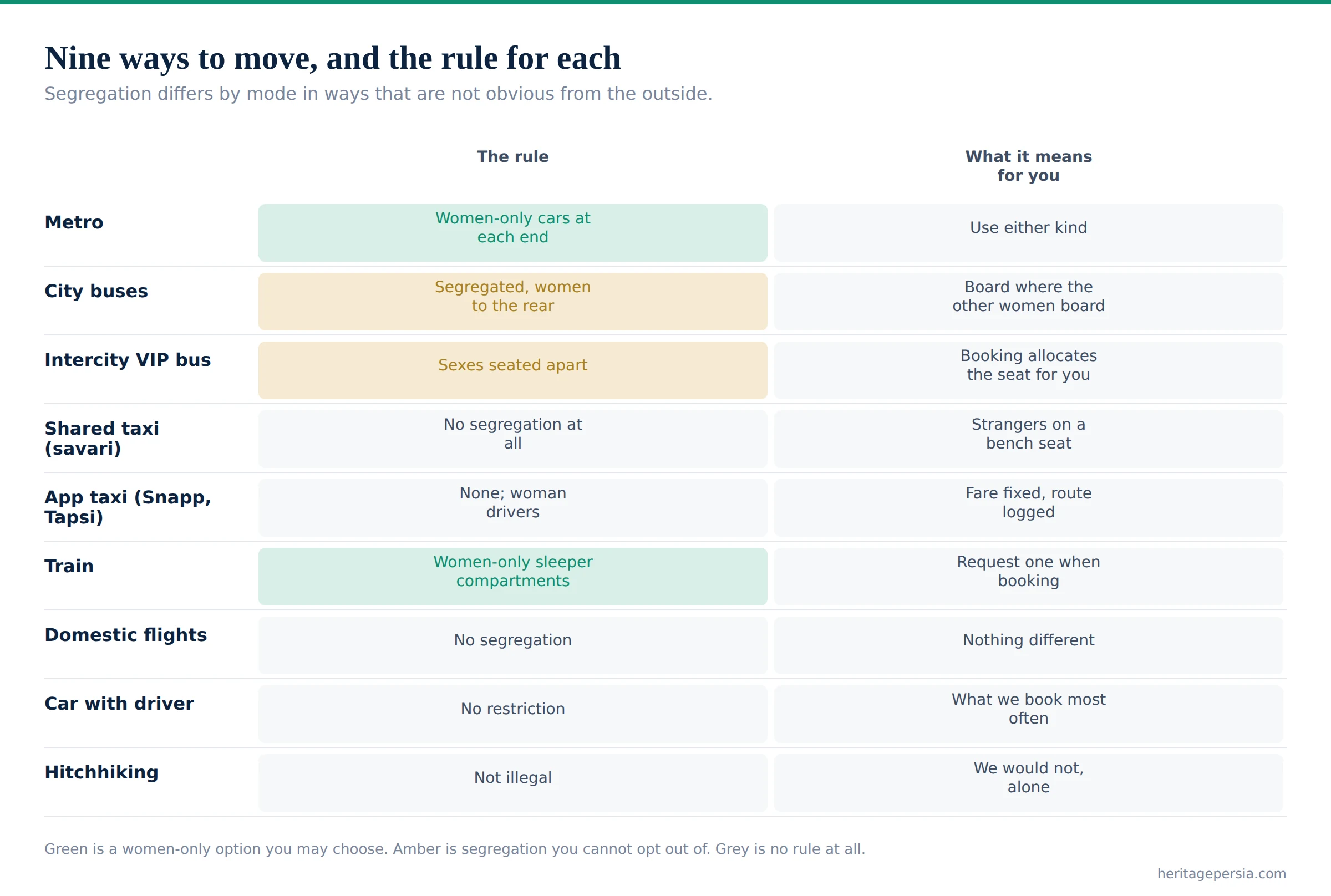
Iranian public transport is partly segregated, and the rules differ by mode in ways that are not obvious. This is the table to have.
| Mode | The rule | What it means for you |
|---|---|---|
| Metro | Dedicated women-only carriages at each end; the rest are mixed | You may use either. The women’s carriage is less crowded at rush hour and is what most Iranian women take |
| City buses | Segregated — women to the rear on standard buses, the front section on BRT lines | Board where the other women board. Payment is often at the front regardless, which is confusing the first time |
| Intercity VIP bus | Unrelated men and women are not seated together | The booking system handles it. Say you are travelling alone when you book and the seat is allocated accordingly |
| Shared taxi (savari) | No segregation at all | You may end up shoulder to shoulder with strangers on a bench seat. Fine in daylight, and the reason many women prefer app cars |
| App taxi (Snapp, Tapsi) | No segregation; some services offer a woman driver option | The best default. Fare fixed in advance, route logged, no negotiation and no cash argument |
| Train | Women-only four-berth compartments available on sleeper routes | Request one when booking. On the overnight routes this is what we book for solo women as a matter of course |
| Domestic flights | No segregation | Nothing different. Headscarf on for the airport and the flight |
| Car with driver | No restriction | The most common arrangement for our solo travellers. Ask for a driver who works the route regularly |
| Hitchhiking | Not illegal | We would not, alone. The offers will come unprompted and there is no upside worth the exposure |
The wider picture — costs, timings and which mode suits which leg — is in the getting around Iran guide. Iran’s road accident rate is high, which is a far larger practical risk to any traveller than anything on this page.
The Honest Section
Serious crime against foreign visitors in Iran is genuinely rare, and has been for as long as we have been running trips. Theft is unusual, violent crime against tourists is very unusual, and a woman walking through a bazaar at nine in the evening is in less danger than she would be in most European city centres. That is the true part of the reassuring version.
What is also true is that a woman travelling alone gets a great deal of attention, and some of it is unwanted. Staring is constant and is mostly curiosity, particularly outside the big cities. Conversation is opened by strangers constantly and is almost always friendly. And a minority of approaches are propositions, sometimes direct ones, from men who have concluded that a foreign woman alone is available in a way an Iranian woman is not. Travellers report this consistently. It is rarely threatening and it is tiring.
What works, from what our guides and our travellers report:
A flat, unembarrassed no ends most of it. There is no social cost to you in being blunt with a stranger, and the encounter is over.
Volume is the tool if a situation does not end. Public intervention is fast and reliable here — bystanders will step in, and shopkeepers especially. Being loudly uncomfortable in a public place is more effective than walking away quietly.
Saying you are married works, whether or not you are, and a ring settles a surprising number of conversations before they start.
Distinguish the invitation from the proposition. Most invitations — to tea, to a family lunch, to a wedding — are exactly what they appear to be, and refusing all of them costs you the best part of the country. The ones to decline are the ones from a man alone, at night, or that involve going somewhere you have not chosen.
The Thing That Actually Surprises People
Ask a woman who has travelled Iran alone what the hardest part was and the answer is usually not fear. It is that she was never left alone.
Iranian hospitality toward a lone foreign visitor is close to overwhelming. You will be given directions by people who walk you to the address. You will be bought tea and refused payment. You will be invited home by families you met on a bus forty minutes earlier, and the invitation will be real. A traveller who planned a quiet week of looking at buildings often finds she has had six long conversations a day and no solitude at all.
This is worth planning for rather than resisting. Build in a slow morning, a hotel courtyard, a meal alone. Accept the invitations you want and decline the rest with the triple refusal that taarof expects — the first no is politeness, the third is heard. And take the family lunches, because they are the part of Iran that no monument competes with.
Practical Notes
| Question | Answer |
|---|---|
| Do I need a tour? | Not for most passports. US, UK and Canadian passport holders are the exception and must travel on an approved itinerary with a guide — see the visa guide |
| Period products | Pads are sold everywhere, tampons are not. Bring what you need for the trip |
| Pharmacies | Everywhere and cheap, but many medicines are short in 2026 — bring your own and see the health guide. Contraception is over the counter |
| What to wear | A scarf, a long top covering the hips, and long trousers. Colour is fine and black is never required of a visitor — the clothing guide has the detail |
| Public toilets | Squat is the norm and paper is not provided. Carry tissues and hand gel, always |
| Connectivity | A local SIM is bought with a passport in twenty minutes. Much of the internet is filtered — the connectivity guide covers what works |
| Sharing your location | Worth doing daily with someone at home, as anywhere. Signal is reliable in cities and patchy on desert roads |
| Money | No foreign card works, so you are carrying the whole trip in cash. A money belt matters more here than the crime rate suggests — see the money guide |
| Women guides | Licensed women guides work in every major city. Request one early; there are fewer of them and they book up |
| Alcohol | Illegal and not available. Accepting home-distilled spirits from a new acquaintance is a bad idea on both legal and medical grounds |
Nothing above is specific to travelling alone except the guide request and the location sharing. That is the point of the table.
Where We Would Send a First Solo Trip
The classic corridor, and specifically Isfahan, Yazd and Shiraz. They are used to foreign visitors, the old quarters are walkable and safe on foot at night, the courtyard hotels put you inside a building rather than on a street, and there is always a rooftop to retreat to. The ten-day route is the standard shape and works unchanged for a solo traveller.
Season matters slightly more alone than in company, because heat compresses your day into the early morning and late evening and leaves a long empty middle. Late March to mid-May or late September to early November, and a courtyard to spend the afternoons in. The month-by-month guide has the figures.
Where we would not send a first solo trip is anywhere that requires long empty roads and improvisation — the border provinces, the deep desert without a driver, and any route where a breakdown leaves you on a road with no traffic. That is a logistics judgement rather than a gender one, and we would say the same to a man.
✉️ Planning a solo trip and want the honest read? Tell us the route you have in mind and we will tell you which parts we would change, including when the answer is to wait. Talk to our team →
Continue reading
Frequently Asked Questions
What travellers ask our guides, answered on the ground.
The Honest Read on Your Route
Tell us the route you have in mind and we will say which parts we would change.
See Our Routes →