
Almost every trip to Iran runs down the middle of the country, from Tehran through Isfahan and Yazd to Shiraz, and never turns north. Tabriz sits six hundred kilometres up in the other direction, in mountains that are green when the plateau is scorched and under snow when the plateau is merely cold, and the everyday language in the street is not Persian.
That is the case for coming, and it is also the reason to be honest about who should. Tabriz is not a detour from the classic route; it is a different trip. If you have ten days, this is not where they go. If you have fourteen, or if you have been to Iran before and want the version of the country that the itineraries leave out, it is the most rewarding place in the north.
Before you plan anything: this is a guide to the city, written to be useful whenever you are able to use it. Whether to travel to Iran at present is a separate question with a different answer — see our current situation report, reviewed 10 September 2026.
A Different Iran
Tabriz has been sacked, rebuilt, made a capital and flattened by earthquakes more times than any other major Iranian city. It was the Safavid capital before Isfahan, a Silk Road hinge between Anatolia and the plateau, and the first city in Iran to have a municipal government, a modern school and a printing press. Much of what it built has been shaken down — the 1780 earthquake alone destroyed most of the medieval city — and the result is a place whose history is more legible in its bazaar and its language than in its monuments.
The language is the first thing visitors notice. East Azerbaijan is Azerbaijani-speaking, and in the street, the bazaar and most homes the everyday language is Azerbaijani Turkish rather than Persian. Everyone also speaks Persian, and younger people often some English, but the texture of the place is Turkic — the food, the music, the sense of humour, the relationship with Turkey an hour's drive west.
For a visitor who has already done the plateau, this is the interest. Tabriz is Iran without the Persian-garden-and-blue-dome framing that the rest of the country supplies so generously.
Every Site, With the Hour to Arrive
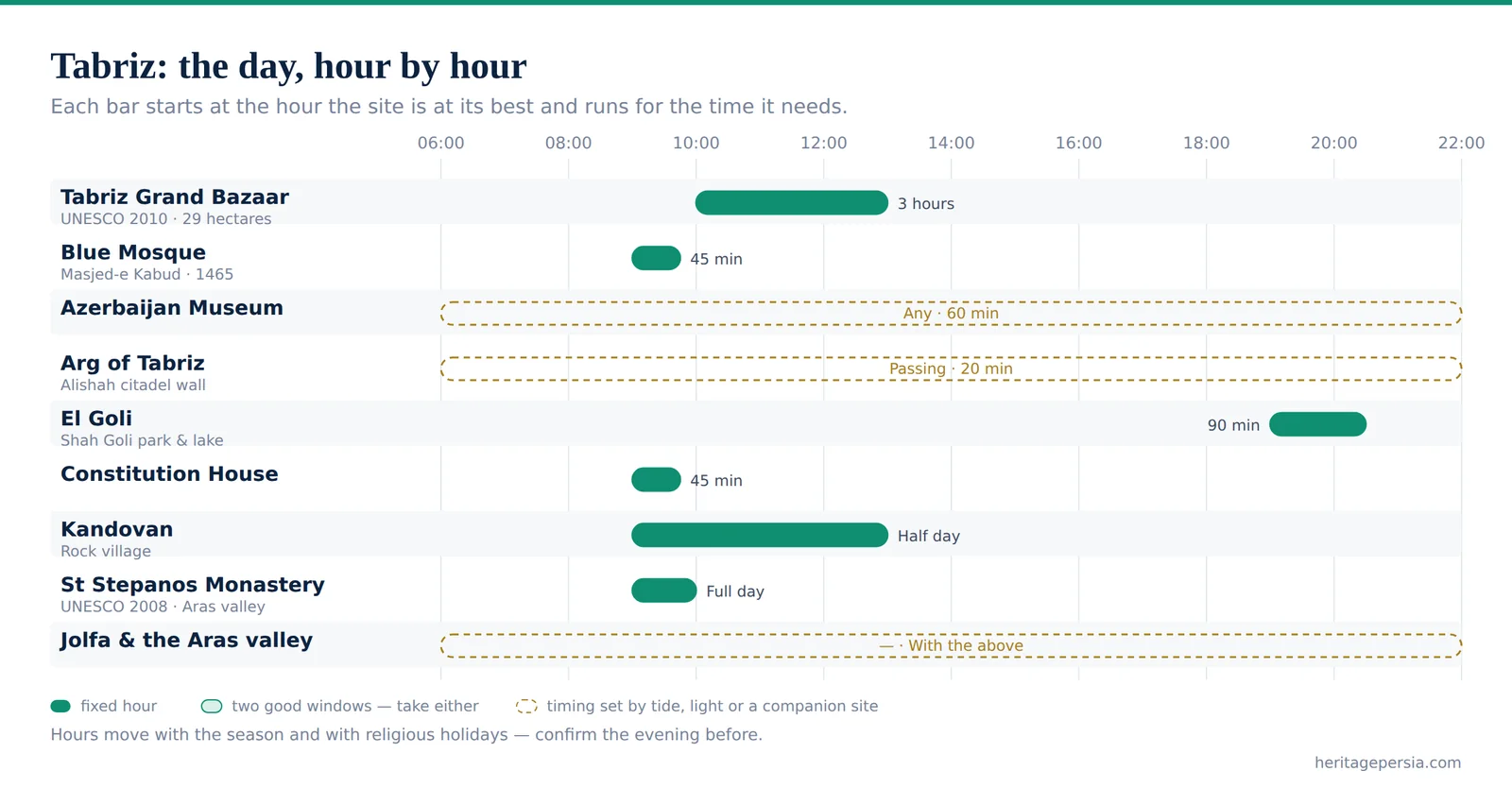
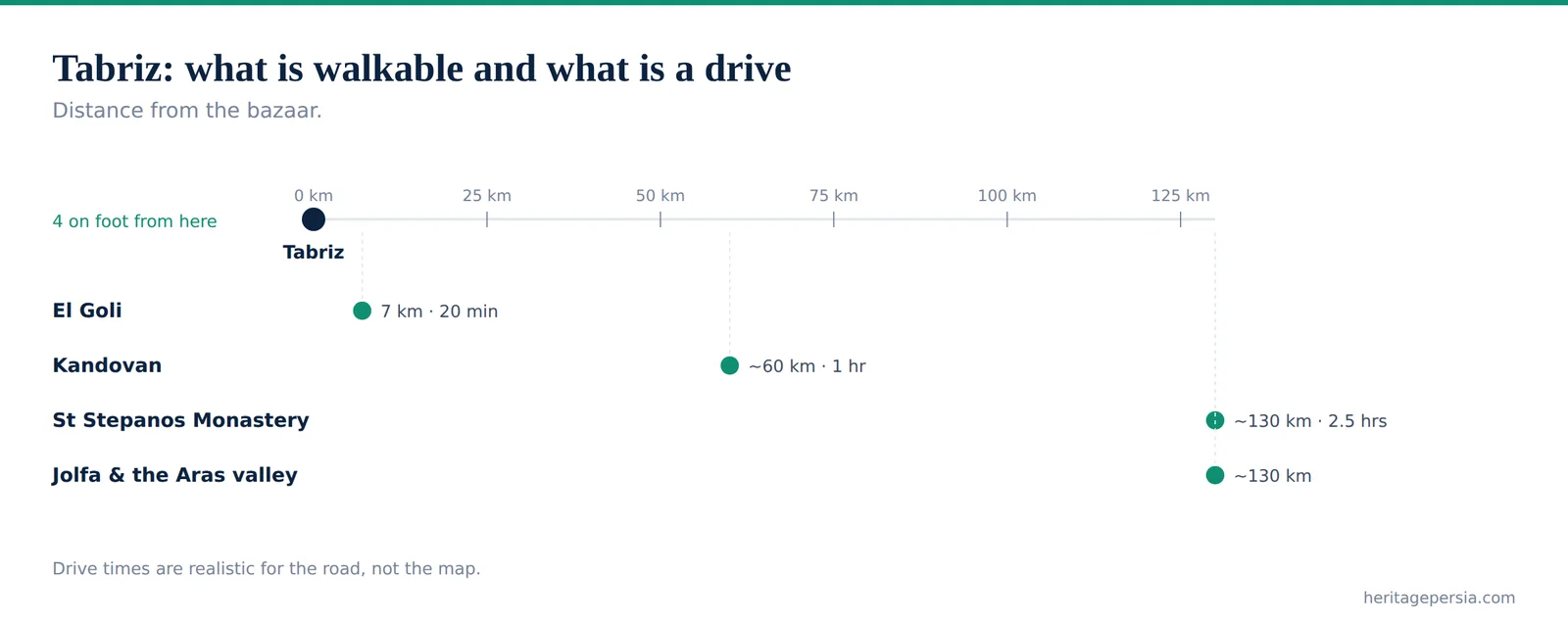
Times are realistic. Distances are from the bazaar, which is the centre of this city in every sense.
| Site | Time needed | Best hour | From the bazaar | Why that hour |
|---|---|---|---|---|
| Tabriz Grand Bazaar UNESCO 2010 · 29 hectares | 3 hours | 10:00 | You are in it | Fully open mid-morning, shuts for a long lunch, and Fridays are dead |
| Blue Mosque Masjed-e Kabud · 1465 | 45 min | Morning | 15 min walk | What survives of the tilework needs direct light to show its depth |
| Azerbaijan Museum | 60 min | Any | Next to the Blue Mosque | Archaeology of the northwest, and the sculpture basement is unexpected |
| Arg of Tabriz Alishah citadel wall | 20 min | Passing | 10 min walk | A single vast brick wall. Worth seeing, not worth planning around |
| El Goli Shah Goli park & lake | 90 min | Evening | 7 km · 20 min | Where the city walks after dark. The pavilion on the water is lit |
| Constitution House | 45 min | Morning | 5 min walk | The Constitutional Revolution began here; small and worth the context |
| Kandovan Rock village | Half day | Morning | ~60 km · 1 hr | Coach groups arrive after eleven and the lanes are narrow |
| St Stepanos Monastery UNESCO 2008 · Aras valley | Full day | Morning start | ~130 km · 2.5 hrs | A long drive through a gorge on the Armenian border — leave early |
| Jolfa & the Aras valley | With the above | — | ~130 km | The river is the frontier; the road along it is the reason to go |
Opening hours in Iran move with the season and with religious holidays, and the bazaar keeps commercial rather than tourist hours — closed over the long lunch and quiet on Fridays. Confirm at your hotel the night before.
The Bazaar Is the City
UNESCO inscribed the Tabriz Historic Bazaar Complex in 2010, and the citation makes the point that matters: this is not a monument with shops in it, it is one of the most complete surviving examples of a traditional Iranian commercial and social system. The property covers nearly twenty-nine hectares of interconnected brick halls, caravanserais, mosques, schools and baths, and between the twelfth and eighteenth centuries it was among the most important trading centres on the Silk Road.
It is also still, entirely, a working market. Nobody is selling you a miniature painting. The carpet section — Tabriz has been one of the great weaving centres for six hundred years — is the part to find, along with the domed timche halls where the light comes down from above onto stacks of rugs.
Allow three hours and expect to get lost, which here is harder to arrange than in Isfahan because the bazaar is busier and more purposeful. Tea is offered constantly. Accept on the second offer, per the usual rhythm — our culture guide covers how that exchange works.
The Blue Mosque, and What an Earthquake Did
The Blue Mosque was completed in October 1465 for the wife of Jahanshah of the Qara Qoyunlu, and in its day it carried tilework that contemporaries described as the finest in the Islamic world — dark blue hexagonal tiles with gilding, mosaic in geometric and floral patterns, calligraphy worked into the surface.
In 1780 an earthquake destroyed it, leaving essentially the entrance iwan standing. It lay in ruins for nearly two centuries, and its remains were quarried by locals in the nineteenth. Reconstruction began in 1973 and is still not complete.
So what you visit is a partial building in which surviving original tilework sits beside modern brick left deliberately plain, following the conservation principle that new work should be distinguishable from old. Some visitors find this unsatisfying. We find it the most honest building in the city — a structure that shows you exactly what was lost and refuses to pretend otherwise. Go in the morning and look at the fragments around the portal, which are the real thing.
Kandovan
About an hour south-west, on the slopes of Mount Sahand, a village is carved into cones of volcanic rock. Ash from ancient eruptions compacted into soft stone, water carved it into pinnacles, and people hollowed out the cones to live in — the local word for them is karaan. The comparison everyone reaches for is Cappadocia, and it is fair, with one difference that matters: Kandovan is still inhabited. Around four hundred and fifty people lived there at the last count, in houses their families have occupied for generations, with satellite dishes on the rock.
That is also the awkwardness of visiting. The lanes are narrow, the houses are homes, and by late morning coach groups are photographing through people's doorways. Go early, buy something from the stalls, ask before photographing anyone, and accept that you are a visitor in a village rather than a ticket-holder at a site. Half a day including the drive is right.
The Armenian Monasteries
The Armenian Monastic Ensembles of Iran were inscribed by UNESCO in 2008 and cover three sites in the northwest: St Thaddeus, whose oldest fabric dates to the seventh century, St Stepanos, and the Chapel of Dzordzor. They are the last substantially intact remains of Armenian Christian culture in this region and they are still places of pilgrimage rather than ruins.
From Tabriz, St Stepanos is the reachable one — roughly two and a half hours north-west, in a gorge above the Aras river which forms the border with Armenia and Azerbaijan. The drive along the river is a large part of the point. It is a full day from the city and it is the single most worthwhile thing in the region after the bazaar.
St Thaddeus, further south towards Maku, is better reached on a route that continues towards the Turkish border rather than as a day trip from Tabriz.
Who Should Actually Come
We would rather say this plainly than sell a leg that does not fit.
Come to Tabriz if
- You have fourteen days or more
- You have already done the classic route once
- You are travelling in July or August and want somewhere cool
- Carpets, bazaars or the Caucasus borderlands are your interest
- You are crossing to or from Turkey or Armenia by land
Leave it for next time if
- You have ten days or fewer
- This is a first visit and you want the famous architecture
- You are travelling between December and February
- You dislike long drives or extra internal flights
- You would be adding it alongside the Caspian in the same fortnight
The last point is the one we argue about most. Travellers with a fortnight often want the northwest and the Caspian, and the two together produce a week of driving. Choose one, do it properly, and leave the other for a second trip — our destinations overview sets out how the regions combine.
Eating in Tabriz
Azerbaijani cooking is its own tradition and Tabriz does it best. Koofteh Tabrizi is the local landmark — a meatball the size of a grapefruit, stuffed with dried fruit, walnuts and sometimes a whole boiled egg, served in broth and carved at the table. Dolmeh here is sweeter and more generous than the plateau version, and ash in its many forms is taken seriously.
The city is also the national capital of chocolate and confectionery, which surprises everybody — Tabrizi sweets are what Iranians bring home from here, along with dried fruit and nuts from the bazaar. Our food guide covers the national repertoire.
Practical Tabriz
Getting there. Fly. Tabriz is about 620 km from Tehran — roughly eight hours by road or a little over an hour in the air, and there are domestic flights several times a day. There is also an overnight train from Tehran, which is comfortable and a genuinely pleasant way to do it. Driving up from Isfahan or the south makes no sense.
Getting around. The bazaar, the Blue Mosque, the museum and the Constitution House are all walkable from one another. El Goli, Kandovan and the Aras valley need a car, and for the monasteries you want a driver for the day rather than a taxi.
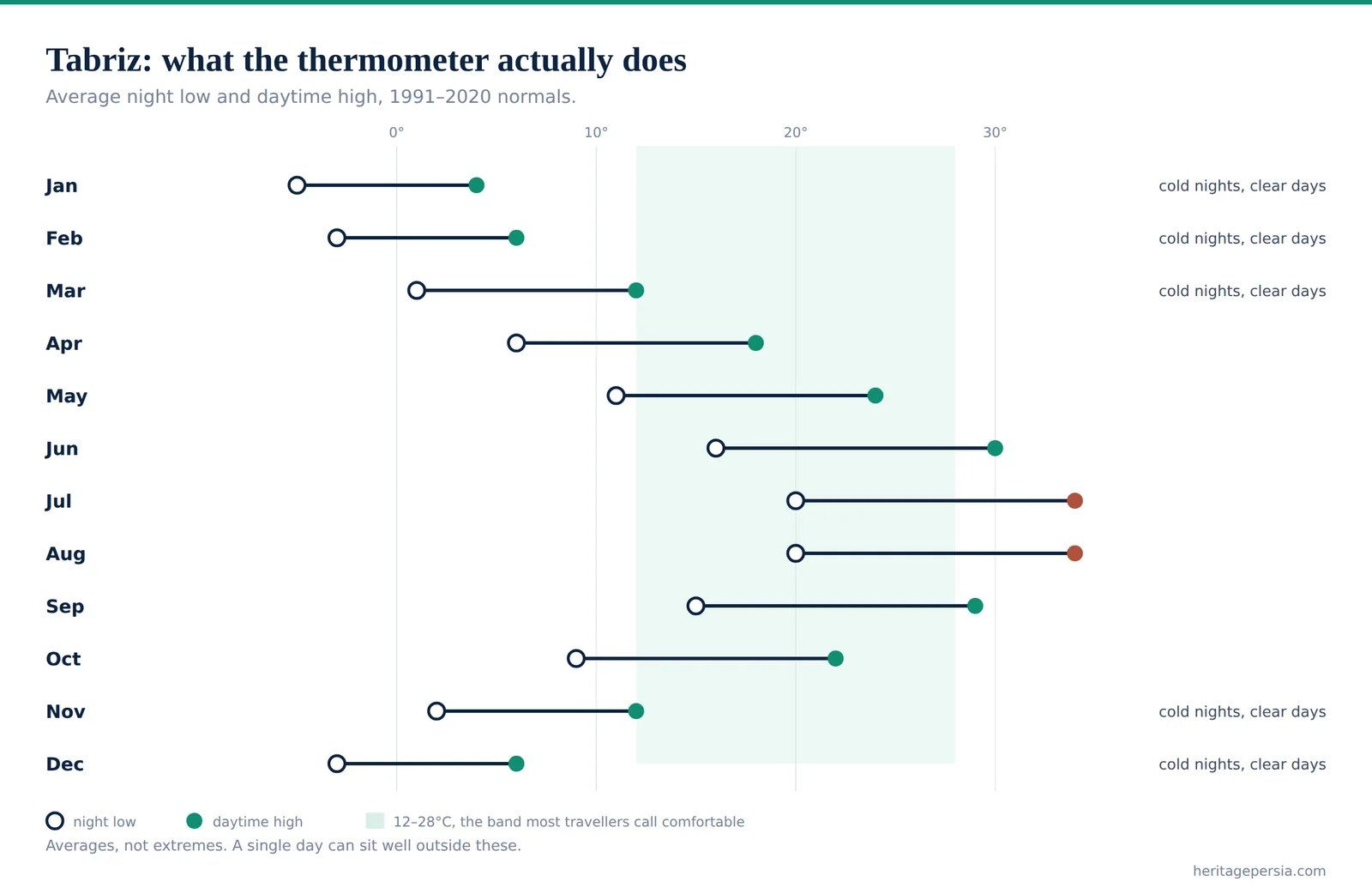
When to come. May to early October. Tabriz sits high and cold — January averages run from about −5°C to 4°C and the city gets real snow, while July is a comfortable 20°C to 34°C, which is why this is the sensible place to be in an Iranian summer when Yazd is at 40°C. See our month-by-month guide for the full picture.
Language. A word of Azerbaijani goes a very long way here. Sağ ol — thank you — will get you a better conversation than its Persian equivalent.
✉️ Thinking about the northwest? Tell us how many days you have in total and we will say honestly whether Tabriz fits, or whether it is the reason to come back. Talk to our team →
Continue reading
Frequently Asked Questions
What travellers ask our guides about Tabriz, answered on the ground.
The Northwest, Done Properly
Bazaar, Kandovan and the Aras valley — with an honest word on whether your trip has room.
Northern Itineraries →