
Iran is the size of Western Europe and contains at least five distinct countries. The plateau that carries the famous cities is dry and high and cold at night. Four hours north of Tehran the forest starts and it rains more than in London. The south-east is desert that has recorded some of the hottest ground temperatures ever measured, and the Gulf coast in February is a beach holiday.
Almost every visitor sees only the first of these, and for a first trip that is the right decision. This page is so that you make it deliberately.
The Five Irans
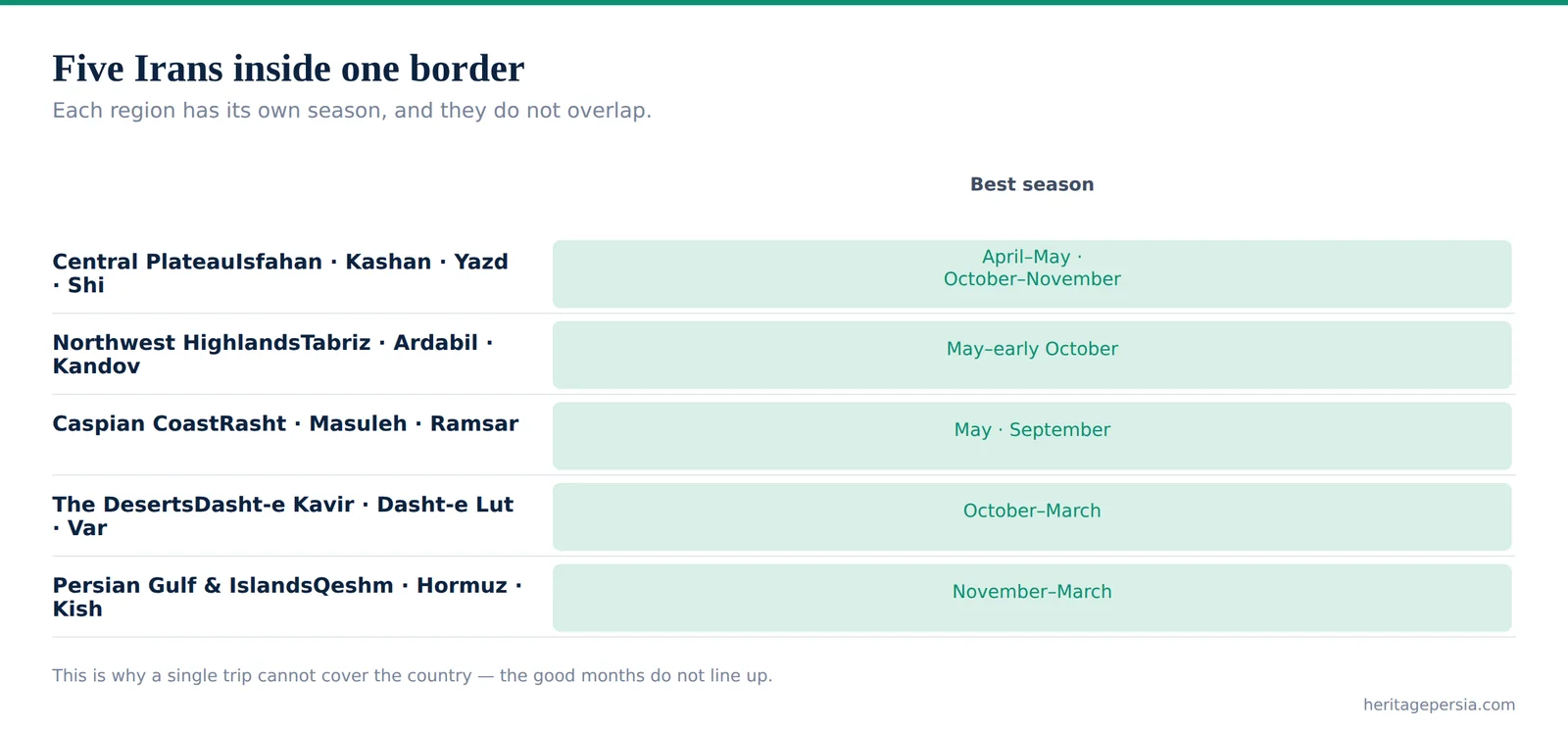
Choose the region before the cities. It decides your season more than anything else.
| Region | What it is | Best season |
|---|---|---|
| Central PlateauIsfahan · Kashan · Yazd · Shiraz | High, dry, 1,200–1,600 m. Hot days, cold nights, almost no rain. The classic route runs through it and so does most of the country’s architecture. | April–May · October–November |
| Northwest HighlandsTabriz · Ardabil · Kandovan | Genuinely cold — Tabriz averages below freezing in January. Green and mild exactly when the plateau is unbearable. | May–early October |
| Caspian CoastRasht · Masuleh · Ramsar | Humid, forested and wet: 1,383 mm of rain a year, roughly twice London’s. Rice paddies, tea terraces and the best vegetarian cooking in Iran. | May · September |
| The DesertsDasht-e Kavir · Dasht-e Lut · Varzaneh | Reached from Yazd, Kerman or Isfahan. The Lut has recorded some of the hottest land-surface temperatures ever measured. | October–March |
| Persian Gulf & IslandsQeshm · Hormuz · Kish · Bandar Abbas | Subtropical and humid. Unbearable in July, and the best winter beach weather in the region from December to February. | November–March |
Twelve Places, and How Long Each Needs
Days are what a place actually takes rather than the minimum it can be rushed in. Where we have a full guide, it is linked.
| Place | What it is for | Days | Season | |
|---|---|---|---|---|
| Isfahan | Safavid architecture at its peak | 3 days | Apr–May · Oct–Nov | Full guide |
| Shiraz | Poets, mirrors, and Persepolis an hour away | 3 days | April · Oct–Nov | Full guide |
| Yazd | Mud-brick old city, wind towers, Zoroastrian Iran | 2 days | Oct–Apr | Full guide |
| Tehran | Museums, modern Iran, the Alborz above it | 1–2 days | Apr–May · Oct | Guide coming |
| Kashan | Merchant houses, the Fin Garden, rose harvest in May | 1–2 days | Apr–May | Full guide |
| Tabriz | The great bazaar, Kandovan, a different Iran | 2 days | May–Oct | Full guide |
| Kerman & Mahan | Desert city, the Lut, a garden that ends a road | 2 days | Oct–Apr | Full guide |
| Qeshm & Hormuz | Red beaches, salt caves, mangroves | 3 days | Nov–Mar | Full guide |
| Rasht & Gilan | UNESCO City of Gastronomy, forest and rice | 2 days | May · Sep | Guide coming |
| Mashhad | The shrine city, and Khorasan’s saffron | 2 days | Apr–May · Oct | Full guide |
| Persepolis | The Achaemenid ceremonial capital | Half day | Oct–Apr | Full guide |
| Pasargadae | Cyrus the Great, on an open plain | Half day | Oct–Apr | Full guide |
Our Destination Guides
Eight cities have the full treatment — every site with the hour to arrive, tested itineraries, and the things no other guide will tell you. More follow.
How the Regions Combine
Ten days: the plateau only. Tehran, Kashan, Isfahan, Yazd, Shiraz — one region, five bases, no flying inside the country.
Fourteen days: the plateau plus one other. Either the desert properly, with two nights at Varzaneh or Kharanaq, or the Gulf islands with a flight south from Shiraz.
Three weeks: add the northwest around Tabriz, or the Caspian, and treat it as a second trip inside the first. Do not attempt both.
The mistake to avoid is a fortnight that touches four regions. Iranian distances are Europe-scale and the internal flights that make it look possible will cost you the mornings, which is when everything here is at its best.
The Places We Would Cut
Advice about where to go is worth very little without advice about what to drop, so here is ours, stated plainly and at some commercial cost to us.
Tehran, if your days are tight. It is a vast modern city with two genuinely excellent museums and a mountain range attached, and on a ten-day trip it is the first thing we cut. The National Museum is the one argument for staying — seeing the Achaemenid material before Persepolis changes what you understand when you arrive. One day covers it.
A fourth plateau city. Travellers who have read widely often want Kerman or Kermanshah added to Isfahan, Yazd and Shiraz. The result is another four-hour drive and a thinner version of what they already have. Spend the day in the city you are already in.
Two regions in a fortnight. The northwest and the Caspian are each a genuinely different country, and each rewards a week. Attempting both inside fourteen days produces a blur of internal flights and hotel lobbies.
Persepolis without Naqsh-e Rostam. This is the reverse — a cut we argue against. They are thirteen kilometres apart, most day trips skip the second, and four Achaemenid kings cut into a cliff above seven Sassanid reliefs is not a footnote to the first site.
The Order That Works
Run the classic route north to south — Tehran, Kashan, Isfahan, Yazd, Shiraz — rather than the reverse. Three reasons. The architecture builds rather than peaks early, since Isfahan after Shiraz is an anticlimax and Shiraz after Isfahan is a relief. The driving legs get shorter as you tire. And Shiraz has the better airport for leaving, which lets you fly open-jaw and save the day a return to Tehran costs you.
If you are adding the desert, put it between Isfahan and Yazd, where it sits geographically and where a night under that sky lands hardest — after the cities, before the mud-brick one.
The other two hubs
Ask Us Directly
Tell us your dates and what you care about. We answer with an honest plan — including the parts we would cut.
Talk to Our Team →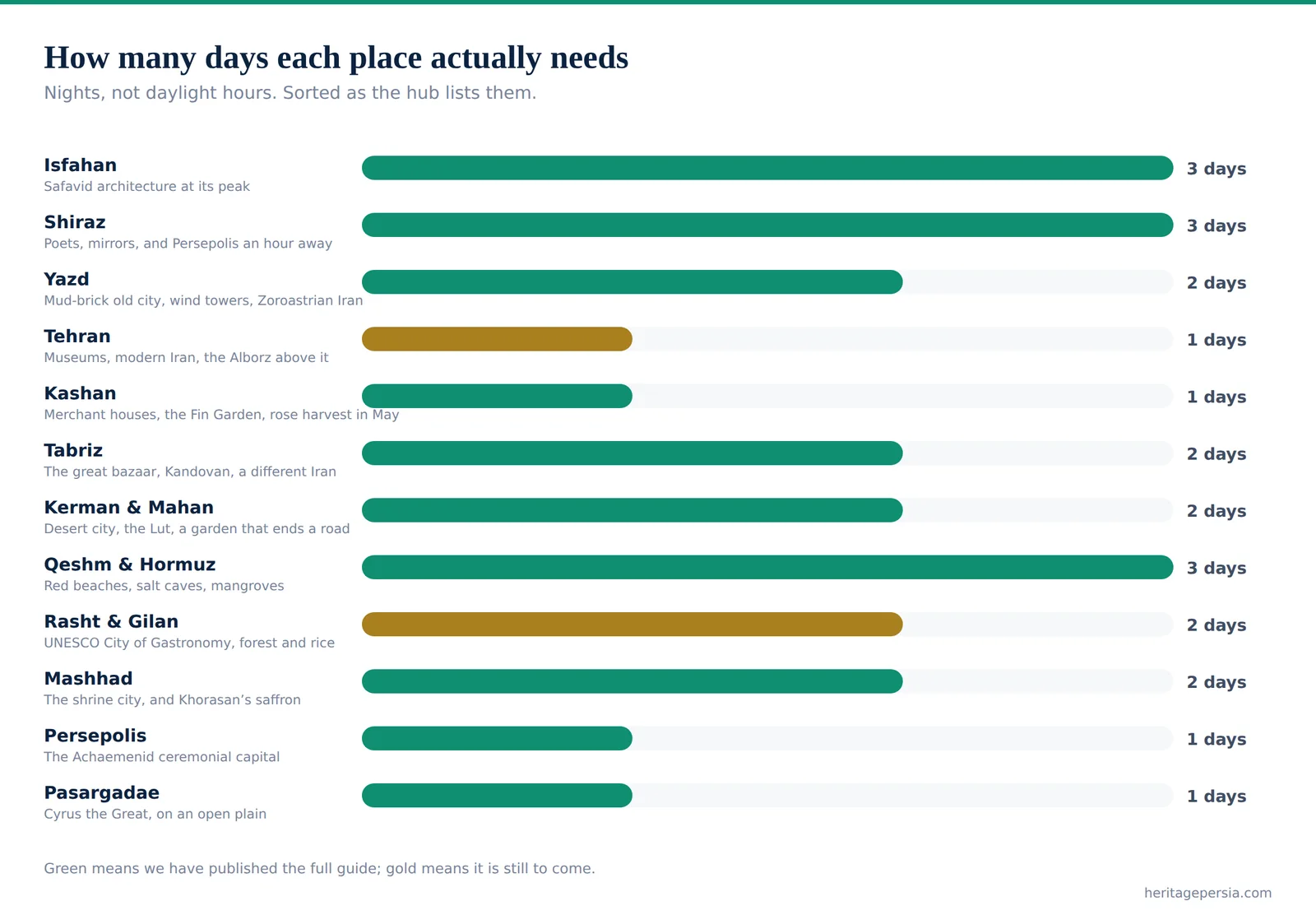
Part ofPlan Your Iran Trip · Persian Culture