
Most itineraries treat Shiraz as a hotel with an airport, ninety minutes from Persepolis. Travellers land in the afternoon, drive out to the ruins the next morning, come back, and fly on. They see one of the greatest archaeological sites on earth and almost nothing of the city they slept in.
This is our home. Our office is here, most of our guides live here, and we would argue — with the bias fully declared — that Shiraz is the most likeable city in Iran to spend time in. It is where Iranians go to read poetry aloud at midnight, where the orange trees flower in April and the whole city smells of it, and where the country's finest single interior sits down an unmarked lane that most tour buses drive straight past.
Persepolis gets its section below, properly and with the logistics that make it work. Everything before that is the city.
Before you plan anything: this is a guide to the city, written to be useful whenever you are able to use it. Whether to travel to Iran at present is a separate question with a different answer — see our current situation report, reviewed 10 September 2026.
Why Shiraz Is Not Just a Base
Isfahan overwhelms you. Yazd bewilders you. Shiraz, in the phrase our guides use with clients, lets you off — it is lower, warmer, greener and slower than anywhere else on the classic route, and it is the only Iranian city where the principal monuments are the graves of two poets rather than a mosque or a palace.
That last fact tells you what kind of place this is. Hafez died here in 1390 and Saadi about a century earlier, and their tombs are not solemn museum pieces. They are gardens full of Iranians on a Thursday evening, reading, arguing, taking a line at random from the Divan as a form of fortune-telling, and occasionally weeping. Poetry in Iran is not a school subject. In Shiraz you see what it actually is.
Add the finest Qajar interior in the country, a Zand-dynasty citadel and bazaar in the middle of town, gardens that carry a UNESCO inscription, one of Shia Islam's holiest shrines, and — an hour up the road — the ceremonial capital of the Achaemenid empire. Three days is right. Two will do it if you are disciplined.
Every Site, With the Hour to Arrive
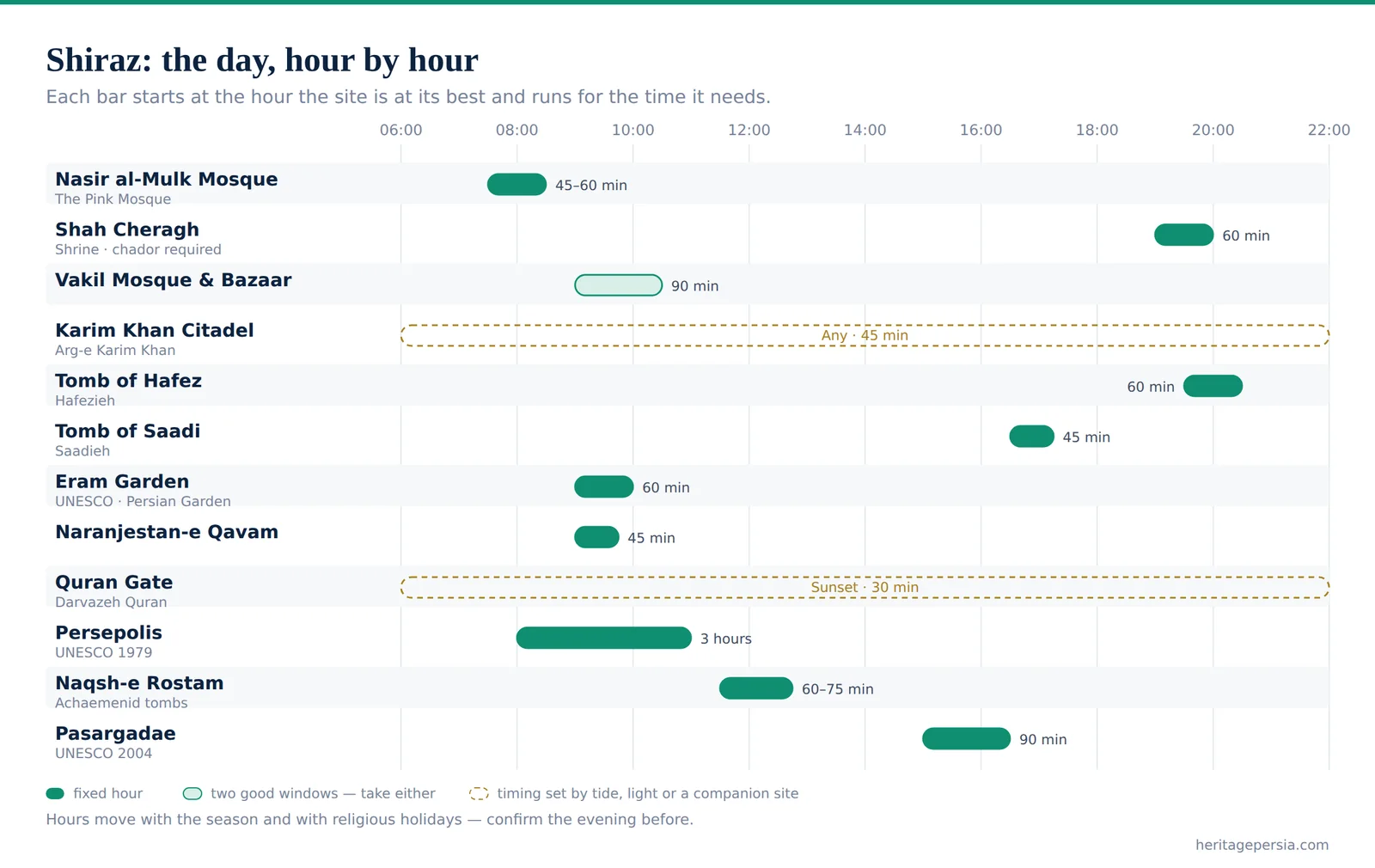
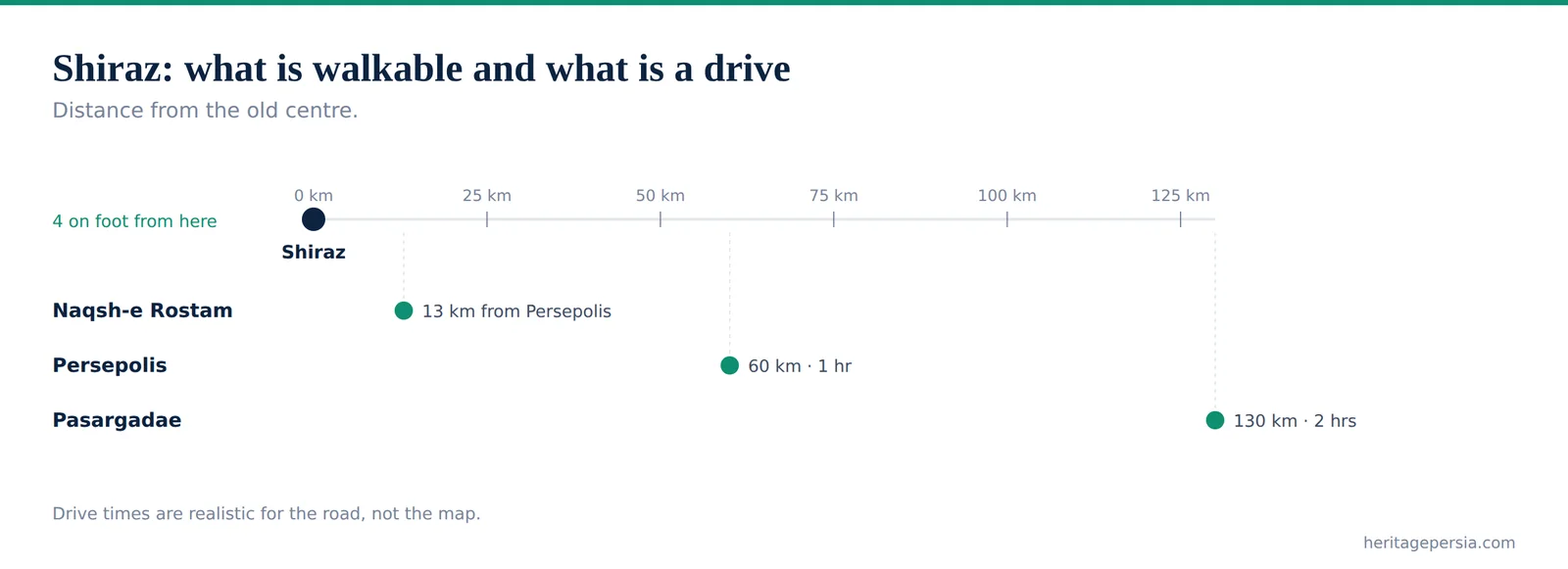
The same table we built for Isfahan, for our own city. Times are realistic and assume you look up rather than tick off. Distances are from the Karim Khan Citadel, which is as close to a centre as Shiraz has.
| Site | Time needed | Best hour | From the citadel | Why that hour |
|---|---|---|---|---|
| Nasir al-Mulk Mosque The Pink Mosque | 45–60 min | 07:30 | 10 min walk | The stained glass throws colour across the floor for roughly ninety minutes after sunrise, then it is over for the day |
| Shah Cheragh Shrine · chador required | 60 min | Evening | 10 min walk | Lit after dark, and the mirror-work is at its most extraordinary under artificial light |
| Vakil Mosque & Bazaar | 90 min | 09:00 or 17:00 | On the doorstep | The bazaar closes for a long lunch; the mosque's spiral columns need side light |
| Karim Khan Citadel Arg-e Karim Khan | 45 min | Any | — | Small, central, and the leaning tower makes more sense in person than in photographs |
| Tomb of Hafez Hafezieh | 60 min | After dark | 15 min taxi | Evening is when Iranians come. Daytime gives you a pretty garden and none of the point |
| Tomb of Saadi Saadieh | 45 min | Late afternoon | 20 min taxi | Quieter than Hafez, with a spring-fed fish pool below the tomb |
| Eram Garden UNESCO · Persian Garden | 60 min | Morning | 15 min taxi | Cypress avenues and a Qajar pavilion; hot and shadeless by midday |
| Naranjestan-e Qavam | 45 min | Morning | 10 min walk | A small Qajar house of extravagant decoration, with orange trees in the courtyard |
| Quran Gate Darvazeh Quran | 30 min | Sunset | 20 min taxi | The old northern entrance to the city, with the whole of Shiraz below you as the lights come on |
| Persepolis UNESCO 1979 | 3 hours | 08:00 | 60 km · 1 hr | Shadeless and fully exposed. By eleven in summer it is punishing |
| Naqsh-e Rostam Achaemenid tombs | 60–75 min | 11:30 | 13 km from Persepolis | Combine with Persepolis in one trip; the cliff faces west, so late morning lights the reliefs |
| Pasargadae UNESCO 2004 | 90 min | Afternoon | 130 km · 2 hrs | Only worth adding if you have a full day or are driving on towards Yazd |
Opening hours in Iran shift with the season and with religious holidays, and shrines close to visitors during prayers. We have given the hour that makes each site best rather than a schedule that will be wrong by the time you read it — confirm the day's hours at your hotel the night before.
The Pink Mosque, and the Ninety Minutes That Matter
Nasir al-Mulk was built between 1876 and 1888 for a Qajar aristocrat, and from the street it is unremarkable enough that visitors walk past the door. Inside the western prayer hall, a wall of stained glass faces east across a room of twisted columns and painted vaults.
For roughly ninety minutes after sunrise, the light comes through that glass and lies on the carpets in slabs of red, blue and yellow that move as you watch. By mid-morning it has climbed the walls and gone. Every photograph you have seen of this building was taken in that window, which is why the courtyard fills with tripods before the doors open.
💡 What our guides actually do: arrive at opening, spend the first fifteen minutes in the courtyard letting the crowd go in and cluster at the famous spot, then enter and work from the back of the hall forwards. You get the same light with none of the queue, and the room empties again by nine. In winter the effect is better, not worse — the sun sits lower and the colour reaches further into the room.
Shah Cheragh After Dark
Shah Cheragh is the funerary shrine of Ahmad ibn Musa, brother of the eighth Shia Imam, who died here in the ninth century. The building around him has been rebuilt repeatedly since the thirteenth century, and the interior is entirely surfaced in cut mirror — hundreds of thousands of fragments set at angles, so that a single chandelier becomes a room full of moving light.
It is a working shrine and one of the holiest sites in Shia Islam, not a monument. Visitors are welcome and are usually met by a guide from the shrine's own office who will show you round. Women are lent a chador at the entrance; men need long sleeves and trousers. Photography rules vary and you should ask rather than assume. Go in the evening, and understand that you are a guest in someone's place of grief and devotion rather than a tourist at a sight.
The Poets — Why Iranians Come to Shiraz
If you visit one thing in this city in the evening, make it Hafez's tomb. Hafez died in Shiraz in 1390 and is buried under an open pavilion in a garden of cypress and orange trees. What happens there on any given night is the reason to come: families arrive after dinner, sit on the marble around the tomb, and read. Someone will open the Divan at random and read the poem aloud as an answer to a question they were holding — the practice is called fal-e Hafez, and Iranians of every disposition take it more seriously than they will admit.
You will be offered a turn. Take it. Somebody will translate, badly and enthusiastically, and it will be the part of your trip you describe first when you get home.
Saadi's tomb, twenty minutes further out, is quieter and less visited, with a spring-fed pool of fish below the mausoleum. Saadi died around 1292 and his Golestan is the book Iranian children still learn from; the line about the sons of Adam being limbs of one body is carved at the United Nations. Come here in the late afternoon when the light is long and there is nobody about.
Persepolis, Done Properly
Darius I founded Persepolis in 518 BC as the ceremonial capital of the Achaemenid empire, and Xerxes and Artaxerxes built on after him. It was inscribed by UNESCO in 1979. What survives is a terrace the size of a small town carrying the remains of the Apadana audience hall, the Gate of All Nations with its winged bulls, the Hundred-Column Hall, and staircases carved with delegations from twenty-three subject nations bringing tribute — Ethiopians with an okapi, Armenians with a horse, Indians with gold dust.
The columns are the detail to look for. The Achaemenids roofed these halls in cedar rather than stone, which let them build columns twenty metres tall and only about 1.6 metres thick — proportions no Greek or Egyptian architect could attempt. Standing under the surviving ones tells you more about that empire than any museum label.
The day that works
Leave Shiraz at seven. Persepolis is about an hour north and the site is entirely shadeless — in summer the stone is unbearable by eleven, and even in October you want the first two hours. Give it three hours.
Then drive thirteen kilometres to Naqsh-e Rostam, which most day trips skip and which we consider unmissable. Four Achaemenid kings — Darius I, Xerxes I, Artaxerxes I and Darius II — are cut into a cliff face high above the ground, and beneath them are seven Sassanid reliefs carved eight centuries later, including Shapur I on horseback with the captured Roman emperor Valerian kneeling before him. Two empires, one wall, and a deliberate act of political theatre by the later one. Allow an hour and go at about half past eleven, when the cliff takes the light.
Lunch in Marvdasht on the way back puts you in Shiraz by mid-afternoon. Pasargadae, the earlier capital and the burial place of Cyrus the Great, is a further two hours out and inscribed separately in 2004; add it only if you have a full day for it, or catch it on the road north towards Yazd, which is how our itineraries usually handle it.
Four UNESCO Inscriptions Within Two Hours
Fars province is unusually dense in this respect, and few visitors realise how much sits within a morning's drive.
| Inscription | Year | What it is | From Shiraz |
|---|---|---|---|
| Persepolis | 1979 | Achaemenid ceremonial capital founded by Darius I in 518 BC | 60 km |
| Pasargadae | 2004 | First Achaemenid capital and the tomb of Cyrus the Great, across 160 hectares | 130 km |
| Eram Garden within The Persian Garden | 2011 | One of the nine gardens in the inscription, with a Qajar pavilion and cypress avenues | In the city |
| Sassanid Landscape of Fars | 2018 | Eight sites at Firuzabad, Bishapur and Sarvestan — palaces, fortifications and the circular city of Ardashir Khurreh | 110–130 km |
The Sassanid sites are the ones almost nobody visits, and they are the missing link in the story — Ardashir's circular city at Firuzabad and the chahar-taq form, four arches around a square space, that Islamic architecture later took and used everywhere. A full day with a driver covers Firuzabad and Sarvestan and you will have them to yourself.
Two and Three Day Itineraries
Two days
Day one: Nasir al-Mulk at 07:30, Naranjestan afterwards, Vakil Mosque and the bazaar until lunch, the citadel, then Hafez's tomb after dark. Day two: Persepolis at eight, Naqsh-e Rostam at eleven-thirty, back for a late lunch, Shah Cheragh in the evening.
Three days
As above, with a third day for Eram Garden in the morning, Saadi's tomb in the late afternoon, the Quran Gate at sunset — or, if ruins are what move you, a full day out to Firuzabad and the Sassanid sites with a driver. The third day is also when to do nothing in particular in a garden, which in this city is a legitimate use of a morning.
Eating in Shiraz
Faloodeh first. Frozen rice-flour vermicelli in rosewater syrup with lime squeezed over it — one of the oldest frozen desserts in the world, sold from dedicated shops all over the city, and eaten after dinner. It is the single food travellers most often tell us they miss afterwards.
Kalam polo is the local rice dish, made with cabbage, herbs and small meatballs, and Shirazi salad — cucumber, tomato, onion and dried mint, cut very fine — is claimed by this city and eaten by the whole country. For the wider repertoire, our food guide covers the twenty dishes worth ordering nationally.
Where to Stay
Stay in the historic centre, within walking distance of the citadel, the bazaar and the Pink Mosque. Being able to reach Nasir al-Mulk at half past seven on foot is worth more than any hotel feature, and several restored Qajar houses in the lanes near the mosque have been converted into small hotels with courtyards and orange trees. The larger international-standard hotels sit further north around Zand Boulevard and towards Eram, comfortable and characterless, with a ten-minute taxi to everything. Hostels cluster near the bazaar.
Practical Shiraz
Getting there. Shiraz has the country's main southern airport with domestic flights to Tehran, Mashhad and the islands, and is the usual southern end of the classic route — about five to six hours by road from Isfahan, with intercity buses running the leg overnight.
Getting around. The historic centre is walkable. Everything else — the tombs, the gardens, the Quran Gate — is a short taxi, and fares should be agreed before you get in. The metro runs but reaches few of the places visitors want.
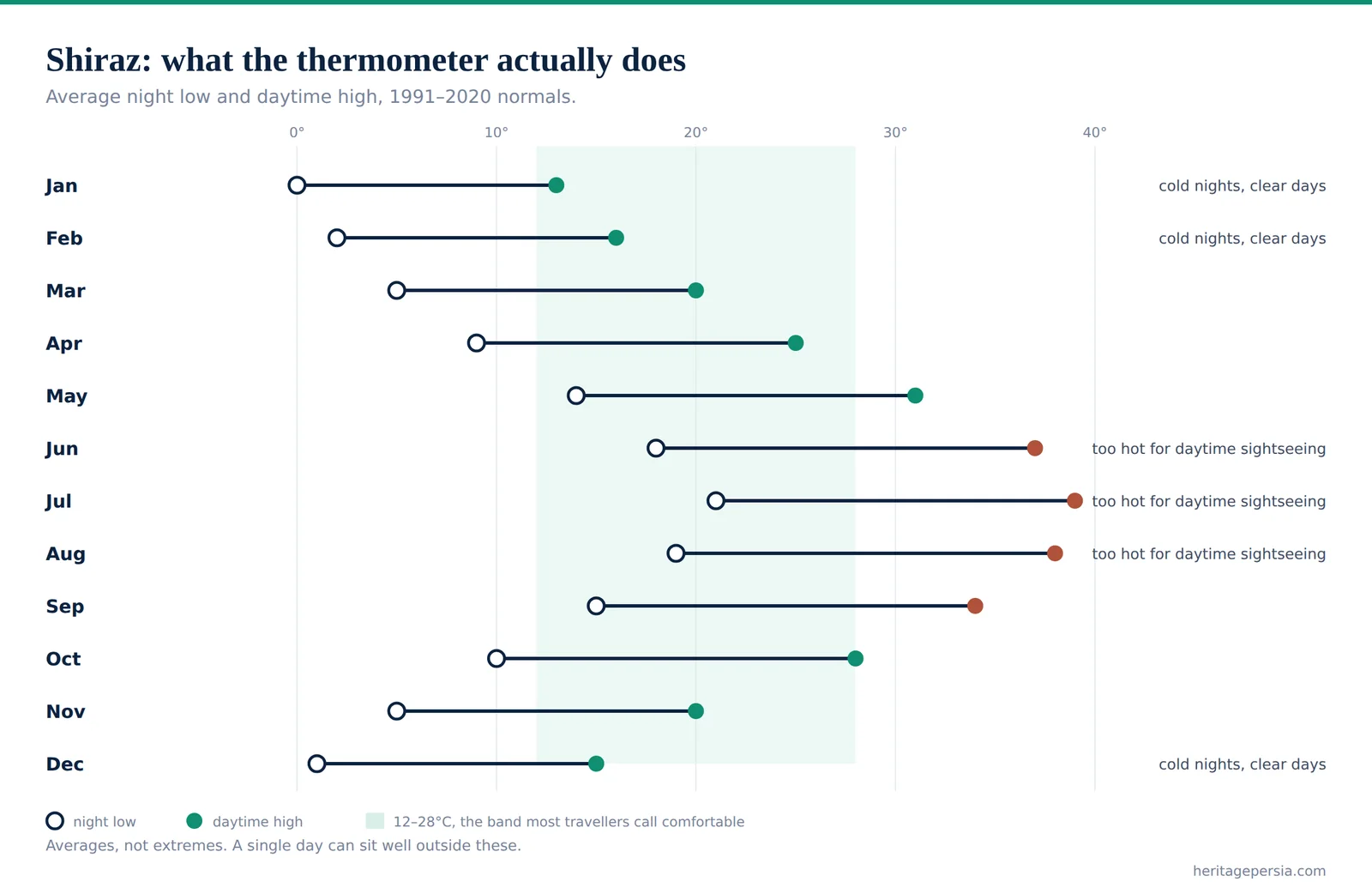
When to come. April, for the orange blossom. Shiraz is planted with bitter orange trees along whole streets, they flower in early spring, and for about three weeks the city smells of it in a way that people plan trips around. Otherwise October and November, when the light is long and the heat has gone. July and August are hot but survivable at 1,500 metres, and winter is mild — our month-by-month guide has the numbers.
Dress. Modest dress applies at all religious sites and a chador is lent at Shah Cheragh — see our dress code guide for what that means in practice.
✉️ Planning Shiraz into a longer route? We are based here, which means we know which guide to send you out to Persepolis with and which restaurant is worth the taxi. Tell us your dates and we will build the days around the hours in the table above. Talk to our team →
Continue reading
Frequently Asked Questions
What travellers ask us about Shiraz, answered by the guides who live here.
See Shiraz With Someone Who Lives Here
The right hour at the Pink Mosque, Naqsh-e Rostam as well as Persepolis, and Hafez's tomb after dark.
Our Fars Itineraries →