
Everything most people picture when they think of Iran — dry light, mud brick, wind towers, the colour of sand — stops at the Alborz. Drive north over the range from Tehran and in under three hours you are in temperate rainforest: rice terraces, tea gardens, wooden houses on stilts, and a forest that predates the last ice age.
Gilan is the province Iranians go on holiday to and foreign visitors almost never see. It has a UNESCO natural inscription, a capital that UNESCO separately named a City of Gastronomy, and the best regional cooking in the country. It also rains, which is the whole reason for the rest of it.
Before you plan anything: this is a destination guide, written to be useful whenever you are able to use it. Whether to travel to Iran at present is a separate question with a different answer — see our current situation report, reviewed 12 September 2026.
The Forest Is the Reason
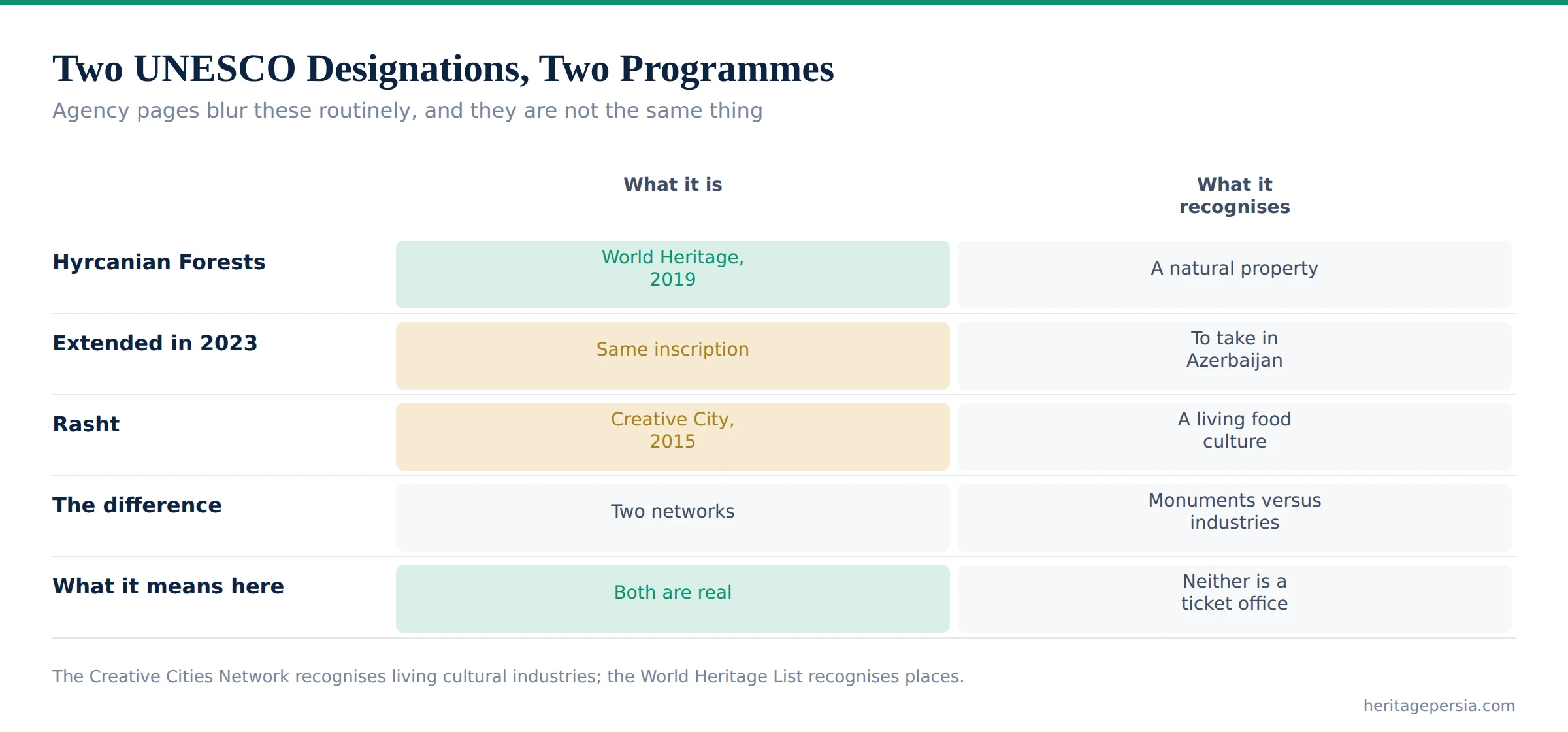
The Hyrcanian forests run in a strip along the southern shore of the Caspian, between the sea and the Alborz, across five Iranian provinces. UNESCO inscribed them in 2019 and extended the inscription in 2023 to take in the Azerbaijani portion.
What makes them a World Heritage site is age and isolation. When the ice sheets came, the Alborz sheltered this strip and the broadleaf forest survived here after it had been wiped from the rest of the region — so this is a living relic rather than a regrown woodland, and the species list shows it: no native conifers at all, oriental beech dominant, nearly three hundred bird species and close to a hundred mammals.
There is no gate and no ticket office. The forest is the landscape you drive through, and the way to experience it is a walk from a mountain village, a night in a forest guesthouse, or the road over the pass — which is itself one of the great drives in Iran.
Every Site, With the Hour to Go
| Site | What it is | Time | From Rasht | Best hour |
|---|---|---|---|---|
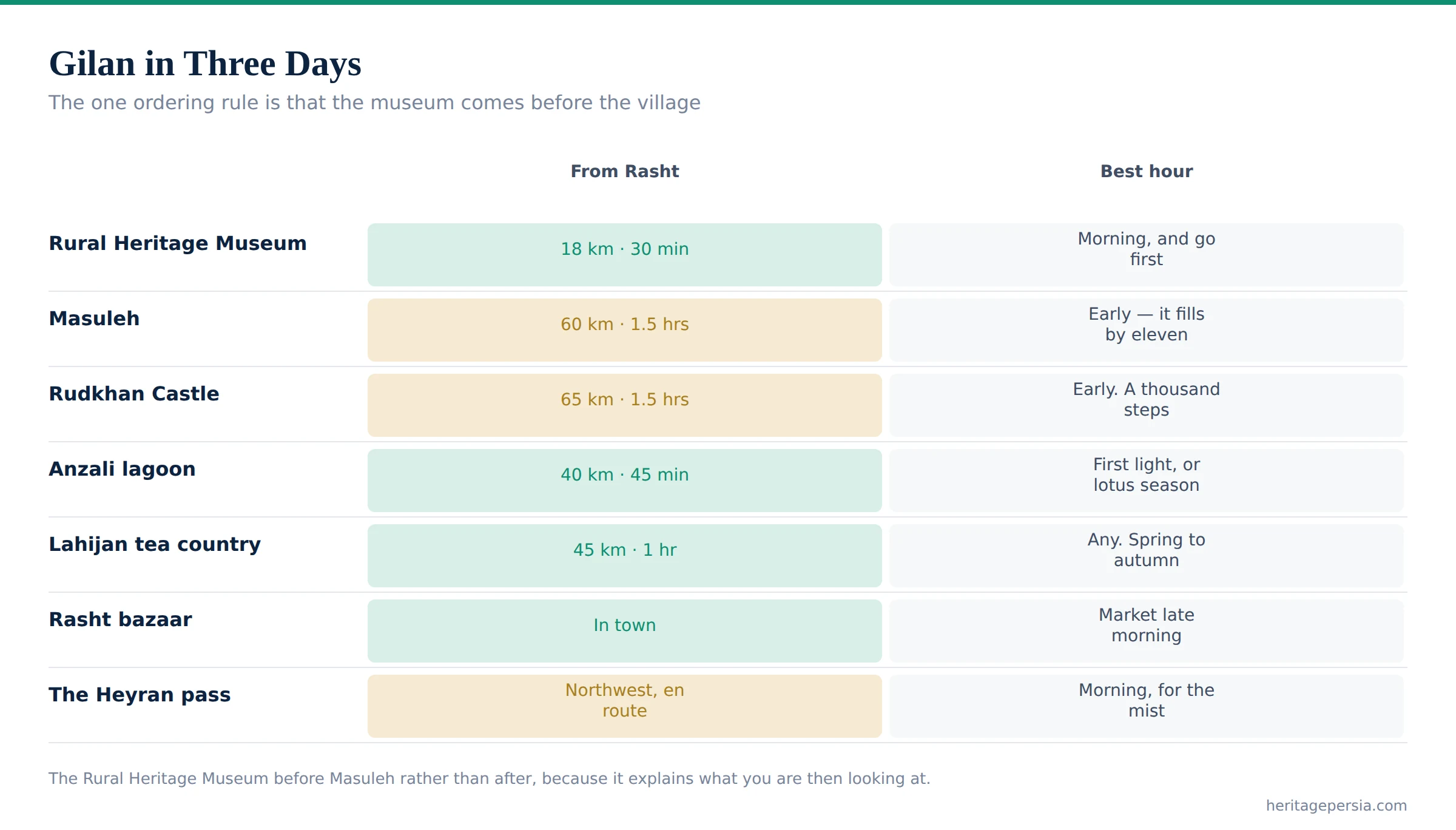
| Masuleh | A stepped village on a mountainside where each house’s roof is the street for the row above | Half a day | 60 km · 1.5 hrs | Early. It fills with domestic visitors by eleven and empties at dusk |
| Rasht bazaar and the food streets | The working market of a UNESCO City of Gastronomy | 2–3 hrs | In town | Late morning for the market, evening for eating |
| Rudkhan Castle | A Seljuk fortress in the forest, reached by about a thousand steps | Half a day | 65 km · 1.5 hrs | Early morning. The climb is long and the forest is humid |
| Anzali lagoon | A wetland of international importance, visited by boat, with lotus in season | 2 hrs | 40 km · 45 min | First light for birds; July–August for the lotus |
| The Rural Heritage Museum Saravan, outside Rasht | Gilaki timber houses moved and rebuilt in forest — the best single explanation of the region | 2 hrs | 18 km · 30 min | Morning, and before the villages, not after |
| The Heyran pass | Forest road climbing toward Ardabil, often above the cloud | Half a day | Northwest, en route | Morning, when the mist sits in the valleys |
| Qaleh Rudkhan to Lahijan tea country | Terraced tea gardens and the first tea factory in Iran | Half a day | 45 km · 1 hr | Any. The harvest runs spring to early autumn |
Three days covers this at a Gilaki pace, which is slower than the plateau. The one ordering rule that matters: the Rural Heritage Museum before Masuleh rather than after, because it explains what you are then looking at.
The Food, Which Is the Other Reason
UNESCO named Rasht a Creative City of Gastronomy in December 2015. That is a different programme from the World Heritage List and it is worth being clear about the distinction, because agency pages routinely blur the two — the Creative Cities Network recognises living cultural industries, not monuments.
What it recognises here is a regional cuisine that has almost nothing in common with the kebab-and-saffron-rice picture of Iranian food. Gilan cooks with sour, with walnuts, with pomegranate molasses, with garlic and with herbs in quantities the plateau does not use.
The dishes to find: mirza ghasemi, smoked aubergine with garlic, tomato and egg; baghali ghatogh, broad beans with dill and egg; fesenjan, which exists countrywide and is at home here; and torsh-e tareh, a sour herb stew that travels nowhere else. Rice is the staple rather than an accompaniment, and it is grown in the fields you drove past.
Our food guide maps the country, and this is the region where that map stops applying — which is also true for vegetarians, for whom Gilan is the easiest province in Iran.
The Rain Is Not a Drawback
Gilan is the wettest province in Iran and it rains in every month. Visitors treat this as a problem and locals treat it as the reason the province looks the way it does.
The practical shape of it: July and August average thirty to thirty-one degrees with high humidity, which is the coolest inhabited air in the country and why Iranians escape here. Autumn is the most beautiful season and the wettest. Winter is mild by Iranian standards, grey, and the mountain villages get snow. Spring is green and unpredictable.
Bring a waterproof shell in any month and accept that the views come and go. A morning of mist in the forest is not a failed day here; it is the thing itself.
How It Fits a Trip
As three days from Tehran. The road over the Alborz takes about three to four hours and the drive is half the experience. This is how most people should do it.
On a summer route. Gilan is on the warm-season version of our 21-day itinerary and nowhere on the winter one, for the straightforward reason that the mountain passes and the forest are at their best now.
Toward Tabriz. The Heyran pass climbs from Gilan toward Ardabil and on to the northwest, which turns two separate regions into one continuous route.
Not with the classic corridor in ten days. Gilan pulls north and Isfahan pulls south, and doing both in ten days means doing neither. Our ten-day guide explains the arithmetic.
Practical Notes
Getting there. Three to four hours by road from Tehran over the Alborz, or a short flight to Rasht. The Chalus road is the scenic one and the slowest.
Stay in a village, not the city. Rasht is a working provincial capital; the guesthouses in the forest villages are where the region is. Our accommodation guide covers eco-lodges and homestays.
The domestic season is the crowd. Gilan is busy with Iranian holidaymakers in high summer and at Nowruz; midweek and shoulder season it empties.
Footwear matters more than usual. Rudkhan is a thousand steps and the forest paths are wet — the packing list covers what does not exist locally.
Gilaki is spoken alongside Persian, and the accent is strong. Your Persian phrases still work; see the phrasebook.
✉️ Thinking about the north? Tell us your month and we will say whether Gilan works alone, with the northwest, or as the cool half of a summer trip. Talk to our team →
Continue reading
Frequently Asked Questions
What travellers ask our guides, answered on the ground.
The Cool Half of a Summer Trip
Tell us your month and we will say whether Gilan works alone, with the northwest, or as the north half of a longer route.
See Northern Routes →