
Hormuz is a small island eight kilometres off Bandar Abbas where the ground is red, ochre, yellow, purple and silver, and where the red part is an ingredient. Local cooks use it — gelack, the edible soil — in bread and in a sauce served with fish, which is the detail that tends to stop people mid-sentence.
The island is a salt dome: a plug of ancient evaporite forced up through the crust, carrying with it the mineral beds that give the surface its colours. That is the whole explanation for everything visitors photograph here, and knowing it turns a strange-looking place into a legible one.
Before you plan anything: this is a destination guide, written to be useful whenever you are able to use it. Whether to travel to Iran at present is a separate question with a different answer — see our current situation report, reviewed 10 September 2026.
One Fact Explains the Whole Island
Hormuz is a salt diapir. Deep beds of salt laid down when this was a shallow evaporating sea are less dense than the rock above them, and over millions of years they rise — slowly, plastically, like a column of toothpaste pushing upwards through the crust. Where a dome reaches the surface it brings everything trapped within it up too.
That is why the island looks the way it does. The rising salt has carried up iron oxides, which give the reds and ochres; other mineral beds give the yellows, the purples, the greens and the silvery greys. More than seventy distinct shades have been counted in the valley that has taken the name Rainbow. The salt itself surfaces as caves and glassy grey outcrops.
It also explains the beach. The famous red sand is not sand in the ordinary sense but iron-rich material weathered off the hills and washed down, which is why the sea runs red at the waterline after rain and why the colour is not uniform along the shore.
The island is small — about forty square kilometres, with five to six thousand residents, most of them fishing or building boats. It can be circled by road in an hour, which is what makes two unhurried days the right length rather than a week.
Every Site, With the Hour to Go
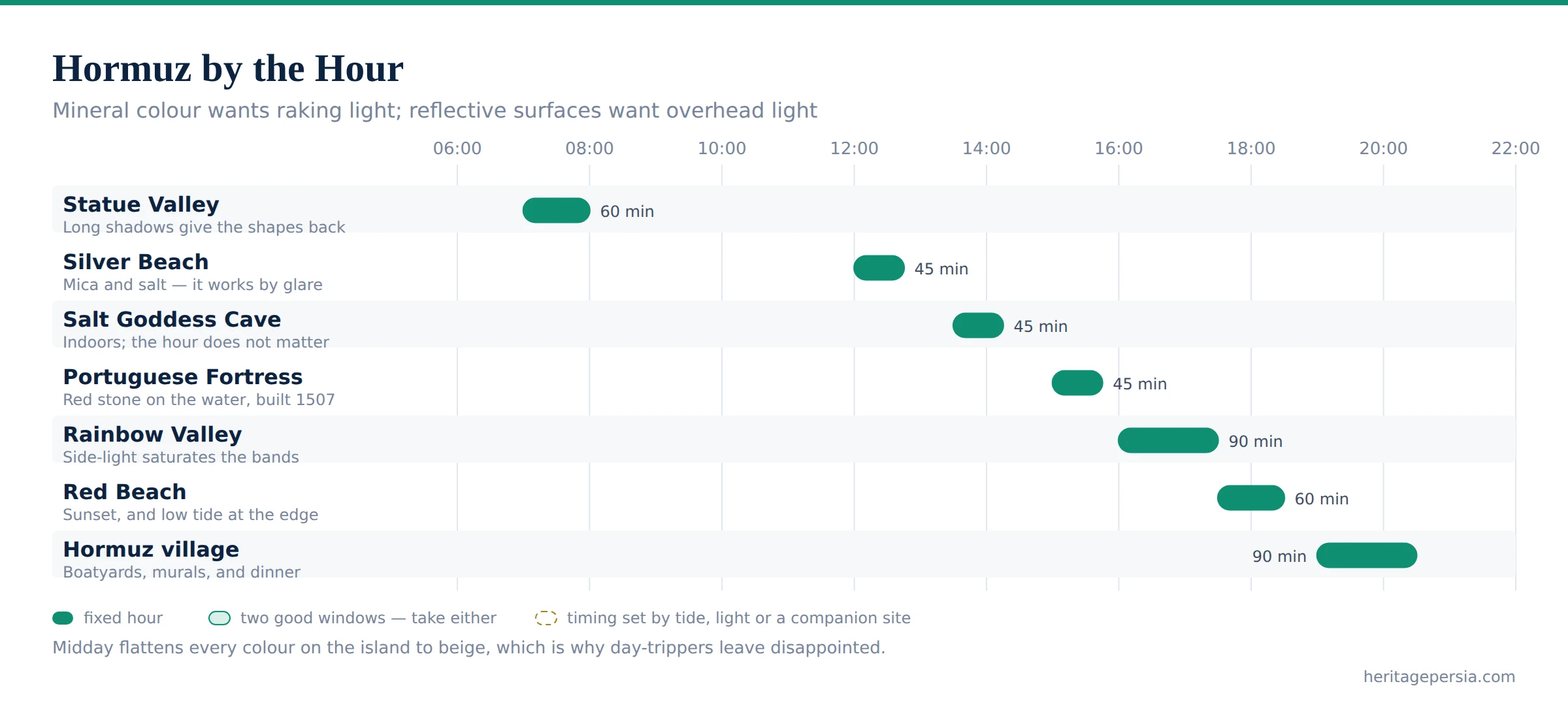
Colour is the whole point here, so the hour matters more than at almost any site in Iran.
| Site | What it is | Time | Arrive | Why then |
|---|---|---|---|---|
| Rainbow Valley Dare-ye Rangin Kaman | Over seventy mineral shades in eroded badlands | 90 min | 16:00 | Low side-light saturates the bands. Midday sun flattens every colour on the island to beige |
| Red Beach Sahel-e Sorkh | Iron-rich shore where the sea runs red at the edge | 60 min | 17:00 | Sunset, and the wet line at low tide is where the colour is strongest |
| Silver Beach | Mica and salt crystals that glitter along the shore | 45 min | Midday | The one site that wants strong overhead light, because it works by reflection |
| Salt Goddess Cave salt caves | Chambers cut into the diapir with glassy salt walls | 45 min | Any hour | Interior, so the light outside does not matter. Good for the middle of the day |
| Portuguese Fortress | Built 1507, when Portugal held the Strait | 45 min | Late afternoon | Red stone against the water. The garrison that controlled the whole Gulf trade sat here |
| Statue Valley Dare-ye Mojassame | Eroded forms in soft rock, read as figures | 60 min | Early morning | Long shadows give the shapes back. At noon they are lumps |
| The island loop by road | About an hour of driving, or a day by bicycle | 2–3 hrs | Morning | Small motorbike-taxis and rented bicycles are the normal way. There is nothing to hurry for |
| Hormuz village | Fishing harbour, boatyards, the Rong-e Zendegi mural project | 90 min | Evening | The working part of the island and where dinner is. Seafood with tamarind and turmeric |
The pattern is simple enough to carry in your head: mineral colour wants raking light and reflective surfaces want overhead light, so Rainbow Valley and the Red Beach are late-afternoon sites and Silver Beach is a midday one.
The Edible Soil
Gelack is the red ochre that gives the island its name in the marketing and its economy for a good deal of its history. It is iron oxide rich enough to have been mined and exported as pigment, and it is also used in the kitchen.
The dish to ask for is souragh — a sauce made with the red soil, tamarind, herbs and fish — and the bread made with gelack folded through it. It is earthy rather than dramatic, and the point is less the flavour than the fact that a geological feature is on the menu.
Two honest notes. Not everyone enjoys it, and nobody will mind if you try a mouthful and stop. And the export of gelack has been a live conservation issue, because industrial extraction for pigment damages exactly the landscape visitors come for — so buying jars of soil as a souvenir is not the harmless purchase it looks like. Buy the meal, not the mineral.
The other thing to eat: the island is Gulf cooking rather than Persian cooking — fish, tamarind, turmeric, chilli and dates — and it is one of the regional cuisines that a traveller who has eaten their way through Isfahan and Shiraz will not recognise at all. Our food guide covers the map.
Getting There
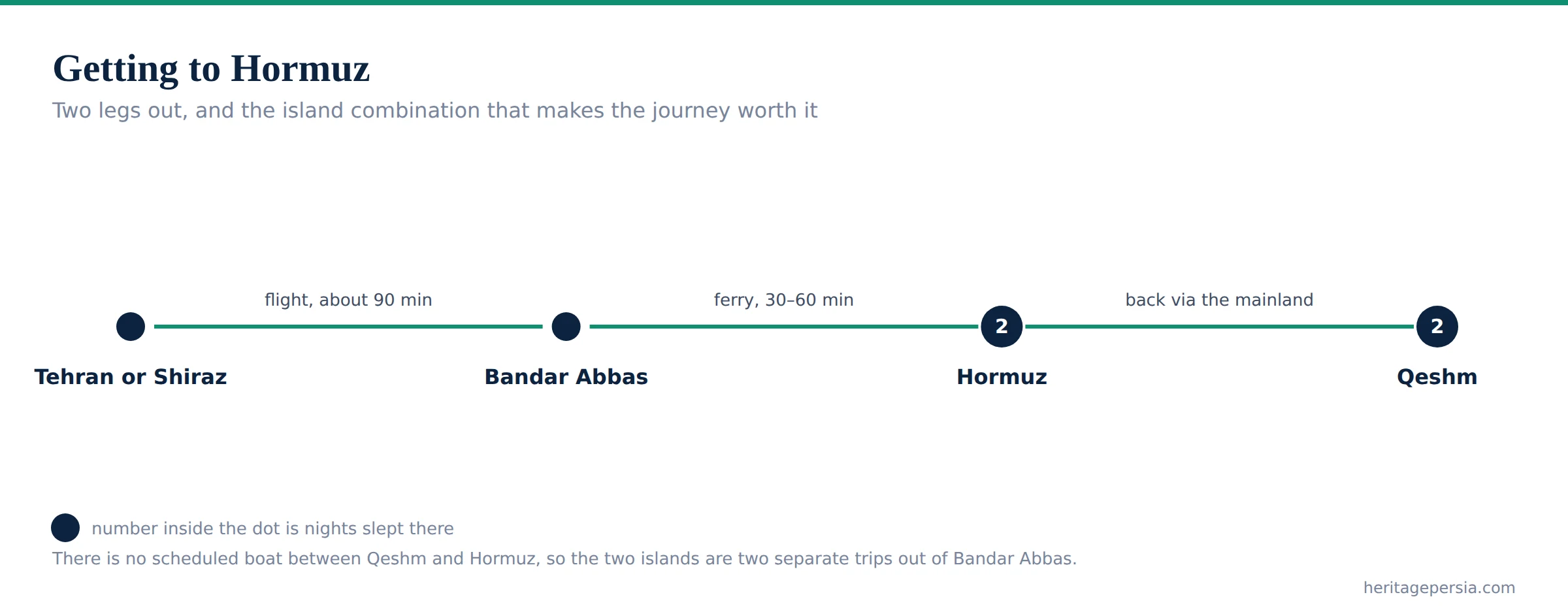
Hormuz is reached from Bandar Abbas, and Bandar Abbas is reached by air from Tehran, Isfahan or Shiraz in about an hour and a half, or by a long train or drive.
| Leg | How | Note |
|---|---|---|
| To Bandar Abbas | Domestic flight, about 90 min from Tehran | Booked through an agency against your passport — no foreign card works on Iranian platforms |
| Bandar Abbas to Hormuz | Open speedboat, about 40 min, from Shahid Haqani port | Frequent in the morning and much thinner after lunch. Be back at the port before 15:00 to be sure of a ride, which is what makes a day trip tight |
| On the island | Motorbike taxi, rented bicycle, or a tuk-tuk | No hire cars in the normal sense. The loop is about an hour by road |
| With Qeshm | Ferries connect both islands with the mainland | The sensible combination. Qeshm is much larger and has the geopark; Hormuz has the colour |
| Staying | Guesthouses and eco-lodges in the village | Simple and good. There are no resort hotels and this is not a resort island |
Stay the night rather than day-tripping from Bandar Abbas. The two best hours on Hormuz are the last two of daylight, and the dependable boats back have gone by mid-afternoon.
When to Go
November to March, and the window is firmer here than for most of Iran.
In those months the island sits at roughly twenty to twenty-eight degrees, dry and clear, and it is genuinely the best weather in the country — while Tabriz is below freezing and the plateau cities are cold, this is swimming weather. From May to September the average high sits near thirty-eight degrees with humidity of sixty per cent and above, which is a different order of unpleasant from dry desert heat and worse than the number suggests, and peaks touch forty-five — which is the reason the island empties.
That seasonality is why Hormuz belongs in a winter itinerary specifically, alongside Khuzestan and the deserts — all three are open in exactly the months the classic corridor is quiet, which gives a winter trip an option a spring trip does not have.
Practical Notes
Two days is right. One means arriving, rushing the valley in bad light and leaving. Three means you have seen everything twice. Arrive in the afternoon, do the colour sites at golden hour, sleep, do the loop and the caves next morning, leave in the afternoon.
There is no shade anywhere on the colour sites. Hat, water, and the late-afternoon timing that this page keeps repeating for the same reason it keeps repeating it.
Facilities are simple. Guesthouses, small restaurants, no ATMs that help you and no cards that work. Bring the cash you need for the island with you — the money guide explains why that is true everywhere in Iran and doubly true here.
Dress is the standard Iranian code, including on the beach — this is not a resort and swimming happens fully covered or not at all for women. The clothing guide has the detail.
Leave the soil where it is. Photographs rather than jars, for the reason set out above.
✉️ Thinking about the Gulf islands? Tell us your month and we will say whether Hormuz alone or Hormuz with Qeshm suits the time you have, and which ferry to aim for. Talk to our team →
Continue reading
Frequently Asked Questions
What travellers ask our guides, answered on the ground.
The Gulf Islands, Properly Timed
Tell us your month and we will say whether Hormuz alone or Hormuz with Qeshm suits your days.
See All Destinations →