
English is widely spoken by younger Iranians in the cities and almost not at all outside them. That gap is where a phrasebook earns its keep — not at the hotel desk in Isfahan, where somebody speaks English, but at a village bakery, in a shared taxi, at a bus counter in a town nobody writes guides about.
What follows is organised by how much work each phrase does rather than by grammatical category. It starts with the four sounds that make the difference between being understood and not, then twelve phrases that carry an entire week, then the specialised lists. The section on taarof phrases is the one we would read twice, because those are the ones that mean the opposite of what they appear to mean.
Before you plan anything: this is a language guide, written to be useful whenever you are able to use it. Whether to travel to Iran at present is a separate question with a different answer — see our current situation report, reviewed 10 September 2026.
Four Sounds, and One Rule
Persian is easier to pronounce than it looks. There are no tones, no gendered nouns, no case endings, and the verb comes at the end and can often be dropped entirely. Four sounds do not exist in English, and getting them approximately right is most of the battle.
| Written here | Script | How to make it | In a word you will use |
|---|---|---|---|
| kh | خ | The ch of Scottish loch or German Bach. Not a k, not a h — a scrape at the back of the throat | khaste nabāshid, khodāhāfez, khub |
| gh | ق / غ | Further back still, and voiced — close to a French r gargled. An English hard g is understood everywhere | gheymat, ghāshogh, āghā |
| ā | آ / ا | Long, as in father, and rounded towards aw in Tehran speech. Plain a is short, as in cat | salām not sal-am; āb not ab |
| ’ | ع / ء | A glottal stop — the catch in the middle of uh-oh. Skipping it entirely is fine | ta’ārof, sā’at, ba’d |
Everything else maps onto English closely enough. zh is the s in measure, ch and sh are as in English, and there is no th or w sound in Persian at all.
The one rule worth more than the four sounds: Persian stress falls on the last syllable of a word. sa-LĀM, mam-NUN, be-bakh-SHID, ba-za-RE. English speakers instinctively stress the first syllable, and it is the single thing that makes a correctly remembered phrase unrecognisable. Say it flat and push the end.
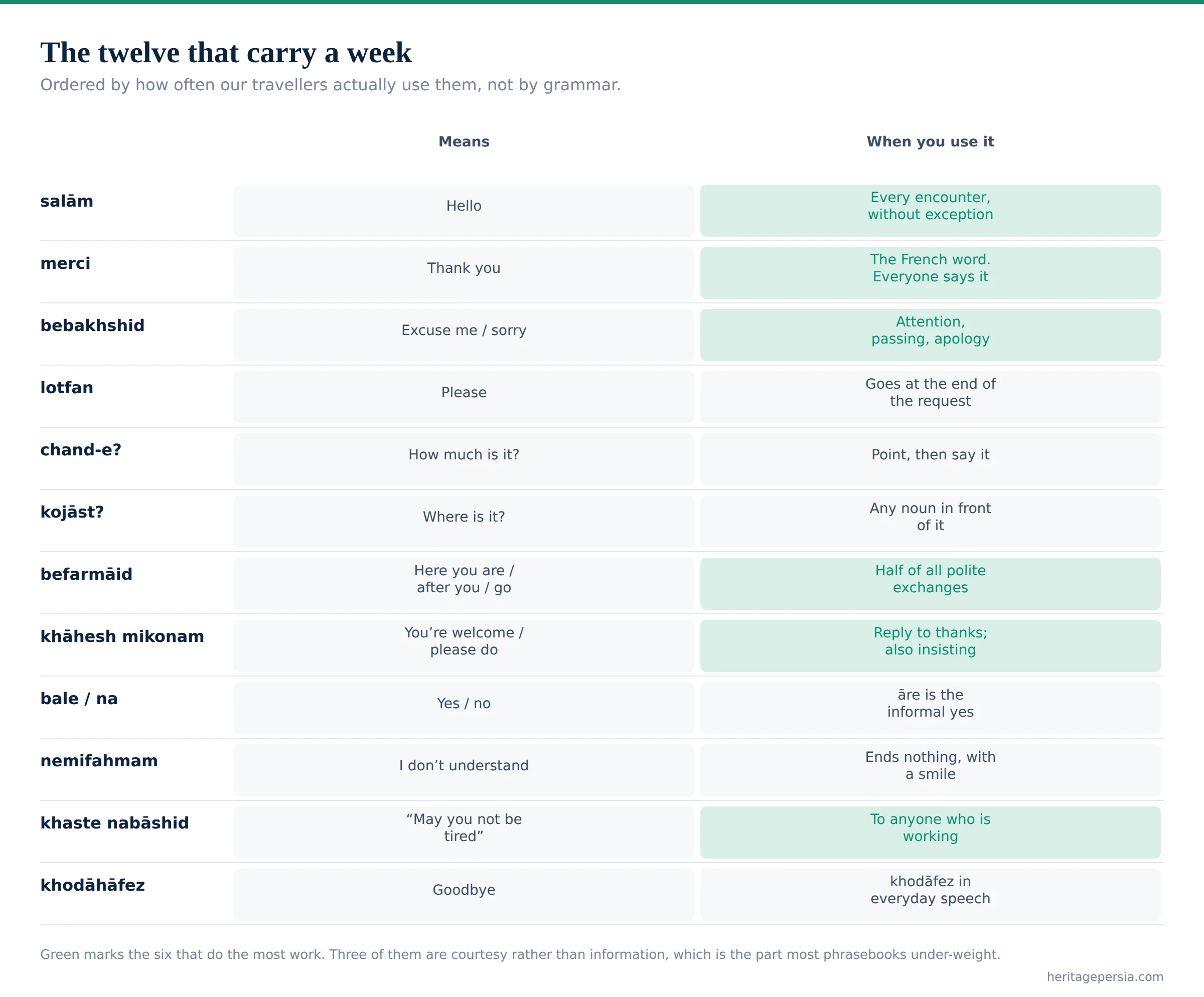
The Twelve That Carry a Week
If you learn nothing else, learn these. They are ordered by how often you will actually use them, which is not the order any textbook puts them in.
| Say this | Script | Means | When |
|---|---|---|---|
| salām | سلام | Hello | Every encounter, every shop, every time. Never skipped, never too casual |
| merci | مرسی | Thank you | The French word, and what everybody says. mamnun and mochakeram are the Persian alternatives |
| bebakhshid | ببخشید | Excuse me / sorry | To get attention, to pass someone, to apologise. Does all three jobs |
| lotfan | لطفاً | Please | Goes at the end. yek āb, lotfan — one water, please |
| chand-e? | چنده؟ | How much is it? | Point and say it. With numerals, this is your entire bazaar vocabulary |
| kojāst? | کجاست؟ | Where is it? | Put any noun in front. hotel kojāst?, dastshuyi kojāst? |
| befarmāid | بفرمایید | Here you are / after you / go ahead / come in | One word for half of all polite exchanges. Said to you constantly; say it back |
| khāhesh mikonam | خواهش میکنم | You’re welcome / please do | The reply to thanks, and the polite way to insist. Learn it for the taarof section below |
| bale / na | بله / نه | Yes / no | āre is the informal yes. na is universal |
| nemifahmam | نمیفهمم | I don’t understand | More useful than any phrase you half-remember. Followed by a smile it ends nothing |
| khaste nabāshid | خسته نباشید | “May you not be tired” | Said to anyone working — a driver, a shopkeeper, a guard. No English equivalent, and watch the face change |
| khodāhāfez | خداحافظ | Goodbye | Literally “God protect you”. khodāfez is the everyday contraction |
Note what is missing. How are you is not in the twelve, because the answer will be a paragraph and you will not follow it. Greet, thank, ask, and let the conversation find its own level.
The Phrases That Are Traps
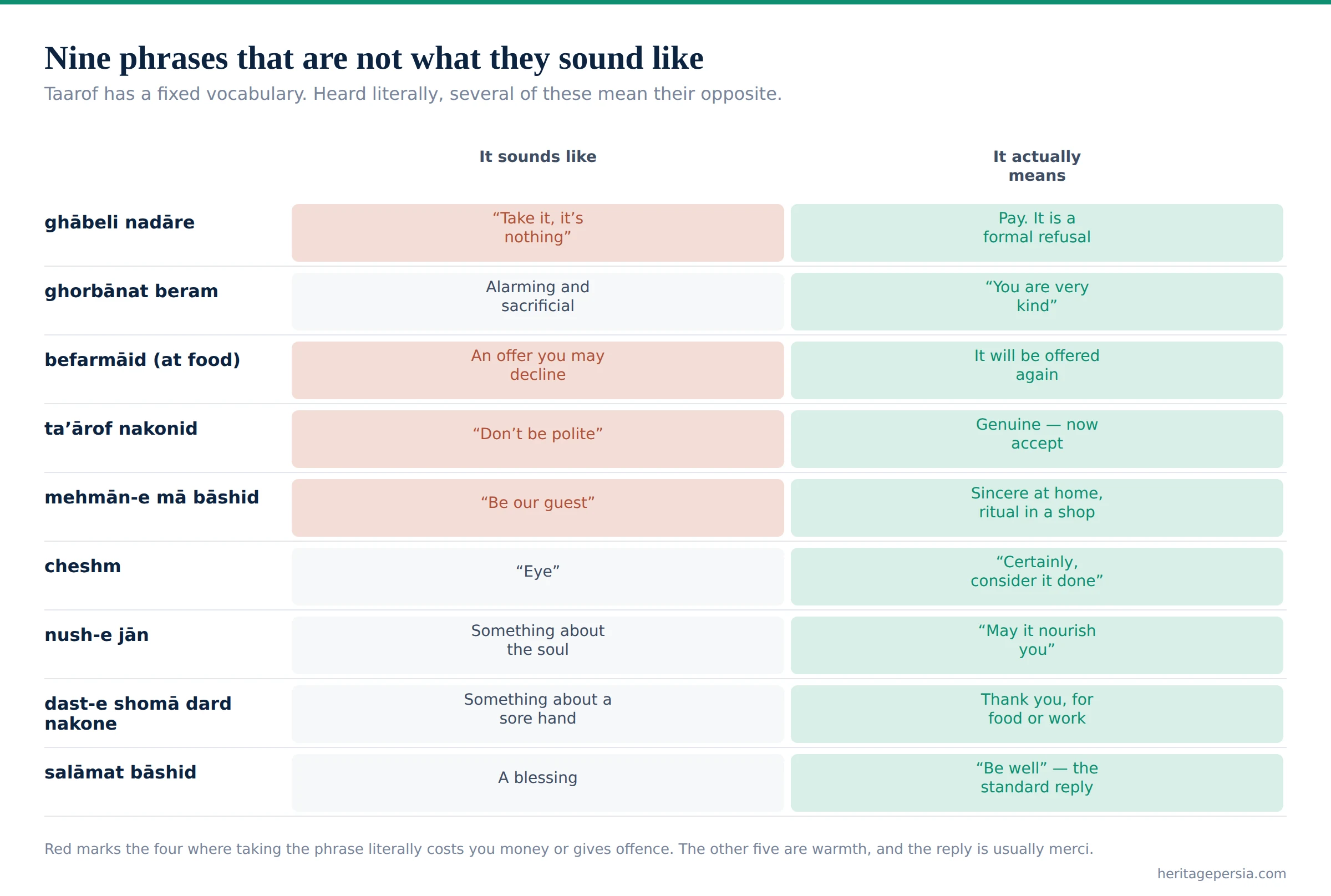
This is the section that is worth actual money. Taarof is a system of ritual courtesy in which the first offer is made to be declined and the first refusal is made to be overcome, and it has a fixed vocabulary. Heard literally, several of these phrases mean something they do not mean.
| You will hear | Script | It sounds like | It actually means | Say |
|---|---|---|---|---|
| ghābeli nadāre | قابلی نداره | “It’s not worth anything — take it” | “It is not worthy of you.” A formal refusal of payment that is not a refusal. The taxi driver and the shopkeeper both expect to be paid | khāhesh mikonam, then press the money a second and a third time |
| ghorbānat beram | قربانت برم | Something alarming and sacrificial | “I’d be your sacrifice” — warm, ordinary affection, roughly “you’re very kind” | lotf dārid — you are kind |
| befarmāid (at food) | بفرمایید | A polite offer you may decline | An offer that will be repeated. Declining once is the expected first move | Decline once, accept on the second offer |
| ta’ārof nakonid | تعارف نکنید | “Don’t be polite” | “Stop performing the ritual” — this offer is genuine, please take it | Now accept. This is the signal |
| mehmān-e mā bāshid | مهمان ما باشید | “Be our guest” | Usually sincere in a home, usually ritual in a shop. Context decides | In a home accept warmly. In a shop insist on paying |
| cheshm | چشم | “Eye” | “Certainly” / “consider it done”. A warm yes to a request | merci |
| nush-e jān | نوش جان | Something about the soul | “May it nourish you” — said while you are eating, by anyone | merci |
| dast-e shomā dard nakone | دست شما درد نکنه | Something about a hand hurting | “May your hand not ache” — thank you, for food cooked or work done | sar-e shomā dard nakone, or simply khāhesh mikonam |
| salāmat bāshid | سلامت باشید | A blessing | “Be well” — the standard reply to khaste nabāshid | Nothing more is needed |
The mechanics are the same every time: an offer is repeated, a refusal is repeated, and the true position emerges on the third exchange. A visitor who accepts the first offer has taken something that was not really given; one who accepts the first refusal has not insisted warmly enough.
Persian Numerals, and Reading a Price
Twenty minutes on the flight, and it pays for itself the first time you are in a bazaar where the price tags are in nothing else. The numerals are not the same as the Arabic ones you may half-know — four, five and six differ.
| Digit | Persian | Say | Digit | Persian | Say |
|---|---|---|---|---|---|
| 0 | ۰ | sefr | 5 | ۵ | panj |
| 1 | ۱ | yek | 6 | ۶ | shesh |
| 2 | ۲ | do | 7 | ۷ | haft |
| 3 | ۳ | se | 8 | ۸ | hasht |
| 4 | ۴ | chahār | 9 | ۹ | noh |
Numerals read left to right, exactly like ours, even though the words around them run right to left. ۱۲۵ is one hundred and twenty-five.
The words for the round numbers: dah ten, bist twenty, si thirty, chehel forty, panjāh fifty, shast sixty, haftād seventy, hashtād eighty, navad ninety, sad a hundred, hezār a thousand, milyun a million.
The trap is not the numerals, it is the units. Printed prices are in rial; spoken prices are in toman, and one toman is ten rial. Worse, speech drops the thousands: a driver who says panjāh means fifty thousand toman. The move that works every time is to say the number back, or hold up the notes — nobody minds, and Iranians do it to each other. The money guide has the full arithmetic.
Greetings and Courtesy
| English | Persian | Script | Note |
|---|---|---|---|
| Good morning | sobh bekheyr | صبح بخیر | Used, but salām covers every hour of the day |
| How are you? | hāletun chetore? | حالتون چطوره؟ | The polite spoken form. The bookish hāl-e shomā chetor ast is written, not said |
| I’m well, thank you | khubam, merci | خوبم، مرسی | Then ask back: shomā chetorid? |
| My name is… | esm-e man … e | اسم من … است | Spoken Persian clips the verb to a single -e |
| What is your name? | esm-e shomā chi-ye? | اسم شما چیه؟ | shomā is the polite you. Use it with everyone you have just met |
| Pleased to meet you | khoshbakhtam | خوشبختم | One word, and it lands well |
| I’m from… | man az … hastam | من از … هستم | You will be asked this within a minute of every conversation |
| Yes / no | bale / na | بله / نه | A raised eyebrow and a click of the tongue also means no, and is very common |
| Sorry / excuse me | bebakhshid | ببخشید | ma’zerat mikhām is the heavier apology |
| No problem | moshkeli nist | مشکلی نیست | Ends most small awkwardnesses |
| Goodbye | khodāhāfez | خداحافظ | khodāfez in speech. be salāmat — go in peace — is said to the one leaving |
| Welcome | khosh āmadid | خوش آمدید | Said to you often. merci is the whole reply |
Persian has a genuine formal register and it is not optional politeness. shomā for you, and the plural verb ending, is what you use with every adult stranger; to is for children, close friends and family. Using shomā everywhere is never wrong.
Eating
| English | Persian | Script | Note |
|---|---|---|---|
| A table for two | miz barā-ye do nafar | میز برای دو نفر | Rarely needed — you are usually simply shown to one |
| The menu, please | menu, lotfan | منو، لطفاً | Many places have no written menu. Ask chi dārid? — what do you have? |
| Water | āb | آب | Tap water is safe in every city on the standard route |
| Tea | chāy | چای | You will be given it constantly and it is rarely charged for |
| Bread | nun | نان | Written nān, said nun. sangak is the one to ask for |
| I’m vegetarian | giyāh-khāram | گیاهخوارم | Understood, though bedun-e gusht — without meat — is clearer |
| Without meat | bedun-e gusht | بدون گوشت | The phrase that actually works. See the food guide |
| Not spicy | tond nabāshe | تند نباشه | Persian food is mild by default, so this is seldom needed |
| It was delicious | khoshmaze bud | خوشمزه بود | Worth saying out loud. It is heard as a compliment to the cook, not the restaurant |
| The bill, please | hesāb, lotfan | حساب، لطفاً | Or surat-hesāb. Expect one round of taarof before it arrives |
| I’m full | sir shodam | سیر شدم | You will need this. Refusing more food takes three attempts |
| I’m allergic to… | be … hassāsiyat dāram | به … حساسیت دارم | Write the word down as well. This is not a phrase to mispronounce |
Getting Around
| English | Persian | Script | Note |
|---|---|---|---|
| Where is the toilet? | dastshuyi kojāst? | دستشویی کجاست؟ | The single most valuable question on this page |
| Straight on | mostaghim | مستقیم | Also the instruction you give a taxi driver |
| Right / left | rāst / chap | راست / چپ | bepichid rāst — turn right |
| Stop here, please | injā negah dārid, lotfan | اینجا نگه دارید، لطفاً | In a shared taxi, injā alone does it |
| How far is it? | cheghadr rāh-e? | چقدر راهه؟ | The answer comes in minutes rather than kilometres |
| Is it walkable? | piyāde mishe raft? | پیاده میشه رفت؟ | The answer is optimistic. Halve it |
| Bus station | termināl | ترمینال | Not istgāh, which is a bus stop. See getting around |
| Train station | rāh-āhan | راهآهن | Literally “iron road” |
| Airport | forudgāh | فرودگاه | |
| Ticket | belit | بلیت | From the French billet, like a surprising amount of Persian vocabulary |
| One ticket to… | yek belit barā-ye … | یک بلیت برای … | Followed by the city name, which is the same in both languages |
| What time? | sā’at-e chand? | ساعت چند؟ | Have the numerals ready for the answer |
In the Bazaar
| English | Persian | Script | Note |
|---|---|---|---|
| How much is it? | chand-e? | چنده؟ | The formal gheymatesh chande? is also fine |
| That’s expensive | gerun-e | گرونه | Said with a smile, it opens the negotiation rather than ending it |
| Is there a discount? | takhfif dārid? | تخفیف دارید؟ | Expected on handicrafts and carpets, not on food or in fixed-price shops |
| I’ll take it | hamin-o mibaram | همینو میبرم | |
| I’m just looking | faghat negāh mikonam | فقط نگاه میکنم | Entirely acceptable and never resented |
| Do you have…? | … dārid? | … دارید؟ | Any noun in front of it |
| Smaller / bigger | kuchiktar / bozorgtar | کوچیکتر / بزرگتر | |
| Is it handmade? | dastbāf-e? | دستبافه؟ | The word to know before buying a carpet — see what to buy |
| Can I pay in cash? | naghdi hesāb konam? | نقدی حساب کنم؟ | You have no alternative. No foreign card works anywhere in Iran |
| Write it down, please | lotfan benevisid | لطفاً بنویسید | The phrase that solves every price misunderstanding on this page |
If Something Goes Wrong
| English | Persian | Script | Note |
|---|---|---|---|
| Help! | komak! | کمک! | Public intervention in Iran is fast and reliable. Volume works |
| I need a doctor | doktor lāzem dāram | دکتر لازم دارم | |
| Hospital | bimārestān | بیمارستان | See the insurance guide for what happens next |
| Pharmacy | dāru-khāne | داروخانه | Everywhere and cheap, but stock is short in 2026 — see the health guide |
| Police | polis | پلیس | |
| I’ve lost my passport | pāsportam gom shode | پاسپورتم گم شده | Your hotel is the first call, not the police |
| I don’t feel well | hālam khub nist | حالم خوب نیست | |
| Please call this number | lotfan be in shomāre zang bezanid | لطفاً به این شماره زنگ بزنید | Have your guide’s and hotel’s numbers written on paper, not only in the phone |
| I don’t speak Persian | fārsi balad nistam | فارسی بلد نیستم | Saying this in Persian is a small joke that always lands |
| Do you speak English? | ingilisi baladid? | انگلیسی بلدید؟ | Ask someone under thirty. The success rate roughly doubles |
| Slowly, please | yavāsh-tar, lotfan | یواشتر، لطفاً | Also what you say to a driver, for an entirely different reason |
Four Things Worth Knowing Before You Open Your Mouth
Persian is not Arabic. The script is shared, with four extra letters, and a good deal of vocabulary is borrowed — but the languages are unrelated, Persian being Indo-European. Arabic greetings land as foreign, and assuming Iranians are Arabs is the one cultural error that genuinely irritates.
Farsi and Persian are the same language. Fārsi is simply the Persian word for it. Either is correct in English; Persian is the older and more usual name, and nobody will correct you for using the other.
Do not use to with a stranger. It is the informal you, and with an adult you have just met it reads the way calling a stranger by a nickname would. shomā is never wrong.
Your accent is not a problem. Foreign visitors attempting Persian are received with a warmth that is disproportionate to the effort. Nobody is grading you, three words are treated as an achievement, and the phrase that gets the largest response for the least work is khaste nabāshid.
How to Actually Get These Into Your Head
Twelve phrases, not sixty-eight. Learn the first table on the flight, use them for two days, and add from the situational tables as you need them. A phrasebook read cover to cover is forgotten by Isfahan; twelve phrases used forty times each are permanent by day three.
Write the numerals on a card and keep it with your cash. That single card does more work than the rest of this page combined, because it converts every price tag in every bazaar from a picture into a number.
Download an offline dictionary before you fly rather than relying on live translation — much of the internet is filtered and connectivity outside the cities is patchy, which the connectivity guide covers. And remember that for the whole classic route you will have a guide who speaks both languages; these phrases are for the hours you are on your own, which are the hours worth having.
✉️ Want a printable card of the twelve and the numerals? Ask and we will send you the one we give our own travellers, with the phrases in script, transliteration and English. Talk to our team →
Continue reading
Frequently Asked Questions
What travellers ask our guides, answered on the ground.
A Card of the Twelve
Ask and we will send the printable card we give our own travellers — script, transliteration and English.
See Our Guided Routes →