
Iranians are, by some distance, the most hospitable people our guides have worked with anywhere, and the friction visitors experience is almost never about hostility. It is about not knowing the rules of a conversation — when an offer is real, when a refusal is politeness, what the black banners in the street in June mean, and why the whole country is in a park on a particular Friday in April.
This page covers the two things that govern everything else: the calendar and the courtesy.
The Year, and What It Does to a Trip
Two calendars run at once in Iran. The solar one carries Nowruz and the seasons and is fixed against the Gregorian year. The Islamic lunar one carries Ramadan and Muharram and moves about eleven days earlier each year, which is why the same trip in two consecutive years can feel completely different.
| Occasion | Next | What happens | More |
|---|---|---|---|
| Chaharshanbe SuriLast Tuesday eve before Nowruz | 16 March 2027 | Bonfires in every street and unregulated fireworks until past midnight. Watch from a courtyard. | Nowruz Travel Guide |
| NowruzThe spring equinox | 21 March 2027 | The Persian new year, thirteen days of holiday, and the hardest fortnight of the year to travel. | Nowruz Travel Guide |
| Sizdah BedarThirteenth day of the year | 2 April 2027 | The entire country picnics outdoors. Monuments empty, roads impossible, atmosphere unrepeatable. | Nowruz Travel Guide |
| Rose harvestLate April – mid May | Annual | Qamsar and the villages around Kashan. Distillation starts before dawn. | Best Time to Visit Iran |
| RamadanIslamic lunar calendar | 8 Feb – 9 Mar 2027 | Restaurants shut in daylight outside hotels; iftar at sunset is the compensation. | Best Time to Visit Iran |
| MuharramIslamic lunar calendar | Ashura 15 June 2027 | The most solemn period of the year. Black banners, night processions, free food given to anyone passing. | Best Time to Visit Iran |
| MehreganMid-autumn | Early October | The ancient festival of autumn, friendship and harvest — quietly observed rather than staged. | Iran Food Guide |
| Yalda NightWinter solstice | 21 December | The longest night. Families stay up with pomegranate, watermelon and Hafez read aloud. | Iran Food Guide |
Taarof — the One Thing to Understand
A taxi driver waves away your fare. A shopkeeper says the carpet is a gift. Your host insists you take the last piece of food while refusing any themselves. None of these are what they appear, and all of them are taarof — a system of ritual courtesy in which the first offer is made to be declined and the first refusal is made to be overcome.
The mechanics are simple once you see them. An offer is repeated; a refusal is repeated; the true position emerges on the third exchange. A visitor who accepts the first offer has taken something that was not really given, and a visitor who accepts the first refusal has failed to insist warmly enough.
💡 The practical version: when a driver or shopkeeper waves your money away with ghābeli nadāre — “it is not worthy of you” — answer khāhesh mikonam, smile, and press the money a second and a third time. They will take it. When food is offered, decline once and accept on the second offer. When you are genuinely offered something you do not want, decline three times rather than once — a single no reads as politeness rather than refusal.
Our Culture Guides
Poetry Is Not a School Subject
Hafez died in 1390 and his tomb in Shiraz fills every evening with families who sit on the marble and read him aloud. Saadi’s Golestan is still what children learn from, and his line about the sons of Adam being limbs of one body is carved at the United Nations. Ferdowsi’s Shahnameh is the reason Persian survived as a language at all, and his tomb at Tus, outside Mashhad, is a place Iranians visit the way other countries visit a battlefield.
A taxi driver will quote poetry at you. This is not performance for a foreigner; it is how the language works. If you learn one thing to say, learn a line of Hafez, and watch what happens in the front seat.
What the Crafts Actually Are
Qalamkar is cotton block-printed by hand with carved pear-wood stamps — check the reverse for the slight bleed that machine printing never has. Minakari is enamel fired onto copper, usually in blue. Khatam is marquetry in bone, brass and wood, and the quality is in how small the pieces are. Carpets are a subject on their own, and the only rule that matters is that a shop offering a government certificate does not have one.
All four are made in front of you in workshops off the bazaars of Isfahan, Shiraz and Yazd. Asking to watch rather than to buy is the correct opening, and it usually ends with tea.
Being Invited Into a Home
It will happen, and more often than you expect. A family in a park will wave you over. A shopkeeper will close early. Somebody you asked for directions will take you to lunch. Iranian hospitality toward foreign visitors is not a tourist-board slogan and it is not transactional; it is the single most reported feature of every trip our guides run.
What to do with it. Accept on the second offer rather than the first, which is the taarof rhythm described above. Bring something — pastries from a bakery, flowers, or anything at all from your own country, however modest; arriving empty-handed is the one visible mistake. Take your shoes off at the door and follow what the household does about the headscarf, which indoors is usually nothing. Expect to be fed far more than you want and to be pressed to eat more after you stop. Compliment the cooking rather than the possessions, because admiring an object too warmly obliges your host to offer it to you.
And expect the conversation to be more direct than you are used to. Iranians will ask what you earn, why you are not married and what you think of their government, in roughly that order, and none of it is hostile. Answering honestly, including that last one, is received better than deflecting.
Six Words That Carry You
English is widely spoken by younger Iranians in the cities and almost not at all elsewhere. These six do more work than any phrasebook.
- Salām — hello. Universal, and worth saying first every time.
- Merci — thank you. Yes, the French word; it is what everybody says.
- Befarmāid — please, go ahead, help yourself, after you. One word for half of all polite exchanges.
- Chand? — how much? Followed by pointing, this is your entire bazaar vocabulary.
- Nush-e jān — said to you when you eat. The reply is merci.
- Khaste nabāshid — literally "may you not be tired", said to anyone working. Say it to a shopkeeper or a driver and watch their face change.
Persian numerals are worth twenty minutes on the flight, because prices in bazaars and on buses are frequently written in them and nowhere else.
The other two hubs
Ask Us Directly
Tell us your dates and what you care about. We answer with an honest plan — including the parts we would cut.
Talk to Our Team →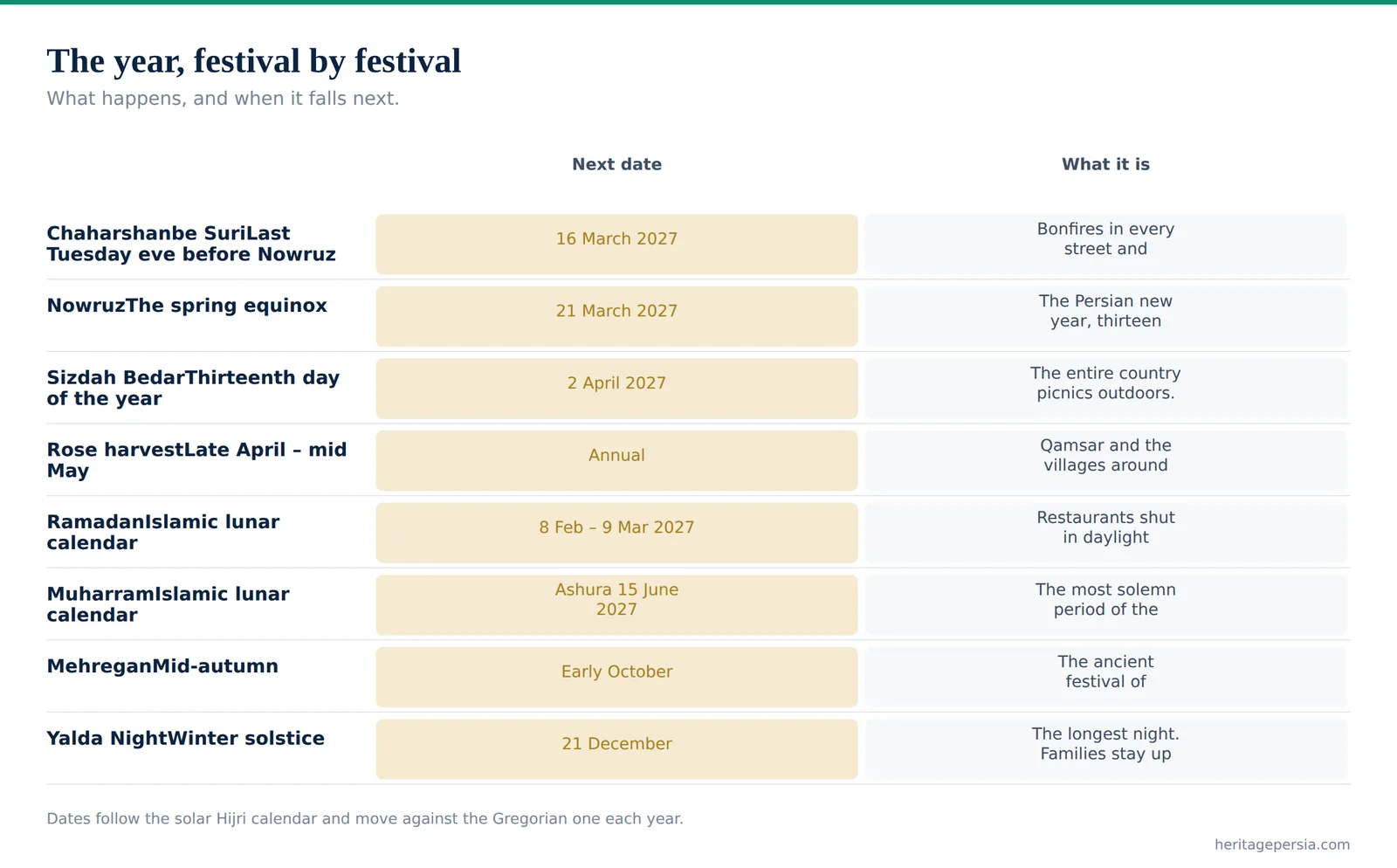
Part ofWhere to Go in Iran · Plan Your Iran Trip