
Isfahan is a masterpiece and Shiraz is a pleasure. Yazd is the one travellers describe as a dream they had, usually while trying and failing to explain the colour of the walls at six in the evening.
It is a city built entirely of mud on the edge of two deserts, in a place with no river and almost no rain, and it has been continuously inhabited for something like three thousand years. Everything interesting about it follows from that sentence. The towers on the rooftops, the tunnels under the streets, the courtyards sunk below ground level, the fire that has been burning since the fifth century — all of it is one long answer to the question of how to live somewhere that should not support a city at all.
Before you plan anything: this is a guide to the city, written to be useful whenever you are able to use it. Whether to travel to Iran at present is a separate question with a different answer — see our current situation report, reviewed 10 September 2026.
Why Yazd Is Different
The UNESCO inscription of 2017 is unusual and it tells you how to look at the place. What is listed is not a monument but the Historic City of Yazd — the whole earthen fabric of it, and specifically the systems that make it work: the qanat network, the courtyard houses, the bazaars and hammams, the mosques, the synagogues and the Zoroastrian temples together.
That last detail matters. Yazd has been the centre of Iranian Zoroastrianism for well over a thousand years, and it still has a living Zoroastrian community alongside its Muslim and Jewish ones. You are not visiting a museum of a vanished faith. The fire in the Atash Behram is tended daily by people who live down the road.
And unlike Isfahan, where the monuments are the point, Yazd's pleasure is the walking. The old city is a labyrinth of unmarked lanes between mud walls, roofed over in places, with almost no signage and no obvious route. Getting lost in it at dusk is not a risk to manage. It is the reason to come.
Every Site, With the Hour to Arrive
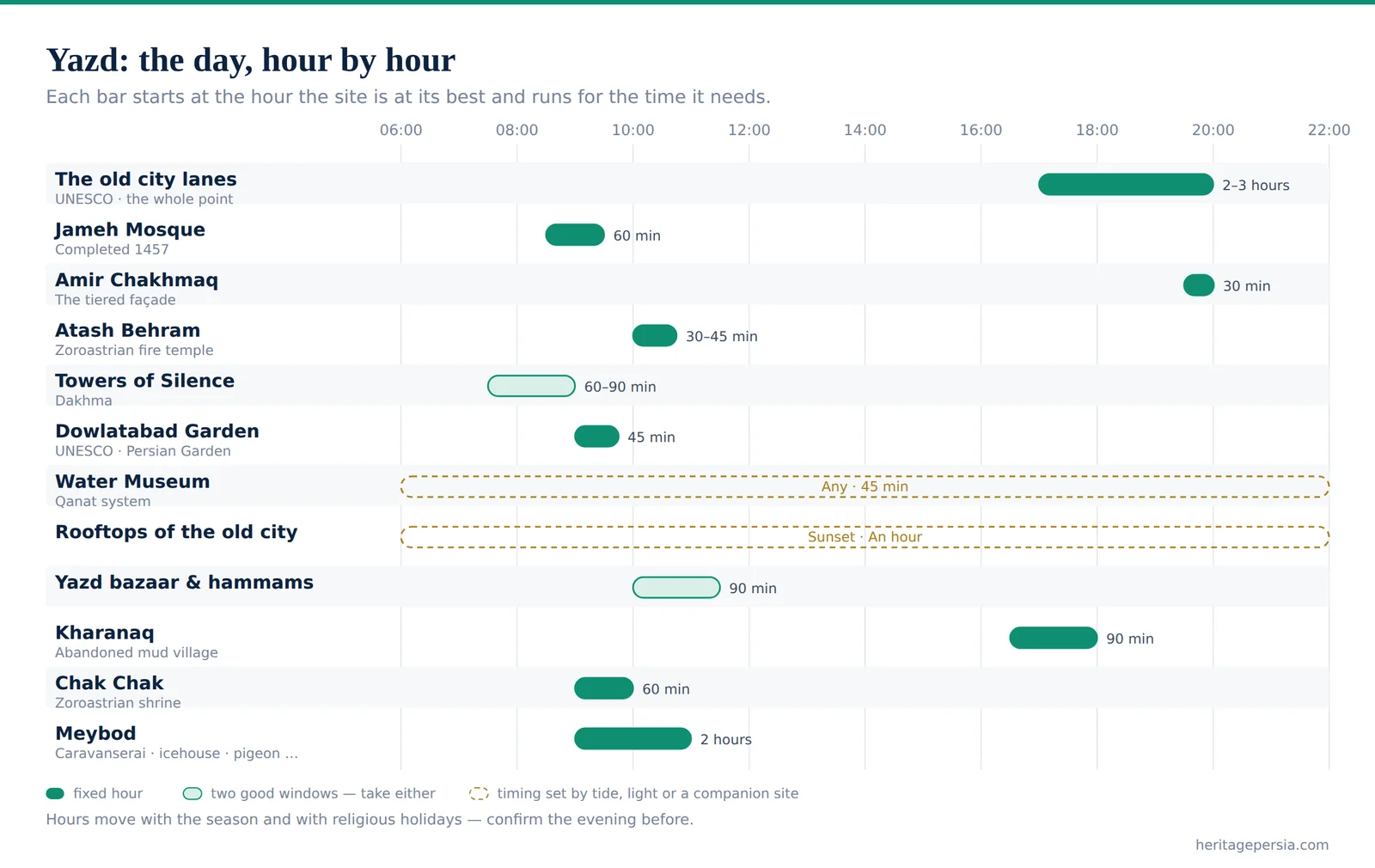
The same table we build for every city. Times assume you look up rather than tick off, and distances are from the Amir Chakhmaq square, which is where everyone starts.
| Site | Time needed | Best hour | From Amir Chakhmaq | Why that hour |
|---|---|---|---|---|
| The old city lanes UNESCO · the whole point | 2–3 hours | 17:00 onwards | You are in it | Low sun turns the mud walls gold and the lanes empty out. Do this on your first evening |
| Jameh Mosque Completed 1457 | 60 min | 08:30 | 10 min walk | Quiet before the groups, and the tiled portal takes morning light |
| Amir Chakhmaq The tiered façade | 30 min | After dark | — | Lit at night and genuinely theatrical; by day it is a flat façade |
| Atash Behram Zoroastrian fire temple | 30–45 min | 10:00 | 15 min taxi | Closes over the middle of the day and earlier than you expect |
| Towers of Silence Dakhma | 60–90 min | 07:30 or 17:30 | 20 min taxi | Exposed hillside with no shade at all. The climb is the point and the heat will stop you |
| Dowlatabad Garden UNESCO · Persian Garden | 45 min | Morning | 15 min taxi | Cypress avenue and the tallest adobe windcatcher on earth |
| Water Museum Qanat system | 45 min | Any | 5 min walk | Small, and the one thing that makes the rest of the city legible |
| Rooftops of the old city | An hour | Sunset | Your hotel | Most courtyard hotels have one. Badgirs, domes and the Jameh minarets against the light |
| Yazd bazaar & hammams | 90 min | 10:00 or 17:00 | On the square | Closed over the long lunch, like every bazaar in Iran |
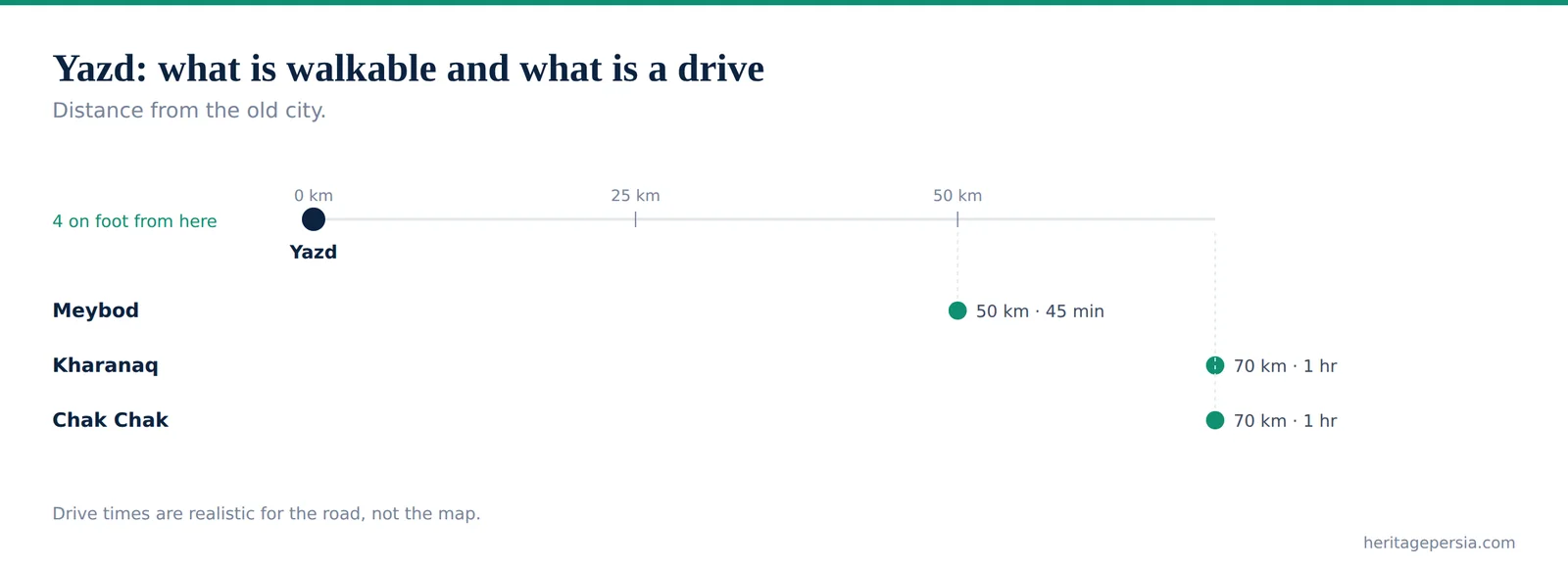
| Kharanaq Abandoned mud village | 90 min | Late afternoon | 70 km · 1 hr | Crumbling and almost empty; the light at the end of the day is what people photograph |
| Chak Chak Zoroastrian shrine | 60 min | Morning | 70 km · 1 hr | A cliff-face sanctuary reached by stairs, hot and exposed later on |
| Meybod Caravanserai · icehouse · pigeon tower | 2 hours | Morning | 50 km · 45 min | On the Isfahan road, so most itineraries take it on the way in rather than as a trip |
Opening hours in Iran move with the season and with religious holidays, and the Zoroastrian sites keep shorter hours than the Islamic ones. We give the hour that makes each place best rather than a schedule that will be wrong by the time you read it — confirm at your hotel the night before.
How a City Survives Where It Should Not
This is the section that changes how the rest of Yazd looks, and it is the reason to spend forty-five minutes in a small museum about water before you do anything else.
The qanat
There is no river here. Yazd is supplied by qanats — gently sloping tunnels dug by hand from an aquifer in the mountains, sometimes for tens of kilometres, running underground so that nothing is lost to evaporation. The vertical shafts you see as rings of spoil on the plain outside town are the access points, dug every few dozen metres so the diggers could work and breathe. The men who built and maintained them, the muqannis, worked in the dark in a tunnel the width of their shoulders, and the trade was hereditary.
Everything else in the city hangs off this. The old city is where it is because the water is where it is.
The badgir
The towers on the skyline are wind catchers. A badgir is open on one or more sides at the top and shafted down into the building, so that any moving air is caught, driven downward and pushed through the rooms below. Run the incoming air over a pool or through a damp underground chamber and you have evaporative cooling with no moving parts and no power, in a place that reaches 40°C by noon in July.
The tallest adobe one in the world stands in the Dowlatabad Garden — 33.8 metres, built with the garden in 1747, and worth standing directly beneath so you can feel the draught it produces on a still day.
The sunken courtyard
Traditional houses here are built around a courtyard set below street level, with a pool in the middle and a sardab, a cellar room, beneath. Cold air sinks, the pool humidifies, the badgir drives the circulation, and the thick mud walls hold the night's cold through the afternoon. Stay in one of these houses — which in Yazd you easily can — and you will notice that you have not thought about the temperature all day.
Zoroastrian Yazd
Yazd is where Zoroastrianism survived, and the two sites people come for are more affecting when you know what they are.
The Atash Behram is the highest grade of Zoroastrian fire — one of nine in the world and the only one in Iran. The flame inside is said to have been burning since about 470 AD, moved between places of safety for a millennium and a half and installed in the present building, which dates from 1934. Non-Zoroastrians have been admitted since the 1960s and view the fire through glass from outside the sanctum, which is the correct arrangement and not a slight. Allow half an hour and read the small display on the walls.
The Towers of Silence stand on two bare hills outside the city. Zoroastrian doctrine holds earth, water and fire to be sacred and a corpse to be polluting, so the dead were carried up to these open circular platforms and exposed to the sun and the vultures. The practice continued at Yazd until 1974, when the city asked for the towers to be closed; burial in concrete-lined graves replaced it. The climb is short, steep and completely unshaded, and the view from the top over the desert and the mud buildings at the foot of the hill is the one that stays with people.
💡 From our guides: go to the towers at half past seven in the morning or half past five in the afternoon, and take water. There is no shade on that hill at any point, the climb is steeper than it looks, and visitors who arrive at noon in spring routinely turn back halfway. Behind the towers at ground level are the old buildings where bodies were prepared and where a well and a cistern served the funerary complex — most people walk past them without looking.
Two Days in Yazd
Day one — the city
Arrive from Isfahan in the early afternoon and check into a courtyard hotel. Water Museum at four, to understand what you are looking at. Then walk the old city from five until dark with no particular destination — this is the single best hour Yazd offers and it should not be spent in a monument. Amir Chakhmaq lit up after dinner.
Day two — early, then out
Towers of Silence at half past seven, before the heat. Jameh Mosque at half past eight — the minarets are 52 metres and the tallest in Iran, and the tiled portal is the finest thing in the city after the streets themselves. Atash Behram at ten. Dowlatabad Garden before lunch. In the afternoon drive out to Kharanaq and Chak Chak, or into the desert for the night.
If you have only one night, cut the villages rather than the evening walk.
The Villages, and the Desert
Kharanaq, about seventy kilometres north, is an abandoned mud village on a ridge above a green valley, parts of it said to be very old indeed and most of it collapsing gently. There is a shaking minaret, a caravanserai restored as a small hotel, and almost nobody there. Go late in the day.
Chak Chak is the most sacred Zoroastrian shrine in Iran, built into a cliff face reached by a long flight of steps, where by tradition a Sassanid princess fleeing the Arab conquest was sheltered by the mountain. Water drips from the rock inside — chak chak is the sound of it. Go in the morning.
Meybod, on the Isfahan road, holds a Safavid caravanserai, a conical mud icehouse and a pigeon tower built to collect fertiliser, and it makes more sense as a stop on the way into Yazd than as a separate trip.
For the desert proper, the dunes and salt flat near Varzaneh lie between here and Isfahan and are the easiest desert night on the classic route — see the ten-day itinerary for where it fits.
Where to Stay — This Matters More Here
In most cities the hotel is where you sleep. In Yazd it is one of the sights. The old city is full of restored courtyard houses turned into small hotels — a sunken courtyard, a pool, a badgir overhead, rooms in the old family quarters and a roof terrace with the domes of the city laid out below. They cost very little by European standards and they are the single best accommodation experience in Iran.
Two practical notes. Rooms in these houses are small in number, so they fill months ahead in April, May and October. And walls of mud and gypsum carry sound, so a courtyard full of people at eleven at night is audible from every room around it — ask for a room off the main courtyard if you are a light sleeper. The larger conventional hotels sit outside the historic core and miss the point of the city entirely.
Eating in Yazd
Yazd is better known for sweets than for savoury cooking, and it takes them seriously. Qottab are almond and cardamom pastries dusted in sugar; baklava here is drier and less syrupy than the Turkish version; pashmak is Persian candy floss spun from sesame, sold in boxes and impossible to eat neatly. Every one of these travels well and they are the standard gift an Iranian brings home from this city.
Ash-e shuli, a sour herb and beetroot soup, is the local dish you will not meet elsewhere. Our food guide covers the national repertoire and what to order everywhere else.
One onward note. Travellers who have time beyond the classic route usually continue east from here rather than doubling back: Kerman and the Lut Desert are about five hours by road, and Yazd is the last city on the corridor before the country changes character entirely.
Practical Yazd
Getting there. Four hours from Isfahan by road with a stop at Meybod or Na'in, and about five hours to Shiraz going south. It sits in the middle of the classic route, which is exactly where it belongs — the desert city between the two great architectural ones. There are domestic flights from Tehran and buses on every leg.
Getting around. The historic core is walkable and unnavigable in equal measure — accept that you will get lost and allow for it. The fire temple, the towers and Dowlatabad all need a taxi; agree the fare first.
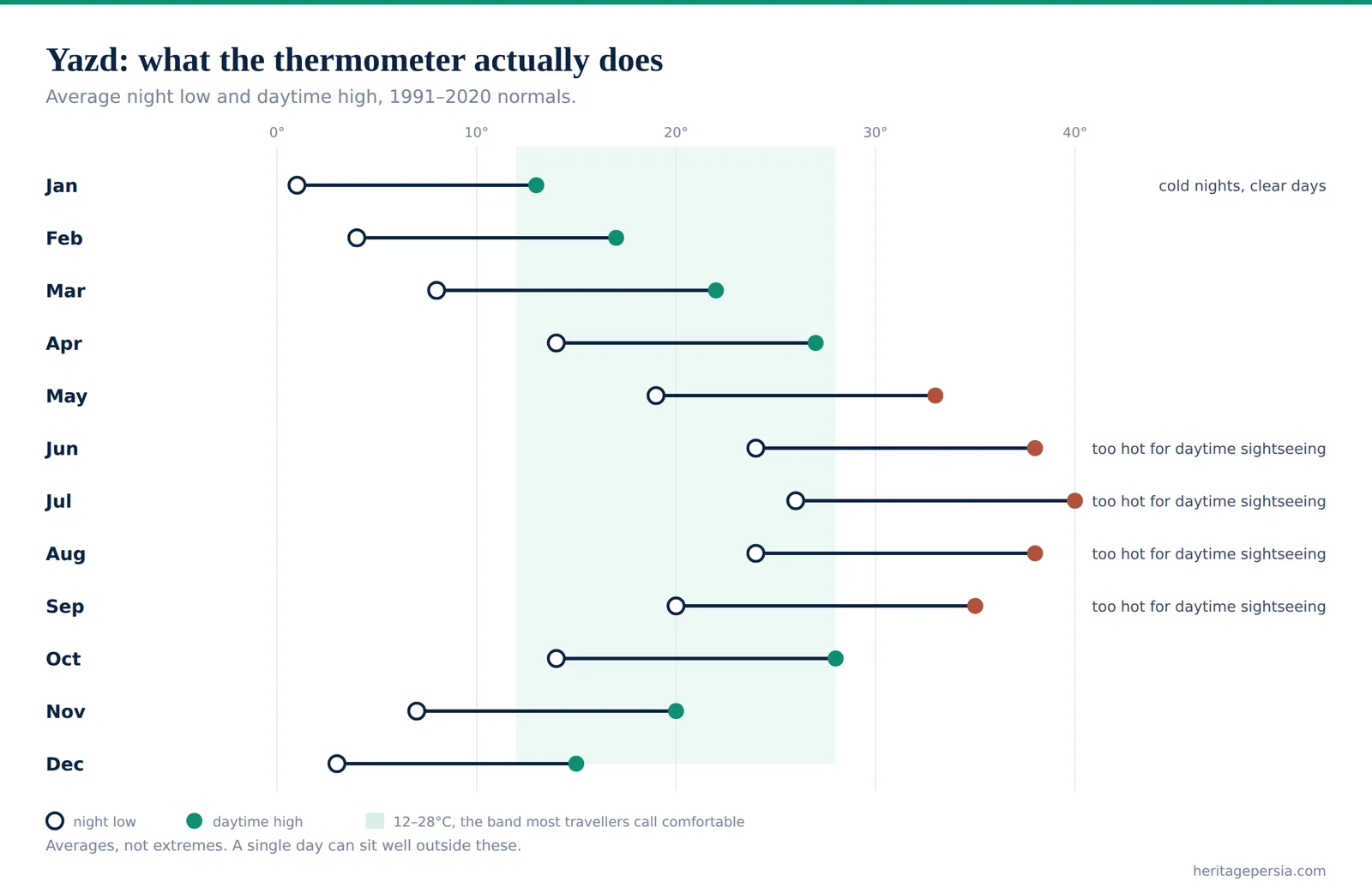
When to come. October to April. Yazd is the hottest city on the classic route: July averages run from 26°C before dawn to 40°C at noon, and even May reaches 33°C. Winter is the secret season here — mild days, cold nights, and the old city almost empty. Our month-by-month guide has the full numbers.
Dress. Yazd is more traditional than Tehran, Isfahan or Shiraz, and dressing a little more conservatively here is both easier and better received. Our dress code guide covers what that means setting by setting.
✉️ Fitting Yazd into a longer route? Tell us your dates and we will build the days around the hours in the table above — including which courtyard house to book and whether the desert night is worth a day of your trip. Talk to our team →
Continue reading
Frequently Asked Questions
What travellers ask our guides about Yazd, answered on the ground.
Yazd, at the Right Hours
The towers before the heat, the lanes at dusk, and a courtyard house with a roof terrace over the domes.
Our Desert Itineraries →