
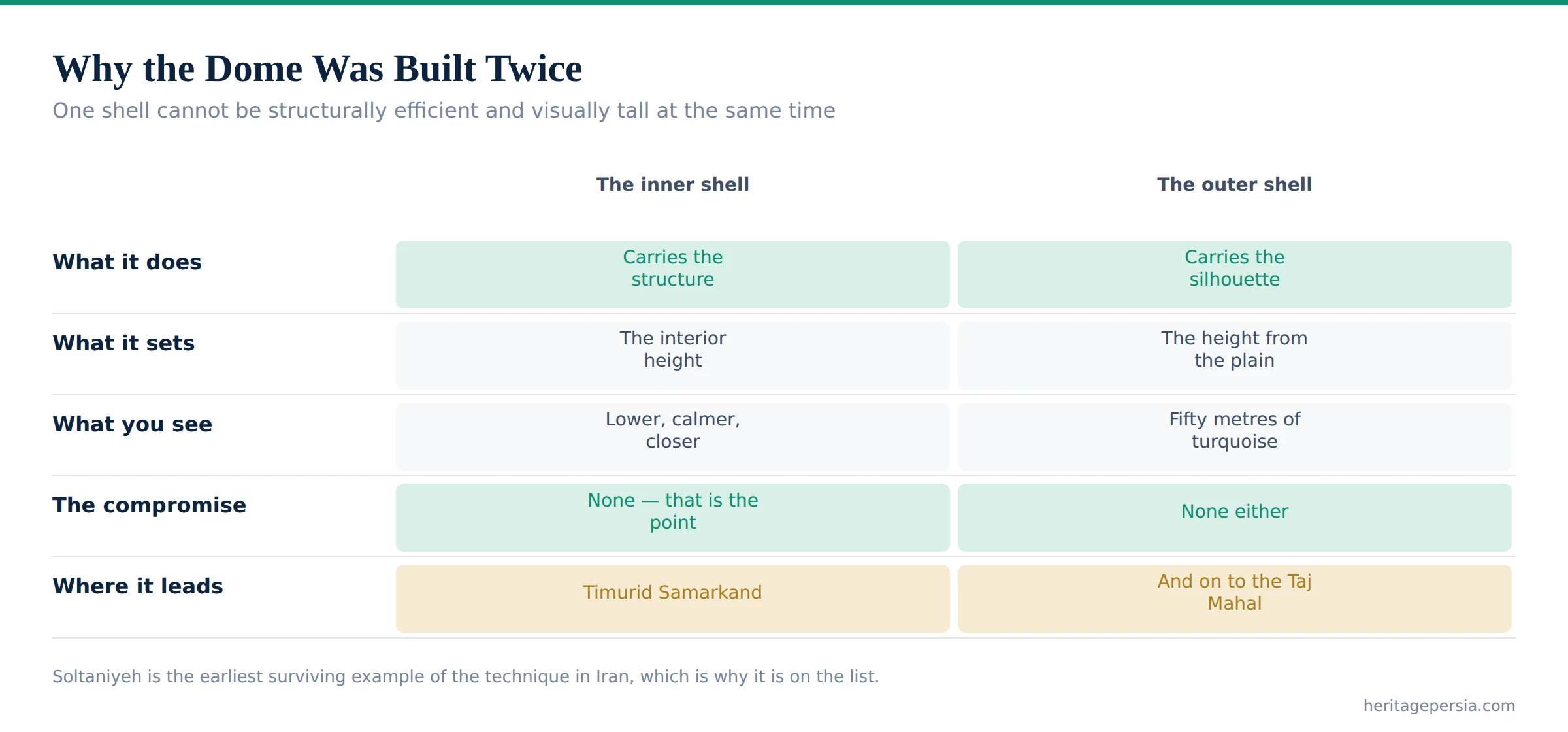
Between 1302 and 1312 a Mongol ruler of Iran built himself a tomb with a fifty-metre dome, and to hold it up his architects did something nobody had done before at that scale: they built the dome twice, an inner shell and an outer one, so that the structure could be enormous outside and still stand.
That double shell is why Soltaniyeh matters beyond its own province. It is the earliest surviving example of the technique in Iran, and the line runs from here through Samarkand to the Taj Mahal. It is also two and a half hours from Tehran on the road to Tabriz, and almost nobody stops.
Before you plan anything: this is a destination guide, written to be useful whenever you are able to use it. Whether to travel to Iran at present is a separate question with a different answer — see our current situation report, reviewed 12 September 2026.
What the Double Shell Solves
A dome has one fundamental problem: the shape that looks right from outside is not the shape that is structurally efficient inside, and the taller and more impressive the profile, the more it wants to push its own walls apart.
The solution at Soltaniyeh was to stop asking one shell to do both jobs. An inner dome does the structural work and closes the interior at a sensible height. An outer dome, built over it and braced against it, provides the tall silhouette visible across the plain. Neither has to compromise, and the whole thing sits on an octagonal drum ringed by eight minarets.
This is the earliest surviving example of the type in Iran, and the technique is what makes the great domes that follow possible — Timurid Samarkand, Safavid Isfahan, and eventually the Taj Mahal, whose architects were working within a tradition this building helped establish.
What that means for a visitor is simple. Stand outside and the dome reads as vast. Step in and the interior is a different, lower, calmer space than the exterior promised. Both are deliberate, and noticing the discrepancy is the point of coming.
The Building, Element by Element
| Element | What it is | Time | What to look for |
|---|---|---|---|
| The dome, from outside | Fifty metres, on an octagonal drum, faced in turquoise faience | 20 min | Walk the full circuit before going in. It is visible from kilometres away and the approach is part of it |
| The eight minarets | Slender towers, one at each corner of the octagon | Within the circuit | They brace the drum as much as they decorate it |
| The interior | A single vast chamber under the inner shell | 30 min | The height the inside reaches, against the height the outside suggested |
| The plaster and tile work | Ilkhanid decoration in several campaigns, some over earlier work | 20 min | Look for where one scheme was applied on top of another; the changes of mind are visible |
| The upper gallery | A walkway around the drum, between the shells where access allows | 20 min | Access varies. Ask on arrival; when it is open it is the best part of the visit |
| The scaffolding | Long-running conservation work on and around the structure | — | It has been there for years and will be for more. Expect it and photograph around it |
Ninety minutes is enough and two hours is generous. This is a single building rather than a site, which is exactly what makes it a good stop on a drive rather than a destination in itself.
Who Built It, and the Story That Explains It
Oljaytu was the eighth Ilkhanid ruler — a great-grandson of Hulagu, who had taken Baghdad, and therefore of the Mongol conquest itself. He built a new capital here on the summer pastures and this tomb at the centre of it.
The tradition, which is worth telling as tradition rather than as fact, is that the building was first intended to hold the relics of Ali and Hussein, brought north from Iraq, and was redesigned as Oljaytu’s own mausoleum when that plan failed. The decoration was reworked more than once, and the layers of plaster over tile are the physical record of somebody changing their mind at scale.
The capital did not outlive its founder by much. What remains of Soltaniyeh is essentially this one building in a small town, which is its own comment on Ilkhanid ambition.
How It Fits a Trip
Soltaniyeh is not a destination and pretending otherwise does nobody any favours. It is one of the best stops in Iran, which is a different and more useful thing.
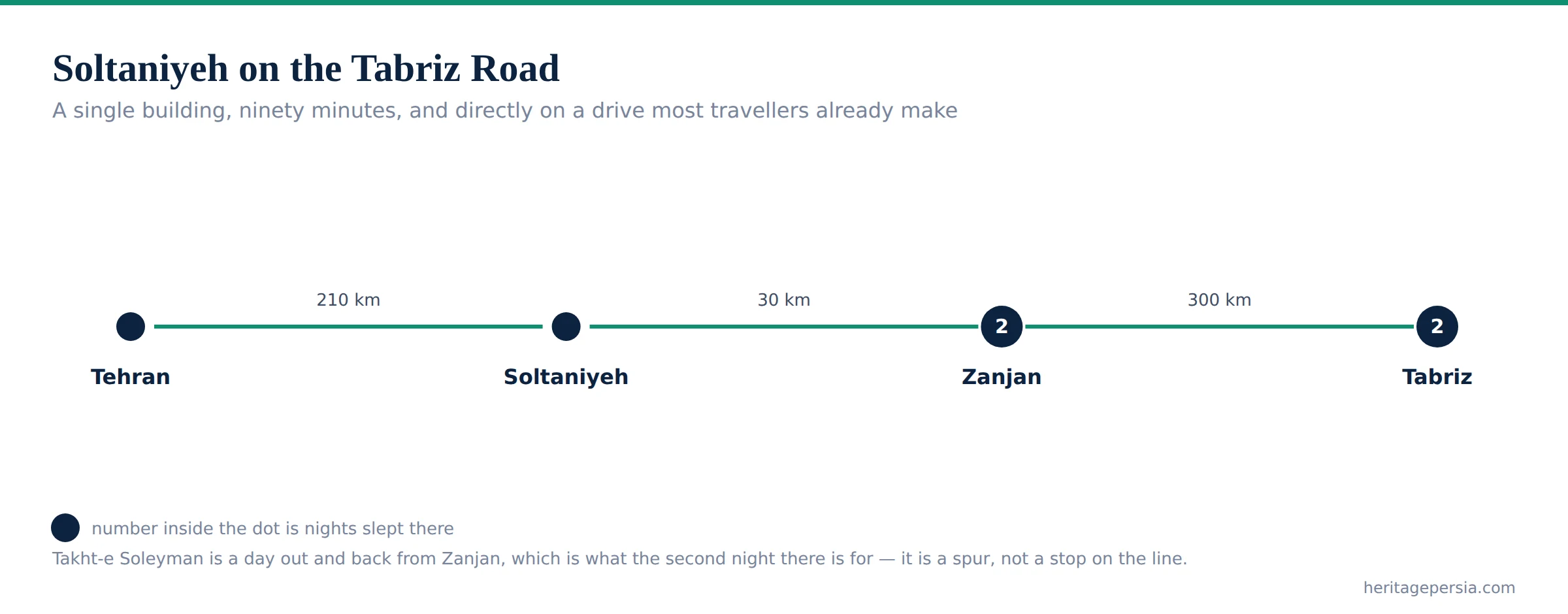
On the Tehran–Tabriz road. It is about 240 kilometres from Tehran and roughly thirty from Zanjan, essentially on the route. Two hours here turns a transfer day into a real one.
With Takht-e Soleyman, from Zanjan. The pairing we run most often: a night in Zanjan, Soltaniyeh in the morning and Takht-e Soleyman as the longer day. Two UNESCO inscriptions and very few other visitors.
With Zanjan itself. The city has a restored Qajar bazaar and the Rakhtshooy-khaneh, a public laundry house now a museum, which is a stranger and better hour than it sounds.
Not as a day trip from Tehran. Five hours of driving for ninety minutes on site is a poor trade, and we would talk you out of it.
When to Come
April to June and September to October. Zanjan province is high and continental: winters are cold with snow, summers are hot and dry but bearable, and the shoulder seasons are clear and comfortable.
The building is open year-round and the interior is unaffected by weather. What changes is the approach and the light — the turquoise of the dome against a clear spring sky is the photograph, and a grey January does not give it to you.
Practical Notes
Go inside, do not just photograph the outside. The whole interest of the building is the difference between the two experiences, and a visitor who stops at the car park has missed the subject.
Ask about the gallery on arrival. Access to the upper level comes and goes with the conservation work and nobody advertises when it is open.
Zanjan is the base, thirty minutes away, with ordinary provincial hotels — our accommodation guide covers the categories.
Zanjan is also where the knives come from. The city is known for hand-forged blades and for filigree silver; the shopping guide has the customs limits.
Cash, as everywhere — see the money guide.
✉️ Driving to Tabriz? Tell us your route and we will build Soltaniyeh and Takht-e Soleyman into it properly rather than as a photo stop. Talk to our team →
Continue reading
Frequently Asked Questions
What travellers ask our guides, answered on the ground.
Driving to Tabriz?
Tell us your route and we will build Soltaniyeh and Takht-e Soleyman into it properly.
See Northern Routes →