
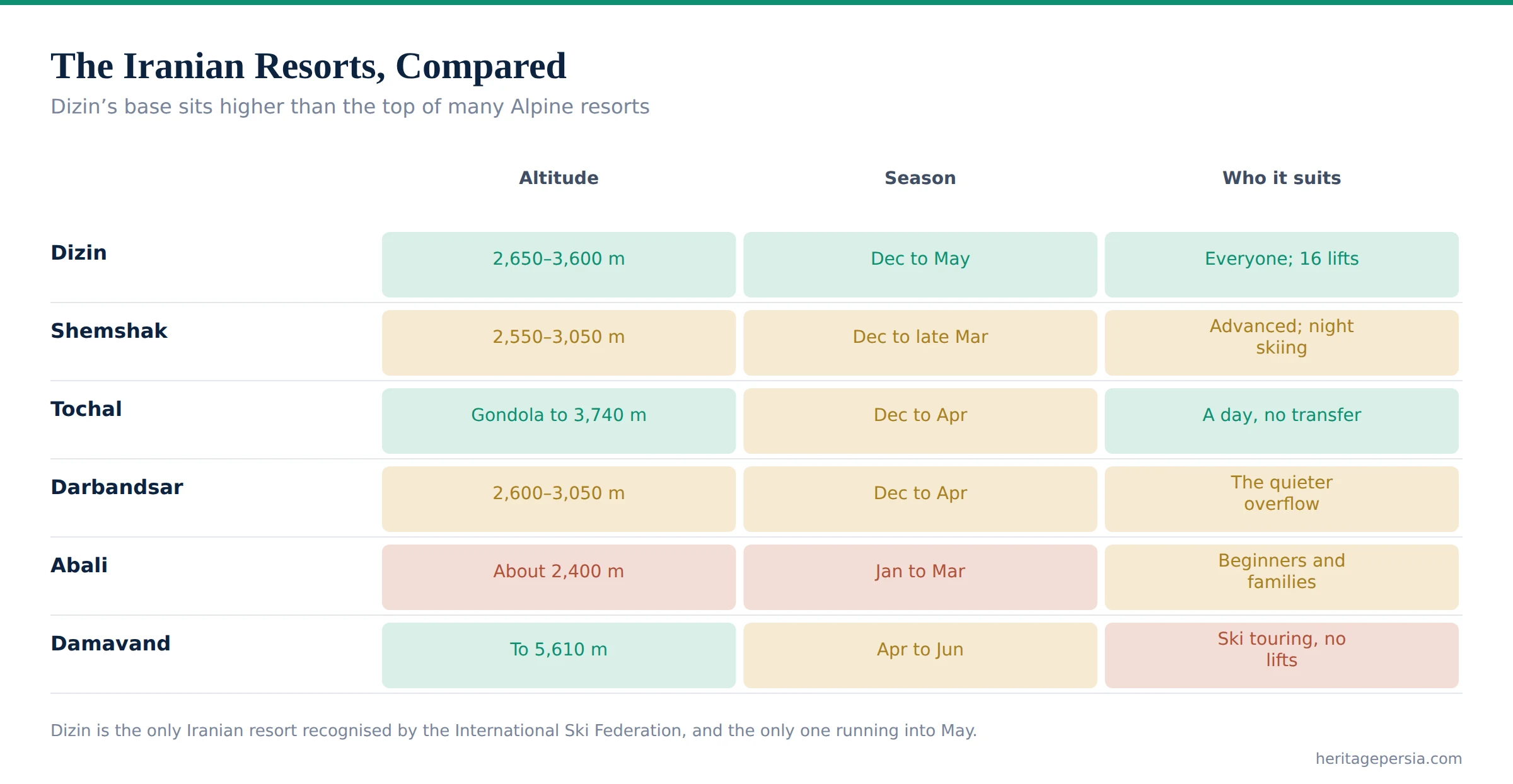
Dizin’s lowest lift station sits at 2,650 metres. That is higher than the top of a great many European resorts, and it is the single fact that explains everything else about skiing in Iran — the season that runs to May, the dry continental snow, and why a country most people associate with desert has a ski industry at all.
The second fact is the drive. Dizin is about seventy kilometres due north of Tehran and roughly two hours by road, which makes it one of the few major resorts anywhere reachable from a capital city before breakfast.
Before you plan anything: this is a seasonal guide, written to be useful whenever you are able to use it. Whether to travel to Iran at present is a separate question with a different answer — see our current situation report, reviewed 12 September 2026.
The Resorts, Compared
| Resort | Altitude | From Tehran | Season | Who it suits |
|---|---|---|---|---|
| Dizin the main one | 2,650–3,600 m | ~70 km · 2 hrs | December to May | Everyone. Sixteen lifts — four gondolas, three chairs, nine surface — the longest season, and the only Iranian resort recognised by the International Ski Federation |
| Shemshak | 2,550–3,050 m | 57 km · 90 min | Early Dec to late March | Advanced skiers. Steeper, mogul-heavy, and the one resort with night skiing |
| Tochal | Gondola to 3,740 m | Inside the city | December to April | A day from Tehran with no transfer. The gondola climbs from Velenjak at 1,900 m, which is a serious ascent in itself |
| Darbandsar | 2,600–3,050 m | 62 km · 90 min | December to April | Quieter than Shemshak next door, and the usual overflow when the others are busy |
| Abali | ~2,400 m | 75 km east | Jan to March | The oldest resort in the country and the smallest of these. Beginners and families |
| Damavand ski touring, not a resort | to 5,610 m | Via Polour | April to June | Ski mountaineering on the highest peak in the Middle East. No lifts, a guide, and a different sport entirely |
Published figures for Dizin disagree — some sources give 2,530–3,410 m and 120 km. The higher altitudes match the resort’s own and the Ski Federation’s; the 120 km is the road distance by one route where seventy is the direct one. Two hours is the number that matters.
The Snow, and Why It Is Good
The Alborz is high, continental and a long way from any ocean, which produces snow that is dry and light in a way that surprises people who expect a Middle Eastern mountain to be slushy. Skiers describe it as too fine to make a snowball from, which is a compliment.
Dizin’s north-facing slopes hold it, and because the base is at 2,650 metres the resort does not depend on a good year the way a low Alpine resort does. The season genuinely runs into May in most years, which is the longest in this part of the world.
The limit is depth rather than quality. This is not Hokkaido, and a thin year is thin. Ask about conditions in the fortnight before you commit rather than trusting a season table, including this one.
What It Costs
| Item | Rough cost | What to know |
|---|---|---|
| Day lift pass, Dizin | around $30 | Unlimited, all lifts. A fraction of an Alpine equivalent and priced in rial, so treat any dollar figure as indicative |
| Equipment hire | Cheap | Available at all the main resorts. Skis are often decades old and snowboards are scarce. Bring your own boots at minimum |
| Lunch on the mountain | $5–10 | Simple and hot. The mountain restaurants are better value than the hotels |
| Accommodation at Dizin | Varies | Two hotels at the resort and apartments in the valley. Both fill for Thursday and Friday nights and empty midweek |
| Transfer from Tehran | Per vehicle | A car and driver for the day is the normal arrangement. There is no useful public transport to the resorts |
| Everything, in cash | — | No foreign card works anywhere in Iran, the resorts included — see the money guide |
Iranian prices move with the currency faster than any published figure can track. Every number here is a scale rather than a quotation, and the scale is the point: a week’s skiing here costs what two days cost in the Alps.
Women on the Slopes
This comes up in every conversation we have about Iranian skiing, so here it is plainly.
The national dress code applies in law on the mountain as everywhere else. In practice enforcement on the slopes is markedly looser than in a city street: women ski in ordinary winter kit — helmet or beanie, goggles, jacket — and a headscarf is not generally worn under a helmet. Visiting skiers consistently report the resorts as among the most relaxed public spaces in the country.
Three caveats, and they matter. This is practice rather than law, and practice can change without notice. It applies on the piste rather than in the hotel lobby, the restaurant or the car park, where the ordinary rules resume. And some resorts have at times operated separate pistes or lift queues, which comes and goes.
The honest summary is that the slopes are more relaxed than the street and that you should arrive dressed for the street. Our clothing guide sets out the twelve settings and what each actually requires.
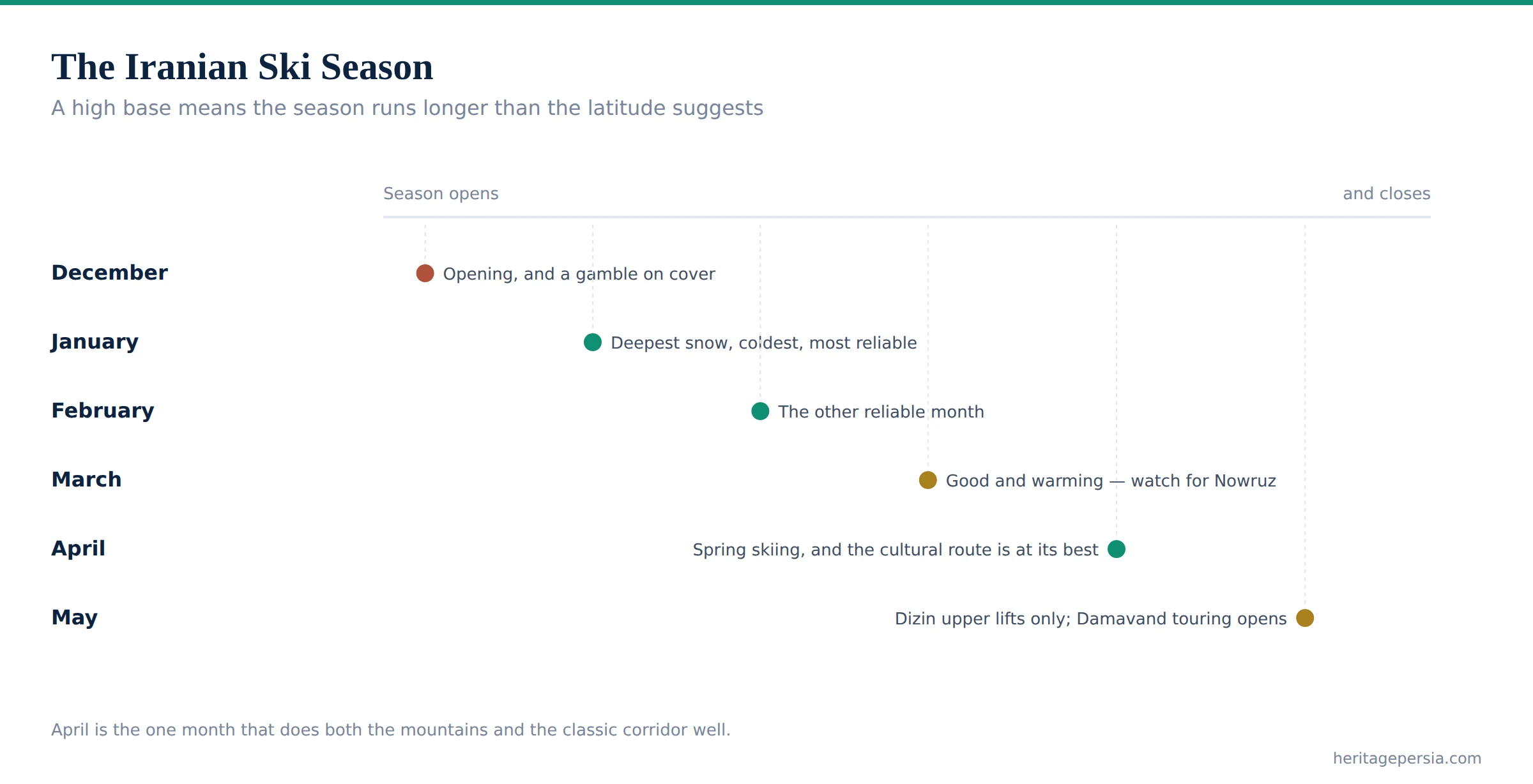
The Season, Month by Month
December. Opening, and unreliable. Dizin and Shemshak start; the lower resorts may not. Cheap and quiet, and a gamble on cover.
January and February. The reliable months, the deepest snow, and the coldest. This is when to come if the skiing is the trip.
March. Still good and warming. Watch for Nowruz in the second half, when the resorts fill with domestic holidaymakers and rates rise sharply.
April. Spring skiing at Dizin, which the base altitude makes real rather than notional. The other resorts are closing. This is also the month the classic cultural route is at its best, which makes April the one month you can do both.
May. Dizin only, upper lifts only, and the beginning of the Damavand ski-touring season.
How It Fits a Trip
Two days, bolted onto the start or end. Fly into Tehran, ski two days while the jet lag clears, and then go south. This is the version that works and the one we run.
A ski week, on its own. Perfectly reasonable, and unusual — Tehran plus the resorts for seven days, with the National Museum and the bazaar on a rest day.
Not inside a ten-day cultural route. The mountains and the classic corridor pull in opposite directions, and fitting both into ten days means losing Kashan or Yazd. We would not do it. Our winter guide covers the rest of what the season offers.
Practical Notes
Altitude is the underrated risk. Tehran is at 1,200 m and Dizin’s top station is at 3,600 m. Arriving from sea level and going straight to the top on day one is how people get headaches and worse — see the health guide.
Ski midweek. The Iranian weekend is Thursday afternoon and Friday, so Saturday to Wednesday is quiet and the same mountain feels like a different resort.
There is no off-piste rescue culture comparable to the Alps. Backcountry here needs a guide who works the range, not a map and optimism.
Your insurance almost certainly excludes it twice over — once for Iran and once for winter sports. Both need naming in writing; our insurance guide explains how to check.
Bring your own boots and goggles. Everything else can be hired badly and cheaply.
✉️ Thinking about a ski week? Tell us your dates and we will say what conditions have been doing and whether to aim for Dizin or Shemshak. Talk to our team →
Continue reading
Frequently Asked Questions
What travellers ask our guides, answered on the ground.
A Ski Week, or Two Days Bolted On
Tell us your dates and we will say what conditions have been doing and which resort to aim for.
See Winter Routes →