
Kerman is where travellers go when they have done Iran once. It sits four hundred kilometres beyond Yazd, past the end of everybody's itinerary, and it is the base for the strangest landscape in the country — a desert that has recorded a surface temperature of 70.7°C and carries wind-carved ridges a hundred and fifty metres high running unbroken for forty kilometres.
The city itself is pleasant rather than spectacular: a Safavid bazaar complex with one of the finest bathhouses in Iran, a high dry climate, and a reputation among Iranians for the best pistachios and the most stubborn people in the country. What you come for is what lies around it — the Lut, a garden at the foot of a mountain that is the most beautiful thing in this guide, and a mud citadel that an earthquake knocked down and two decades of work put back.
Before you plan anything: this is a guide to the region, written to be useful whenever you are able to use it. Whether to travel to Iran at present is a separate question with a different answer — see our current situation report, reviewed 10 September 2026.
Who Kerman Is For
We will be direct, because this is the region we most often talk people out of. Kerman adds two days of driving to a route that already has enough of it, and the city's own monuments do not compete with Isfahan's or Shiraz's. On a first visit of ten days, leave it.
Come if the landscape is what moves you. The Lut is not a sand desert with some dunes in it; it is a geological freak — the best-expressed yardang field on earth, according to the UNESCO citation, visible from space and unlike anything else you will stand in. Come, too, if you are continuing south towards the Gulf or east towards Sistan, because Kerman is the hinge for both.
And come for Mahan. Thirty-five kilometres out of town, at the foot of a mountain, sits a Qajar garden of five and a half hectares stepping down a slope with water running the whole length of it, and a Sufi shrine under turquoise domes beside it. Travellers who arrive sceptical about another Persian garden tend to go quiet there.
Come if
- Landscape moves you more than architecture — the Lut has no equivalent anywhere in Iran
- This is a second visit, or a trip of eighteen days or more
- You are continuing south to the Gulf or east towards Sistan, and Kerman is the hinge
- You travel between October and April, which is the only usable window
- A night in the desert is something you would actually want to do
Leave it if
- This is a first trip of ten to fourteen days — the classic five will already be tight
- Your dates fall between May and September, when the Lut and Bam are genuinely hazardous
- Long drives on desert roads are the part of travel you dread
- You want monuments; Kerman’s own are good, not the country’s best
The honest arithmetic is this. Kerman and the Lut cost two to three days, and those days come out of Isfahan, Shiraz or Yazd rather than out of nowhere. We would rather a traveller saw four cities properly than six in a blur, and we say so before anyone books.
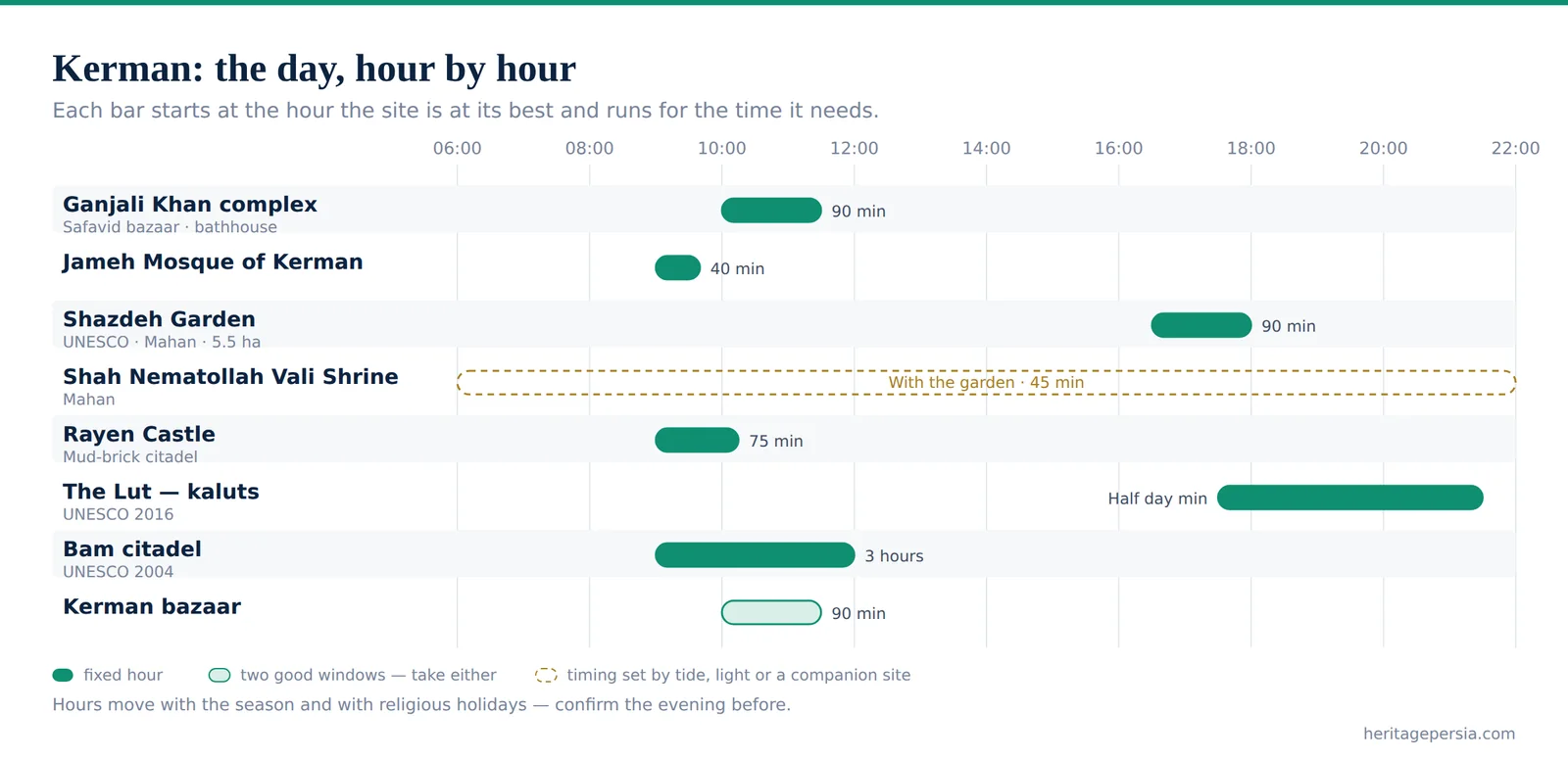
Every Site, With the Hour to Arrive
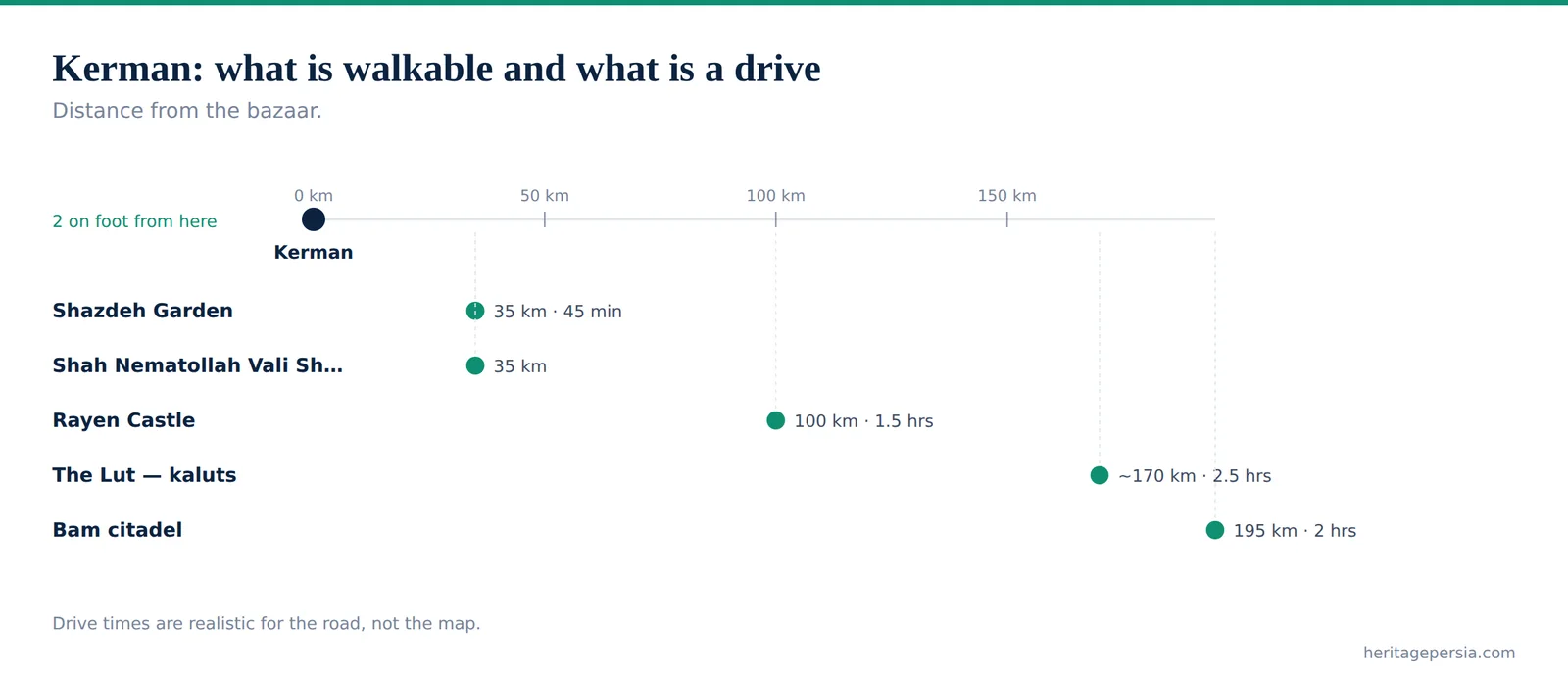
Times are realistic. Distances are from the Ganjali Khan complex in the middle of the old city.
| Site | Time needed | Best hour | From the bazaar | Why that hour |
|---|---|---|---|---|
| Ganjali Khan complex Safavid bazaar · bathhouse | 90 min | 10:00 | You are in it | The bathhouse museum and the caravanserai open mid-morning; the bazaar shuts for a long lunch |
| Jameh Mosque of Kerman | 40 min | Morning | 10 min walk | Blue-tiled portal, best before the sun is overhead |
| Shazdeh Garden UNESCO · Mahan · 5.5 ha | 90 min | Late afternoon | 35 km · 45 min | The water runs down the slope towards you and the low sun sits behind the pavilion |
| Shah Nematollah Vali Shrine Mahan | 45 min | With the garden | 35 km | Six kilometres from Shazdeh — always done as one trip |
| Rayen Castle Mud-brick citadel | 75 min | Morning | 100 km · 1.5 hrs | Unshaded adobe. Also the answer for anyone who cannot reach Bam |
| The Lut — kaluts UNESCO 2016 | Half day min | Sunset onwards | ~170 km · 2.5 hrs | The ridges only work in low light, and the heat makes anything else pointless |
| Bam citadel UNESCO 2004 | 3 hours | Morning | 195 km · 2 hrs | Large, exposed and entirely mud. Go early or not at all |
| Kerman bazaar | 90 min | 10:00 or 17:00 | — | One of the longest covered bazaars in Iran and a working one |
Opening hours in Iran move with the season and with religious holidays. We give the hour that makes each place best rather than a schedule that will be wrong by the time you read it — confirm at your hotel the night before.
The Lut Desert
UNESCO inscribed the Lut in 2016 under the two natural criteria, across a property of 2.28 million hectares, and the citation is unusually enthusiastic for a document of that kind. Three things are worth knowing before you stand in it.
The heat. A land surface temperature of 70.7°C has been recorded inside the property — among the highest ever measured anywhere on earth. That is ground temperature rather than air temperature, and it is the reason no one visits between May and September, and the reason you do not walk away from the vehicle.
The kaluts. The corrugated ridges that everyone photographs are yardangs — bedrock carved and streamlined by decades of sandblasting wind. In the Lut they reach 155 metres high and individual ridges can be traced for more than forty kilometres, which UNESCO describes as the best-expressed formations of their kind in the world for extent, continuity and height. From the air they look like a ploughed field the size of a country.
The dunes. Elsewhere in the property, sand dunes reach 475 metres and nebkhas — dunes that form around a plant — stand over twelve metres, among the tallest known.
💡 How to actually see it: leave Kerman after lunch, reach the kaluts about two hours before sunset, and stay until the light goes. The ridges are flat and uninteresting at midday and extraordinary in the last hour, when the shadows between them run for hundreds of metres. Go with a driver who knows the tracks — this is open desert without signage, phone signal is unreliable, and a wrong turn here is a serious matter rather than an inconvenience. Sleeping out is the reason to give the Lut a whole day.
Mahan — the Garden and the Shrine
Thirty-five kilometres south-east of the city, Shazdeh Garden steps down a slope at the foot of the Joupar mountains — five and a half hectares of walled garden, a Qajar pavilion at the top, and a chain of pools and fountains falling the whole length of it. It joined the Persian Garden UNESCO inscription in June 2011.
What makes it work is the gradient. Most Persian gardens are flat and their water is a still reflecting surface; Shazdeh's runs downhill, so the water moves and sounds the whole time, and you approach it from below with the fountains coming towards you. Set that against bare brown mountain on three sides and it is the clearest statement of what a Persian garden was for — a walled argument against the landscape outside it.
Six kilometres away, the Shah Nematollah Vali Shrine holds the tomb of a fourteenth-century Sufi poet and master, under turquoise domes with tall Safavid minarets. The two are always visited together, and an afternoon covers both with time to sit.
Bam, and What an Earthquake Taught
Two hours south-east, Arg-e Bam was the largest adobe structure in the world — a fortified medieval city of mud brick, palm trunk and straw on the edge of the desert. On 26 December 2003 an earthquake destroyed it, along with much of the modern town around it and tens of thousands of lives.
It was inscribed by UNESCO in 2004, immediately placed on the List of World Heritage in Danger, and removed from that list in June 2013 after a decade of restoration. One detail from the UNESCO assessment is worth carrying with you: much of the fabric lost in the earthquake was itself modern restoration rather than original material, which changed how the rebuilding was approached.
What stands now is partly original, partly rebuilt, and openly both. It is a long, hot, exposed walk and it needs a morning. For travellers who cannot spare the four hours of driving, Rayen Castle an hour from Kerman is a smaller citadel of the same kind, undamaged, and gives a fair sense of what Bam was.
The City Itself
Kerman's centrepiece is the Ganjali Khan complex, a Safavid ensemble of bazaar, caravanserai, mint, water cistern and bathhouse built around a square in the early seventeenth century. The bathhouse is now a museum with wax figures in it, which sounds dreadful and is not — the painted vaults and the plan of the building survive intact, and it is one of the best-preserved hammams in the country.
The bazaar around it is among the longest covered bazaars in Iran and is entirely a working market. Kerman is Iran's pistachio capital and the nut sellers are the thing to find, along with the cumin the region is equally known for.
Two more things in the city are worth an hour each if you have it. The Jameh Mosque, ten minutes' walk from Ganjali Khan, carries a blue-tiled entrance portal that is the best piece of tilework in Kerman and is best seen before the sun is overhead. And the Moshtaghieh, a complex of three domed tombs at the edge of the old town, is the kind of place where you will be the only visitor and somebody will bring you tea.
What Kerman is not is an evening city. The old quarter is quiet after dark, the restaurants close early, and travellers who expect Isfahan's river promenade will find nothing like it. Plan your days long and your nights short, and use the evening to get to the desert instead.
Eating in Kerman
The region's own dish is boz ghormeh — a slow-cooked stew of mutton, chickpeas, whey and walnut, dark and sour, and quite unlike the herb stews of the north. It is a household dish more than a restaurant one, so ask at your guesthouse rather than looking for it on a menu; the courtyard hotels will usually make it with a day's notice.
Beyond that, expect the national repertoire done well and cheaply — our food guide covers the dishes worth ordering anywhere in the country. Two local particulars: the bread here is often komaj, a sweet spiced flatbread eaten at breakfast, and the pistachio is used as an ingredient rather than a snack, in ice cream, in rice and ground into sauces.
Practical Kerman
Getting there. About 370 km and five hours from Yazd, or an hour by air from Tehran with domestic flights most days. The sensible shape is Yazd, Kerman, then either back to Shiraz or onward south towards the Gulf and Qeshm.
When to come. October to April, and that is not a preference. Kerman sits at about 1,750 metres so the city itself is bearable in summer, but the Lut and Bam are at lower altitude and genuinely dangerous between May and September. Winter days are mild, winter nights cold.
Getting around. The old city is walkable. Mahan, Rayen, Bam and the Lut all need a car, and for the desert you want a driver who works it regularly rather than a city taxi.
Where to stay. Kerman has several restored courtyard houses in the old quarter, in the same tradition as Yazd and Kashan, plus conventional hotels in the modern town. For the Lut, the options are a desert camp or driving back the same night.
What to buy. Pistachios, cumin, and the region's flatweave carpets. Kerman's pateh — hand-embroidered wool felt in dense floral patterns — is the local craft and is not sold much anywhere else.
✉️ Adding the desert to a longer route? Tell us your dates and we will tell you honestly whether Kerman fits, or whether the Lut is the reason to come back with two more days. Talk to our team →
Continue reading
Frequently Asked Questions
What travellers ask our guides about Kerman, answered on the ground.
The Desert, Properly
The kaluts at sunset with a driver who works them, Mahan in low sun, and Bam in the morning.
Desert Itineraries →