
There is a couplet every Iranian child learns — Esfahan nesf-e jahan, Isfahan is half the world. It was coined in the seventeenth century, when the city held perhaps half a million people, a hundred and sixty mosques, forty-eight religious schools and a royal square larger than anything in Europe, and travellers arriving from Paris or Delhi wrote home in language that sounds like exaggeration until you stand in it.
We bring travellers into this city most weeks of the year. What follows is the guide we would write for a friend — which sites earn their reputation and which are oversold, what hour to arrive at each one, how long things actually take, what the river looks like now, and how to buy a carpet without being taken for a fool.
Before you plan anything: this is a guide to the city, written to be useful whenever you are able to use it. It is not advice on whether to travel to Iran at the moment, which is a separate question with a different answer — see our current situation report, reviewed 10 September 2026.
Why Isfahan Is the One City You Cannot Skip
Iran has older cities than Isfahan and stranger ones. Yazd is more atmospheric, Shiraz more lyrical, Tabriz more surprising. Isfahan is the one that makes people cry in public.
The reason is concentration. In 1598 Shah Abbas I moved his capital here and commissioned a single act of city planning that produced, within about thirty years, a royal square, two of the finest mosques ever built, a palace, a covered bazaar running for kilometres, a boulevard of gardens and a set of bridges that doubled as dams and meeting places. Almost all of it survives, almost all of it is within a half-hour walk, and it was designed by people who understood that a city is experienced at walking pace.
Set against that, three days is not generous. It is the minimum at which you stop moving between monuments and start noticing the light.
Every Major Site, With the Hour to Arrive
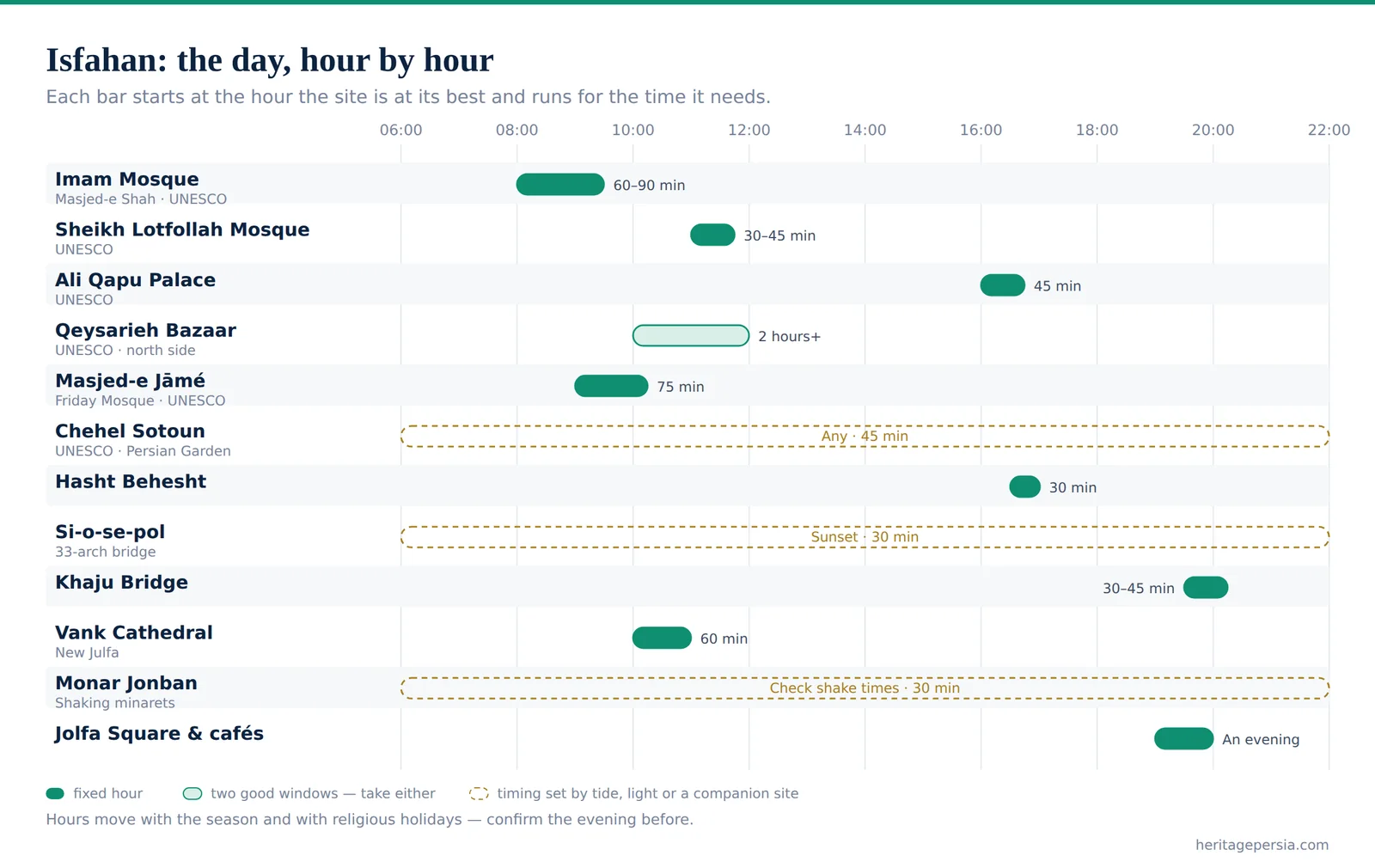
This is the table we wish someone had handed us. Time needed is realistic rather than minimal — it assumes you look up. Walking times are from the centre of Naqsh-e Jahan Square, at an unhurried pace.
| Site | Time needed | Best hour | Walk from the square | Why that hour |
|---|---|---|---|---|
| Imam Mosque Masjed-e Shah · UNESCO | 60–90 min | 08:00 | On the square | Empty for the first hour and the low sun lifts the blue tilework |
| Sheikh Lotfollah Mosque UNESCO | 30–45 min | 11:00 | On the square | The dome's light shaft reaches the floor near midday — the whole point of the building |
| Ali Qapu Palace UNESCO | 45 min | 16:00 | On the square | The terrace looks east over the square as the afternoon light turns |
| Qeysarieh Bazaar UNESCO · north side | 2 hours+ | 10:00 or 17:00 | On the square | Shops shut for a long lunch; mid-afternoon is dead |
| Masjed-e Jāmé Friday Mosque · UNESCO | 75 min | 09:00 | 25 min north | Quiet before the tour groups, and the brickwork needs raking light |
| Chehel Sotoun UNESCO · Persian Garden | 45 min | Any | 10 min west | The pool reflection works whenever the water is on |
| Hasht Behesht | 30 min | Late afternoon | 15 min west | A garden pavilion, best combined with a walk down Chahar Bagh |
| Si-o-se-pol 33-arch bridge | 30 min | Sunset | 20 min south-west | Locals gather in the arches at dusk; that is the experience, not the structure |
| Khaju Bridge | 30–45 min | After dark | 30 min south-east | Lit at night, and singers use the central arches for the acoustics |
| Vank Cathedral New Julfa | 60 min | 10:00 | 30 min south-west | Includes the museum; closes earlier than you expect |
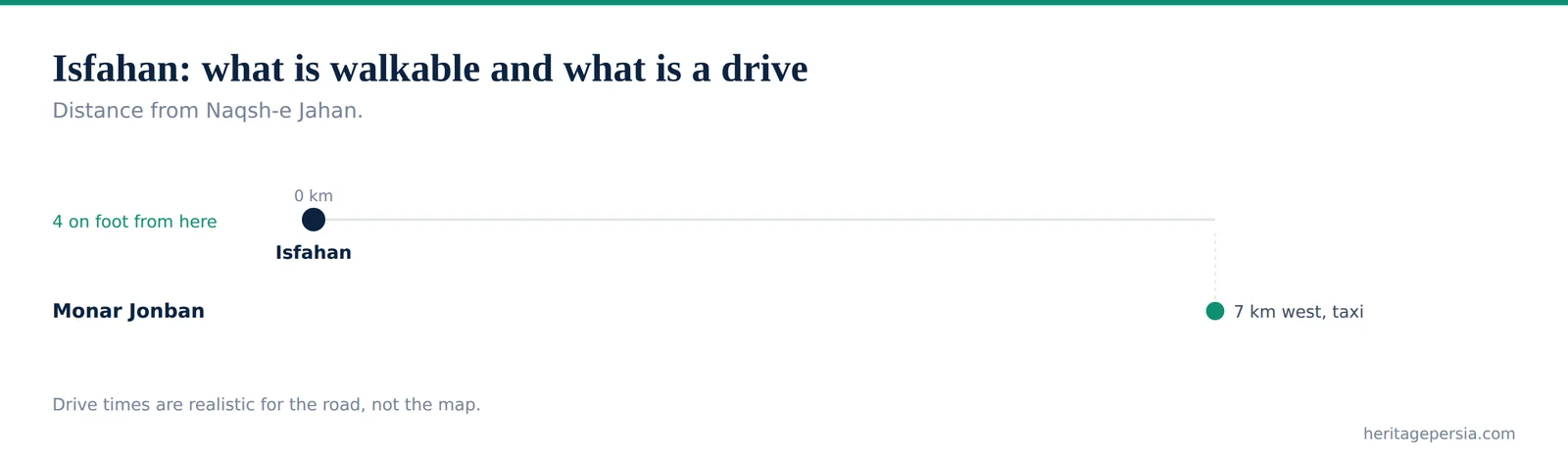
| Monar Jonban Shaking minarets | 30 min | Check shake times | 7 km west, taxi | The minarets are shaken only at set times; without that it is a small tomb |
| Jolfa Square & cafés | An evening | 19:00 | 30 min south-west | The city's social centre after dark, and where you will want dinner |
Opening hours in Iran move with the season, with religious holidays and occasionally with no announcement at all — mosques close to visitors during prayers, and museum hours shorten in winter. We have given the hour that makes each site best rather than a schedule that will be wrong by the time you read it. Confirm the day's hours at your hotel desk the night before.
Naqsh-e Jahan Square
Five hundred and sixty metres long, a hundred and sixty wide, nine hectares of enclosed space — the second largest square on earth, inscribed by UNESCO in 1979 and, unusually for a monument of this scale, still the middle of an ordinary working city. Families picnic on the grass. Horse carriages circle. On the four sides stand four buildings that between them cover everything the Safavid state was: a congregational mosque, a private royal chapel, a palace and a market.
Walk it twice. Once in the morning for the buildings, once after dark when the arcades are lit and the square fills with people who live here.
The Imam Mosque
The building on the south side is the one on every poster, and it deserves the attention. Note what the architects did with the entrance: the portal faces the square, but the mosque behind it must face Mecca, so the whole structure pivots forty-five degrees behind the doorway without the visitor ever feeling the turn. It is the most elegant solved problem in Persian architecture.
Inside, stand under the main dome and speak normally. The acoustics were built to carry an unamplified voice to a full courtyard, and the effect is startling. Arrive at eight, before the groups.
Sheikh Lotfollah Mosque
The smaller building opposite Ali Qapu was the shah's private mosque, which is why it has no minaret and no courtyard — nobody was being called to it. It is also, by a distance, the finest interior in Iran.
The dome is worked in cream and ochre rather than the usual blue, and around eleven in the morning the light entering the high grilles forms a shaft that moves across the floor like the tail of a peacock. Iranians will tell you the design intends this. Whether the seventeenth-century builders planned the peacock or later visitors found it, standing there when it happens is the reason to come to Isfahan at all.
Ali Qapu Palace
Six storeys and a forty-eight-metre portal, built as the ceremonial gate into the royal precinct. Two things justify the climb: the raised terrace, from which the shah watched polo in the square below and from which you get the view every photographer wants, and the music room at the top, where the plaster is cut into the shapes of vessels and instruments to tune the room's acoustics. The stairs are steep and narrow. Go late in the afternoon.
The Qeysarieh Bazaar
The portico on the north side leads into a covered market that runs for kilometres and has been trading continuously for four centuries. The tourist section closest to the square sells miniatures and enamel; keep walking, and within ten minutes you are among copper-beaters, spice merchants and men selling nothing but string. The deeper you go the better the prices and the more interesting the conversation. Getting lost is the correct way to use it.
Masjed-e Jāmé — Twelve Centuries in One Building
Twenty-five minutes' walk north of the square, in the old city, stands the building that most rewards a slow visit and that most visitors miss. The Friday Mosque was begun in AD 841 and added to continuously for twelve hundred years, by Abbasids, Buyids, Seljuqs, Ilkhanids, Timurids and Safavids, each leaving their own idiom in place rather than erasing what came before. UNESCO inscribed it in 2012 for exactly that reason.
Two things here changed architecture across half a continent. This was the first Islamic building to arrange four iwans around a courtyard, a plan borrowed from Sassanid palaces that became the template for mosques from Anatolia to India. And the Nezam al-Molk dome was the first double-shell ribbed dome in the Islamic world — an engineering solution that made everything after it possible.
Come at nine, when the brickwork is still in raking light. Give it seventy-five minutes and walk the courtyard's four sides in order, which is the only way to read the twelve centuries as a sequence rather than a jumble.
The Bridges, and the River You Probably Will Not See
Here is the thing no other guide to this city will tell you plainly, and every visitor discovers within an hour of arriving.
The Zayandeh Rud is usually dry. The river that gave Isfahan its gardens and its bridges has run empty for much of the year for well over a decade — the result of reduced rainfall, of irrigation expansion across the basin, of tens of thousands of wells, and of inter-basin tunnels that divert the water to Yazd and Kashan before it reaches the city. Water is released periodically, usually with snowmelt in April and May, and for those few weeks the photographs you have seen become true. The rest of the year the bridges span sand.
This is worth knowing for two reasons. The first is expectation: arrive in October imagining reflections and you will feel cheated, while arriving prepared lets you see what is actually in front of you. The second is that the drying is doing real damage. The Safavid bridges were designed to sit in water and to work as weirs when the river was high; standing dry, their foundations are exposed, and the groundwater depletion beneath the city has caused land subsidence that Iranian heritage authorities have repeatedly warned threatens the historic monuments themselves.
📌 What to do about it: go anyway, and go at dusk. Si-o-se-pol's thirty-three arches are full of people every evening regardless of the water — families, students, men singing in the alcoves for the echo. Khaju, half an hour downstream and lit after dark, has better acoustics and fewer visitors. The bridges are still the city's living room. They are simply a living room with a dry floor.
New Julfa — the Armenian Quarter
In 1606 Shah Abbas I moved the entire population of the Armenian town of Julfa to his new capital, partly as a strategic depopulation of his northern border and partly because he wanted their skill in silk trading. He gave them land south of the river, freedom of worship and a degree of autonomy, and the quarter they built is still Armenian four centuries later.
Vank Cathedral is the reason most people come, and it is genuinely disorienting — an exterior that looks like a Persian mosque, an interior covered floor to dome in Italianate frescoes, gilding and a graphically detailed Last Judgement. The attached museum holds the first printing press used in Iran and a hair with a verse inscribed on it, which is exactly as strange as it sounds. Allow an hour for both, and go in the morning, since it closes earlier than visitors expect.
Then stay for the evening. Jolfa Square and the lanes around it hold the best cafés in the city and a young crowd that has nothing to do with tourism. If you spend one evening in Isfahan doing what residents do, spend it here.
Chehel Sotoun and the Garden City
Ten minutes west of the square, Chehel Sotoun is a Safavid pavilion set in a formal garden, commissioned by Shah Abbas I and finished under Abbas II, and part of the Persian Garden inscription that UNESCO made in 2011. The name means "forty columns", and there are twenty — the other twenty are the reflection in the long pool, which tells you something about how seriously this culture took water in a dry country.
Inside are six large frescoes of Safavid court life and battle, including a banquet for a Mughal guest that is worth ten minutes on its own. Nearby, Hasht Behesht ("eight paradises") is a smaller pavilion in a park, best folded into a walk down Chahar Bagh, the boulevard Abbas laid out as a promenade of gardens and which still carries the city's evening crowd.
Three Itineraries That Work
These are the routes we actually run, built around the hours in the table above rather than around a map.
One day — the raid
08:00 Imam Mosque. 09:30 walk the square's arcades. 11:00 Sheikh Lotfollah for the light. 12:30 lunch and beryani near the bazaar. 14:00 Chehel Sotoun. 16:00 Ali Qapu terrace. 18:00 Si-o-se-pol at dusk. You will have seen the headline sights and missed the city. If a single day is all you have, do this and accept the trade.
Two days — the sensible minimum
Day one as above, minus Chehel Sotoun, at half the pace. Day two: Masjed-e Jāmé at nine, then get lost in the old city and the deep bazaar until lunch; Chehel Sotoun and Hasht Behesht in the afternoon; Vank Cathedral late afternoon; dinner and the evening in Julfa; Khaju Bridge after dark on the way back.
Three days — what we recommend
Days one and two as above, unhurried. Day three is the one that changes people's minds about the city: a morning workshop visit — a qalamkar block-printing or miniature studio in the bazaar — followed by a long lunch, then either the Armenian quarter properly, or a half-day out to Abyaneh or the Varzaneh desert. The third day is where Isfahan stops being a list of monuments.
Where to Stay, and What Each Area Costs You
Three areas make sense, and the choice matters more here than in most cities because of the walking distances.
Around Naqsh-e Jahan puts you inside the monument zone — you can be at the Imam Mosque at eight without a taxi, which is the single best thing you can do for your trip. Evenings are quieter than you might like. Several restored traditional houses sit in the lanes behind the square, and they are the most atmospheric rooms in the city.
Julfa is where to stay if you want evenings — cafés, restaurants, a walkable social quarter — at the cost of a twenty-five-minute walk or a short taxi to the monuments each morning.
Chahar Bagh and the modern centre holds most of the larger international-standard hotels, with the reliability that implies and none of the character. Budget travellers will find hostels concentrated near the square and in Julfa.
What to Eat in Isfahan
Isfahani food is distinct from the rest of Iran and the city is quietly proud of it.
Beryani is the dish to try, and it is not the Indian biryani. Minced lamb and lung are cooked, pressed into a flat disc, seared and served on flatbread with mint and cinnamon. It is heavy in a way that ends the day, which is why Isfahanis eat it at lunch and consider dinner beryani a foreigner's mistake. Once is right.
Khoresht-e mast — literally yoghurt stew — is a sweet saffron and yoghurt dish served cold as a side, and it confuses everyone the first time. Gaz is the city's nougat, made with pistachio and the sap of tamarisk, and the good version is nothing like the boxes sold at airports; buy it in the bazaar where they let you taste first. Fesenjan, walnut and pomegranate stew, is at its best in this region in autumn.
For a wider tour of the national repertoire, our guide to Iranian food covers the dishes worth ordering everywhere else.
Buying Crafts Without Being Taken for a Fool
Isfahan is Iran's craft capital and the bazaar is built for selling to visitors. The crafts are genuinely superb; the pricing is genuinely elastic.
Four things are worth carrying home. Qalamkar is block-printed cotton, stamped by hand with carved pear-wood blocks — check the reverse for the slight bleed of real printing rather than the flat perfection of a machine. Minakari is enamel on copper, usually blue; look at the rim for evenness. Khatam is marquetry in bone, brass and wood, and the quality is in the size of the pieces — smaller means finer means slower means more expensive. And carpets, about which the only rule that matters is that no shop selling a "government certificate" has one.
💡 How our guides do it: never buy in the first shop, never buy on the first day, and ask the price of the same object in three places before you like anything out loud. A shopkeeper who knows you are leaving tomorrow prices differently from one who thinks you will return. None of this is hostile — bargaining here is a conversation, and it is expected to be enjoyable.
Day Trips From Isfahan
Abyaneh, about two and a half hours north, is a red-mud village on a mountainside where older women still wear the floral chador of the region. It is touristed and still worth it. Varzaneh, ninety minutes east, puts you in real desert with dunes, a salt lake and a night sky — the best half-day escape from the city and an easy add-on for anyone continuing towards Yazd. Kashan, two hours north on the road to Tehran, deserves a night rather than a day, and in late April and May it is the gateway to the rose harvest.
Practical Isfahan
Getting there. Isfahan sits almost exactly between Tehran and Shiraz on the classic route, roughly four to five hours by road from either, with domestic flights and intercity buses on both legs. Most itineraries reach it on day three or four.
Getting around. The monument core is walkable end to end and that is how it should be seen. For Julfa, Monar Jonban and Khaju, use taxis and agree the fare before the door closes — or use the metro line, which is clean, cheap and runs north to south through the centre.
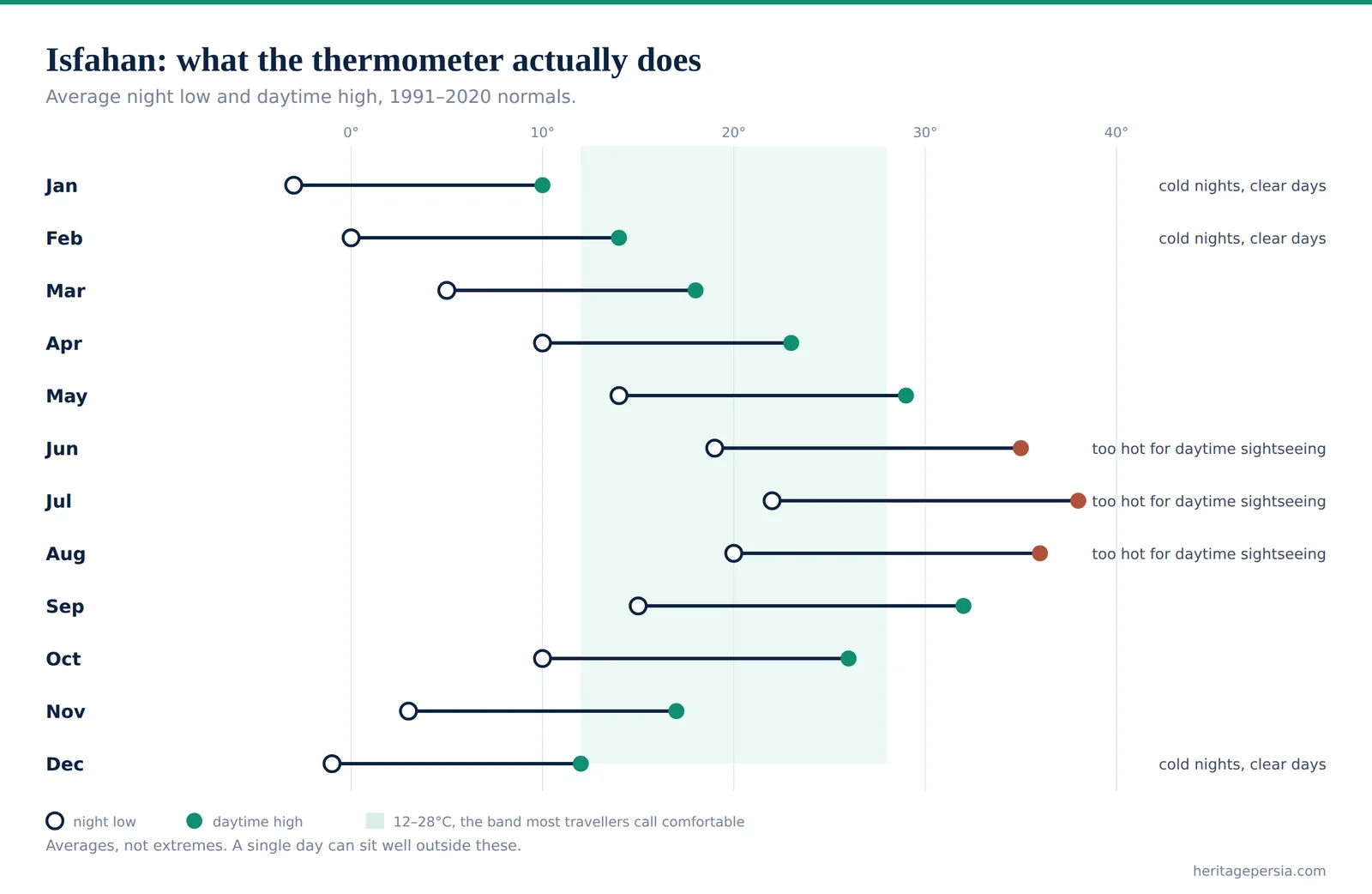
When to come. April, May, October and early November, in that order. Isfahan sits at about 1,570 metres, which means hot dry summers and genuinely cold nights in winter — in March the city averages 5°C before dawn and 18°C at noon, a swing that catches out anyone who packed for the daytime figure. Our month-by-month guide has the full picture.
Dress. Mosques require modest dress and headscarves for women, and chadors are lent at the door of the major sites. Nobody will be unfriendly about it.
Money. No foreign card works anywhere in Iran, including here. Bring cash and see our note on paying for things.
✉️ Planning Isfahan into a longer trip? Tell us how many days you have and what you care about, and we will send an honest itinerary — including the parts we would cut. Talk to our team →
Continue reading
Frequently Asked Questions
The questions travellers ask us about Isfahan most often, answered as our guides answer them on the ground.
See Isfahan Properly
Three days, the right hours, and a guide who knows which door to knock on in the bazaar.
Our Isfahan Itineraries →