
Almost every article about what to wear in Iran was written before 2022 and lightly edited since. They describe a country where every woman covers her hair, where a stern official waits at the airport, and where a foreign visitor should pack shapeless black. A traveller who arrives with that picture in her head spends the first afternoon confused, because it does not match what she sees walking down Valiasr Street.
The honest version has two parts that sit uncomfortably together, and a guide that gives you only one of them is not being useful. The law has not changed. What people do has changed a great deal. This page explains both, tells you what that means for a visitor specifically, and then gets practical about fabric, layers and what to put in the suitcase.
A note on timing: this is a practical guide to clothing, written to be useful whenever you travel. Whether to travel to Iran at present is a separate question with a different answer — see our current situation report, reviewed 10 September 2026.
The Legal Position, Stated Once and Plainly
Covering the hair in public is a legal requirement for women in Iran, and it applies to foreign visitors exactly as it applies to Iranians. Iran's judiciary confirmed in October 2025 that the existing hijab laws remain in force. That is the position, and no amount of what you observe on the street changes it.
A separate and much harsher piece of legislation — the Hijab and Chastity bill, which passed parliament and would have introduced heavy fines, long prison terms and a citizen-reporting mechanism — was blocked by the Supreme National Security Council before it came into effect. It has not been implemented. Confusion between the law that exists and the bill that was suspended is why so many pages on this subject contradict each other.
In September 2026 an official in the Supreme Leader's office acknowledged that enforcement was being held back under what he described as war conditions. Take from that what you will about the near term; take from it also that this is a live and shifting question, which is why this page carries a review date at the top.
What You Will Actually See
In Tehran, in the north of the city particularly, and in Isfahan, Shiraz and the university districts of most large cities, a substantial number of Iranian women now go without a headscarf in public — in cafés, in shopping centres, in the street. This has been the most visible social change in Iran since 2022 and it is not a marginal phenomenon.
You will also see the opposite, in the same street, in the same hour. Older women in chador, younger women in a scarf pushed back to the crown of the head, and women with no covering at all, walking past each other without comment. Outside the big cities, in smaller towns and in religious centres such as Qom and Mashhad, covering remains close to universal.
Guides that tell you everyone covers are describing 2019. Guides that tell you nobody bothers any more are describing one neighbourhood of one city. Both are selling you a simpler country than the one you are going to.
📌 Why a visitor's calculation is not an Iranian woman's. What Iranian women are doing is a choice made by citizens in their own country, with their own networks, their own lawyers and their own reasons. A foreign visitor who copies it is exposed differently — a confrontation you cannot argue your way out of in Persian, a complication attached to your visa, and, at present, an embassy with very limited ability to assist. Our advice to every client is the same and it is practical rather than moral: carry a scarf, wear it where it matters, and do not make your trip a test case.
Where the Rules Actually Bite
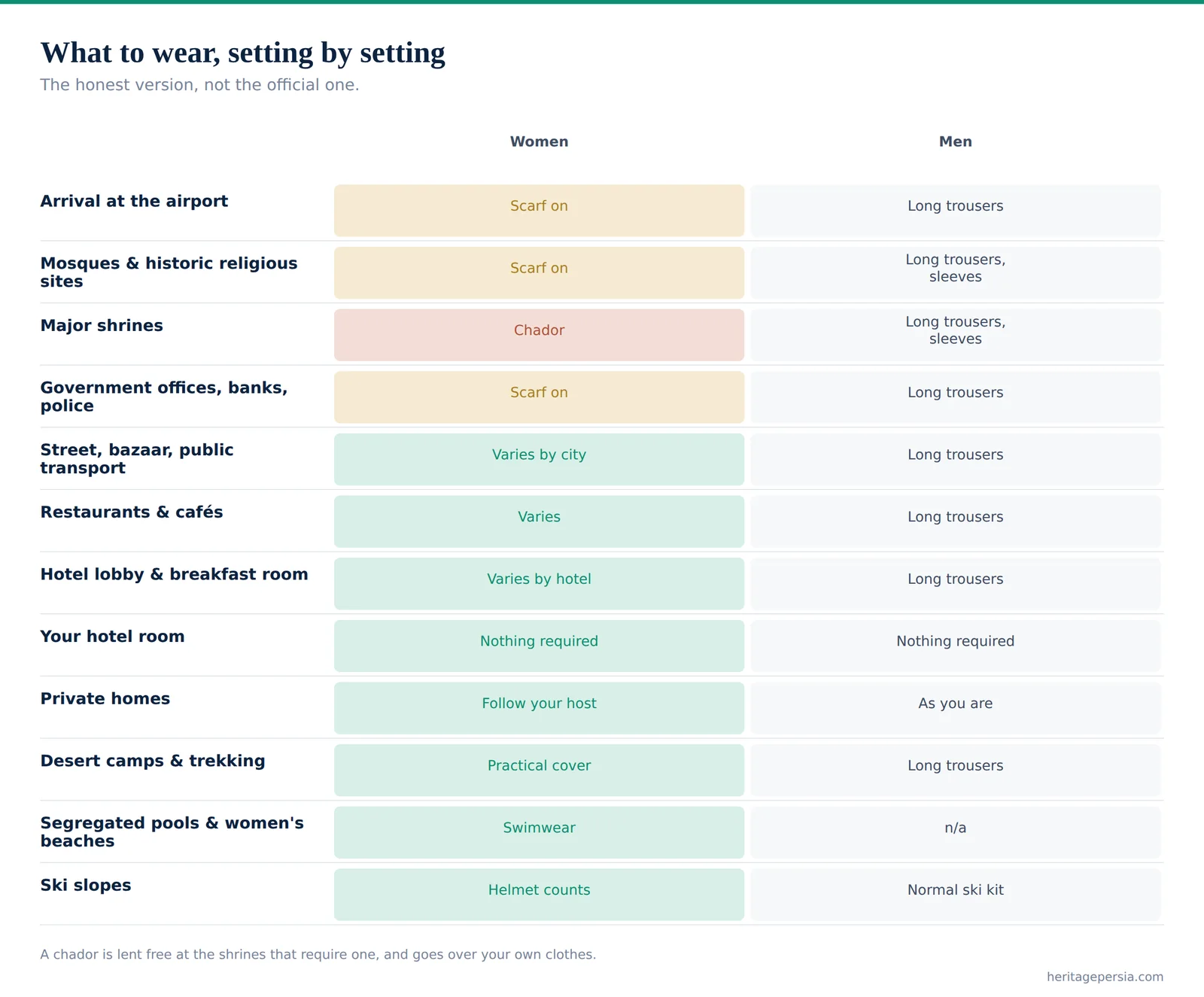
The single most useful thing we can give you is not a list of garments. It is this table, because the requirement is not uniform across a day — it changes between the shrine, the taxi, the hotel lobby and the desert camp, and knowing which is which removes nearly all the anxiety.
| Setting | Women | Men | Note |
|---|---|---|---|
| Arrival at the airport | Scarf on | Long trousers | Put the scarf on before landing. First impressions at passport control are not the moment to experiment. |
| Mosques & historic religious sites | Scarf on | Long trousers, sleeves | Non-negotiable everywhere in the country, including at tourist monuments such as the Imam Mosque. |
| Major shrines Mashhad · Qom · Shah Cheragh | Chador | Long trousers, sleeves | Lent free at the entrance. It goes over your clothes and you return it on the way out. |
| Government offices, banks, police | Scarf on | Long trousers | Any official business. Also applies at the immigration office if you extend a visa. |
| Street, bazaar, public transport | Varies by city | Long trousers | Legally required; unevenly observed in large cities. Carry the scarf on your shoulders and read the room. |
| Restaurants & cafés | Varies | Long trousers | Legally a public space. In practice the most relaxed setting in the cities. |
| Hotel lobby & breakfast room | Varies by hotel | Long trousers | Technically public. Larger international hotels tend to be relaxed; traditional guesthouses vary. |
| Your hotel room | Nothing required | Nothing required | Private space. Wear whatever you like. |
| Private homes | Follow your host | As you are | Iranian women take the scarf off at home. Guests do the same once the host does. |
| Desert camps & trekking | Practical cover | Long trousers | Sun and cold matter more than anything else here. Cover for the climate. |
| Segregated pools & women's beaches | Swimwear | n/a | Normal swimwear in women-only facilities. Mixed public swimming does not exist. |
| Ski slopes | Helmet counts | Normal ski kit | The Alborz resorts are among the most relaxed places in the country. |
"Varies" means the legal requirement stands while observance in practice differs by city, district and week. It is not permission — it is a description of what you will see. When in doubt in an unfamiliar setting, put the scarf on for ten minutes and watch what the women around you are doing.
Women — What to Actually Pack
The headscarf
A plain rectangular scarf, roughly 70 by 180 centimetres, in a fabric with some grip. Silk looks elegant and slides off your head every four minutes; a cotton or viscose blend stays put. Bring two, wear one, and buy a third in the bazaar for two euros because you will want it as a souvenir anyway.
It is worn loosely, draped over the head with the ends over the shoulders or thrown back. There is no requirement to cover every strand, and the tight-under-the-chin style you may have seen in photographs is a religious choice rather than the legal standard.
The layer over the top
The requirement is loose clothing that covers the shape of the body to roughly mid-thigh. The Iranian solution is the manteau, a light long-line coat, and it exists in every weight from summer linen to winter wool. A long tunic, an oversized shirt worn open over a top, or a knee-length dress over trousers does the same job. Sleeves to the wrist are the safe standard; three-quarter sleeves are widely worn and cause no difficulty.
Legs and feet
Trousers or a long skirt to the ankle. Jeans are entirely normal and worn everywhere by Iranian women. Leggings alone are not enough, since the covering layer needs to reach mid-thigh over them. Feet are the surprise: sandals are fine, bare toes are fine, and painted nails are fine. Nobody has ever been stopped over a foot.
The chador question
You do not need to own one and you will not be expected to wear one, with three exceptions — the shrines at Mashhad, Qom and Shah Cheragh in Shiraz. At each of those a chador is lent at the entrance, usually a floral one for visitors, worn over your own clothes and handed back as you leave. It takes a minute to learn and there is always a woman at the door who will show you.
The black myth
Iranian streets are not black. Women here wear coral, olive, mustard, every shade of blue, and the scarves in any bazaar are a wall of colour. Black is customary at shrines, at funerals and during Muharram, and it is common among older and more religious women, and that is the whole of it. Pack what you actually like wearing.
Men — the Short Version
Long trousers in public, and no sleeveless tops. That is the entire dress code for men in Iran.
Shorts are the one thing that genuinely does not work — they are not worn by adult men in public anywhere in the country, and a man in shorts in a bazaar reads roughly as a man in swimming trunks in a European supermarket. Keep them for the hotel and the pool. Short sleeves are completely normal in summer. Beards, long hair, tattoos and jewellery attract no attention. In a mosque or a shrine, wear long sleeves as a courtesy; nobody will hand you anything at the door.
Packing by Season
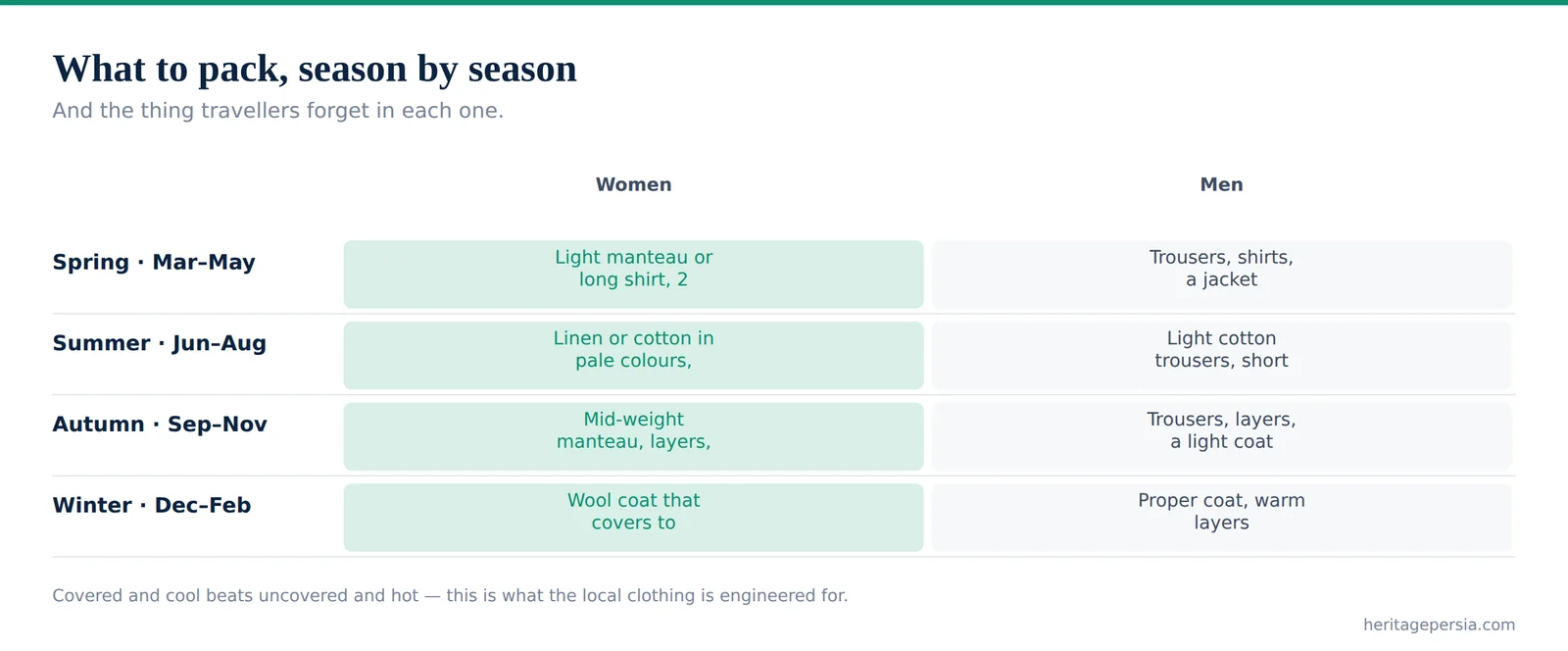
Iran's climate does most of the work in this decision. The plateau is dry with a large daily swing, the Caspian is humid, the south is subtropical, and the desert is cold at night in every month.
| Season | Women | Men | The thing people forget |
|---|---|---|---|
| Spring Mar–May | Light manteau or long shirt, 2 scarves, jeans, a warm layer | Trousers, shirts, a jacket | Nights on the plateau are near freezing in March. Isfahan runs 5°C before dawn and 18°C at noon. |
| Summer Jun–Aug | Linen or cotton in pale colours, loose everything, cotton scarves | Light cotton trousers, short sleeves | Covered and cool beats uncovered and hot — this is what the local clothing is engineered for. |
| Autumn Sep–Nov | Mid-weight manteau, layers, one warm scarf | Trousers, layers, a light coat | The best season and the easiest to dress for. November nights turn cold quickly. |
| Winter Dec–Feb | Wool coat that covers to mid-thigh, warm scarf, boots | Proper coat, warm layers | Tabriz sits below freezing and Tehran snows. The south stays at 17–20°C, so pack for both if you travel between them. |
Our month-by-month guide has the full temperature picture for nine cities if you want to pack precisely.
Buy It There — It Is Better and Cheaper
Bring enough to get through the first two days and buy the rest in Iran. Manteau shops exist in every shopping street, the cut is designed for the climate and the requirement at once, and prices in euro terms are very low. Scarves in the bazaars of Isfahan, Shiraz and Tehran cost a few euros and make better gifts than anything on the souvenir shelf.
There is also a practical argument. A manteau bought in Tehran fits the situations you are actually in, whereas a garment chosen at home from a photograph is usually either too heavy for the afternoon or too formal for a desert camp. Our guides regularly take clients shopping on the first morning, and it is one of the more enjoyable hours of the trip.
Swimming, Beaches and Pools
Mixed public swimming does not exist in Iran. Beaches on the Caspian and in the Gulf have separated sections, hotel pools operate on alternating hours or separate facilities for men and women, and inside those women-only spaces normal swimwear is worn. What does not work is swimming in a mixed setting, which is simply not available rather than frowned upon.
On Kish and Qeshm the arrangements are the most developed, with dedicated women's beaches that are genuinely pleasant. Ask your hotel which hours apply before you plan an afternoon around it.
What Actually Causes Friction
In fifteen years the difficulties our clients have had with clothing have almost never involved the police. They have involved these.
- Arriving at a shrine in shorts or a sleeveless top. You will be turned away at the gate, having travelled across a city to get there.
- Packing only silk scarves. They slide constantly and you will spend the trip adjusting rather than looking at buildings.
- Assuming Tehran and Qom are the same country. Dress for the town you are in, not the one you flew into.
- Packing black because an article said to. You will be hotter than everyone around you and no better dressed for it.
- Taking a photograph of a woman without asking. Nothing to do with clothing, and the most common way visitors cause genuine offence.
✉️ Still unsure what to pack? Tell us your dates and where you are going and we will send a list for your particular route — the plateau in March needs a different suitcase from the Gulf in January. Ask our team →
Continue reading
Frequently Asked Questions
The questions our guides answer before every trip, and a few nobody asks until they arrive.
Sources
- Iran's judiciary spokesman confirming that hijab laws remain in force, 14 October 2025.
- Hijab and Chastity bill — passed by parliament, blocked by the Supreme National Security Council, never implemented.
- Statement by the Office of the Supreme Leader's Representative in Universities on constrained enforcement, 9 September 2026.
The legal position on dress in Iran has changed repeatedly since 2022 and may change again. This page carries a review date at the top for that reason.