
Khuzestan holds three World Heritage inscriptions — a 3,250-year-old ziggurat, a city with twenty-seven superimposed layers of settlement, and a hydraulic system still running water through Sassanid tunnels. They sit within ninety minutes of each other. Almost no visitor to Iran goes.
There are two reasons for that, and only one of them is good. The bad reason is that Khuzestan is not on the corridor between Tehran and Shiraz, so it never appears on a standard route. The good reason is the heat, which from May to September is not a discomfort but a hazard. Get the month right and this is the best three days in Iran that nobody takes.
Before you plan anything: this is a destination guide, written to be useful whenever you are able to use it. Whether to travel to Iran at present is a separate question with a different answer — see our current situation report, reviewed 10 September 2026.
Why Nobody Goes, and Why That Is Half Wrong
Khuzestan is the south-west corner of Iran, a flat alluvial plain between the Zagros and the Gulf, watered by the Karun — the only navigable river in the country. It is Iran's oil province, its most Arab province, and the one that took the worst of the 1980s war. None of that reads as a holiday.
What it also is, and what the brochures never say, is the oldest continuously urban landscape in Iran. Elam was a state here while Persia was still pastoral. Susa was a functioning city for six thousand years, and it was the administrative capital from which Darius actually ran the empire — Persepolis received tribute, but the orders went out from Susa.
So the case against going is really a case against going in the wrong half of the year. Between May and September the plain is among the hottest inhabited places on earth and there is nothing to be gained by testing that. Between November and March it is 18 to 26 °C, the sites are empty, and you can walk a ziggurat at noon.
The Sites, With Distances and Time Needed
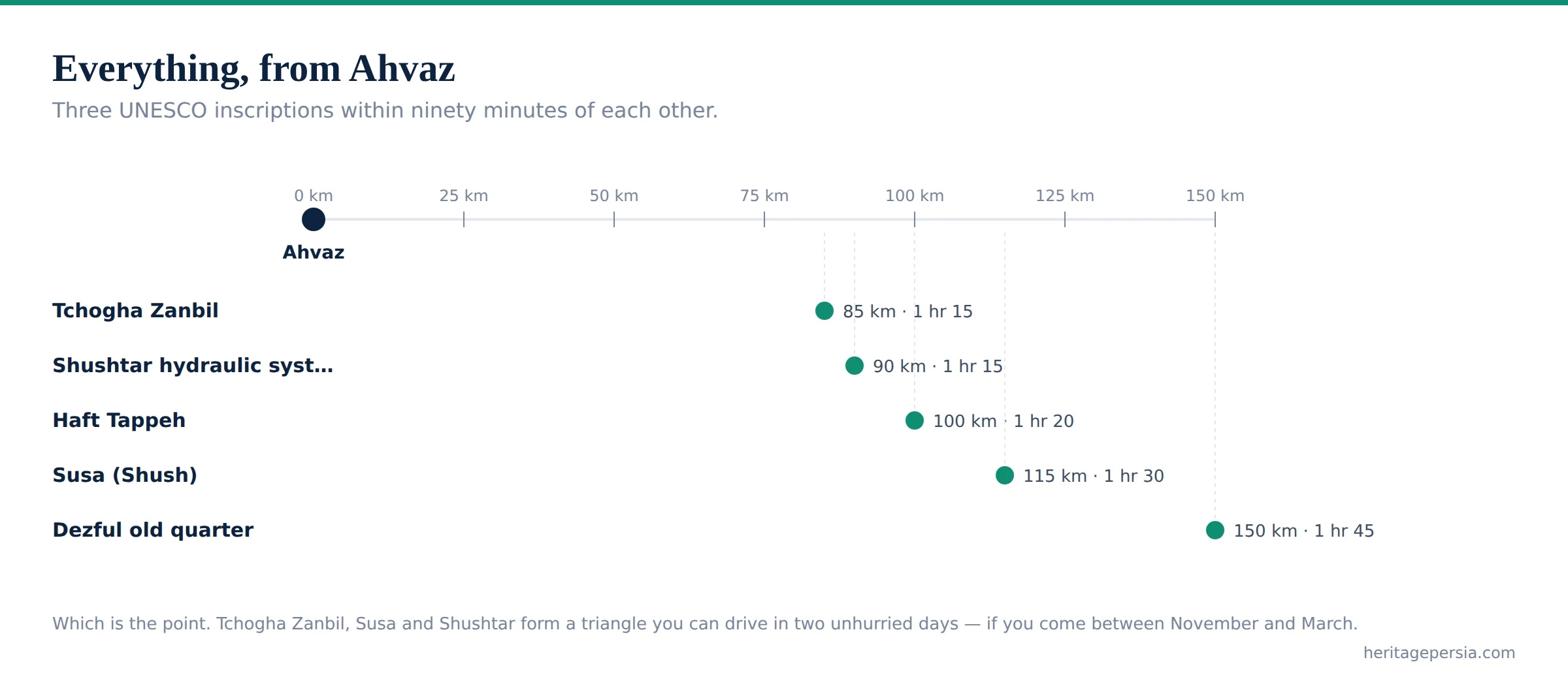
Everything below is reachable from Ahvaz, and the three inscriptions plus Haft Tappeh fit comfortably into two full days with a third for Dezful and the drive.
| Site | Status | Time | From Ahvaz | Arrive | Why then |
|---|---|---|---|---|---|
| Tchogha Zanbil Elamite ziggurat | UNESCO 1979 | 2 hrs | 85 km · 1 hr 15 | 08:30 | No shade on the mound at all. The brickwork and its cuneiform bands read best in low side-light |
| Susa (Shush) Elamite & Achaemenid city | UNESCO 2015 | 2–3 hrs | 115 km · 1 hr 30 | 11:00 | The acropolis mounds are open ground; the Apadana site and Ardeshir’s palace need real time rather than a walk-past |
| Shushtar hydraulic system Sassanid waterworks | UNESCO 2009 | 2–3 hrs | 90 km · 1 hr 15 | 15:00 | The cascades face west and the afternoon sun puts the falls and the mill ruins in the same frame |
| Haft Tappeh Elamite site & museum | — | 45 min | 100 km · 1 hr 20 | — | Fifteen minutes from Tchogha Zanbil and on the way to Susa. The museum is the context the ziggurat does not give you |
| Susa castle French archaeological fort | — | 30 min | at Susa | — | Built by de Morgan’s mission in the 1890s out of Elamite bricks. A monument to how the excavation was done |
| Tomb of Daniel Shush | — | 30 min | at Susa | — | The white sugarloaf cone in every photograph of Shush. Active pilgrimage site — dress accordingly |
| Shushtar old town bridges & bazaar | — | 1 hr | at Shushtar | — | The Band-e Kaisar weir and the Sassanid bridges are part of the same water system and are not inside the ticketed area |
| Dezful old quarter Sassanid bridge, sardabs | — | 2 hrs | 150 km · 1 hr 45 | — | The bridge has carried traffic since the third century. Underground sardab rooms are how the town survived the summers |
The three inscriptions alone are one long day if you are brutal about it and two comfortable ones if you are not. We run two, and use the third for Dezful or for the drive out towards Isfahan.
Tchogha Zanbil
Untash-Napirisha, king of Elam, founded a new holy city here around 1250 BC and walled it three times over. At its centre he raised a ziggurat 105 metres to a side and about 53 metres high in five stepped levels. Twenty-four and three-quarter metres of it still stand, which makes it both the largest ziggurat outside Mesopotamia and the best preserved of the type anywhere.
The thing that makes it feel unlike a ruin is that it was never finished and never rebuilt. Ashurbanipal's Assyrians came through around 640 BC and the site was simply left. Thousands of unused bricks lie where the builders stacked them. Bands of cuneiform run horizontally around the structure at intervals, each brick in the band inscribed with the king's dedication, and you can read the same sentence marching around the building at eye height.
Two practical notes. You climb it, on the original ramps, and there is no shade on any level — which is the entire argument for the November-to-March rule and for an 08:30 arrival even then. And the enclosure is large: the ziggurat is one element inside three concentric walls with temples, a water reservoir and royal tombs between them, so two hours is the real figure rather than the forty-five minutes a coach tour allows.
Susa
Susa is not a monument. It is a set of mounds with twenty-seven layers of superimposed settlement running in continuous succession from the late fifth millennium BC to the thirteenth century AD — Elamite, Achaemenid, Parthian, Sassanid, Islamic — and what you walk is the excavated cross-section of six thousand years of one place.
The Achaemenid layer is the one most visitors come for and the one least visible. Darius built a palace here with an apadana on the Persepolis model, and it was Susa rather than Persepolis that functioned as his working capital; the foundation inscription listing where every material and craftsman came from — cedar from Lebanon, gold from Sardis and Bactria, ivory from Ethiopia and Sind, stonecutters who were Ionians and Sardians — was found on this site.
It is also the site from which a great deal left. The French mission held an archaeological concession here from 1897, and the Code of Hammurabi — carried to Susa as Elamite war loot in the twelfth century BC — was excavated in 1901 and went to the Louvre, where it remains. The castle on the mound, built by that mission out of ancient bricks, is the most physically obvious thing at Susa and is a nineteenth-century French fort. Knowing that before you arrive changes what the visit is about.
See the National Museum first if you can. The Tehran museum on day two of the standard route holds much of the Elamite and Achaemenid material from these mounds. Susa is mounds and foundations; the objects that came out of them are four hundred kilometres away, and the visit works far better in that order.
The Shushtar Hydraulic System
This is the one that surprises people, because it is not a ruin at all — it is infrastructure, inscribed in 2009 on the criterion of creative genius, and parts of it still work.
The scheme begins with the Band-e Kaisar, a weir thrown across the Karun, which splits the river into two artificial channels. The Gargar canal carries water through tunnels cut into the rock beneath the town, drives a bank of watermills, and drops out of the cliff face as a set of cascades into a basin below. From there it irrigates the Mianab plain — roughly forty thousand hectares, called Paradise locally — and rejoins the river downstream.
What UNESCO's citation singles out is that this is a synthesis rather than an invention: Elamite canal practice, Mesopotamian hydraulics, and Roman engineering, the last of it reportedly built with Roman prisoners taken after Valerian's defeat at Edessa in 260 — the same defeat carved on the cliff at Naqsh-e Rostam. The inscribed property covers 240 hectares and includes Salasel Castle, the water-level tower, the dams, the bridges, the basins and the mills.
Allow two to three hours and walk the whole circuit rather than stopping at the viewpoint above the falls. The mills, the tunnel mouths and the stepped basins are the part that explains the system; the cascades are just the photograph.
The Month That Decides Everything
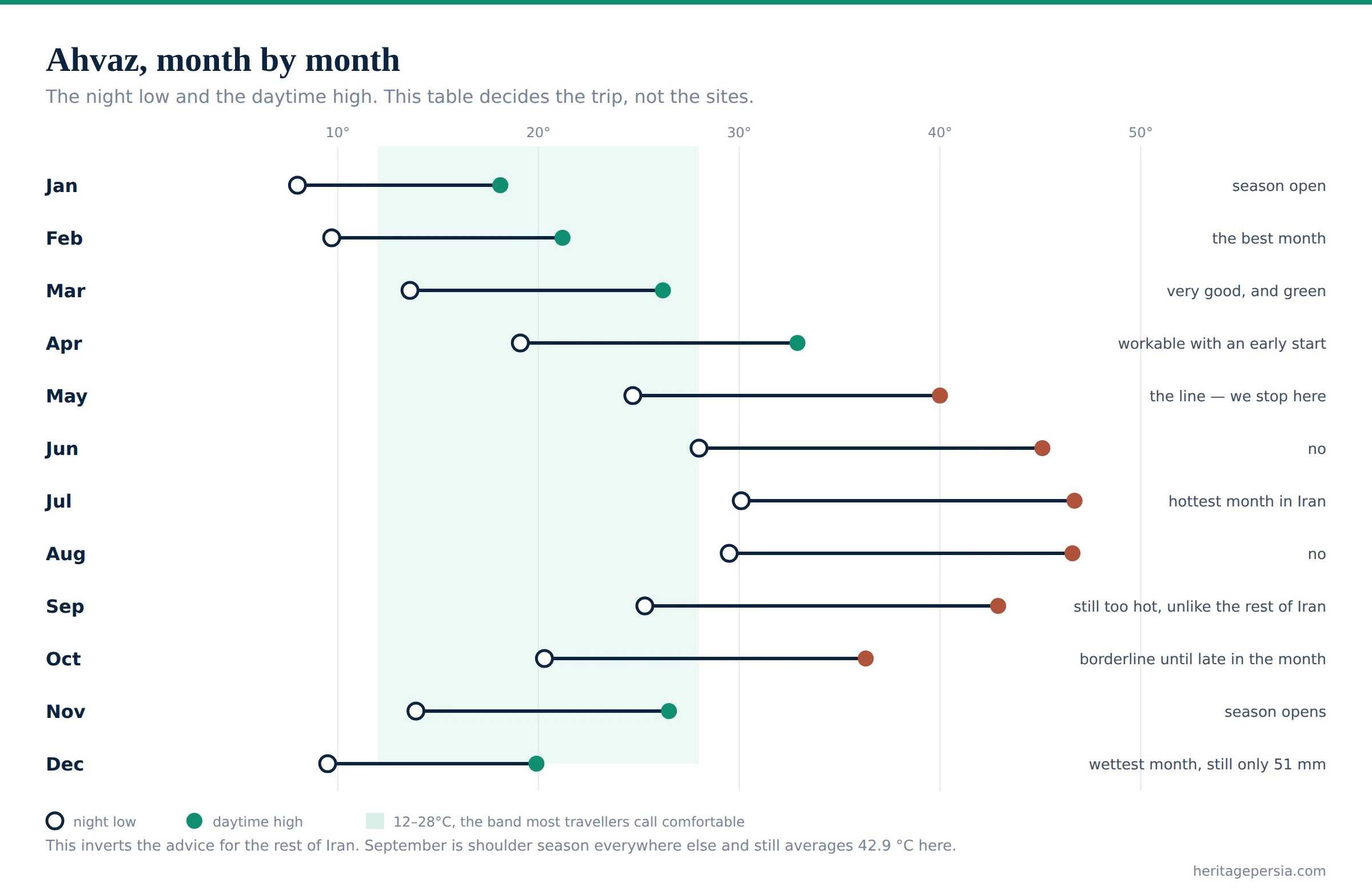
Ahvaz is one of the hottest inhabited cities on earth. It reached 53.7 °C in June 2017. Below is the year, and it is the only table on this page that matters before you book.
| Month | Average high | Average low | Rain | Verdict |
|---|---|---|---|---|
| January | 18.1 °C | 8.0 °C | 46 mm | Ideal. Cool, occasional rain, sites empty |
| February | 21.2 °C | 9.7 °C | 23 mm | Ideal. The best single month |
| March | 26.2 °C | 13.6 °C | 29 mm | Very good, and green. Nowruz crowds late in the month |
| April | 32.9 °C | 19.1 °C | 17 mm | Warm but workable with an early start |
| May | 40.0 °C | 24.7 °C | 3 mm | The line. We stop running Khuzestan in May |
| June | 45.1 °C | 28.0 °C | 0 mm | No |
| July | 46.7 °C | 30.1 °C | 0 mm | No. The hottest month of the Iranian year anywhere |
| August | 46.6 °C | 29.5 °C | 0 mm | No |
| September | 42.9 °C | 25.3 °C | 0 mm | No, despite being shoulder season everywhere else in Iran |
| October | 36.3 °C | 20.3 °C | 9 mm | Borderline. Late October begins to work |
| November | 26.5 °C | 13.9 °C | 41 mm | Excellent. The season opens |
| December | 19.9 °C | 9.5 °C | 51 mm | Excellent, wettest month, still only 51 mm |
This inverts the advice for the rest of the country. September and October are the best weeks in Isfahan and Shiraz and are still too hot here; December and January are quiet elsewhere and are Khuzestan at its best. Our month-by-month guide covers the rest of the country.
Three Days, From Ahvaz
| Day | Sleep in | Leg | What you do |
|---|---|---|---|
| Day 1 | Ahvaz or Shush | Arrive · flight or overnight train | Fly in from Tehran in the morning, or step off the night train. Karun riverside and the bridges in the afternoon, an early night |
| Day 2 | Shush or Ahvaz | 85 + 15 + 25 km | Tchogha Zanbil at 08:30, Haft Tappeh at 11:00, Susa from 13:00 with the castle and the tomb of Daniel |
| Day 3 | — | 90 km · 1 hr 15 | Shushtar for the full circuit, the old bridges and the bazaar, then out — Ahvaz for a flight, or the road east |
A fourth day buys Dezful and its third-century bridge, or an unhurried second morning at Susa. Three is the honest minimum and two is a compression we do not recommend.
Getting There, and Where It Fits
Ahvaz is the gateway and there are three ways in. Flying from Tehran takes about an hour and twenty minutes and is what most visitors do. The overnight train from Tehran is 834 kilometres, roughly fourteen hours, leaves in the late afternoon and has four-berth and VIP sleepers — it is one of the better sleeper routes in the country and it puts you in Ahvaz at breakfast. Driving from Tehran is about 790 kilometres and a long day.
Where it fits in a trip is the more useful question. Khuzestan is a three-day detour, not a stop on the way to anywhere, and it attaches to a fourteen-day itinerary most naturally at the start or the end rather than in the middle. From Isfahan or Shiraz it is a long drive or a connecting flight through Tehran; both work, neither is quick.
Tickets for the internal flight and the sleeper are booked through an agency against your passport, because no foreign card works on Iranian booking platforms — the getting-around guide covers how that works and the money guide covers why.
Practical Notes
Accommodation is the weakest part of the province. Ahvaz has business hotels rather than good ones, Shush and Shushtar have modest options, and there is no courtyard-hotel tradition here of the kind that makes Kashan and Yazd a pleasure. Book on location rather than character: a night in Shush saves you two hours of driving on day two.
The food is genuinely different from the rest of Iran and is a reason to come in its own right. This is the fish and date belt — ghalyeh mahi, a thick tamarind and coriander fish stew, is the dish of the province, and the Arab influence shows in the breads and the grilled river fish. Our food guide covers the regional map.
Two cultural notes worth having. Khuzestan has a large Arab population and Arabic is widely spoken alongside Persian, which shifts the register of hospitality and of taarof slightly. And the province was the front line of the Iran–Iraq war; Khorramshahr and Susangerd carry war memorials and battlefield sites that receive a steady stream of Iranian visitors and almost no foreign ones. Treat them as what they are.
Finally, the province is a border region with oil infrastructure. Photographing installations, bridges and military sites is a straightforwardly bad idea here in a way it is not in Isfahan, and a local guide is worth having for judgement as much as for history.
✉️ Thinking about adding Khuzestan? Tell us your month and we will tell you plainly whether it is open, and whether it attaches better to the start or the end of your route. Talk to our team →
Continue reading
Frequently Asked Questions
What travellers ask our guides, answered on the ground.
The Three Days Nobody Takes
Tell us your month and we will tell you plainly whether Khuzestan is open.
See All Destinations →