
We process Iranian visa applications for travellers from about sixty countries every month, and we have watched the same three mistakes cost people their trips for fifteen years. Someone books a flight before checking whether their passport can even use visa on arrival. Someone from London assumes an e-visa exists for them. Someone arrives at Imam Khomeini airport with travel insurance that covers "worldwide" and discovers that worldwide, in the small print, excludes Iran.
This guide is the answer we would give you on the phone. It tells you which of the four routes into Iran applies to your passport, what each one actually costs, how long it really takes, and what happens at the counter when you land.
📌 Before anything else: visa rules for Iran change more often than any other part of trip planning — three separate changes landed between February 2024 and May 2026. Everything here was checked on 10 September 2026 against the Ministry of Foreign Affairs and current practice at our own visa desk. Treat any page you read on this subject, including this one, as a starting point and confirm your own case before you buy a flight.
Find Your Route — Select Your Nationality
Every passport in the world takes one of four routes into Iran. Choose yours and the answer appears below, with the documents, the realistic timeline, and what it costs.
The route shown is the mechanism that applies to your passport. The permitted length of stay under a visa exemption differs by country and is renegotiated between governments from time to time, so the guide gives the usual band rather than a single number you might rely on and regret. Your embassy, or our visa desk, confirms your exact entitlement in writing before you book.
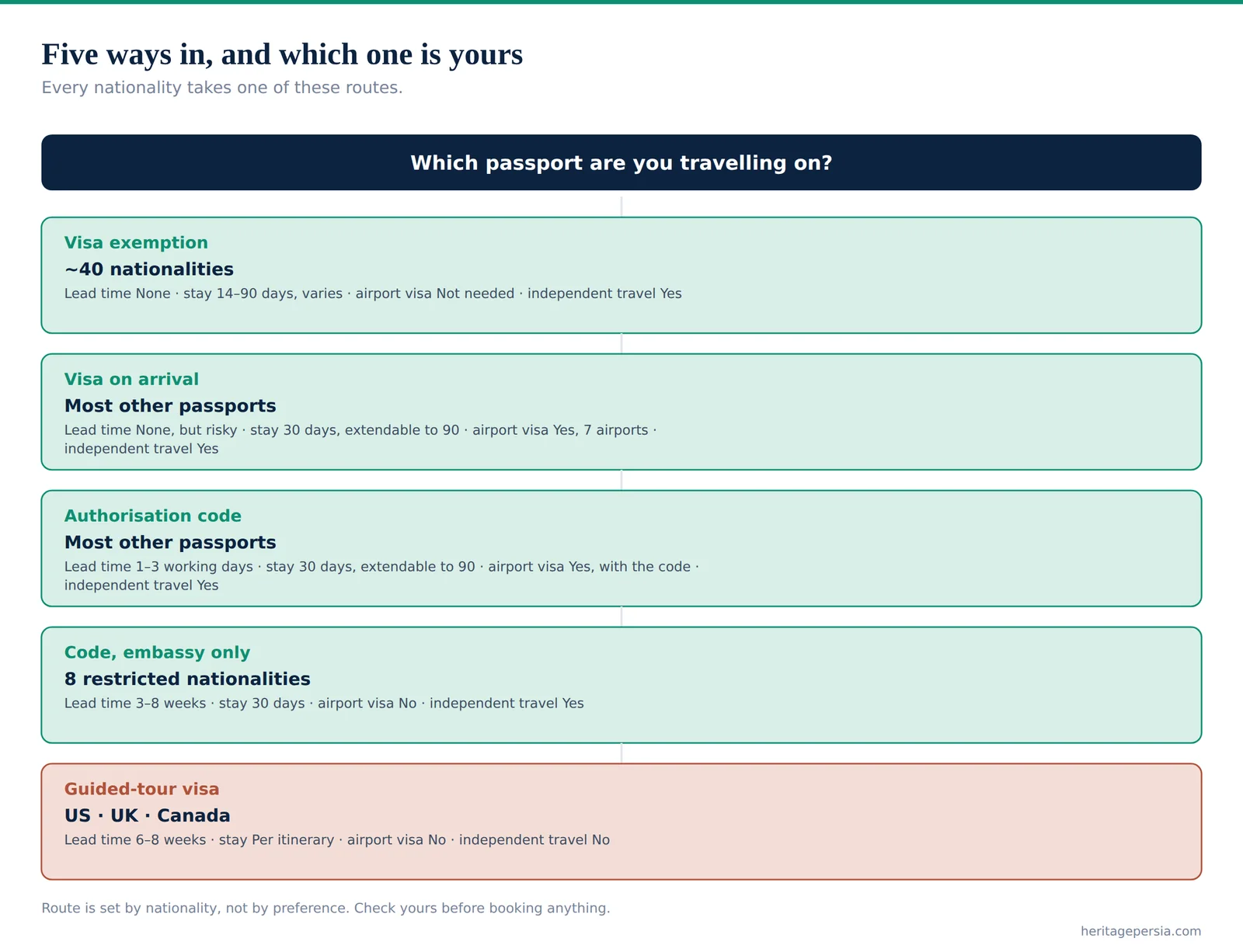
The Four Routes Explained
Almost every confusing thing written about Iranian visas comes from mixing these four up. They are separate systems, with separate paperwork and separate failure modes.
Route 1 — Visa exemption
About forty nationalities enter Iran with no visa at all. You show a passport valid for at least six months, you pass through immigration, and that is the whole procedure. The group is mostly Iran's neighbours and long-standing partners — Turkey, Armenia, Azerbaijan, Georgia, Iraq, Syria, Egypt, the Gulf states, China including Hong Kong and Macau, and Japan — together with the twenty-eight countries added in February 2024, among them Brazil, Mexico, Peru, Cuba, Indonesia, Vietnam, Singapore, Brunei, Croatia, Serbia, Bosnia, Belarus and Tunisia.
Two cautions. First, the permitted stay varies from fourteen days to ninety, and it varies by country rather than by region — neighbouring passports do not necessarily get the same allowance. Second, exemptions are added and withdrawn: India's exemption was cancelled in November 2025 and Lebanon's in May 2026, in both cases with almost no notice. Check yours in the month you travel, not the year you plan.
Route 2 — Visa on arrival
If your passport is not exempt and not on the restricted list, you may collect a thirty-day tourist visa at the airport on landing. It is issued at seven airports — Tehran Imam Khomeini, Mashhad, Shiraz, Isfahan, Tabriz, Kish and Qeshm — and at no land border. Plan for two to three hours from touchdown to the exit, and occasionally six when several flights arrive together.
Visa on arrival works, and we still tell most clients not to rely on it alone. The reason is not the Iranian side. Since 2022 a number of airlines have refused boarding to passengers who cannot show a visa at check-in, on the grounds that they carry the cost if entry is refused. You can be legally entitled to a visa on arrival and still be turned away at your departure gate in Frankfurt or Istanbul. An authorisation code obtained beforehand removes that risk for the price of a restaurant meal.
Route 3 — Authorisation code, then collection
This is the standard route and the one we use for most travellers. An authorisation code — sometimes called a grant code or a reference number — is a permission issued by the Ministry of Foreign Affairs against your passport details. It is not itself a visa. Once the code exists, you take it either to an Iranian embassy or consulate, which stamps the visa into your passport, or to the visa counter at the airport, which issues it on arrival with none of the boarding-gate uncertainty.
Codes come from two places. The ministry's own e-visa portal is free and, in our daily experience, slow and unpredictable — applications sit at "waiting for verification" for weeks and rejections arrive without a stated reason. A licensed Iranian agency files the same application through a channel that gets an answer in one to three working days, for a service fee of roughly €30. The code is then valid for one month, which is the real deadline in your planning: collect the visa inside that window or start again.
Eight nationalities must use this route and cannot take a visa at the airport under any circumstances — Afghanistan, Bangladesh, Colombia, Jordan, Nepal, Pakistan, Somalia and Sri Lanka. For these passports the application is slower and the documentation heavier, and it should begin at least two months before departure.
Route 4 — The guided-tour visa
Citizens of the United States, the United Kingdom and Canada may visit Iran, and the conditions are specific and non-negotiable. The visa is granted only against a complete itinerary booked with a licensed Iranian agency, and you are accompanied by an approved guide for the duration of your stay. Independent travel — the kind that lets you take an intercity bus or a hire car where you please — is not available on these passports, visa on arrival is not available, and the ministry's e-visa portal does not accept them.
Allow six to eight weeks, and start earlier if your dates are fixed. The itinerary has to be submitted with the application, hotel by hotel and city by city, which means the trip is designed before the visa exists rather than after. Passports on this route are stamped in the ordinary way, with a sticker visa and entry and exit stamps.
There is one narrow alternative worth knowing. The free-trade islands of Kish and Qeshm admit these nationalities for fourteen days without a visa, provided a licensed guide meets the flight and accommodation is booked in advance. It is a genuine option for a short first visit to Iran, and it does not extend to the mainland. If safety rather than paperwork is the real hesitation, we answer that in our honest guide to whether Iran is safe.
The Four Routes Side by Side
| Route | Who | Lead time | Stay | Airport visa? | Independent travel? |
|---|---|---|---|---|---|
| Visa exemption | ~40 nationalities | None | 14–90 days, varies | Not needed | Yes |
| Visa on arrival | Most other passports | None, but risky | 30 days, extendable to 90 | Yes, 7 airports | Yes |
| Authorisation code | Most other passports | 1–3 working days | 30 days, extendable to 90 | Yes, with the code | Yes |
| Code, embassy only | 8 restricted nationalities | 3–8 weeks | 30 days | No | Yes |
| Guided-tour visa | US · UK · Canada | 6–8 weeks | Per itinerary | No | No |
The Timeline, Working Backwards From Your Flight
Most visa failures are scheduling failures. This is the calendar we work to.
Eight weeks out — only if you hold a US, UK or Canadian passport
Choose your dates and cities and have the itinerary built — our Classic Persia route and Ancient Empires itinerary are where most first trips start. Nothing can be filed until the itinerary exists, and the six-to-eight week clock starts from filing, not from your first email. If your trip has to happen in a particular fortnight, this is the moment.
Four to eight weeks out — the eight restricted nationalities
Afghan, Bangladeshi, Colombian, Jordanian, Nepali, Pakistani, Somali and Sri Lankan passports need the full embassy route with supporting documents. Begin now.
Two to three weeks out — everyone else
File for the authorisation code. Three working days is normal, a week is common in the fortnight before Nowruz, and the code stays valid for a month. Filing earlier than four weeks is counterproductive, because a code that expires before you fly has to be applied for a second time.
One week out
Buy travel insurance that names Iran in the policy document. Print your first night's hotel confirmation and your onward ticket — domestic flights inside Iran count as onward travel. Put €100 in cash somewhere separate from your wallet — the visa counter takes euros in cash and nothing else, and there are no working foreign card machines anywhere in the country, whether you are paying for a hostel bed or a room in a restored caravanserai.
On the day
Carry the printed authorisation code, the printed hotel booking, the insurance certificate, and the cash. Everything else is a formality.
What You Actually Need
The list is short and every item on it has caused a refusal at some point. Travellers coming for treatment rather than sightseeing should check the separate requirements for a medical visa, and anyone still choosing a trip can compare our day tours and multi-day itineraries.
- A passport valid six months beyond your arrival date, with at least two blank pages.
- A digital passport photo on a plain light background, taken within the last six months. Women should be photographed with a headscarf, since the photo is checked against the arrival.
- A scan of the passport's photo page, in colour, with all four corners visible — a cropped scan is the single most common reason a code is delayed.
- Travel insurance that names Iran. Policies that promise "worldwide" cover almost always exclude Iran in the exclusions clause, and the officer at the counter reads that clause. Cover can be bought at the airport for €14 to €34 depending on trip length, though it is thin.
- Your first night's accommodation confirmation, printed.
- An onward or return ticket. Immigration no longer insists on it in most cases; the airline that boards you often does.
- Cash in euros. No foreign card works in Iran, at the visa counter or anywhere else.
What It Costs, Honestly
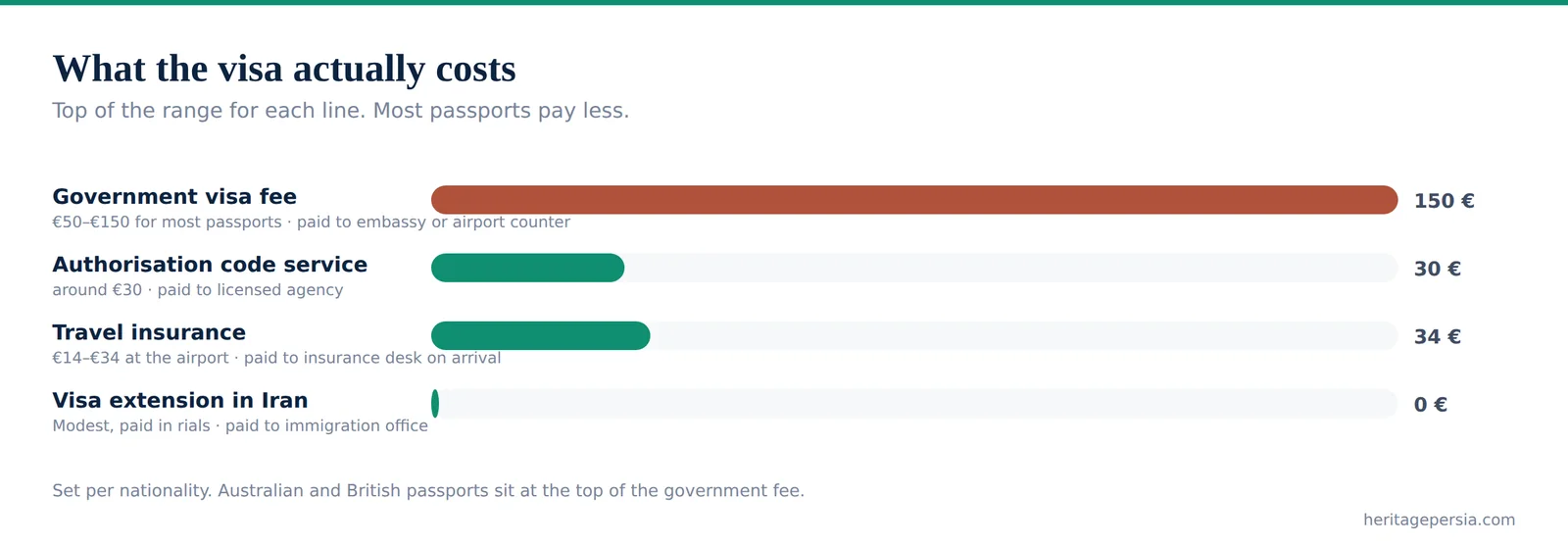
Iranian visa pricing is not one number, because the government fee is set nationality by nationality under reciprocity agreements. A British passport is charged several times what a Belarusian one is charged, for reasons that have nothing to do with the applicant. What follows is the shape of the bill rather than a quotation.
| Item | Typical amount | Paid to | Notes |
|---|---|---|---|
| Government visa fee | €50–€150 for most passports | Embassy or airport counter | Set per nationality; Australian and British passports sit at the top of the range |
| Authorisation code service | around €30 | Licensed agency | Optional in theory, and the difference between a smooth trip and a gate refusal |
| Travel insurance | €14–€34 at the airport | Insurance desk on arrival | Airport cover is minimal; buying a real policy at home costs about the same |
| Visa extension in Iran | Modest, paid in rials | Immigration office | Two extensions of 30 days each are normally available |
💡 From our visa desk: the government fee is collected in cash euros at the airport counter and the officers do not give change in euros, and the same cash rule applies to your transfer into the city. Bring the amount in clean notes — a torn or marked note is refused, which is a genuinely strange way to start a holiday.
What Happens When You Land
For anyone collecting a visa at the airport, the sequence at Imam Khomeini is the same every time and knowing it removes most of the anxiety.
You leave the aircraft and follow the signs for the visa office rather than joining the passport queue, which is where people lose forty minutes. You hand over the passport, the printed code if you have one, and the hotel booking. An officer checks the insurance; if yours is not accepted, you buy a policy at the desk beside the counter and return. You pay the fee in cash euros, wait while the visa is printed, and then join immigration with the visa in hand.
The visa arrives on a separate sheet of paper, not in your passport. Iran stopped stamping the passports of ordinary tourists some years ago, and the entry and exit records go on the same loose sheet. Keep it with the passport for the whole trip, because you surrender it on the way out and you will be asked for it at hotel check-in.
Extending Your Stay Inside Iran
A thirty-day tourist visa can normally be extended twice, thirty days each time, which gives ninety days in the country. Extensions are handled at the Immigration and Alien Affairs Office in any provincial capital — Shiraz, Isfahan, Yazd and Tehran all have one, and the Shiraz office is the one our clients report as the least painful.
Apply three or four days before your visa expires rather than on the last morning, bring passport photographs and the fee in rials — our note on paying for things in Iran explains where to change money — and expect to return the following day. Extensions are stamped into the passport as a full page, so an extended visit does leave a permanent record even though the original entry did not.
Passport Stamps, Israel, and What Actually Matters
Two questions arrive in our inbox more than any others, and both are the reverse of what people assume.
Does an Iranian visa cause problems later? Rarely, and largely because there is nothing in the passport to find. The visa and the entry record are on the loose sheet described above. The exception is a visa extension, which is stamped in the passport, and the guided-tour visa issued to US, UK and Canadian citizens, which is a sticker.
Can I enter Iran with an Israeli stamp in my passport? Entry is refused to Israeli passport holders outright. For other passports containing an Israeli stamp or visa, the rule as written refuses entry where the evidence is less than twelve months old, and practice has been inconsistent in both directions — travellers have been admitted with older stamps and occasionally refused with them. If your passport carries such a stamp and you have any flexibility, renew the passport before applying. It is a cheaper solution than a refused boarding.
If You Were Born in Iran
Iran does not recognise dual nationality. Anyone born in Iran, and anyone with an Iranian father, is treated as an Iranian citizen regardless of which other passport they hold or how they think of themselves — and Iranian citizens enter and leave Iran on an Iranian passport, not a foreign one.
In practice this means applying for or renewing an Iranian passport at the nearest Iranian consulate before travelling, which takes time and is a different process from the one described in this guide. Men of military-service age have additional formalities to complete. If any of this describes you, speak to the consulate that covers your city before you make any other arrangement — this is the one situation where a tour operator, including us, is not the right first call.
Five Ways People Lose Their Trip
Each of these has happened to someone who contacted us afterwards, when it was too late to help.
- Booking the flight first. Fifteen minutes checking your route would have shown that your passport needs eight weeks and a guide.
- Trusting "worldwide" insurance. Read the exclusions clause. If Iran appears there, your policy is worth nothing at the counter and you buy another one on arrival.
- Letting the authorisation code expire. It lives for one month. A code obtained ten weeks before departure is a code that has to be bought twice.
- Relying on visa on arrival with a connecting flight. The Iranian officer will issue your visa; the airline in the transit airport may never let you reach him.
- Arriving with only cards. No foreign card functions anywhere in Iran. Travellers have landed with a valid code, no euros, and no way to pay the fee.
✉️ Not sure which route is yours? Send us a photograph of your passport photo page and your travel dates. We will tell you the route, the realistic timeline and the total cost in writing, before you commit to anything. Talk to our visa desk →
Continue reading
Frequently Asked Questions
These are the questions our visa desk answers every working day, with the answers we actually give.
Let Us Handle the Paperwork
Send your passport page and dates. We confirm your route in writing, file the application, and tell you exactly what to carry to the airport.
Start Your Visa →