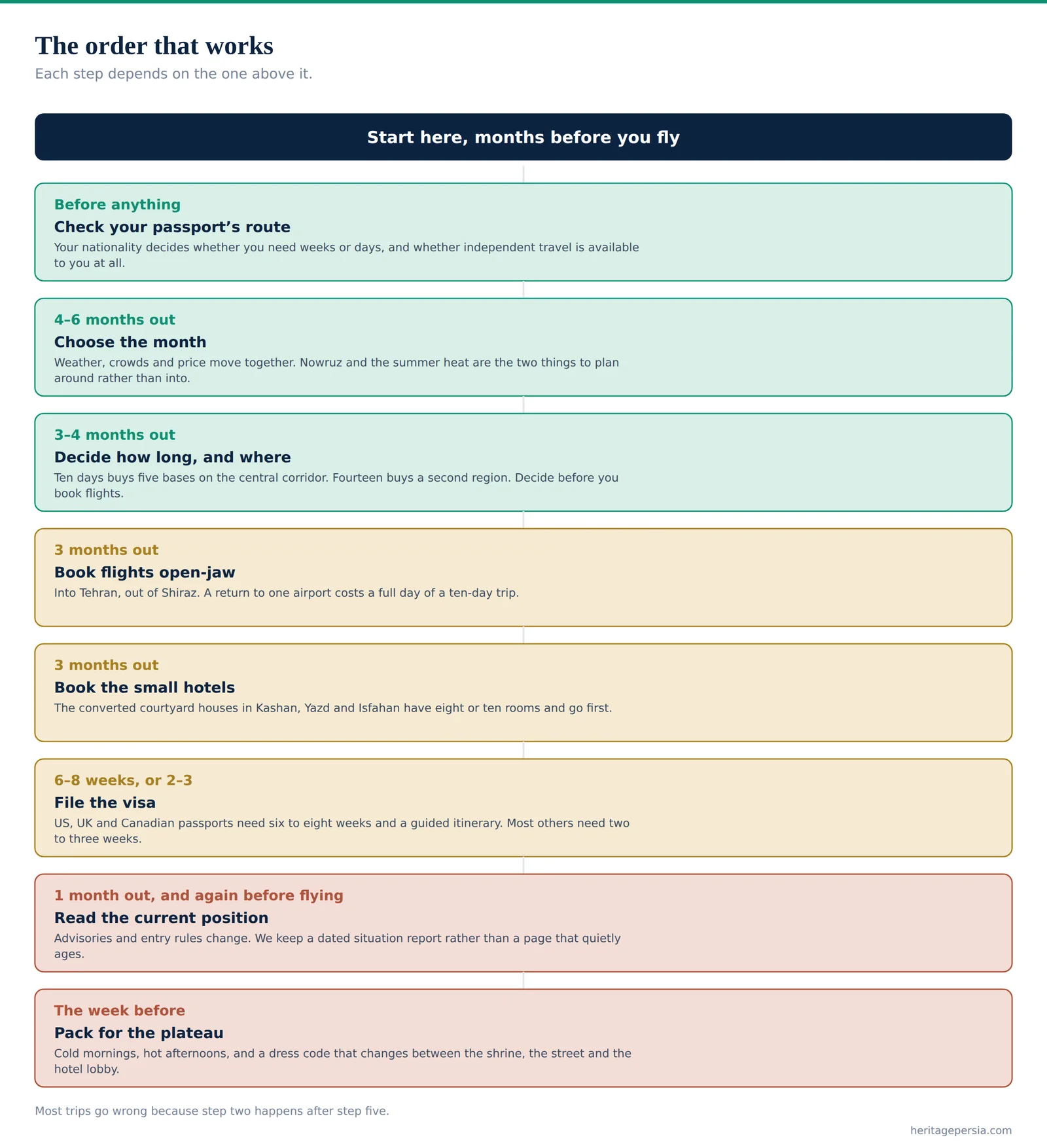
Everything a first trip needs, in the order the decisions actually have to be made — from the visa that gates your dates to the suitcase you pack last.
By the Heritage Persia team, Shiraz·Published 11 September 2026·Last reviewed 11 September 2026·Updated whenever a guide below is
Iran is not a difficult country to travel in. It is a difficult country to plan, because the decisions have a strict order and most people discover it backwards — they book a flight, then find their passport needs eight weeks and a guide, or they choose March without knowing that the entire country will be on the road.
This page is the order. Eight decisions, the month each one belongs in, and the guide that covers it. Follow it from the top and nothing on your trip will be a surprise.
📌 The single most common planning failure is booking flights before checking the visa route. A US, UK or Canadian passport cannot travel independently in Iran and needs six to eight weeks of lead time against a complete itinerary — which means the trip has to be designed before the visa exists, not after the flights are paid for.
The Five Planning Guides
Each one is written by the guides who do this work daily, dated at the top, and revised when the facts move rather than left to age quietly.
Go in October or late April. Not because the other months are bad, but because these two give you the widest margin — stable weather, every site open, and rates below the Nowruz peak.
Ten days buys five cities. Fourteen buys a second region. Anything that promises more than that in the same time is promising you a coach schedule.
Bring the whole budget in cash. No foreign bank card works anywhere in Iran. This catches out more first-time visitors than every other practical detail combined.
Ask us to talk you out of your dates. We move roughly one enquiry in six to a different month, and those are the trips that come back with the best photographs.
What a Trip Actually Costs
Iran is inexpensive by European, Gulf or East Asian standards, and the shape of the bill surprises people. Food and accommodation are very cheap — a good meal in a restored courtyard restaurant in Isfahan costs less than a sandwich at the airport you flew from. The two real costs are the international flight and a private car with a driver, and the second of those is the difference between a trip and a fortnight of bus stations.
The parts that catch people out are not prices at all.
No foreign bank card works anywhere in the country. Not in hotels, not in restaurants, not at cash machines. The whole budget arrives with you in euros or dollars, in cash, and running short has no easy remedy.
Insurance must name Iran in the policy document. Cover sold as worldwide very often lists Iran in the exclusions, and the officer at the visa counter reads that clause.
Visa fees vary by nationality under reciprocity agreements rather than by service level, so two travellers on the same tour can pay very different amounts for the same document.
Domestic flights are cheap and buses cheaper, but on the classic route both cost you the stops between cities, which are half the reason to take that road.
Five Things Nobody Tells You
Lunch is the main meal. It runs from one until three and it is when the stews appear. Travellers who keep European hours eat kabab for a fortnight and go home thinking that is Iranian food.
The plateau is cold before breakfast. Isfahan in March averages about 5°C at dawn and 18°C at noon. Almost everyone packs for the second number.
Sites open early and close early. The best hour at most monuments is the first one, and in summer the afternoon at an unshaded site like Persepolis is genuinely punishing rather than merely hot.
You will be invited to things. Iranian hospitality is not a tourist-board claim; it is the single most reported feature of every trip we run. Leave gaps in the plan for it.
Nothing needs reserving except beds. Restaurants do not take bookings, sites do not sell timed tickets, and a driver can be arranged the evening before. The small courtyard hotels are the exception and they are the exception that ruins trips.