
Seven days in Iran is a subtraction problem. The country has five cities that everybody wants and the roads between them eat half a day each, so the only real decision is which two you are not going to see. Travellers who refuse to make that decision end up with five hotel check-ins, four long drives and about nine hours of actual sightseeing, which is a worse week than three cities done properly.
This page gives you the version we run, the two alternatives, and the honest arithmetic behind all three. If you have ten days rather than seven, our ten-day itinerary is a different and easier trip and you should read that instead.
Before you plan anything: this is a routing guide, written to be useful whenever you are able to use it. Whether to travel to Iran at present is a separate question with a different answer — see our current situation report, reviewed 10 September 2026.
The Arithmetic
Seven days is six nights, and every change of base costs you roughly half a day once you count packing, the drive, checking in and finding your feet. Three bases means two travel half-days and four and a half days of actual looking. Five bases means four travel half-days and three days of looking — you will have paid the same and seen a third less.
The cities themselves are not interchangeable in the time they need. Isfahan wants three days and is the reason most people come. Shiraz wants three but survives on two if Persepolis is handled on the way in. Yazd is two and cannot be done in one. Tehran is one to two and is the easiest thing to cut. Kashan is one night and is the cheapest addition on the list because it sits on the road anyway.
Run those numbers and seven days gives you exactly one of two shapes: Isfahan plus Shiraz plus one other, or Isfahan plus Shiraz with more time in each. Everything below is a version of one of those.
The Seven Days, With Every Distance
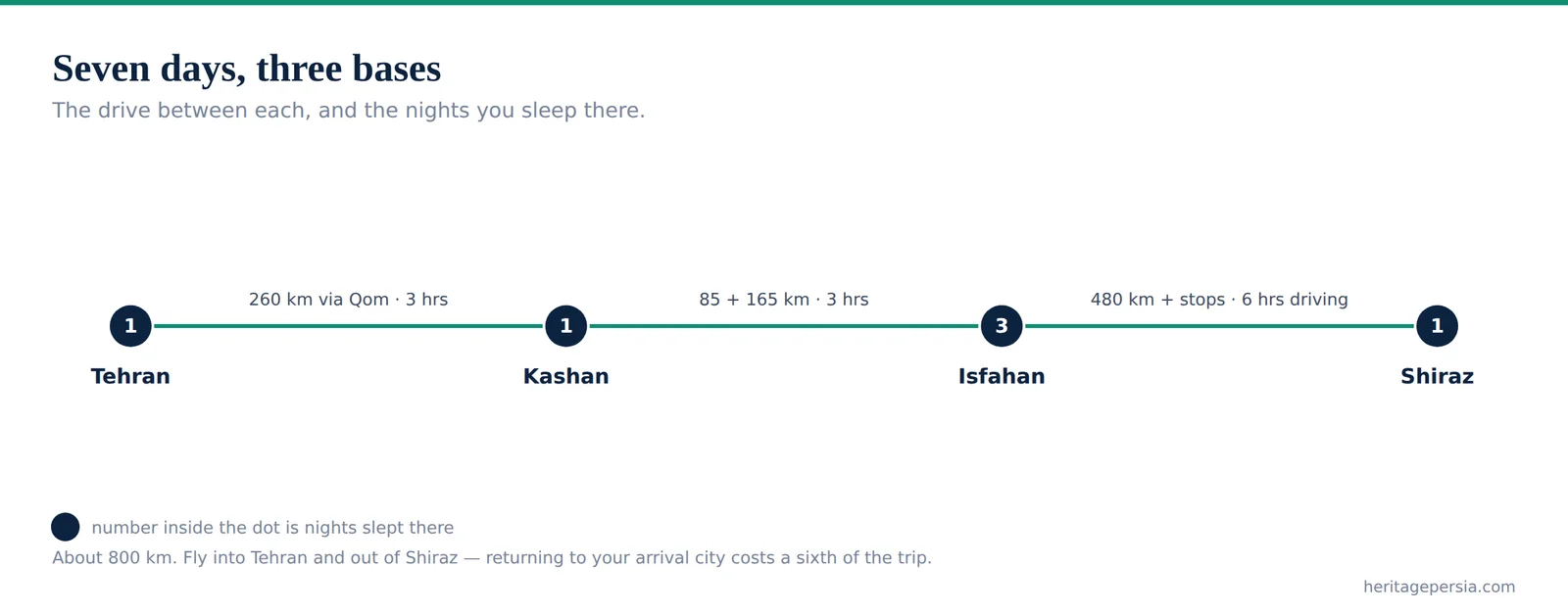
This is the version we run most often. It flies into Tehran and out of Shiraz, which is what makes it work.
| Day | Sleep in | Leg & drive | What you do | Book ahead |
|---|---|---|---|---|
| Day 1 Arrive in Tehran | Tehran | IKA → city 45–90 min | Most European flights land before dawn. Sleep, then the National Museum in the afternoon for the Achaemenid context you will need on day six. Nothing ambitious. | Airport transfer |
| Day 2 Tehran → Kashan | Kashan | 260 km via Qom 3 hrs | Golestan Palace first thing, then drive south after an early lunch. Kashan in the late afternoon: the Fin Garden, and one merchant house rather than three. | Courtyard hotel |
| Day 3 Kashan → Isfahan | Isfahan | 85 + 165 km 3 hrs | Abyaneh, the red-mud village, mid-morning. Into Isfahan by late afternoon and out to Naqsh-e Jahan after dark for the first sight of it lit. | Isfahan hotel |
| Day 4 Isfahan — the square | Isfahan | — | Imam Mosque at 08:00 before the coaches, Sheikh Lotfollah at 11:00 for the light shaft, lunch, Ali Qapu terrace at 16:00, the bazaar until it closes. | — |
| Day 5 Isfahan — the rest | Isfahan | — | Masjed-e Jāmé at 09:00, Chehel Sotoun after lunch, Vank Cathedral and the Armenian quarter, dinner in Julfa and the Khaju bridge after dark. | — |
| Day 6 The long one | Shiraz | 480 km + stops 6 hrs driving | Leave at seven. Pasargadae late morning, Persepolis in the early afternoon, Naqsh-e Rostam after it, into Shiraz for a late dinner. | Driver & guide |
| Day 7 Shiraz, then home | — | City → airport 20 min | Nasir al-Mulk at 07:30 while the glass still works, the Vakil bazaar, Hafez’s tomb if the flight is late enough. Fly from Shiraz. | Onward flight |
About 800 km in total. Every leg is a morning except day six, which is the price of seeing Persepolis without giving it a separate day.
What You Are Cutting, and Why
Yazd goes first in this version, and it is a real loss. The mud-brick old city is a World Heritage Site in its entirety and the evening walk through its lanes is the thing travellers most often name as their favourite hour in Iran. It goes because it sits between Isfahan and Shiraz and adding it turns two drives into three, costing a full day for two nights that would each be half-used.
Tehran nearly goes too. It survives here only because you land there and the first afternoon is dead time anyway. If your flights allow you to fly straight into Isfahan, cut it and take version B below.
Everything beyond the corridor is out of reach. Kerman and the Lut, Tabriz and the northwest, Qeshm, Mashhad and Khuzestan each need their own trip or a fortnight. Attempting any of them in seven days means two internal flights and a week spent in transit.
💡 The open-jaw ticket is the single best decision on this page. Fly into Tehran and out of Shiraz, or into Isfahan and out of Shiraz. Returning to your arrival city to catch a flight home costs you a full day out of six, and on a week-long trip that is a sixth of everything. Most airlines price an open-jaw within a few per cent of a return.
Three Versions of the Same Week
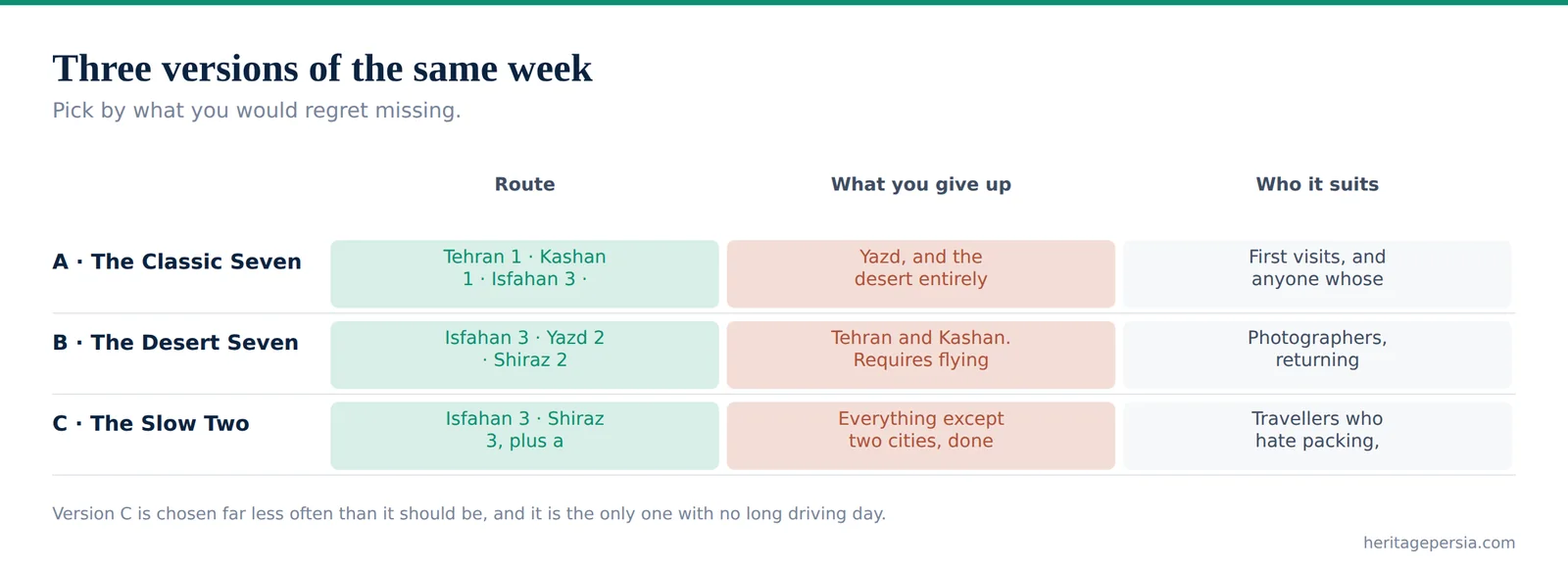
Same seven days, three different trips. Pick by what you would regret missing.
| Version | Route | What you give up | Who it suits |
|---|---|---|---|
| A · The Classic Seven The table above | Tehran 1 · Kashan 1 · Isfahan 3 · Shiraz 2 | Yazd, and the desert entirely | First visits, and anyone whose interest is Safavid architecture |
| B · The Desert Seven | Isfahan 3 · Yazd 2 · Shiraz 2 | Tehran and Kashan. Requires flying into Isfahan | Photographers, returning visitors, anyone who wants the mud city |
| C · The Slow Two | Isfahan 3 · Shiraz 3, plus a Persepolis day | Everything except two cities, done unhurriedly | Travellers who hate packing, families, and anyone with mobility limits |
Version C is chosen far less often than it should be. Two cities in a week with a day trip from each is a genuinely good holiday, and it is the only one of the three with no long driving day in it.
The Mistake We See Most
The seven-day itinerary that arrives in our inbox most often reads: Tehran, Kashan, Isfahan, Yazd, Shiraz. It is the ten-day route with the nights removed, and it does not work.
What happens in practice is that Isfahan drops to two nights, which means one full day, which means you see the square and nothing else. Yazd drops to one night, so you arrive at six and leave at eight the next morning having seen a hotel. And day six becomes a seven-hour drive because you are starting from Yazd rather than Isfahan.
If five cities in a week is genuinely what you want, the honest advice is to find three more days. Our ten-day route is that same list with the nights that make it work, and the difference between the two weeks is not proportional to the difference in length.
What to Book Ahead, and When
| Item | When | Why |
|---|---|---|
| Visa | 2–8 weeks out | Depends entirely on your passport — see the visa guide. US, UK and Canadian passports need about eight weeks |
| Open-jaw flights | 3–4 months out | The routing matters more than the price and the good combinations go first |
| Courtyard hotels | 3–4 months out | Kashan and Yazd have few rooms and they sell out in April, May and October |
| Car and driver | 1–2 months out | Per vehicle rather than per person. On this route it is the difference between a trip and a series of bus stations |
| Nothing else | — | Restaurants, entries and local transport are all walk-up. Do not over-plan a week this short |
During Nowruz every line of this table moves to months rather than weeks, and the courtyard hotels are gone by January.
What a Week Costs
Excluding the international flight, a comfortable seven days runs roughly €400–560 per person: accommodation, food, entries and a shared car with driver. The lean version on buses and in guesthouses is closer to €180–250; the unhurried version with four- and five-star hotels throughout is €850 upwards.
The two numbers that dominate are the international flight and the car. Everything else in Iran is cheap enough that it barely moves the total, and entries run €8–15 a day across a normal itinerary.
All of it is cash. No foreign card works anywhere in the country, so the whole budget comes in with you in euros or dollars — our money guide explains the mechanics and is the page to read before you book anything.
When to Run This Route
Late March to mid-May, and late September to early November. This corridor is at 1,200 to 1,600 metres and runs hot from June: Isfahan averages 38°C in July and Yazd 40°C, which turns a walking itinerary into an endurance exercise.
Winter works better than people expect if you accept cold nights — the light is exceptional, the sites are empty, and hotel prices fall. Avoid the Nowruz fortnight in late March unless being in the country for it is the point, and read our month-by-month guide before fixing dates, because the two-week window you choose matters more on a short trip than on a long one.
✉️ Seven days and not sure which two cities to cut? Send us your dates and what you most want to see, and we will tell you which version fits — including when the answer is that you need ten. Talk to our team →
Continue reading
Frequently Asked Questions
What travellers ask our guides, answered on the ground.
Seven Days, Planned Properly
Tell us your dates and what you most want to see, and we will say which version fits.
See Short Itineraries →