
Travel insurance for Iran is the subject on which the gap between what a traveller believes they have bought and what they actually hold is widest. Two separate policies are involved, most people confuse them, and the one that is compulsory is the one that covers least.
This page is more cautious than the rest of our blog, because getting this wrong is expensive in a way that getting a hotel wrong is not. It sets out what each policy does, the three mechanisms that quietly void cover, and the reason claims in Iran work backwards from everywhere else.
Read this first. As of 11 September 2026 the FCDO advises against all travel to Iran and states that travel insurance “could be invalidated if you travel against advice”; Global Affairs Canada advises avoiding all travel, last updated 9 September 2026. For most Western travellers that means an ordinary travel policy is void today regardless of what it says about Iran. Our full position is in the current situation report, and it is no. The rest of this page is the durable picture, written to be useful when that changes.
Two Policies, and They Are Not Alternatives
Since 21 May 2024 an Iranian travel insurance policy has been compulsory for visa applicants. It is issued by an Iranian insurer, it is bundled with the visa and emailed to you about a day after issue, and travellers arriving without one buy it at the airport. Most visitors therefore hold Iranian cover whether or not they ever thought about insurance.
That policy exists to satisfy an Iranian regulation. It is not a substitute for the policy you would buy for any other trip, and treating it as one is the mistake this page exists to prevent. The second policy — a real international one that names Iran — is the one that would actually respond to a serious event, and it is optional in the sense that nobody checks it at the border.
The visa officer checks the first. Your family would need the second.
What Each Policy Actually Does
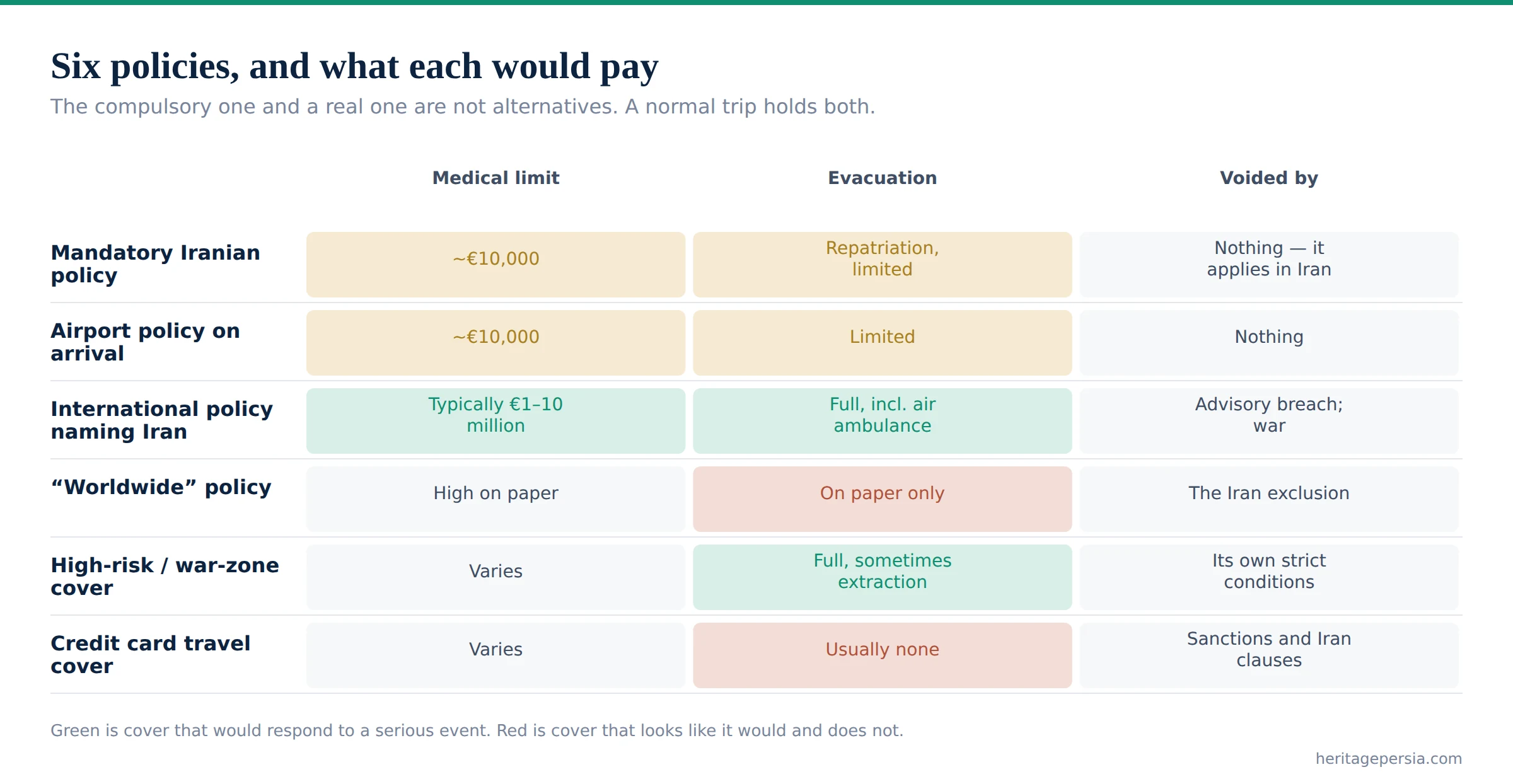
| Policy | Cost | Medical limit | Evacuation | Voided by | What it is for |
|---|---|---|---|---|---|
| Mandatory Iranian policy Iran Insurance or Saman | €10–34 | ~€10,000 | Repatriation, limited | Nothing — it applies inside Iran | Satisfying the visa requirement, and small in-country medical bills |
| Airport policy on arrival bought at the counter | €14–34 | ~€10,000 | Limited | Nothing | The same thing, bought late. Take it if you arrive without the emailed certificate |
| International policy naming Iran a handful of insurers | €40–90 / two weeks | Typically €1–10 million | Full, including air ambulance | Advisory breach; war; Iran unnamed | The one that would respond to a serious event |
| “Worldwide” policy what most people already hold | Already paid | High on paper | On paper | The Iran exclusion in the small print | Nothing, in Iran. Check the exclusions rather than the summary |
| High-risk / war-zone cover specialist underwriters | Several hundred euro upwards | Varies | Full, sometimes with security extraction | Its own conditions, which are strict | Journalists, NGOs and contractors. Not leisure travellers |
| Credit card travel cover | Included | Varies | Usually none | Sanctions clauses and the Iran exclusion | Assume it does not apply here until the issuer confirms in writing that it does |
The compulsory policy and a real policy are not competing options. A traveller going in normal conditions holds both, and the second one is where the money is.
The €10,000 Problem
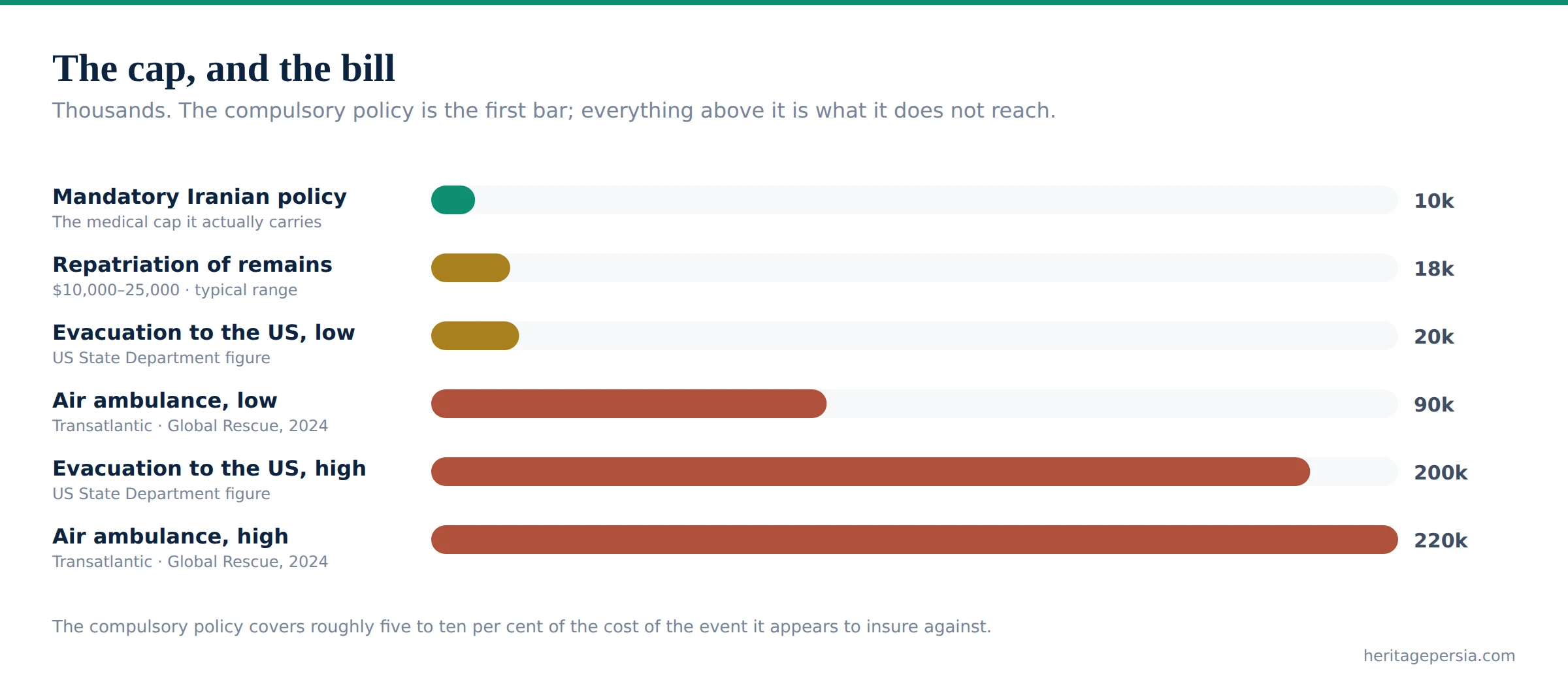
Here is the single number that reframes this subject. The mandatory Iranian policy caps medical cover at roughly ten thousand euro. A transatlantic air ambulance costs between ninety thousand and two hundred and twenty thousand dollars, on Global Rescue's published 2024 figures, and the US State Department puts international medical evacuation back to the United States at twenty thousand to two hundred thousand. Repatriation of remains runs ten to twenty-five thousand.
So the compulsory policy covers roughly five to ten per cent of the cost of the event it appears to insure against. It is genuinely useful for what it is designed for — a fall, a course of treatment, a few nights in a Tehran hospital, a dental emergency — and it is close to irrelevant for the category of event that ends a trip.
This is not an Iranian peculiarity; the same is true of most compulsory visa insurance schemes anywhere. It matters more here because the alternatives are fewer and because the sanctions environment complicates everything that follows.
The test we use. Ask what the policy pays if you need an air ambulance to Dubai or Frankfurt. If the answer is a five-figure cap or the word "limited", the policy will not do the job on its own, whatever else it says.
Three Ways a Policy Becomes Worthless
Each of these is independent of the others, and a policy can fail on all three at once.
One: the policy never covered Iran. Cover sold as worldwide very often lists Iran among its excluded territories, alongside a handful of other sanctioned countries, and the exclusion sits in the policy wording rather than the summary page. This is also why the Iranian visa process refuses generic worldwide certificates — the officer at the counter reads that clause. The visa guide covers the documentary side.
Two: you travelled against your government's advice. The FCDO states plainly that insurance “could be invalidated if you travel against advice”, and most standard policies exclude countries under a US Level 4 advisory outright. This is a condition of the contract rather than a judgement anyone makes afterwards, and it applies from the moment you board.
Three: the war exclusion. Every standard travel policy excludes loss arising from war, hostilities and war-like events. Insurers describe these as risks that cannot be priced into a conventional product, and the exclusion applies regardless of the advisory position — a policy bought before an escalation does not pay for losses caused by it. Emergency medical treatment is often still covered for unrelated causes; cancellation, evacuation and losses arising from the conflict itself are not.
The practical upshot is worth stating in one sentence. A traveller who buys a policy today, flies against advice, and has a medical emergency caused by anything at all is relying on an insurer's discretion rather than on a contract.
Why Claims Work Backwards Here
In most countries a serious medical event runs through the insurer's assistance line: they find the hospital, they guarantee payment, and you never see a bill. In Iran that mechanism is largely unavailable, because sanctions make it difficult or impossible for a Western insurer to transfer funds to an Iranian hospital, and because no foreign card works anywhere in the country.
What happens instead is that you pay in cash, in rial, at the point of treatment, and claim the money back after you are home. That has three consequences worth planning for.
The first is that your cash reserve is your real insurance for anything below the evacuation threshold. The money guide explains why the whole trip budget already arrives with you in notes; treat a medical contingency as a separate envelope rather than a line in the same budget.
The second is documentation. A claim reimbursed from abroad rests entirely on paper you collected at the time — itemised bills, the treating physician's report, receipts, and photographs of all of it taken the same day. Iranian hospital paperwork is in Persian, and an English summary letter requested at discharge is worth the twenty minutes it takes.
The third is that evacuation is the exception. No individual pays a hundred thousand euro in cash, which is precisely why the international policy naming Iran matters more here than in a country where you could put a deposit on a card.
How to Buy Cover That Applies
| Check | What to look for | Why it matters |
|---|---|---|
| Iran named, in writing | The word Iran in the covered-territories list, not merely absent from the exclusions | Silence is not cover, and the visa process will not accept it either |
| Medical evacuation limit | A seven-figure limit or an explicit “unlimited medical evacuation” | This is the line item the whole policy exists for. A five-figure cap is decorative |
| Repatriation of remains | Stated separately with its own limit | Ten to twenty-five thousand, and families discover the gap at the worst moment |
| The advisory clause | What the policy says about travel against government advice | The most common reason a valid-looking policy pays nothing |
| The war and terrorism wording | Whether medical treatment remains covered when the cause is unrelated | Distinguishes a policy that fails entirely from one that fails partially |
| How claims are paid | Direct settlement or reimbursement, and in which currency | Sanctions make direct settlement in Iran unlikely. Know before you go |
| Pre-existing conditions | Declared and accepted in writing before departure | Undeclared conditions void the medical section, which is the section you need |
| Adventure activities | Desert driving, trekking above 3,000 m, skiing, diving at Qeshm | The Iran itineraries that include these are common and the exclusions are standard |
| The 24-hour assistance line | A number that answers, and whether it operates in Iran at all | Some insurers cover Iran on paper with an assistance network that does not reach it |
Ask for each of these confirmed by email before you pay. An insurer that will not put Iran in writing is telling you something about how a claim would go.
What Iranian Healthcare Is Actually Like
Better than most travellers expect, and uneven. Global Affairs Canada puts it accurately: good health care is limited in availability and quality varies greatly across the country. Tehran, Isfahan, Shiraz and Mashhad have private hospitals with specialists trained abroad and equipment that would not look out of place in southern Europe. Provincial towns are a different proposition, and rural Khuzestan or the desert fringe more so again.
Costs are low by Western standards, which is the reason the compulsory policy's ten thousand euro goes further here than the number suggests. Pharmacies are everywhere and dispensing is cheap, and most medicines are sold without the prescription they would require at home — but stock is the problem rather than price. Iran is currently short of roughly 800 medicines, ninety of them classed as essential, so assume you cannot buy what you need locally. Our health guide has the detail.
Two practical notes. Bring a supply of anything you take regularly, in original packaging with the prescription, because brand availability is unpredictable under sanctions. And plan your route with the medical map in mind if you have a condition that could need care — the classic corridor keeps you within an hour of a major hospital almost throughout, which is not true of the Lut or the Khuzestan plain.
What We Tell Our Own Travellers
Hold both policies. The compulsory Iranian one because you must, and an international one that names Iran because the first one does not cover the event that matters.
Read the exclusions, not the summary. Every failure mode on this page lives in the wording rather than on the sales page, and the four pages of small print take fifteen minutes.
Carry a medical cash envelope separate from the trip budget. A few hundred euro in notes converts to more Iranian hospital care than the figure suggests.
Collect paper at the time. Itemised bills, a physician's report, an English discharge summary, photographs of all of it. A reimbursement claim is only as good as the documentation you left the country with.
Declare pre-existing conditions in writing. This is the cheapest thing on the list and the one most often skipped.
And when your government advises against all travel, the honest answer is that no ordinary policy covers you. Specialist high-risk cover exists and is not sold to leisure travellers. That is not a gap to work around — it is the market pricing the risk, and it is the same conclusion we reach in our situation report.
✉️ Not sure whether your policy actually covers Iran? Send us the covered-territories and exclusions pages and we will tell you plainly what it would and would not pay — including when the answer is nothing. Talk to our team →
Continue reading
Frequently Asked Questions
What travellers ask our guides, answered on the ground.
Have Your Policy Read Properly
Send us the covered-territories and exclusions pages and we will tell you what it would actually pay.
Visa & Insurance Help →