
Most health advice for Iran leads with vaccinations, which is roughly the least important thing on this page. The realistic risk order for a visitor is road traffic first, air quality second, heat third, and infectious disease a long way down — and the one item that has genuinely changed in 2026 is not a disease at all but the supply of medicine.
What follows is the vaccine list from the source that sets it, then the part we would actually spend your attention on: what you can no longer assume you will be able to buy once you are there.
Two things before you read on. This page is a traveller’s summary and not medical advice — see a travel clinic or your own doctor six to eight weeks before departure, because some courses need that long. And whether to travel to Iran at present is a separate question with a different answer: as of 10 September 2026 ours is no, and the situation report explains why.
The Vaccine List
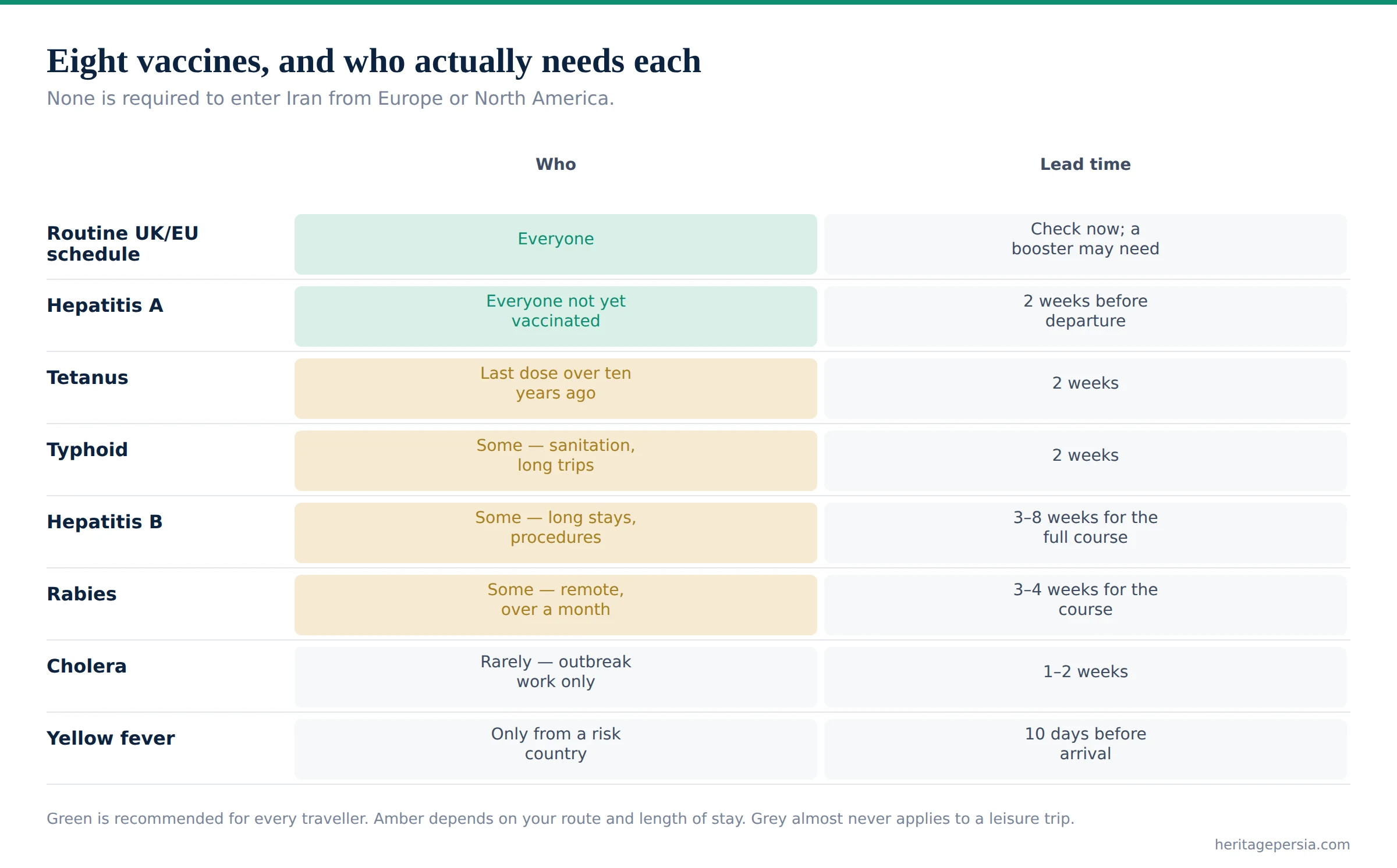
Iran requires no vaccination certificate for entry from Europe or North America. A yellow fever certificate is required only if you are arriving from a country with a risk of transmission, which is the sole entry condition of this kind. Everything below is a recommendation rather than a rule, and the grouping follows the UK National Travel Health Network and Centre.
| Vaccine | Who | Why here | Lead time |
|---|---|---|---|
| Routine UK/EU schedule MMR, diphtheria-tetanus-polio | Everyone | Being up to date matters more than any travel-specific vaccine on this list | Check now; a booster may need weeks |
| Hepatitis A | Everyone not already vaccinated | The one travel vaccine recommended for all visitors to Iran. Food and water transmission | 2 weeks before departure |
| Tetanus | Anyone whose last dose was over ten years ago | Relevant to any cut or animal bite, which is the scenario that actually occurs | 2 weeks |
| Typhoid | Some — poorer sanitation, staying with families, long trips | Worth it if you are eating widely outside hotels and restaurants | 2 weeks |
| Hepatitis B | Some — long stays, medical procedures, certain exposures | Worth discussing if a hospital visit is plausible, which it is more than usual here | 3–8 weeks for the full course |
| Rabies | Some — remote areas, stays over a month, cycling or trekking | Rabies is present in domestic animals. Pre-exposure cover buys time rather than immunity | 3–4 weeks for the course |
| Cholera | Rarely — outbreak or humanitarian work | Not a normal tourist recommendation | 1–2 weeks |
| Yellow fever | Only if arriving from a risk country | The one genuine entry requirement, and it does not apply from Europe or North America | 10 days before arrival |
Malaria is not a consideration on the classic route. Low risk exists from March to November in rural south-eastern provinces and parts of the northern border; the corridor from Tehran to Shiraz has none, and no antimalarials are normally advised for a standard itinerary.
The Part That Changed in 2026
For years the honest advice was that Iranian pharmacies were cheap, everywhere, and better stocked than visitors expected, with most medicines sold without the prescription they would need at home. That is no longer a safe assumption, and we have corrected it elsewhere on this blog rather than leave it standing.
As of September 2026 Iran is short of roughly eight hundred pharmaceutical products, ninety of them classed as essential or life-saving, according to Hadi Ahmadi of the Iranian Pharmacists Association. Four hundred of the scarce items are ones Iran manufactures itself. The categories affected include cancer drugs, epilepsy and nerve-pain medication, antibiotics, insulin, antidepressants, and rotavirus and influenza vaccines.
Prices have moved with the shortage. Year on year, gabapentin is reported up 220 per cent, paracetamol 375 per cent, amoxicillin 285 per cent, fluoxetine 100 per cent and insulin by as much as 600 per cent.
The causes are stacked rather than singular: around forty-four pharmaceutical and medical-equipment companies damaged or destroyed since February 2026, a naval blockade restricting shipping through the Strait of Hormuz along with air, rail and overland routes, continued dependence on imported active ingredients, and the withdrawal of subsidised foreign currency for medical imports.
What this means for you, in one sentence. Bring every medicine you might plausibly need, including the ordinary ones — paracetamol, an antihistamine, rehydration salts, a course of antibiotics if your doctor will prescribe one — because the assumption that you can buy them on arrival no longer holds reliably. The packing list has the full kit.
Bringing Your Own Medicines
Bring more than the trip requires — a week's surplus is the usual rule and we would double it here — and split it between your hand luggage and your case so that a delayed bag is an inconvenience rather than an emergency.
Keep everything in original packaging with the pharmacy label, and carry a copy of the prescription, ideally in English and naming the generic drug rather than only the brand. Brand names differ between countries and a generic name is what an Iranian pharmacist or doctor will recognise.
Some categories need more care. Medicines containing codeine, strong painkillers, sedatives and stimulants are controlled and may require documentation at the border; bring the prescription and only the quantity the trip needs. Any medicine that is contentious at home is likely to be contentious here, and the sensible step is to check your specific drug with the Iranian consulate before you fly rather than discover the answer at the airport.
If you use insulin or anything else that needs refrigeration, plan for it explicitly. Courtyard hotels do not always have room fridges, summer road transfers are long and hot, and insulin is among the medicines currently in shortest supply locally, so a cool bag and your own stock are not optional.
The Honest Risk Order
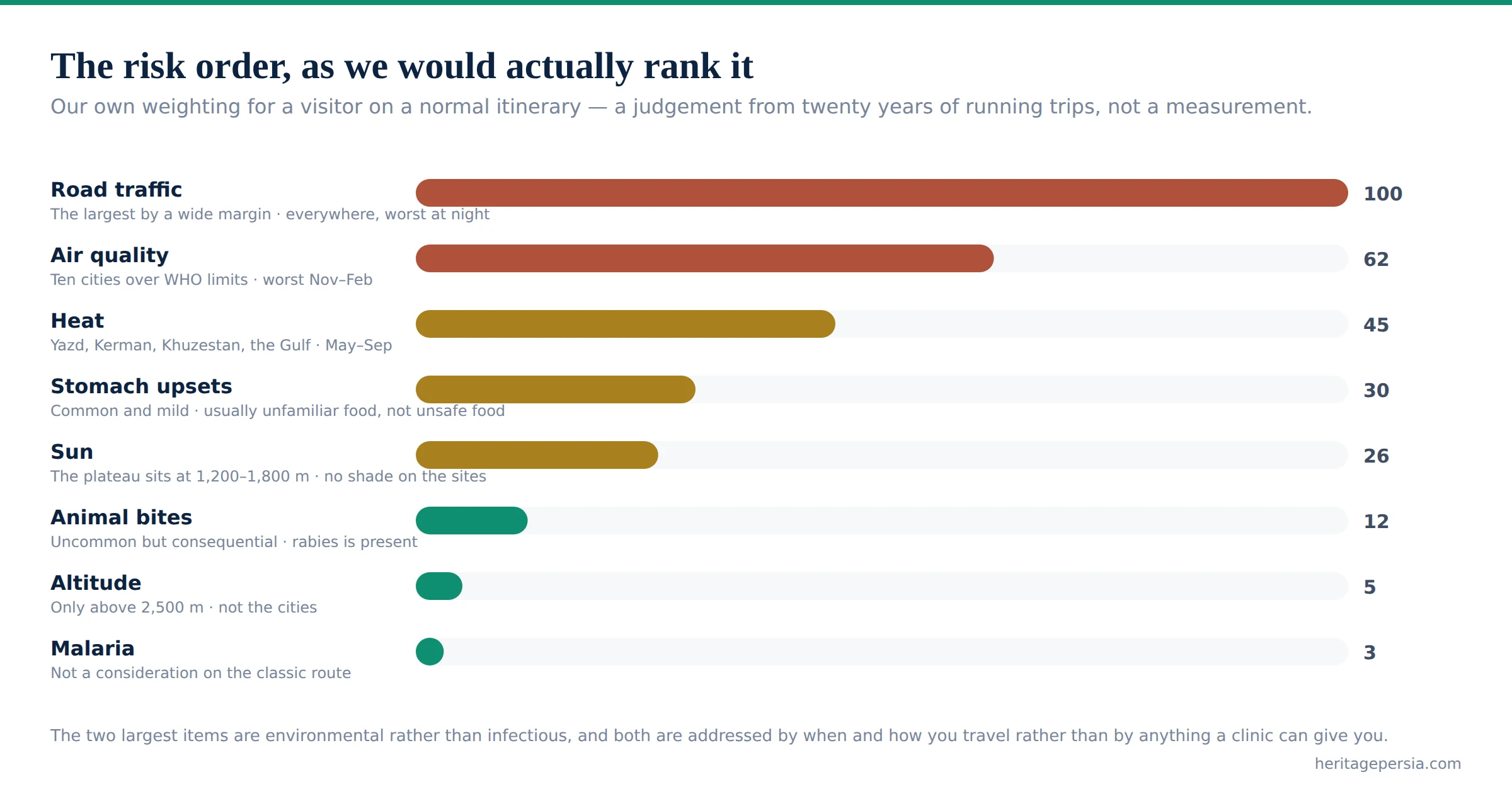
This is the table we would actually hand a traveller. It is ordered by how likely each item is to affect your trip, not by how alarming it sounds.
| Risk | How real | Where and when | What actually reduces it |
|---|---|---|---|
| Road traffic | The largest by a wide margin | Everywhere, worst on intercity roads and at night | Seat belts in every seat, a driver who works the route, and refusing night drives. See getting around |
| Air quality | A genuine public health problem | Tehran and nine other cities, worst November to February | Plan winter city days around the morning, carry an inhaler if you use one, and check the daily index |
| Heat | Serious in the wrong month | Yazd, Kerman, Khuzestan and the Gulf, May to September | Travel in the shoulder seasons, and treat Khuzestan as closed in summer |
| Stomach upsets | Common and mild | Anywhere, usually from unfamiliar food rather than unsafe food | Rehydration salts in the bag. Tap water in the cities is not the cause |
| Sun | Underrated at altitude | The whole plateau sits at 1,200–1,800 m; Persepolis has no shade at all | A wide hat and high-factor sunscreen, brought with you |
| Animal bites | Uncommon but consequential | Street dogs and cats, rural areas | No contact with animals; wash any bite immediately and seek care the same day |
| Altitude | Not an issue on the standard route | Only above 2,500 m — Damavand, Alborz trekking, Dizin | Gradual ascent if you are going up. The cities are all comfortably below the threshold |
| Malaria | Not a consideration on the classic route | Low risk March–November in rural south-east and parts of the north | Bite avoidance if you go there. No prophylaxis for a normal itinerary |
Notice that the two largest items are environmental rather than infectious, and that both are addressed by when and how you travel rather than by anything a clinic can give you.
Winter Air in the Cities
Iran's air pollution is not a footnote. Government-linked figures attribute nearly fifty-nine thousand deaths in the Iranian year to March 2025 to air pollution — around a hundred and sixty a day — with economic damage put at $17.2 billion. Ten major cities, including Tehran, Isfahan, Mashhad, Tabriz, Ahvaz and Yazd, exceeded WHO limits for fine particulates on hundreds of days, some districts at four to nine times the safe threshold.
For a visitor this matters mainly in winter and mainly in Tehran, where cold air sits trapped under the Alborz and the index climbs through November, December and January. Schools and offices close in the worst episodes, which is the signal to change your own plans rather than push through.
The practical response is modest: if you are travelling between November and February, weight your city days towards the morning, keep a reliever inhaler with you if you have asthma, and treat a heavily polluted day as a reason to take an indoor museum rather than a walking route. Isfahan and Shiraz are consistently better than Tehran, and Yazd and the desert are better again.
Food and Water
Tap water is treated and safe to drink in every city on the standard route, and Iranians drink it. In villages and in the far south we would use bottled or filtered water, which is what local practice does too.
Food-borne illness is uncommon and usually mild. Salads and herbs are washed as a matter of course in restaurants and the fresh herb plate served with almost every meal is not a risk worth avoiding. Street food is generally safe; the usual rule of eating where there is turnover applies here as anywhere.
Two genuine cautions. Unpasteurised dairy in rural areas carries a brucellosis risk and is worth declining. And raw camel products are best avoided on account of MERS, which has been reported in the region — this affects almost no ordinary itinerary but is the reason the advice exists. The food guide covers what to eat rather than what to avoid, which is the more useful half.
What Care Is Actually Like
Uneven, and better than most travellers expect where it is good. Global Affairs Canada puts it accurately: good health care is limited in availability and quality varies greatly across the country. Tehran, Isfahan, Shiraz and Mashhad have private hospitals with foreign-trained specialists and equipment that would not look out of place in southern Europe; provincial towns are a different proposition and rural areas more so again.
Two things about paying. More than seventy per cent of healthcare costs in Iran are met directly by patients rather than by insurance, so the cash-at-the-counter model you will encounter is the normal domestic one rather than something applied to foreigners. And because sanctions make it difficult for a Western insurer to transfer funds to an Iranian hospital, you pay in cash and claim afterwards — which our insurance guide sets out in full, including why your cash reserve is the real cover below the evacuation threshold.
Plan the route with the medical map in mind if you have a condition that could need attention. The classic corridor keeps you within about an hour of a major hospital throughout; the Lut, the Khuzestan plain and the mountain routes do not.
What We Would Actually Do
See a travel clinic six to eight weeks out. Hepatitis A and a tetanus check are the whole conversation for most people, and both are quick.
Build the medical kit first, not last. In 2026 it is the single most consequential thing in the suitcase, and the packing list has the contents.
Carry a one-page medical summary with your conditions, allergies, generic drug names and doses, and an emergency contact — in English, on paper, in your bag rather than only in your phone.
Choose the month with health in mind, because the two biggest risks on this page are seasonal. The month-by-month guide is the place to start.
And read the insurance page before you book, not after. When your government advises against all travel, the ordinary policy that would have paid for a medical evacuation does not.
✉️ Travelling with a condition that needs planning? Tell us what it is and we will tell you where on the route the hospitals are, which legs we would change, and what to bring rather than expect to buy. Talk to our team →
Continue reading
Frequently Asked Questions
What travellers ask our guides, answered on the ground.
Travelling With a Condition?
Tell us what it is and we will say where the hospitals are and which legs we would change.
See Our Routes →