
Iran is the size of Western Europe and the classic route across it is about eleven hundred kilometres. How you cover that distance decides more about the trip than most travellers realise: an overnight train turns a lost day into a night’s sleep, a badly chosen flight turns a four-hour drive into a six-hour airport exercise, and a private car turns the empty stretch between two cities into the part people talk about afterwards.
This guide goes mode by mode with real journey times, then puts them side by side on the routes you are actually likely to take. The short version is that Iran’s intercity transport is cheap, frequent and better than its reputation, and that the right answer changes from leg to leg.
Before you plan anything: this guide describes how the network works in normal conditions. Air travel in and around Iran has been disrupted through 2026 and several aviation authorities restrict the airspace — see our current situation report, reviewed 10 September 2026, before you build an itinerary around a flight.
The Shape of the Country
Almost everything a first-time visitor wants sits on one corridor running south-east from Tehran: Kashan, Isfahan, Yazd, Shiraz. That corridor is well served by road and partly by rail, and the legs between its cities are three to five hours by car — long enough to matter, short enough to do in a morning.
Step off that corridor and the distances change character. Tabriz is a day from Tehran in the north-west. Mashhad is nine hundred kilometres east. Qeshm is in the Gulf. For those, flying stops being a luxury and becomes the only sensible way to spend your days on the place rather than the road.
One piece of the network is itself a monument: the Trans-Iranian Railway, built in the 1930s across two mountain ranges between the Caspian and the Gulf, was inscribed by UNESCO in 2021. If you take the northern line you are travelling on a World Heritage Site.
Every Mode, and What It Is Good For
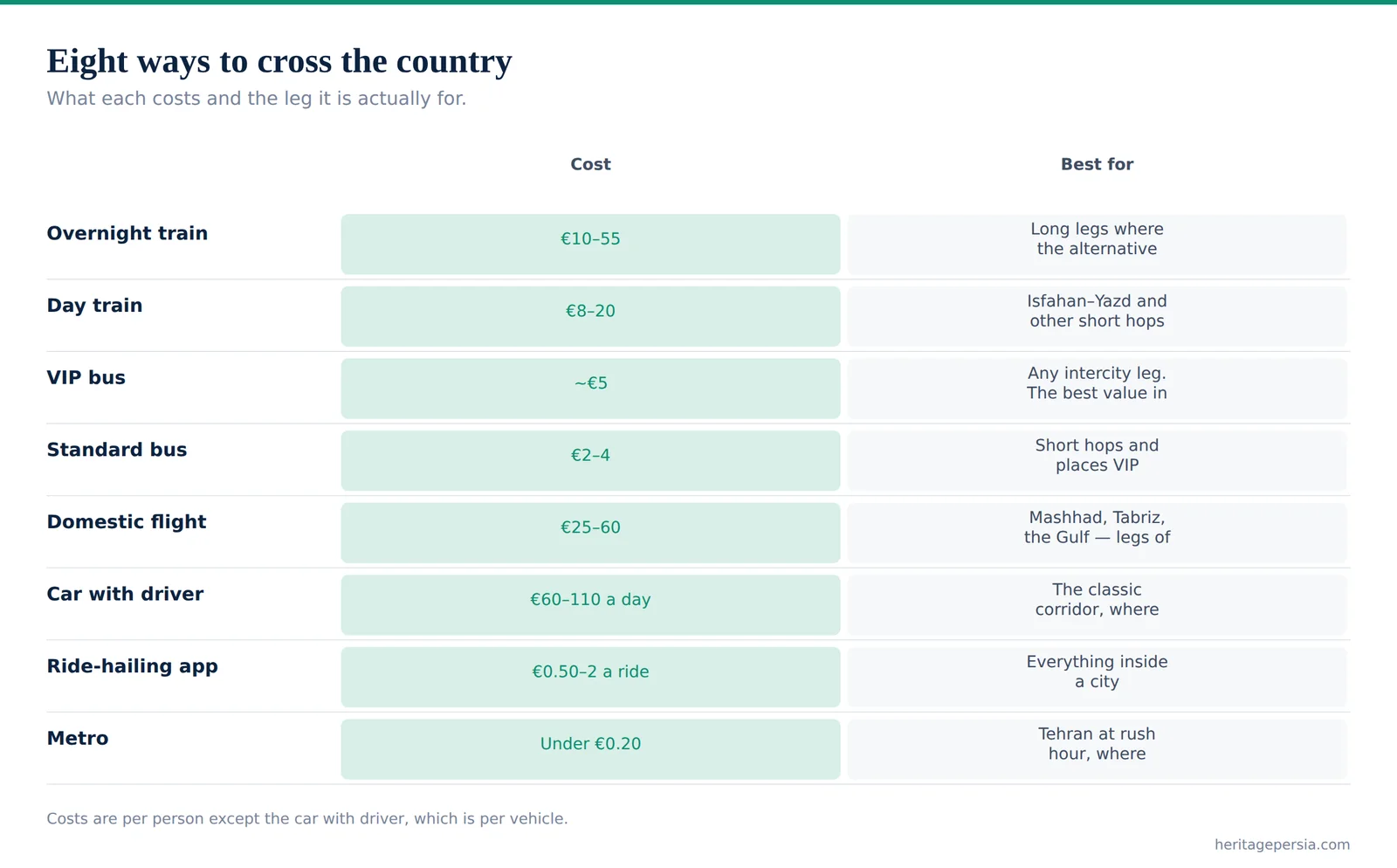
Costs are per person in euro, because a rial figure goes stale within months.
| Mode | Typical cost | Comfort | Book how | Best for |
|---|---|---|---|---|
| Overnight train 4-berth or 6-berth sleeper | €10–55 | High | Agent, days ahead | Long legs where the alternative wastes a daylight day |
| Day train Seated, some express | €8–20 | High | Agent, days ahead | Isfahan–Yazd and other short hops with good scenery |
| VIP bus Reclining seats, 2+1 layout | ~€5 | High | Agency or terminal | Any intercity leg. The best value in Iranian transport |
| Standard bus | €2–4 | Basic | Terminal | Short hops and places VIP services do not run |
| Domestic flight | €25–60 | Variable | Agency | Mashhad, Tabriz, the Gulf — legs of 700 km and up |
| Car with driver Per vehicle, not per seat | €60–110 a day | Highest | Agency | The classic corridor, where the stops between cities are the point |
| Ride-hailing app Snapp · Tapsi · Maxim | €0.50–2 a ride | Good | App, pay cash | Everything inside a city |
| Metro Tehran and other large cities | Under €0.20 | Crowded | Ticket at the station | Tehran at rush hour, where nothing else moves |
Fares move with the currency rather than with policy. Treat these as a scale for comparing modes against each other, not as quotes.
Trains
Iranian trains are the pleasant surprise of the trip for most visitors. They are clean, they run to time more often than not, and the sleepers are a genuine bed rather than a reclining seat. Compartments are four-berth or six-berth; the four-berth is worth the difference. Men and women travel in the same compartments on both trains and long-distance buses, which surprises some visitors who expect otherwise.
Journey times on the routes that matter, and what each costs at the time of writing:
| Route | Time | Typical fare | Day or night | Verdict |
|---|---|---|---|---|
| Tehran → Isfahan | 8 hrs | ~€8 | Overnight | Cheap, comfortable, saves a hotel night |
| Tehran → Yazd | 5–8 hrs | €9–15 | Either | The Pardis express is the fast one; worth asking for by name |
| Tehran → Shiraz | 15 hrs | €25–45 | Overnight | Long, but it is a bed and it arrives in the morning |
| Tehran → Mashhad | 8–14 hrs | €17–60 | Overnight | The busiest line in the country. Book well ahead |
| Tehran → Tabriz | 12 hrs | €10–16 | Overnight | Sensible alternative to the long drive north-west |
| Isfahan → Yazd | 3.5 hrs | €8–12 | Day | Short, scenic and the easiest rail leg on the classic route |
| Shiraz → Isfahan | — | — | — | No rail link. This leg is road or air, and road is better |
Fares are indicative and depend on class and season. The absence of a Shiraz–Isfahan line catches people out more than anything else on this table.
💡 Booking is the awkward part. The national booking system does not take foreign cards, so in practice a traveller books rail through an agency, which issues the ticket against your passport details. Do it days in advance rather than hours — sleepers on the popular lines sell out, and the Mashhad route fills weeks ahead around religious holidays. We book rail and coach tickets for travellers whether or not they are on one of our tours.
VIP Buses
The intercity bus network is the thing Iran does best and visitors expect least. More than twenty private companies run it — Royal Safar, Hamsafar, Iran Peyma and Seir-o-Safar among the larger ones — and the VIP class is a genuinely comfortable vehicle: wide seats that recline properly, air conditioning, a screen, and a bottle of water handed to you as you board. A long-distance ticket costs around five euros.
Two practical points. Terminals sit on the outskirts of cities, so budget a taxi at each end and add half an hour. And buses leave frequently on the main corridors — on Tehran–Isfahan or Isfahan–Shiraz you can generally turn up and take the next departure, which is not true of the trains.
Standard buses are cheaper and markedly less comfortable, with more seats across and no recline worth the name. For anything over two hours, pay the extra two euros.
Domestic Flights
Flying makes sense on exactly three kinds of leg: Mashhad, the north-west, and the Gulf. Tehran to Mashhad is about ninety minutes in the air against nine hundred kilometres of road; Tehran to Kerman is an hour; Shiraz to Qeshm saves a day and a half of driving. On the classic corridor it makes no sense at all — by the time you have reached an airport, checked in and reached the city at the other end, you have spent longer than the drive and seen nothing.
Fares are low, typically twenty-five to sixty euros. Booking has the same problem as rail: no foreign card works on the airlines’ own sites, so tickets are issued through an agency against your passport. Baggage allowances are tighter than you may be used to, and schedules change more often than they do in Europe.
Read the status note at the top of this page before you build a plan around a flight. Aviation around Iran has been disrupted through 2026 and several regulators restrict the airspace; our situation report carries the current detail and the dates on it.
A Car and a Driver
This is what most of our travellers end up doing on the classic corridor, and the reason is not comfort. It is the stops. The road from Kashan to Isfahan passes Abyaneh; the road from Yazd to Shiraz passes Persepolis and Naqsh-e Rostam; the road east from Kerman goes into the Lut. A bus passes all of them at speed.
A car with a driver costs sixty to a hundred and ten euros a day depending on the vehicle and the distance — per car, not per person, so it divides well across two or four. The driver is not a guide, and in most of Iran a separate licensed guide is what you want at the sites themselves.
Self-drive is possible and we rarely recommend it. An International Driving Permit is required, urban traffic is assertive in a way that takes weeks rather than days to read, and signage outside the main routes is inconsistent. If you want the freedom of a vehicle, hire one with someone at the wheel who knows the roads.
Inside Cities
Ride-hailing. Snapp is the largest and runs in all thirty-one provinces; Tapsi and Maxim cover the main cities. All three have English interfaces, which is the single most useful fact in this section. Fares are trivial — half a euro to two euros across a city — and you can pay the driver in cash at the end. The in-app payment needs an Iranian bank card, so either pay cash or use the prepaid card described in our money guide.
Registering for the apps needs a phone number that can receive an Iranian SMS, which means a local SIM — see the connectivity guide. Without one, ask your hotel to call a car; every hotel does this all day long.
Street taxis. Still everywhere, and there are two kinds. A shared taxi runs a fixed route and picks up whoever is going that way; you say your destination through the window and get in if the driver nods. A private hire — darbast, meaning “closed door” — takes only you, and the fare is agreed before you get in, not after.
Metro. Tehran’s is extensive, cheap and the fastest way across the city in the hours when the traffic does not move. Several other large cities have systems of their own. Tickets are bought at the station; there are women-only carriages at the ends of the trains, which women may use or not as they prefer.
The Legs You Are Actually Likely to Take
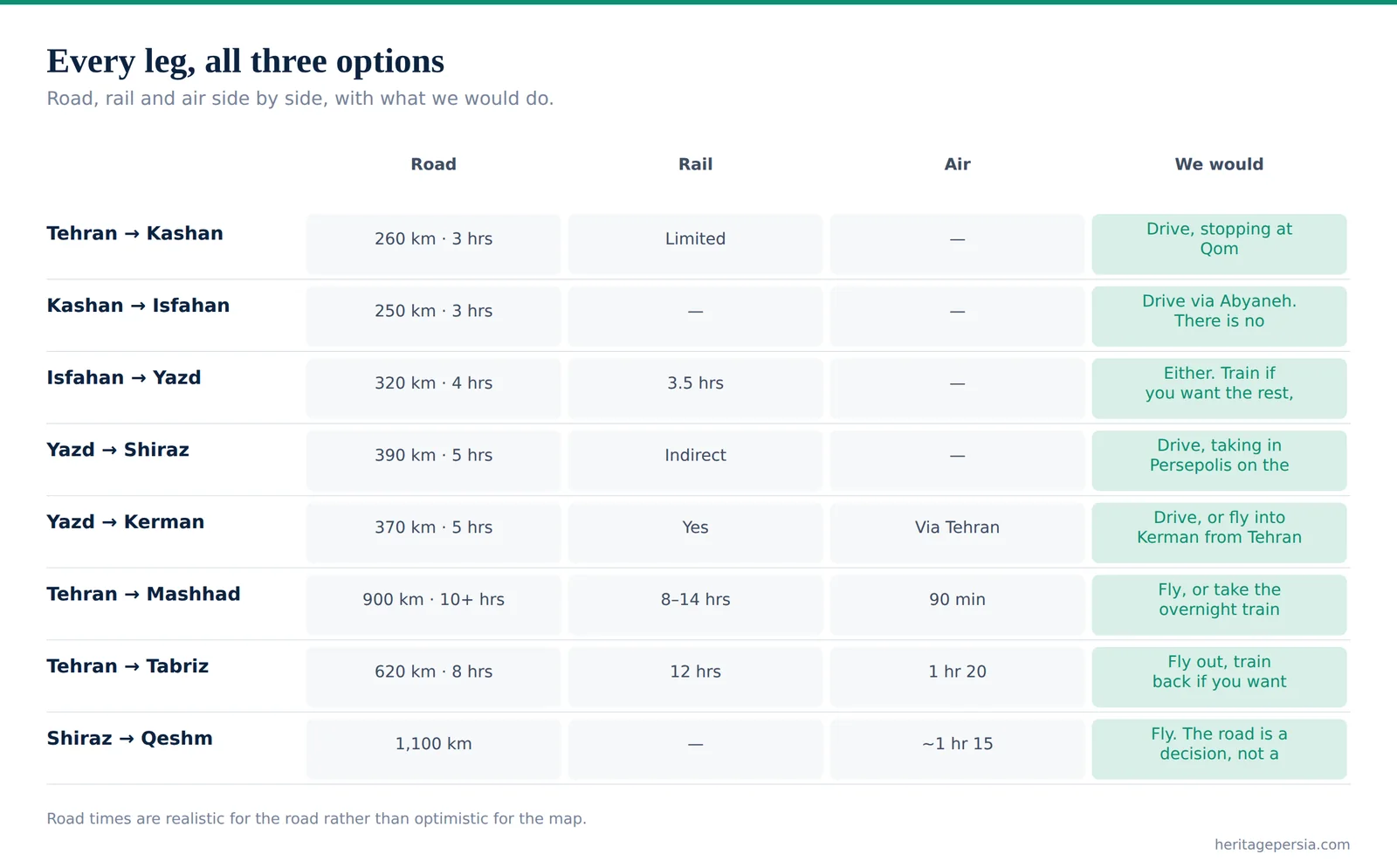
Same routes, all three options side by side, with our recommendation.
| Leg | By road | By rail | By air | We would |
|---|---|---|---|---|
| Tehran → Kashan | 260 km · 3 hrs | Limited | — | Drive, stopping at Qom |
| Kashan → Isfahan | 250 km · 3 hrs | — | — | Drive via Abyaneh. There is no substitute |
| Isfahan → Yazd | 320 km · 4 hrs | 3.5 hrs | — | Either. Train if you want the rest, road for Meybod |
| Yazd → Shiraz | 390 km · 5 hrs | Indirect | — | Drive, taking in Persepolis on the way |
| Yazd → Kerman | 370 km · 5 hrs | Yes | Via Tehran | Drive, or fly into Kerman from Tehran |
| Tehran → Mashhad | 900 km · 10+ hrs | 8–14 hrs | 90 min | Fly, or take the overnight train for the experience |
| Tehran → Tabriz | 620 km · 8 hrs | 12 hrs | 1 hr 20 | Fly out, train back if you want the night |
| Shiraz → Qeshm | 1,100 km | — | ~1 hr 15 | Fly. The road is a decision, not a transfer |
Road times are realistic for the road rather than optimistic for the map, and assume a morning departure. Add an hour to anything crossing Tehran.
Practical Notes
Booking anything. Foreign cards do not work on any Iranian booking platform. Rail, coach and domestic flights are all booked through an agency against your passport. Build a day or two of lead time into the plan.
Luggage. Trains and buses are generous; domestic flights are not. If you are flying internally, weigh the bag before the airport.
Timing. Intercity roads are busiest on Thursday afternoons and Friday evenings, which is the Iranian weekend. During Nowruz the entire network is full and booked out weeks in advance.
Women travelling alone. Buses and trains are used by women travelling alone all the time. On a sleeper you can request a compartment with other women when booking, and it is a normal request rather than an awkward one.
What we would not do. Overnight buses on the corridor when a train exists, self-drive on a first visit, and any itinerary that puts two internal flights in three days.
✉️ Not sure which legs to fly and which to drive? Send us the cities and the dates and we will lay out the route with the mode for each leg and what it costs. Talk to our team →
Continue reading
Frequently Asked Questions
What travellers ask our guides, answered on the ground.
The Route, Leg by Leg
We will lay out your cities with the right mode for each leg and what it costs.
Book Transport →