
Fourteen days is the length at which Iran stops being a corridor and starts being a country. Ten days buys the classic five cities; the extra four are what let you leave them, and the whole planning question is which direction you go when you do.
There are four honest answers — the desert and the Lut, the northwest, Khuzestan, or more nights in the cities you already had — and they are not interchangeable, because each is open in a different season. This page lays out the fourteen days we run most often, then the four ways to spend the extra four, with the seasons that decide between them.
Before you plan anything: this is a routing guide, written to be useful whenever you are able to use it. Whether to travel to Iran at present is a separate question with a different answer — see our current situation report, reviewed 10 September 2026.
What the Extra Four Days Actually Buy
Not four more cities. That is the mistake, and it is the one we spend most of our time talking people out of.
A fourteen-day trip has the same structure as a ten-day one — the same corridor, the same five cities — with one region attached to the end or the beginning. Attaching a region costs three to four days because it is a flight or a long drive in each direction plus the time on the ground, and it gives you something genuinely different from the corridor rather than more of the same.
Adding four scattered cities instead gives you four more half-days of driving and four more hotel check-ins. You will have covered more of the map and seen less of the country, and you will have spent the fourteenth day wishing you had three nights somewhere instead of one night everywhere.
The Fourteen Days, With Every Distance
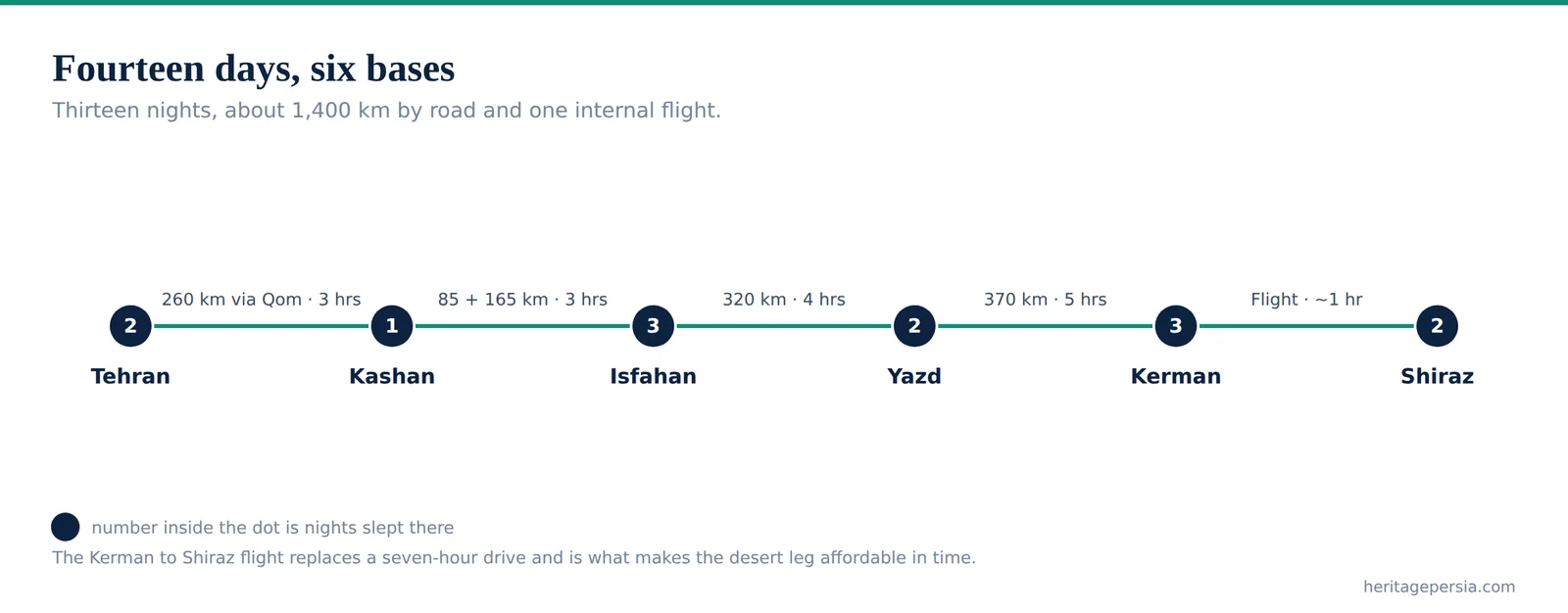
This is the version we run most often — the classic corridor with Kerman and the Lut attached, and one internal flight to avoid a seven-hour drive.
| Day | Sleep in | Leg & drive | What you do |
|---|---|---|---|
| Day 1 | Tehran | IKA → city · 45–90 min | Land, transfer, sleep. Most European flights arrive before dawn, so treat it as a half day |
| Day 2 | Tehran | — | National Museum for the Achaemenid context, Golestan Palace, the Grand Bazaar |
| Day 3 | Kashan | 260 km via Qom · 3 hrs | Drive south after breakfast. Fin Garden and one merchant house in the afternoon |
| Day 4 | Isfahan | 85 + 165 km · 3 hrs | Abyaneh mid-morning. Into Isfahan late afternoon, Naqsh-e Jahan after dark |
| Day 5 | Isfahan | — | Imam Mosque 08:00, Sheikh Lotfollah 11:00, Ali Qapu 16:00, the bazaar |
| Day 6 | Isfahan | — | Masjed-e Jāmé, Chehel Sotoun, Vank Cathedral and Julfa, Khaju bridge at night |
| Day 7 | Yazd | 320 km · 4 hrs | Leave after breakfast, stop at Na’in or Meybod, first walk through the old city as the heat drops |
| Day 8 | Yazd | — | Towers of Silence at first light, the Jameh Mosque, the fire temple, the wind-tower rooftops |
| Day 9 | Kerman | 370 km · 5 hrs | The drive east. Ganjali Khan complex and the bazaar in the late afternoon |
| Day 10 | Kerman | 70 km round trip | Mahan: Shazdeh Garden in low afternoon sun and the Shah Nematollah Vali shrine |
| Day 11 | Kerman | ~170 km · 2.5 hrs each way | Leave after lunch for the Lut. The kaluts two hours before sunset, and stay until the light goes |
| Day 12 | Shiraz | Flight · ~1 hr | Fly rather than drive — the road is seven hours. Shiraz in the afternoon, Shah Cheragh after dark |
| Day 13 | Shiraz | 130 km round trip | Persepolis at opening, Naqsh-e Rostam after it, Pasargadae if the day holds |
| Day 14 | — | City → airport · 20 min | Nasir al-Mulk at 07:30 while the glass works, the Vakil bazaar, Hafez, then home |
Thirteen nights across six bases, roughly 1,400 km by road plus one internal flight. The flight on day twelve is what makes the Kerman leg affordable in time.
Four Ways to Spend the Extra Four Days
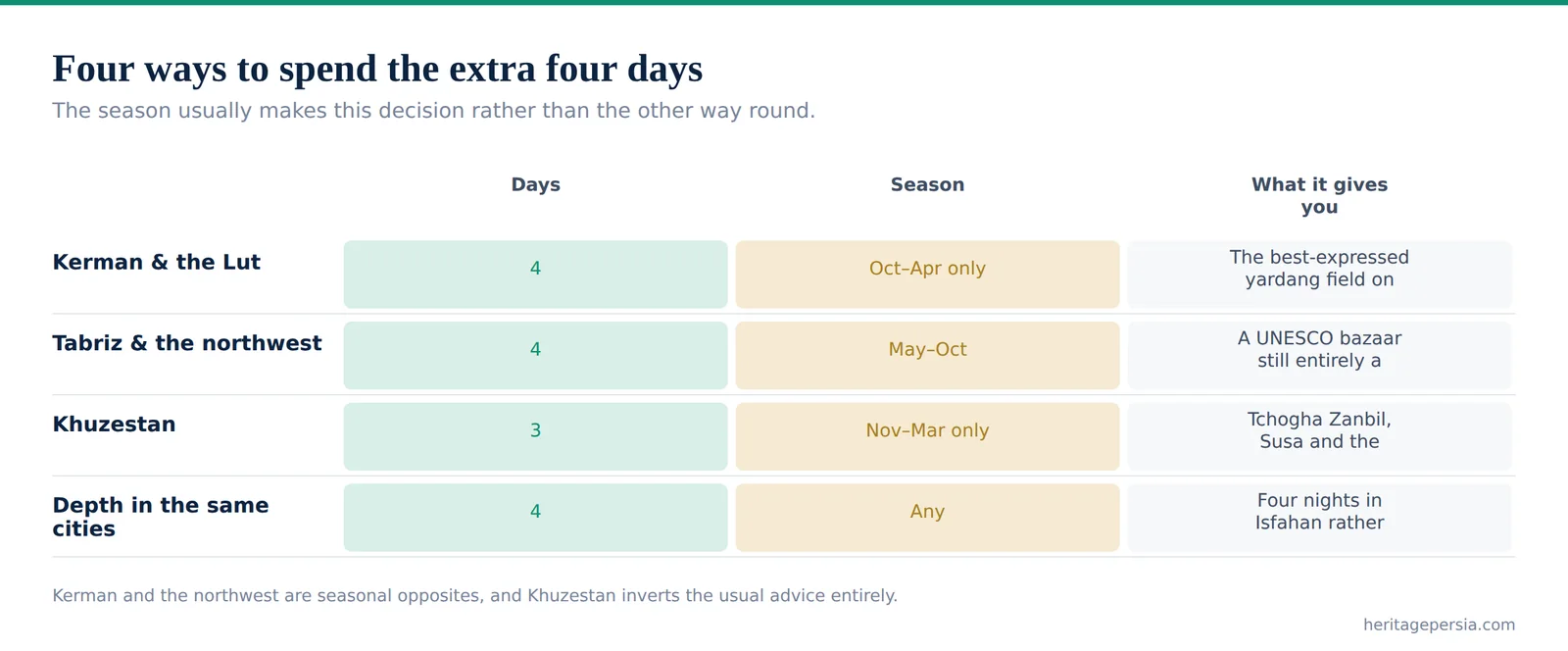
The table above takes the first option. Here are all four, with the thing that actually decides between them, which is the season you are travelling in.
| Add this | Days | Season | What it gives you | What it costs |
|---|---|---|---|---|
| Kerman & the Lut 3 UNESCO sites | 4 | Oct–Apr only | The best-expressed yardang field on earth, Shazdeh Garden, and Bam or Rayen. Landscape you will not see anywhere else | One internal flight, and it is unusable May to September |
| Tabriz & the northwest 2 UNESCO sites | 4 | May–Oct | A UNESCO bazaar still entirely a working market, Kandovan, the Armenian monasteries, and a region where Persian is the second language | A flight at the start, and it is cold and closed in winter |
| Khuzestan 3 UNESCO sites | 3 | Nov–Mar only | Tchogha Zanbil, Susa and the Shushtar hydraulic system. The best addition nobody makes | Brutal heat May to September. Inverts the usual advice entirely |
| Depth in the same cities | 4 | Any | Four nights in Isfahan rather than three, a third day in Shiraz for Sassanid Fars, a desert night from Yazd | Nothing. This is the option with no drawback and it is chosen least |
Kerman and the northwest are seasonal opposites, which is why the month you travel usually makes this decision for you rather than the other way round. Our month-by-month guide has the figures.
The Case for the Fourth Option
Adding no region at all is a real itinerary and it is the one experienced travellers choose more often than first-timers expect.
Four extra days spread across five cities you are already visiting buys: a fourth night in Isfahan, which is the city that most rewards it; a third day in Shiraz for the Sassanid landscape at Firuzabad and Sarvestan, which is a UNESCO inscription almost nobody visits; a desert night out of Yazd; and a second night in Kashan with a morning in the rose villages if you are there in May.
No flights, no long drives, no packing on four extra mornings. If your previous trips have ended with a feeling of having rushed, this is the version to take.
Two Mistakes at This Length
The first is the grand tour. Fourteen days is not enough for the classic corridor plus Tabriz plus Kerman, however the map looks. That itinerary contains four internal flights and is sold by operators who count cities rather than days. You will spend a quarter of the trip in airports.
The second is the single-night stop. Every base on this route gets at least two nights except Kashan, which is genuinely a one-night town on the way. A single night anywhere else means arriving in the evening and leaving in the morning, which is a hotel rather than a place.
💡 The test we apply to any itinerary someone sends us. Count the nights, then count the bases. If the first number divided by the second is under two, the trip is too fast whatever its length. A fourteen-day route with seven bases fails that test; the one above, with thirteen nights across six bases, passes it narrowly and only because Kashan is a deliberate exception.
What to Book Ahead, and When
| Item | When | Why |
|---|---|---|
| Visa | 2–8 weeks out | Passport-dependent — see the visa guide. US, UK and Canadian passports need around eight weeks and an approved itinerary |
| Open-jaw international flights | 4–5 months out | In to Tehran, out of Shiraz. Returning to your arrival city costs a day you cannot spare even at this length |
| The internal flight | 1–2 months out | Kerman to Shiraz, or Tehran to Tabriz on the northwest version. Booked through an agency — no foreign card works on Iranian sites |
| Courtyard hotels | 4–5 months out | Kashan, Yazd and Kerman have few rooms each and they go first in April, May and October |
| Car and driver | 2 months out | Per vehicle rather than per seat. On the desert legs you want someone who works those roads |
| The Lut night | 2 months out | If you want to sleep out rather than drive back. Limited and seasonal |
Every line moves to months rather than weeks around Nowruz, when domestic travel peaks and the courtyard hotels are gone by January.
What a Fortnight Costs
Excluding the international flight, a comfortable fourteen days runs roughly €800–1,150 per person: accommodation, food, entries, the internal flight and a shared car with driver. The lean version on buses and in guesthouses is closer to €380–500. The unhurried version with the best courtyard hotels and a private car throughout is €1,700 upwards.
Entries add €8–15 a day, and this route collects eleven or more UNESCO inscriptions — our guide to all thirty says which ones need a licensed guide to mean anything.
All of it in cash, carried in. No foreign card works anywhere in Iran, which on a fourteen-day budget is a genuinely large amount of currency to plan for — read the money guide before you book anything, not after.
When to Run It
Late March to mid-May and late September to early November for the corridor itself. Then the added region narrows it further: Kerman and the Lut are October to April, Khuzestan is November to March, and the northwest is May to October.
That leaves two genuinely good windows for the full fourteen days. October and early November takes the corridor at its best and the Kerman desert as it becomes usable. Late April and May takes the corridor in flower and opens the northwest instead. Pick the region to match the month rather than the other way round, and read the month-by-month guide before fixing dates.
✉️ Fourteen days and undecided which direction to add? Tell us your month and we will tell you which of the four options is actually open, and which we would take. Talk to our team →
Continue reading
Frequently Asked Questions
What travellers ask our guides, answered on the ground.
Fourteen Days, Pointed the Right Way
Tell us your month and we will tell you which of the four directions is actually open.
See Longer Routes →