
Three weeks is the length at which Iran stops making you choose between regions — and starts making you choose between seasons instead. That swap is the whole subject of this page, and almost nobody writes it down.
At seven days you cut cities. At fourteen you pick one region to add. At twenty-one you can have the classic corridor plus everything a fortnight forces you to leave out — except that the things you would add do not share a season. The deserts and the Gulf are winter. The northwest is summer. There is no twenty-one-day route that does both well, so there are two routes on this page rather than one, and the month you can travel decides which.
Before you plan anything: this is a route guide, written to be useful whenever you are able to use it. Whether to travel to Iran at present is a separate question with a different answer — see our current situation report, reviewed 10 September 2026.
Why There Are Two Routes
The four regions worth adding to the classic corridor each have a season, and the seasons do not line up.
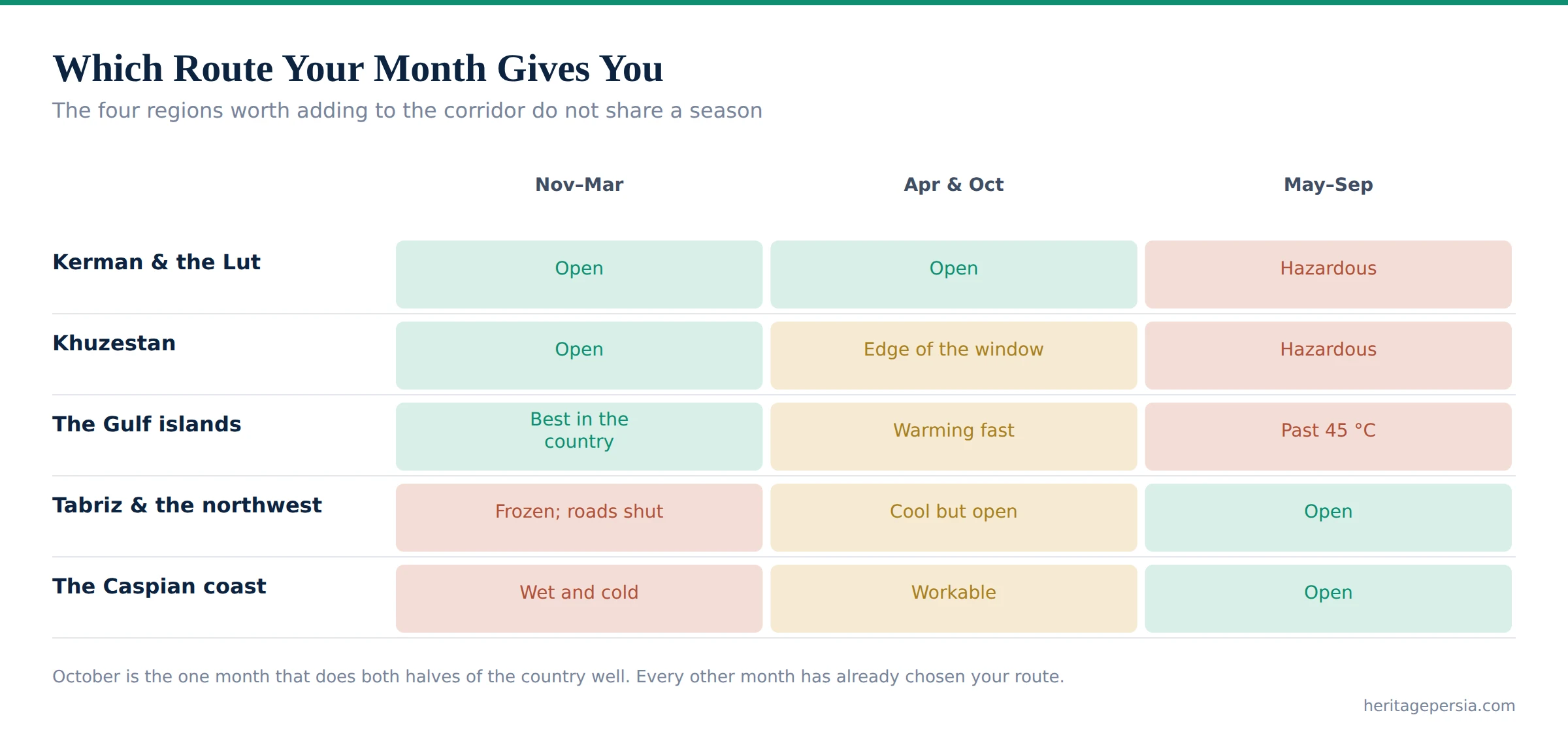
Kerman and the Lut are October to April, because the property holds the hottest land-surface temperature ever recorded and the summer is not a matter of discomfort. Khuzestan is November to March, for the same reason with humidity added. The Gulf islands are November to March, and genuinely the best weather in the country in those months. Tabriz and the northwest are May to October, because the winter there is a serious one and the mountain roads close.
Line those up and the overlap is a single month at each end of the year — October, at a stretch April. Every other month belongs firmly to one route or the other. That single month of overlap is the most useful planning fact about a three-week Iranian trip, and it makes when the opening question rather than where.
If your dates are fixed, read the season table below first and let it pick the route. If your dates are open, pick the route you want and then take the months it gives you. Doing it the other way round is how people end up standing in Ahvaz in July.
The Winter Route, Day by Day
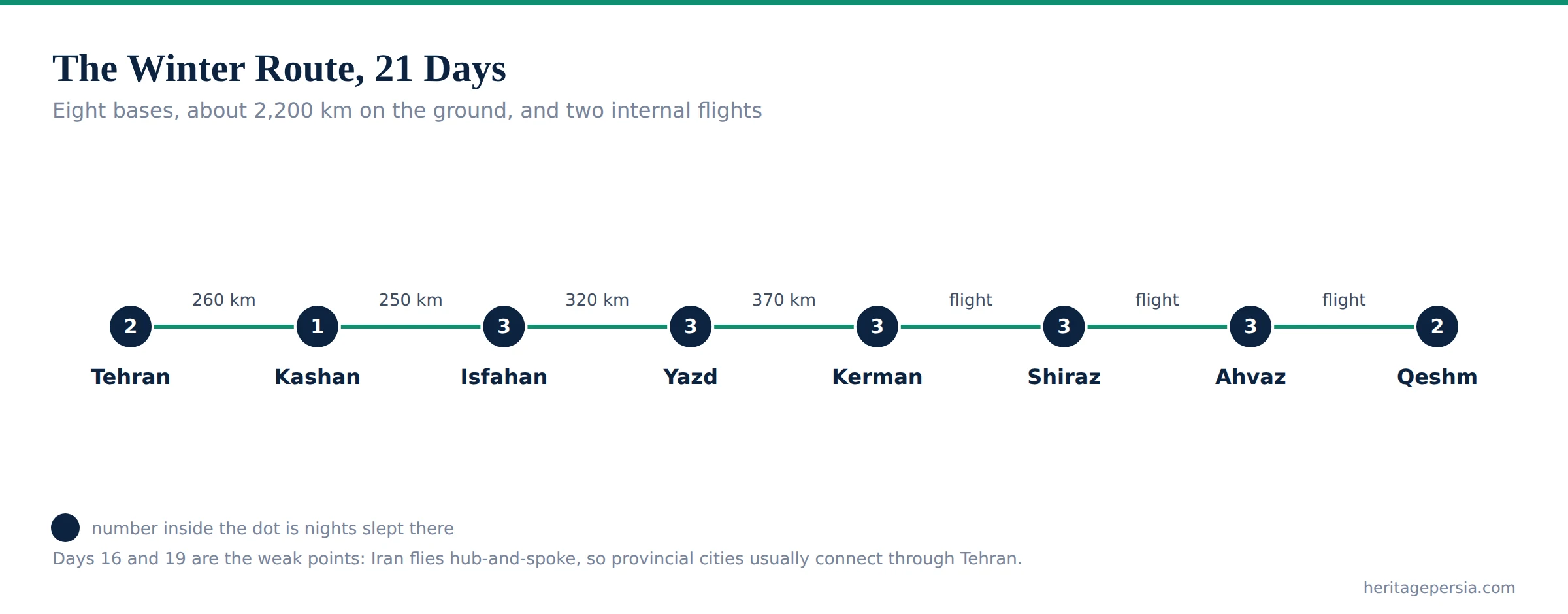
November to March. Eight bases, about 2,200 kilometres on the ground once the day trips are counted, and two flights.
| Day | Sleep in | Leg & drive | What you do |
|---|---|---|---|
| 1–2 | Tehran | IKA → city · 45–90 min | Land, then the National Museum for the Achaemenid context you will use for three weeks, Golestan, the Grand Bazaar |
| 3 | Kashan | 260 km via Qom · 3 hrs | Fin Garden and one merchant house. Not all three of them |
| 4–6 | Isfahan | 85 + 165 km · 3 hrs | Abyaneh on the way in. Then three days on the square, the old city, Julfa and the bridges |
| 7–8 | Yazd | 320 km · 4 hrs | Na’in or Meybod en route. Towers of Silence at first light, the fire temple, the rooftops |
| 9 | Yazd | 144 km round trip | Chak Chak, Kharanaq and Meybod — the day that makes Zoroastrian Iran make sense |
| 10–12 | Kerman | 370 km · 5 hrs | Ganjali Khan and the bazaar, Mahan and Shazdeh Garden, and a night out in the kaluts |
| 13 | Shiraz | Flight · ~1 hr | Fly rather than drive; the road is seven hours. Shah Cheragh after dark |
| 14–15 | Shiraz | 130 km round trip | Persepolis at opening and Naqsh-e Rostam after it. Nasir al-Mulk at 07:30, Hafez at dusk |
| 16 | Ahvaz | Flight via Tehran · half a day | There is no direct Shiraz–Ahvaz flight. Travel day, and the only genuinely wasted half-day on the route |
| 17–18 | Ahvaz | ~330 km over two days | Tchogha Zanbil and Susa on one day, the Shushtar hydraulic system on the other. Three UNESCO inscriptions |
| 19–20 | Qeshm | Flight via Tehran · ~5 hrs | The geopark, the Valley of Stars, the mangroves and the salt cave |
| 21 | — | Boat + flight | Fly home from Qeshm or Bandar Abbas. Add two days here if you want Hormuz as well, and you should |
The weak point of this route is day 16 and day 19 — Iran’s domestic network is a hub-and-spoke through Tehran, so moving between two provincial cities usually means going back through the capital. Building the route so those transfers land on days you were half-losing anyway is most of the craft in it.
The Warm-Season Route
May to October. The same first fifteen days, then a different country.
| Day | Sleep in | Leg | What you do |
|---|---|---|---|
| 1–12 | As above | — | Tehran, Kashan, Isfahan, Yazd. Drop the Kerman block and give those three days back to Isfahan, Yazd and Shiraz |
| 13–15 | Shiraz | 390 km from Yazd · 5 hrs | Persepolis, Naqsh-e Rostam, Pasargadae, and the Sassanid sites at Firuzabad on the third day |
| 16–18 | Tabriz | Flight via Tehran | The UNESCO bazaar, Kandovan, the Armenian monasteries, and a region where Persian is the second language |
| 19–20 | Masuleh or Rasht | ~500 km · 7 hrs | Down into the Caspian provinces — rice terraces, forest, a food culture with almost nothing in common with the plateau |
| 21 | Tehran | ~330 km · 5 hrs | Back over the Alborz, and home. Or swap days 19–21 for Mashhad and Tus |
The Caspian leg is the one most often cut and the one we most often argue for. It is wet, green and entirely unlike the Iran of the photographs, and three weeks is the first length at which it fits without costing you something better.
Which Route Your Month Gives You
| Month | Route | Why |
|---|---|---|
| November–February | Winter only | The northwest is cold and the mountain roads are unreliable. The deserts and the Gulf are at their best |
| March | Winter, with care | Khuzestan is closing and Nowruz shuts the country for a fortnight. Check the dates before anything else |
| April | Either, neither perfectly | The corridor is at its best. The Gulf is warming and Tabriz is still cool. A compromise month |
| May–June | Warm only | Khuzestan and the Gulf are already dangerous. The northwest is opening |
| July–August | Warm, reluctantly | Even the corridor is hard. Tabriz and the Caspian are pleasant and the rest of the route is endured |
| September | Warm | The best month for the northwest version, and the corridor has cooled |
| October | Either, both well | The one month that genuinely does both. If your dates are open, this is the month |
October is the answer if you can take it, and April is the answer if you cannot. Every other month has already chosen your route for you, which is easier than it sounds — it removes the hardest decision on the page.
What Three Weeks Does to the Pace
Nine bases is the ceiling. Twenty-one nights across nine hotels averages two and a bit nights each, which is already brisk. Every base beyond nine converts a travel day into two half-days of packing, and the trip starts to feel like logistics.
Build in two nothing-days. Not sightseeing days with a light programme — actual days with nothing on them, placed after the two longest transfers. Three-week trips fail in week three, and they fail from accumulated fatigue rather than from anything going wrong.
The second week is the one to slow down. Weeks one and three carry their own momentum, arrival and departure. The middle week is where a fourth night in Isfahan or a third in Yazd earns more than another city would.
Two flights, not four. Each internal flight costs you roughly half a day once you count the transfers and the check-in, so it only pays where it replaces six hours or more of road. Kerman to Shiraz and Shiraz to Ahvaz qualify. Isfahan to Yazd does not, and the drive is a good one.
What to Book, and When
| Item | When | Why |
|---|---|---|
| Visa | 2–8 weeks out | Passport-dependent — see the visa guide. US, UK and Canadian passports need around eight weeks and an approved itinerary, and a 21-day itinerary takes longer to approve than a 10-day one |
| Open-jaw international flights | 5–6 months out | In to Tehran, out of Shiraz, Qeshm or Tabriz depending on route. Returning to your arrival city costs a day even at this length |
| The two internal flights | 2–3 months out | Booked through an agency against your passport, because no foreign card works on Iranian platforms — see money in Iran |
| Courtyard hotels | 5–6 months out | Kashan, Yazd and Kerman have a handful of rooms each and they go first in April, May and October |
| Car and driver | 3 months out | Priced per vehicle rather than per seat, which makes it cheaper per head than it looks over three weeks |
| The desert night | 2–3 months out | Limited and seasonal, and the single thing on the winter route people most regret missing |
| Nothing on the Caspian leg | — | The one part of either route where turning up and finding a room still works, and where the good places are not online |
What Three Weeks Still Cannot Hold
Even at this length the country does not fit, which is worth saying plainly because most three-week guides imply otherwise.
Both seasonal halves. The whole point of this page. You will leave either the northwest or the south for another trip.
Sistan and Baluchistan. The south-east corner is a separate expedition with its own security picture, and it does not attach to anything.
The Zagros properly. The mountain villages and the nomadic migration routes need their own fortnight and a different kind of travel.
Depth anywhere. Three weeks buys breadth. If what you want is to know one city, three weeks in Isfahan and its province would be a better trip than either route here, and nobody ever books it.
✉️ Have three weeks and fixed dates? Tell us the month and we will tell you which of these two routes your dates actually allow, and where the two nothing-days should sit. Talk to our team →
Continue reading
Frequently Asked Questions
What travellers ask our guides, answered on the ground.
Three Weeks, Planned Around Your Dates
Tell us the month and we will say which of the two routes your dates allow.
See Long Itineraries →