
Zoroastrianism is not an archaeological subject in Iran. There is a community, there are working temples, and the fire in Yazd has been burning since roughly the year 470 — which is to say it was already a thousand years old when the first stone of the Taj Mahal was laid.
That distinction organises this page. Some of what you will visit is heritage, open and explicable, and some of it is in current religious use with rules about who may go where. Getting that wrong is the one way a visitor can be genuinely rude here, and almost nobody tells you in advance.
Before you plan anything: this is a culture and site guide, written to be useful whenever you are able to use it. Whether to travel to Iran at present is a separate question with a different answer — see our current situation report, reviewed 10 September 2026.
Every Site, and What You May Enter
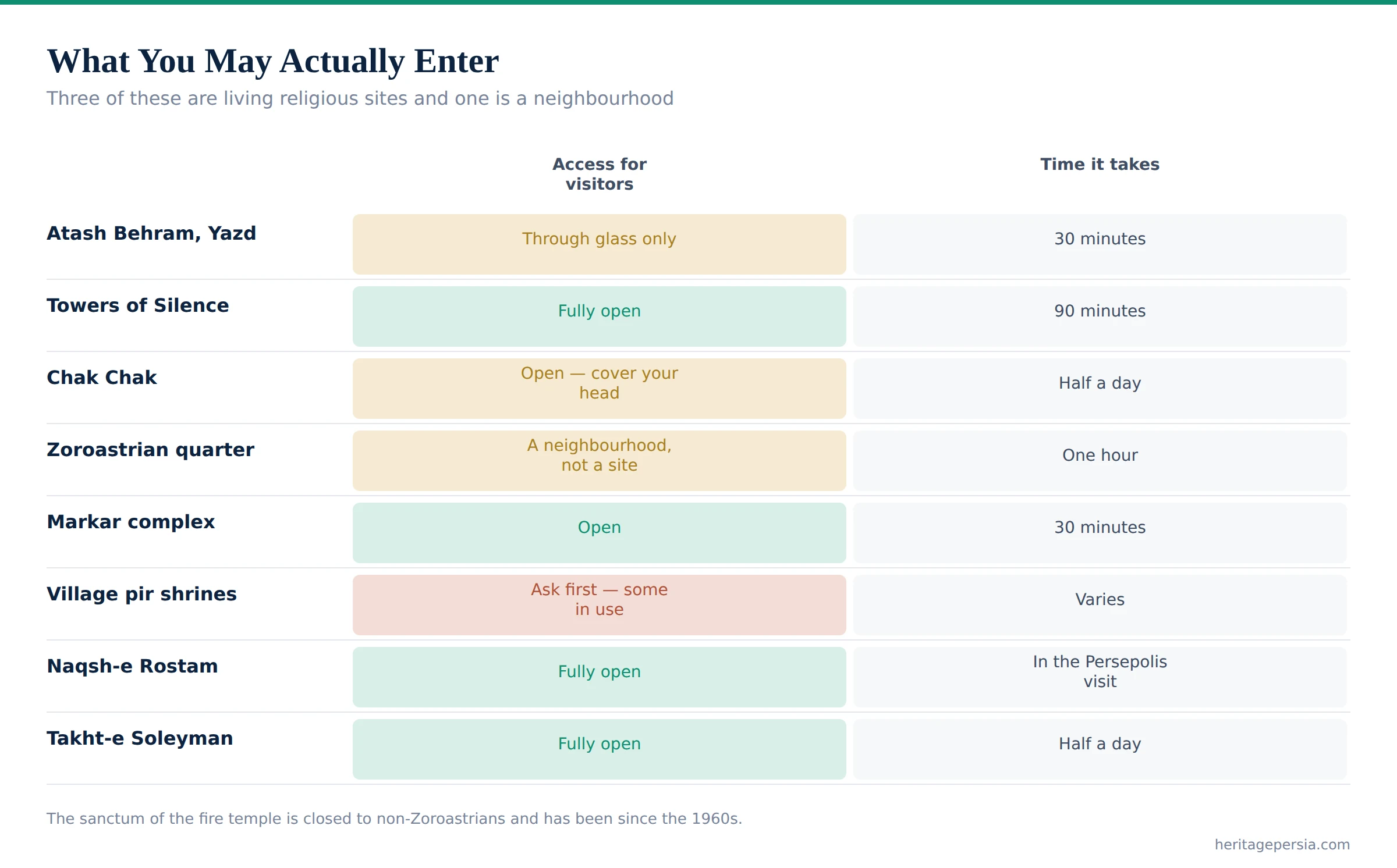
The last column is the one that matters and the one no other guide gives you.
| Site | Where | Time | What it is | Access |
|---|---|---|---|---|
| Atash Behram the fire temple | Yazd, in the city | 30 min | One of nine Atash Behrams in the world and the only highest-grade fire in Iran. The building dates from 1934 | Open, with a limit. Non-Zoroastrians view the fire through glass; the sanctum is closed to visitors |
| Towers of Silence dakhma | Yazd, southern edge | 90 min | Two hilltop towers where excarnation was practised. Closed as a burial site since 1966–67 | Fully open. Heritage rather than religious use. The climb is short and steep |
| Chak Chak Pir-e Sabz | 72 km north-west of Yazd | Half a day | A shrine built into a cliff around a spring, and the most important Zoroastrian pilgrimage site in Iran | Open, but it is a shrine. Cover your head, remove shoes at the sanctuary, and do not photograph inside |
| Zoroastrian quarter | Yazd, around the temple | 1 hr | A living neighbourhood with its own school, hall and cemetery | A neighbourhood. Walk it; do not treat courtyards as exhibits |
| Markar complex | Yazd | 30 min | A clock tower, school and orphanage endowed by Parsi philanthropy from India | Open |
| Cheshmeh Sabz & village shrines | Around Yazd and Kerman | Varies | Smaller pir shrines, each with its own pilgrimage date | Ask first. Several are in use and some are not open to visitors |
| Naqsh-e Rostam reliefs | Near Persepolis | In the site visit | Sassanid investiture scenes showing Ahura Mazda handing the ring of kingship to the king | Fully open. Archaeology, not religion |
| Takht-e Soleyman | West Azerbaijan, far north-west | Half a day | UNESCO-inscribed Sassanid fire sanctuary around a crater lake. The grandest Zoroastrian site in Iran | Fully open. A genuine detour — not near anything else |
The rule of thumb: anything Sassanid or earlier is archaeology and entirely open; anything still in use has limits, and the limits are about ritual purity rather than about you. Asking is never resented and is often answered with an invitation.
The Fire, and Why It Is Behind Glass
The fire in the Yazd Atash Behram was, by tradition, first consecrated around 470 AD and has been kept burning ever since — moved between locations over fifteen centuries, including a long period at Pars Karyan, and finally installed in the present building in Yazd.
Atash Behram is the highest of the three grades of Zoroastrian ritual fire. Consecrating one is an enormous undertaking involving the ritual purification and combination of fires gathered from many sources, which is why there are only nine in the world — eight in India and this one in Iran. A priest tends it with sandalwood five times a day and has done so, in unbroken succession, for longer than most countries have existed.
The building around it is much younger than the flame. It was completed in 1934, funded by the Parsi Zoroastrian community of Bombay — the descendants of Iranian Zoroastrians who emigrated to India after the Arab conquest, returning wealth to the community they had left twelve centuries earlier. That relationship is a thread running through modern Zoroastrian Iran and explains several of the buildings on this page.
Visitors have been admitted since the 1960s and view the fire through a glass screen from an anteroom. The sanctum itself is closed to non-Zoroastrians. This is not a tourist restriction but a purity rule of long standing, and it is worth understanding rather than resenting: you are being shown something that is not, in the ordinary sense, on display.
The Towers of Silence
Two bare hills on the southern edge of Yazd, each with a circular walled tower on the summit, and a scatter of small buildings at the foot where families waited.
The logic is consistent with everything else in the religion. Earth, fire and water are sacred elements and a corpse is polluting, so burial would defile the earth and cremation the fire. Excarnation solved it: the body was carried to the tower and exposed within a stone enclosure for the vultures, and the bones — cleaned and dried — were afterwards placed in an ossuary pit at the centre. Within the tower the placement was ordered, with men in the outer ring, women in the middle and children innermost. Archaeological evidence for the practice in Iran runs back to the fourth and fifth centuries BC.
It ended in 1966–67, when the practice was prohibited, and no body has been placed in the Yazd towers since. Iranian Zoroastrians now bury their dead in concrete-lined graves, which keeps the body from contact with the earth and resolves the same theological problem a different way. The cemetery is beside the towers and is in current use.
What that means for a visit is straightforward: the towers themselves are heritage and you may climb them, and the cemetery below is not. The climb is short, steep and completely exposed, and the view over Yazd from the top is one of the best in the city. Go at the end of the afternoon.
Chak Chak
Seventy-two kilometres north-west of Yazd, a shrine is built into a cliff face high above an empty plain, around a spring that drips continuously from the rock. Chak chak is the sound of the dripping.
The tradition attached to it is that Nikbanou, a daughter of the last Sassanid king Yazdegerd III, fled here during the Arab conquest and prayed to be delivered; the mountain opened and took her in, and the spring is the rock weeping for her. The shrine is the most important Zoroastrian pilgrimage site in Iran and the annual pilgrimage falls in mid-June, when Zoroastrians come from across the country and from India.
Practically: it is a two-hour drive each way from Yazd across genuinely empty country, and the last stretch is a climb of a few hundred steps to the sanctuary. There is a bronze door, a great plane tree growing from the rock, and a small enclosed room with the spring. Cover your head, take your shoes off at the threshold, and do not photograph the interior. If you arrive during the June pilgrimage you will find several thousand people there and should probably not — that is their week rather than a visitor attraction.
Combine it properly. Chak Chak sits on the road that also passes Kharanaq, an abandoned mud-brick village with a shaking minaret, and Meybod with its Sassanid-era caravanserai, ice house and pigeon tower. All three make one very good day out of Yazd, and doing Chak Chak alone wastes the drive.
The Community Today
There is one, it is small, and it is concentrated in Yazd, Kerman and Tehran. Census figures put Iran’s Zoroastrian population in the region of twenty-five thousand, with a larger diaspora — the Parsis of India, who left after the Arab conquest, and more recent emigration to North America and Australia.
Zoroastrians are one of the recognised religious minorities in the Iranian constitution, with a reserved seat in parliament alongside Jews, Armenian Christians and Assyrian Christians. In Yazd the community is visible in a way it is not elsewhere: a school, a hall, the cemetery, businesses, and a quarter around the fire temple where families have lived for generations.
What a visitor should take from that is a matter of tone rather than information. The sites on this page are not the remains of a vanished religion; they belong to people who live beside them. Ask before photographing anyone, do not treat the quarter as an open-air museum, and accept that some doors are closed for reasons that have nothing to do with tourism.
What Survived Into Ordinary Iranian Life
This is the part that surprises visitors most, because a great deal of Zoroastrian practice did not disappear at the conquest — it became Iranian rather than religious.
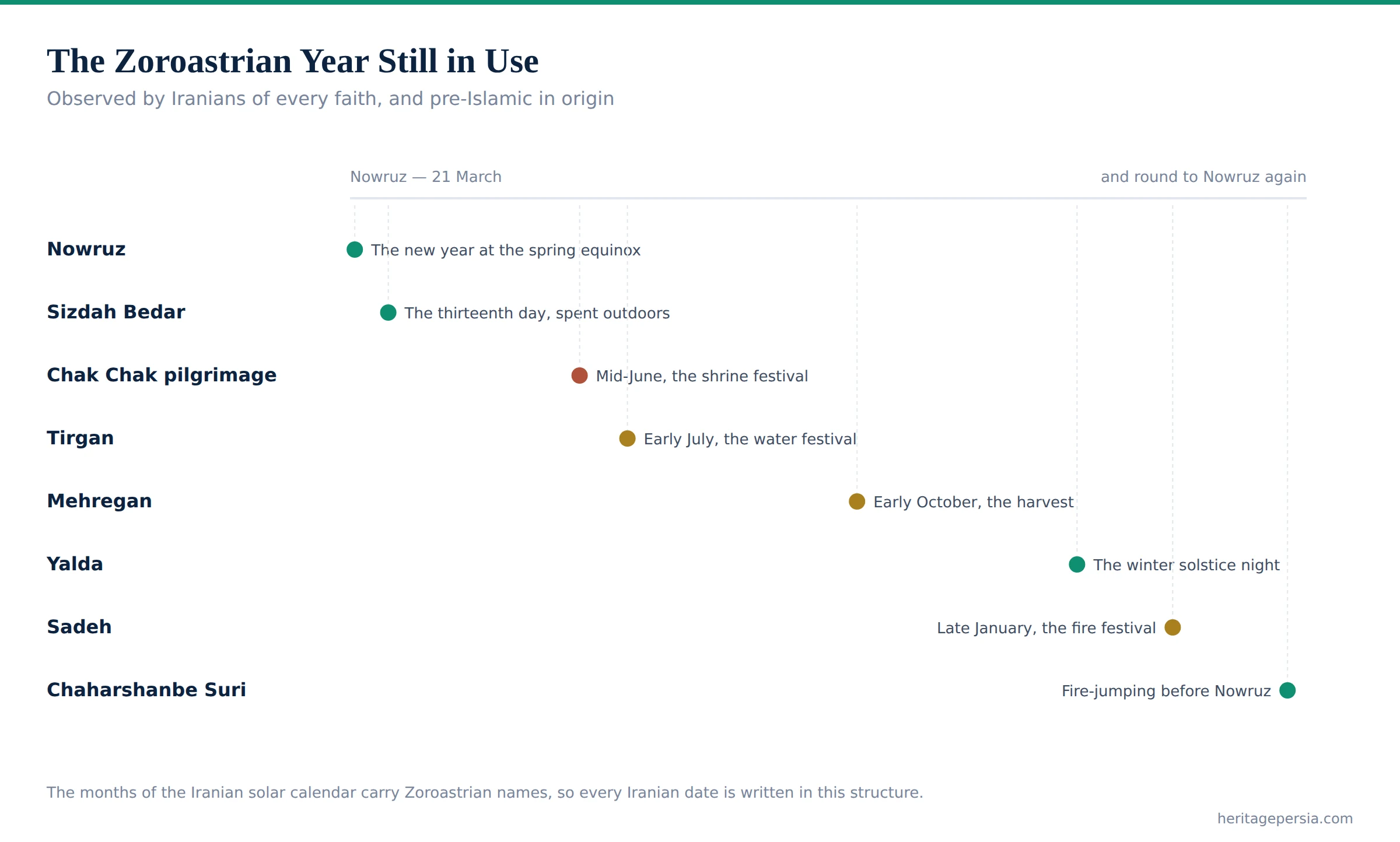
Nowruz, the new year at the spring equinox, is the largest example. It is the central festival of the Iranian year, observed by everyone regardless of faith, and it is pre-Islamic in origin. Our Nowruz guide covers the fortnight in detail.
Chaharshanbe Suri, the fire-jumping on the last Tuesday night before Nowruz, is the most obviously Zoroastrian survival of all — people leap over bonfires calling on the fire to take their pallor and give them its red.
Yalda, the winter solstice night with pomegranates and Hafez, marks the turn of the sun — the same solar logic, and covered in our winter guide.
Sadeh and Mehregan are fire and harvest festivals still observed by the Zoroastrian community and, in a diminished form, more widely.
And the calendar itself. The Iranian solar year begins at the vernal equinox and its months carry Zoroastrian names — Farvardin, Ordibehesht, Khordad — which are the names of divine attributes. Every date on every Iranian document is written in a calendar whose structure is Zoroastrian.
How to Fit It Into a Trip
Yazd does most of it. The fire temple, the Towers of Silence and the quarter are all inside the city and take half a day between them. Every standard ten-day route already stops in Yazd for two nights, so this costs you nothing but an afternoon.
Chak Chak is the addition worth making, as a full day with Kharanaq and Meybod. That needs a third night in Yazd, which is the single change we would make to a standard itinerary for a traveller interested in this subject.
Takht-e Soleyman is a different trip. It is in the far north-west and belongs with a Tabriz leg rather than with Yazd — on a fourteen-day route with the northwest attached, it fits well.
Season: October to April for Yazd and the desert drives, exactly as for everything else in that part of the country. The June pilgrimage at Chak Chak falls in the month we would otherwise tell you to avoid, which is a genuine trade-off rather than an oversight.
✉️ Interested in Zoroastrian Iran specifically? Tell us and we will add the third Yazd night, arrange the Chak Chak day properly, and find you a guide from the community rather than one who has read about it. Talk to our team →
Continue reading
Frequently Asked Questions
What travellers ask our guides, answered on the ground.
A Zoroastrian Itinerary
Tell us and we will add the third Yazd night, arrange Chak Chak properly and find a guide from the community.
See Our Routes →