
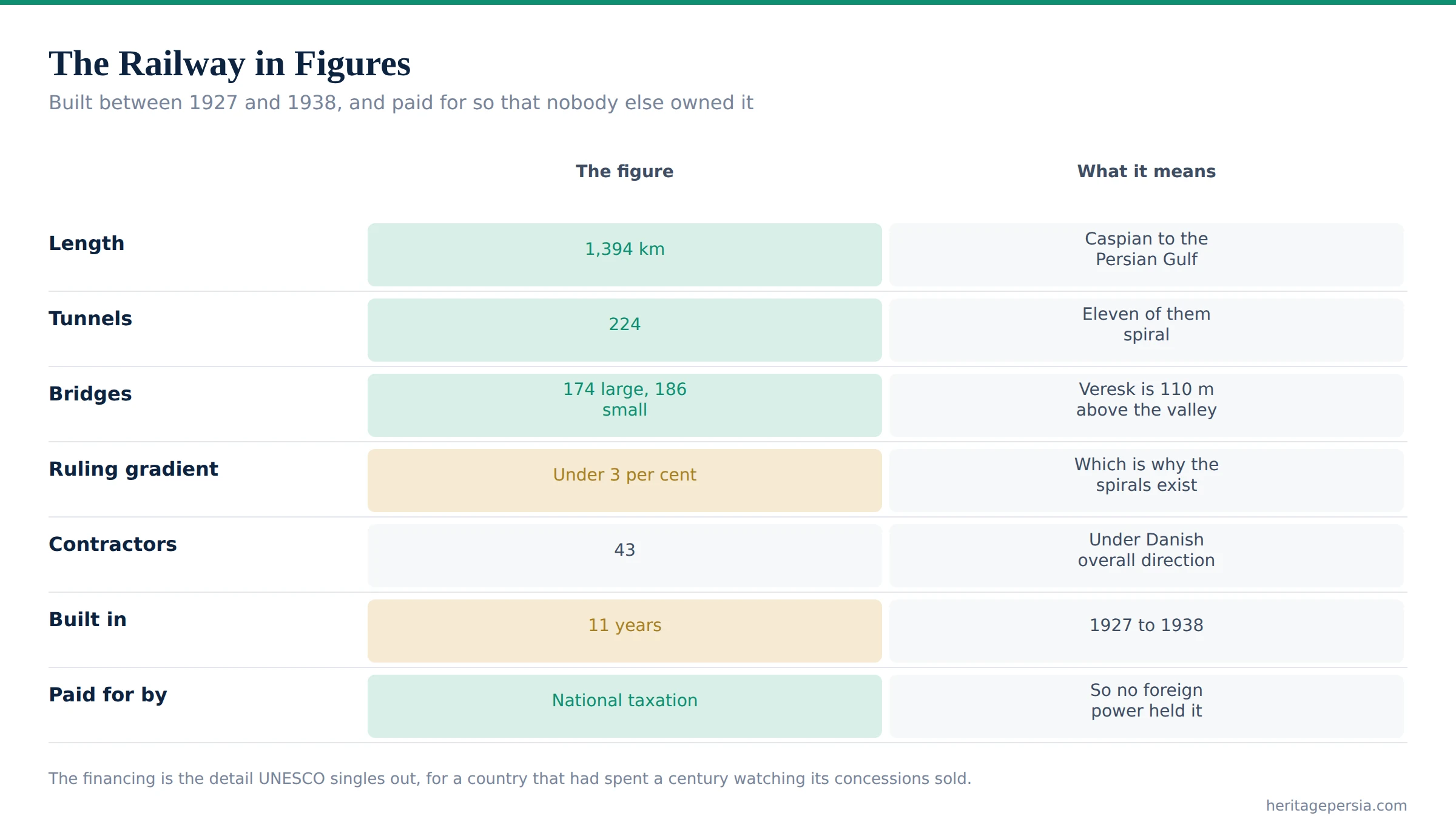
Of Iran’s thirty World Heritage properties, twenty-nine are places you travel to and look at. One is a railway that still runs, and you travel through it — 1,394 kilometres from the Caspian to the Persian Gulf, across two mountain ranges, through 224 tunnels including eleven that spiral inside the rock to gain height.
UNESCO inscribed it in 2021. It remains the least-understood Iranian site on the list, partly because nobody explains which bit is the interesting bit or how to get on it. That is what this page is for.
Before you plan anything: this is a destination guide, written to be useful whenever you are able to use it. Whether to travel to Iran at present is a separate question with a different answer — see our current situation report, reviewed 12 September 2026.
What Was Actually Built
The line runs from Bandar Torkaman on the Caspian to Bandar Imam Khomeini on the Persian Gulf, by way of Tehran, Qom and Ahvaz. Between those two seas it crosses the Alborz in the north and the Zagros in the south, and passes through four distinct climatic zones on the way.
It was built between 1927 and 1938 — eleven years — with forty-three contractors from a string of countries working under Danish overall direction. The engineering numbers are the striking part: 224 tunnels, 174 large bridges and 186 smaller ones, and gradients held below three per cent across mountains that did not want to cooperate.
The detail UNESCO singles out is financial rather than technical. The railway was paid for out of national taxation specifically so that no foreign power would hold the debt, and therefore the leverage, over it. For a country that had spent the previous century watching its concessions sold, that decision was the point of the project as much as the track was.
The Spiral Tunnels, and Why They Exist
A train cannot climb a mountain the way a road can, because steel wheels on steel rail lose grip at gradients a car would not notice. Three per cent is already steep for a railway. The Alborz rises far faster than that.
The answer is to make the track longer than the distance. A spiral tunnel turns a full circle inside the mountain, crossing over or under its own alignment, so the line gains height while the map barely moves. There are eleven of them on this railway, and on the northern climb there are places where you can see track above you and track below you that your own train has been on, or is about to be.
The famous piece of it is the Veresk bridge in Mazandaran: a single arch of a sixty-six-metre span, standing a hundred and ten metres above the valley floor, built without steel in the structure. It was designed by an Austrian engineer and completed in the 1930s, and it is the image on every article about this railway including, at this point, ours.
Which Section to Ride
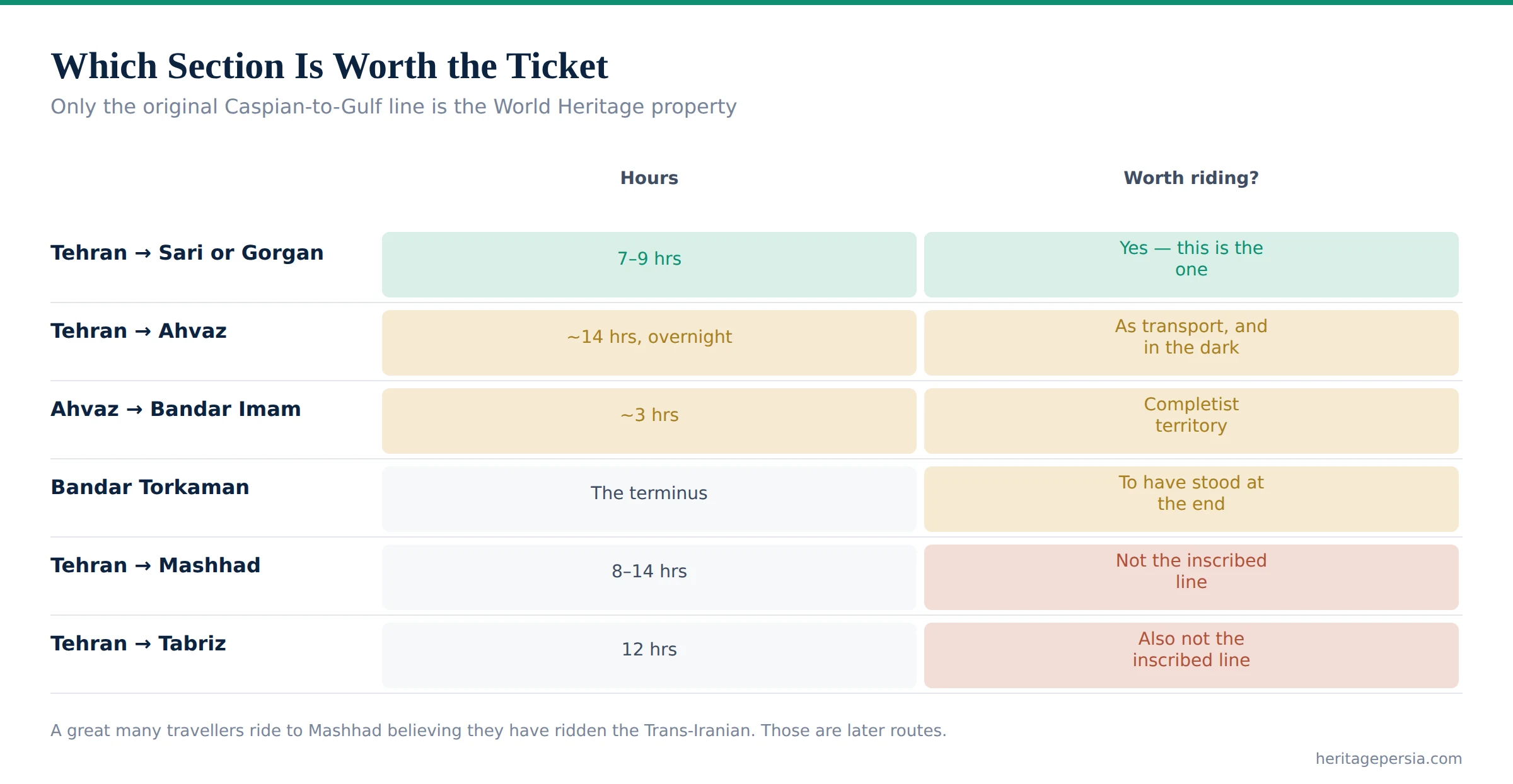
You do not ride 1,394 kilometres for pleasure, and almost nobody does it end to end. These are the sections that are worth a ticket, in order.
| Section | What you see | Time | Verdict |
|---|---|---|---|
| Tehran → Sari or Gorgan the northern climb | The Alborz crossing: spiral tunnels, the Veresk bridge, forest on the far side | 7–9 hrs | This is the one. The engineering and the scenery are on the same stretch |
| Tehran → Ahvaz | The southern descent through the Zagros into Khuzestan | ~14 hrs, overnight | Good, and mostly in the dark. Take it as transport to Khuzestan rather than as sightseeing |
| Ahvaz → Bandar Imam | The final run to the Gulf terminal | ~3 hrs | Completist territory. The landscape is flat and hot |
| Bandar Torkaman | The northern terminus on the Caspian | — | A small port town. Worth reaching if you want to have stood at the end |
| Tehran → Tabriz or Mashhad | Good long-distance sleepers on later lines | 12–14 hrs | Not the inscribed railway. Excellent trains, different heritage |
The distinction in the last row catches people out. Iran has a large rail network and only this one line is the World Heritage property — the Mashhad and Tabriz services are newer routes, and riding them is not riding the Trans-Iranian.
What the Ride Is Actually Like
The trains are better than visitors expect. Iranian long-distance stock ranges from four-berth and six-berth sleepers to comfortable seated day trains, and the four-berth compartments on the good services are genuinely pleasant. Our transport guide has fares and comfort by route.
Sit on the correct side and stay awake for the climb. On the northern run the gorge scenery and the spirals occupy a few hours in the middle; the rest is approach and aftermath. Ask your agency which side of the carriage faces the valley on the day.
Food is basic and available. Tea comes round constantly. Bring your own lunch if you care about it.
It is slow, and that is the deal. Seven to nine hours to cover what a car does in four. You are buying the crossing rather than the arrival.
Booking is through an agency against your passport, because no foreign card works on Iranian platforms — the money guide explains why. Book days ahead, not hours.
How It Fits a Trip
As the way into Gilan or Mazandaran. The strongest use: take the northern line from Tehran instead of the road, and arrive in the Caspian provinces having crossed the Alborz properly rather than driven through it.
As the overnight into Khuzestan. Tehran to Ahvaz saves a daylight day and a hotel night, and puts you at the UNESCO sites in the morning.
As a day out from Tehran. Ride north, stay a night, ride back — the least efficient and most enjoyable version.
Not on a ten-day first visit. The classic corridor runs south and this line runs north; our ten-day guide has the arithmetic. It earns its place on a longer trip.
Practical Notes
Book days in advance. Sleepers on popular routes fill, particularly around Nowruz and in high summer.
Ask for the route by name. Agencies book what you ask for; "the northern line to Sari" gets you the crossing, "a train north" may not.
Photography from a moving train is hard here — tunnels, reflections and a schedule you do not control. Look rather than shoot for the spirals; the Veresk bridge is better photographed from the ground at Veresk village if you are driving.
Dress code applies on trains as everywhere public — the clothing guide has the settings.
Mixed and single-sex compartments both exist. Say which you want when booking; families are normally allocated together.
✉️ Want to ride the line? Tell us your dates and which direction you are travelling, and we will book the section that is actually worth the hours. Talk to our team →
Continue reading
Frequently Asked Questions
What travellers ask our guides, answered on the ground.
Want to Ride the Line?
Tell us your dates and direction and we will book the section that is actually worth the hours.
See Rail Journeys →