
Iran has thirty World Heritage Sites — twenty-eight cultural and two natural — which puts it among the most densely inscribed countries on earth and ahead of every other state in the Middle East. The newest, Alamūt Castle and its related fortifications in Qazvin province, was added in 2026. Most lists you will find online still stop at fifteen or twenty-five and are several years out of date.
A complete list is not the same as a useful one. Eleven of the thirty sit on or beside the classic two-week route and you will see them without planning for it. Some of the rest are worth restructuring a trip around. A handful are, honestly, for specialists. This guide gives you all thirty with their inscription years, and then tells you which is which.
Before you plan anything: this is a reference to the sites themselves, written to be useful whenever you are able to use it. Whether to travel to Iran at present is a separate question with a different answer — see our current situation report, reviewed 10 September 2026.
What Thirty Sites Actually Means
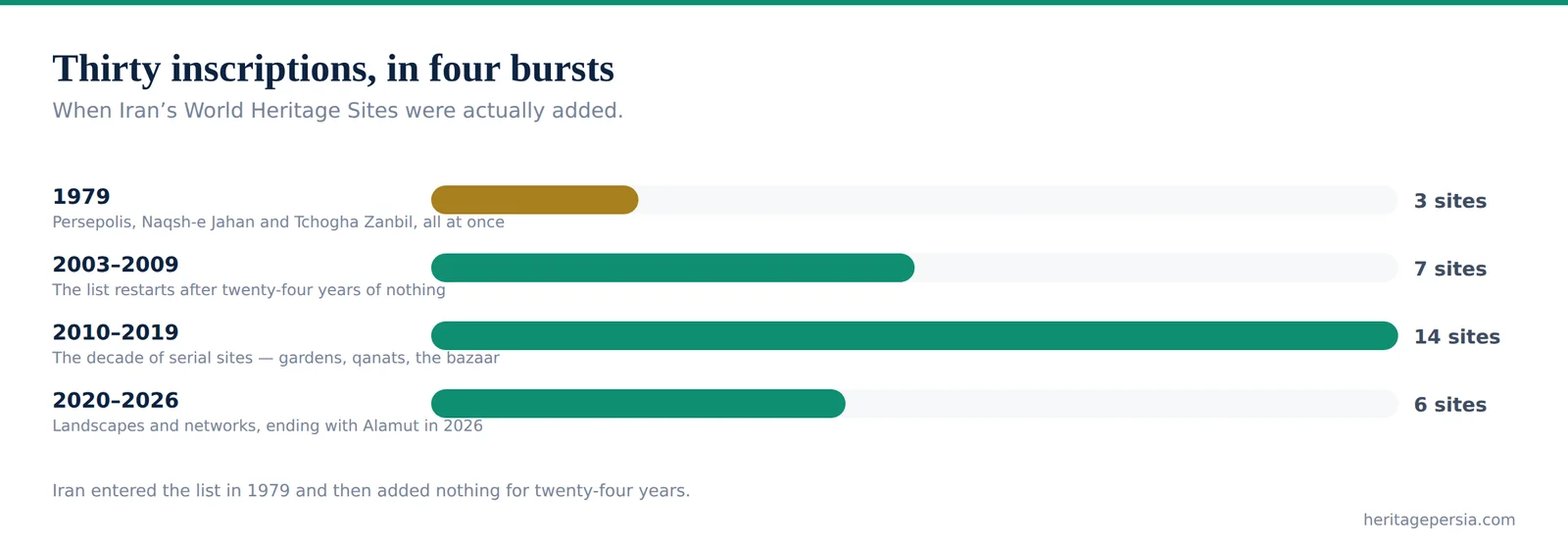
Iran entered the list in 1979 with three inscriptions at once — Persepolis, Naqsh-e Jahan Square and the Elamite ziggurat of Tchogha Zanbil — and then added nothing for twenty-four years. The list restarted in 2003 and has grown almost every year since, which is why so many published guides are stale: a list written in 2019 is missing a third of the country’s sites.
The thirty are not thirty equivalent things. Two are serial inscriptions covering many separate places: the Persian Garden is nine gardens in six provinces, and the Persian Qanat is eleven underground water systems. The Persian Caravanserai, added in 2023, covers fifty-four buildings across twenty-four provinces. So the number of physical places carrying the designation is well over a hundred, and you will pass several without noticing.
Two are natural rather than cultural: the Lut Desert and the Hyrcanian Forests along the Caspian. They are at opposite ends of the country and could not be less alike.
All Thirty, With Dates
In order of inscription. The last column is our honest view of where it belongs in a trip.
| Site | Year | Where | Type | Where it fits |
|---|---|---|---|---|
| Persepolis | 1979 | Fars · Shiraz | Cultural | On the classic route. Unmissable |
| Naqsh-e Jahan Square | 1979 | Isfahan | Cultural | On the classic route. Two days on its own |
| Tchogha Zanbil | 1979 | Khuzestan | Cultural | Detour. The best Elamite ziggurat anywhere |
| Takht-e Soleyman | 2003 | West Azerbaijan | Cultural | Detour from the northwest |
| Pasargadae | 2004 | Fars · Shiraz | Cultural | On the classic route. Cyrus’s tomb |
| Bam and its Cultural Landscape | 2004 | Kerman | Cultural | Second visit. Rebuilt after the 2003 earthquake |
| Soltaniyeh | 2005 | Zanjan | Cultural | Detour. One of the largest brick domes ever built |
| Bisotun | 2006 | Kermanshah | Cultural | Detour west. The Darius inscription |
| Armenian Monastic Ensembles | 2008 | Azerbaijan · Tabriz | Cultural | Second visit, with the northwest |
| Shushtar Hydraulic System | 2009 | Khuzestan | Cultural | Detour. Sassanid engineering, still running |
| Tabriz Historic Bazaar | 2010 | Tabriz | Cultural | Second visit. A working market, not a museum |
| Sheikh Safi al-din Ensemble | 2010 | Ardabil | Cultural | With the northwest |
| The Persian Garden Nine gardens, six provinces | 2011 | Multiple · Kashan | Cultural | On the classic route. Fin, Eram, Chehel Sotoun |
| Masjed-e Jāmé of Isfahan | 2012 | Isfahan | Cultural | On the classic route. Twelve centuries in one building |
| Gonbad-e Qābus | 2012 | Golestan | Cultural | Specialist. A 53-metre brick tower from 1006 |
| Golestan Palace | 2013 | Tehran | Cultural | On the classic route, on your Tehran day |
| Shahr-e Sukhteh | 2014 | Sistan and Baluchestan | Cultural | Specialist. The Burnt City, remote |
| Susa | 2015 | Khuzestan | Cultural | Detour, with Tchogha Zanbil and Shushtar |
| Cultural Landscape of Maymand | 2015 | Kerman | Cultural | Second visit. Rock-cut dwellings, still lived in |
| Lut Desert | 2016 | Kerman | Natural | Second visit. The hottest land surface ever measured |
| The Persian Qanat Eleven systems | 2016 | Multiple · Yazd | Cultural | On the classic route, underneath it |
| Historic City of Yazd | 2017 | Yazd | Cultural | On the classic route. The whole old city |
| Sassanid Landscape in Fars | 2018 | Fars · Shiraz | Cultural | A day from Shiraz. Firuzabad and Sarvestan |
| Hyrcanian Forests | 2019 | Caspian provinces | Natural | Its own trip. Ancient temperate forest |
| Trans-Iranian Railway | 2021 | Caspian to the Gulf | Cultural | Travel on it rather than visit it |
| Cultural Landscape of Hawraman | 2021 | Kurdistan | Cultural | Its own trip. Terraced Kurdish villages |
| The Persian Caravanserai Fifty-four buildings | 2023 | Twenty-four provinces | Cultural | You will pass several. Some are now hotels |
| Hegmataneh | 2024 | Hamadan | Cultural | Detour west. Ancient Ecbatana |
| Khorramabad Valley sites | 2025 | Lorestan | Cultural | Specialist. Palaeolithic caves |
| Alamūt Castle The newest inscription | 2026 | Qazvin | Cultural | Detour from Tehran. The Assassins’ fortress |
Thirty inscriptions covering well over a hundred individual places, because three of them are serial sites. Years are the year of inscription on the World Heritage List, not the age of the thing.
The Eleven You Will See Anyway
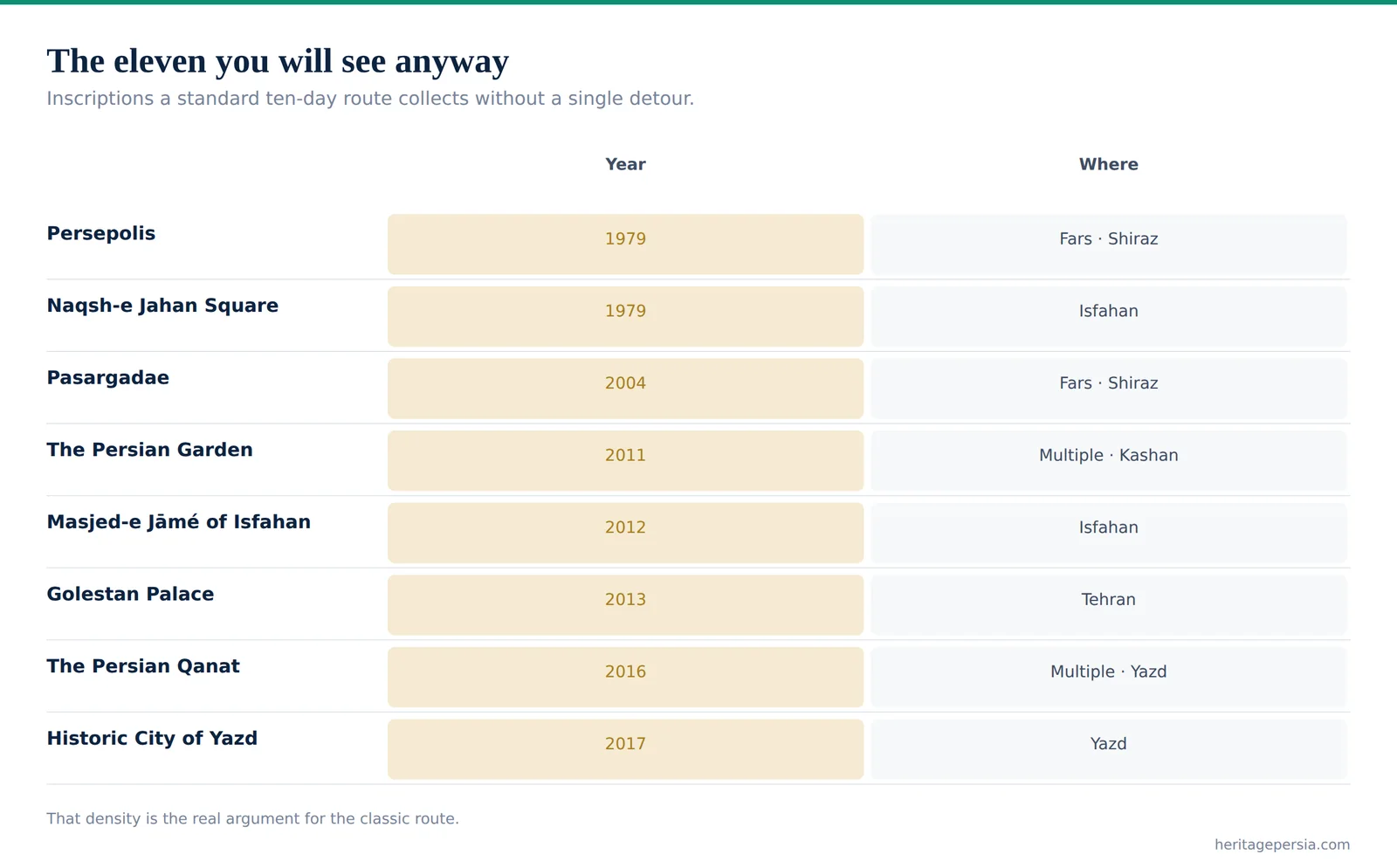
A standard ten-day route through Tehran, Kashan, Isfahan, Yazd and Shiraz collects eleven inscriptions without a single detour: Golestan Palace, a Persian Garden at Fin and another at Eram, Naqsh-e Jahan, the Masjed-e Jāmé of Isfahan, the historic city of Yazd, a qanat system beneath it, Persepolis, Pasargadae, at least one caravanserai on the road, and the Sassanid landscape if you give Shiraz a third day.
That is the argument for the classic route in one sentence. It is not a beginner’s itinerary that you graduate from — it is the densest concentration of World Heritage in the country, and our ten-day plan is built along it for exactly that reason.
The Ones Worth Rearranging For
Khuzestan. Three sites in one province — Tchogha Zanbil, Susa and the Shushtar hydraulic system — and almost nobody goes. Tchogha Zanbil is the best-preserved ziggurat outside Mesopotamia and older than most of what you will have seen; Shushtar is a Sassanid water system of canals, tunnels and mills that is still functioning. Two days from Isfahan or Shiraz, and the single best addition to a two-week trip.
Bisotun and Hegmataneh. West, towards the Iraqi border. Bisotun carries the trilingual inscription Darius cut into a cliff in 520 BC — the text that let scholars decipher cuneiform. Hegmataneh, inscribed in 2024, is the Median capital under modern Hamadan.
Alamūt. Newly inscribed and newly fashionable because of it. The Nizari fortress in the Alborz north of Qazvin, reachable as a long day from Tehran, and the landscape is as much the point as the ruin.
The Kerman group. Bam, Maymand and the Lut are three inscriptions within a couple of hours of each other, which makes Kerman the densest UNESCO stop outside the classic corridor.
The Ones That Need Their Own Trip
Being honest about this saves people from disappointment. Shahr-e Sukhteh is in Sistan and Baluchestan, close to the Afghan border, and is an archaeological site that rewards preparation rather than curiosity. Gonbad-e Qābus is a single extraordinary tower a long way north-east. The Hyrcanian Forests and Hawraman are landscapes rather than monuments and want days, not hours. The Khorramabad Valley caves are a specialist’s pilgrimage.
None of these belongs in a first visit, and any operator who packs them into a fortnight is selling you a coach journey rather than a trip.
The Four Newest, and Why They Were Added
The list has grown by four since 2023 and the additions say something about how the criteria are moving — away from single spectacular monuments and towards systems, landscapes and networks.
The Persian Caravanserai (2023) is fifty-four buildings across twenty-four provinces, inscribed as a network rather than as individual structures — the accommodation layer of the Silk Road. Several have been restored as hotels, so you can sleep inside the inscription.
Hegmataneh (2024) is the Median capital, excavated under the modern city of Hamadan.
The Prehistoric Sites of the Khorramabad Valley (2025) are Palaeolithic cave sites in Lorestan documenting some of the earliest human occupation of the Iranian plateau.
Alamūt Castle and Related Fortifications (2026) is the most recent, and the one with the best story attached — the mountain strongholds of the Nizari Ismailis, dismantled by the Mongols in 1256 and mythologised ever since.
Practical Notes
Tickets. Foreigner pricing applies at almost every site. Budget eight to fifteen euros a day for entries across a normal itinerary, in cash — see the money guide.
Hours and light. Every one of our city guides gives the hour to arrive at each site and why. That matters more at these than anywhere else: Persepolis at midday in June is an endurance exercise, and at eight in the morning it is the reason you came.
Guides. At the archaeological sites in particular, a licensed guide is the difference between looking at stones and reading them. Persepolis, Tchogha Zanbil and Bisotun are close to meaningless without one.
Season. Khuzestan is genuinely brutal from May to September and pleasant in winter, which inverts the usual advice — our month-by-month guide has the figures.
The tentative list. Iran has dozens more sites nominated and awaiting assessment. Expect this number to keep rising, and expect most published lists to keep lagging behind it.
✉️ Want to build a route around the sites rather than the cities? Tell us how many days you have and we will tell you how many inscriptions fit, and which are worth the driving. Talk to our team →
What the Criteria Actually Mean
A site is inscribed against numbered criteria, and knowing which ones were cited tells you what you are looking at. Iran’s list leans heavily on three.
Criterion (i) — a masterpiece of human creative genius — is the rare one, and Naqsh-e Jahan and Persepolis carry it. Criterion (iii), bearing unique testimony to a civilisation, covers most of the archaeological inscriptions: Tchogha Zanbil for the Elamites, Susa and Shahr-e Sukhteh for what came before Persia. Criterion (iv), an outstanding example of a building type or landscape illustrating a stage in human history, is what the Persian Garden, the qanats and the caravanserais were inscribed under — systems rather than single monuments.
The two natural sites use a different set. The Lut was inscribed under criteria (vii) and (viii), for exceptional natural beauty and for being an outstanding record of geological processes; the citation calls its yardang field the best expressed on earth. The Hyrcanian Forests came in under (ix), for ongoing ecological and biological evolution.
This matters practically as well as academically. A site inscribed for its landscape wants different weather, different hours and often a different season from a site inscribed for its architecture — which is why the Lut is an autumn-to-spring proposition and Naqsh-e Jahan is a morning one.
What Is Coming Next
Iran maintains a long tentative list — the queue of sites formally nominated and awaiting assessment — and it runs to dozens of entries. That is why the count has risen almost every year since 2003 and why nearly every published guide to this subject is out of date within eighteen months of being written.
Two practical consequences for a traveller. First, several places you will visit on an ordinary itinerary are candidates rather than inscriptions, and being uninscribed says nothing about whether they are worth your morning — the Zoroastrian fire temple at Yazd and much of Kerman’s old city are cases in point. Second, if the designation genuinely matters to you, check the current list before you fix a route rather than trusting a number, including this one: we date this page for exactly that reason and review it when the committee meets.
Continue reading
Frequently Asked Questions
What travellers ask our guides, answered on the ground.
A Route Built on the Sites
Tell us your days and we will tell you how many inscriptions fit, and which are worth the driving.
See the Routes →