
Taarof is a system of ritual courtesy in which the first offer is made to be declined and the first refusal is made to be overcome. That sentence is the whole of it, and it is also not remotely enough, because the useful question is never what taarof is but what is happening in the specific exchange you are standing in.
So this page is built as situations rather than as an essay. What the person actually means, what the correct move is, and how to tell the ritual from the sincere — which is the only distinction that matters and the one most explanations skip.
Before you plan anything: this is a culture guide, written to be useful whenever you are able to use it. Whether to travel to Iran at present is a separate question with a different answer — see our current situation report, reviewed 10 September 2026.
The Three-Exchange Rule
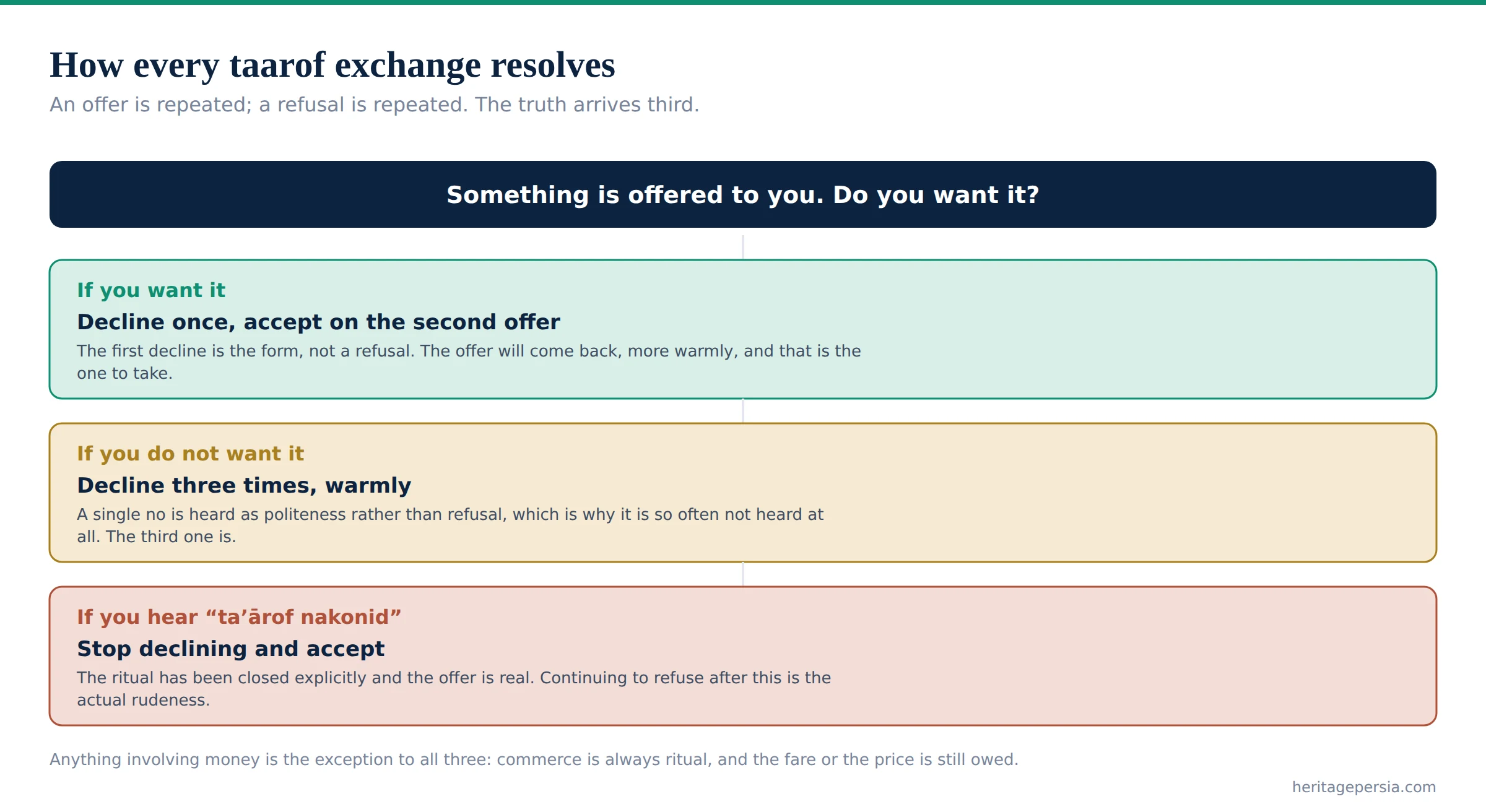
Almost every taarof exchange follows the same shape, and once you can see it you can navigate the ones you have never met before.
First exchange — the form. An offer is made that is not yet a real offer, or a refusal is given that is not yet a real refusal. Nothing has been decided. The purpose is to establish that the other person is generous and that you are not grasping.
Second exchange — the test. The offer is repeated, more warmly. If it is repeated with any energy, it is probably real. If it evaporates, it was form, and no harm has been done to anyone.
Third exchange — the truth. What survives here is what was meant. An invitation pressed a third time is genuine. A refusal held a third time is genuine. This is the point at which you decide.
Two practical rules fall out of that shape, and between them they cover most of what a visitor needs.
Accepting something you want: decline once, accept on the second offer. Declining something you do not want: decline three times, warmly. A single no reads as politeness rather than refusal, which is why the first no is so often not heard.
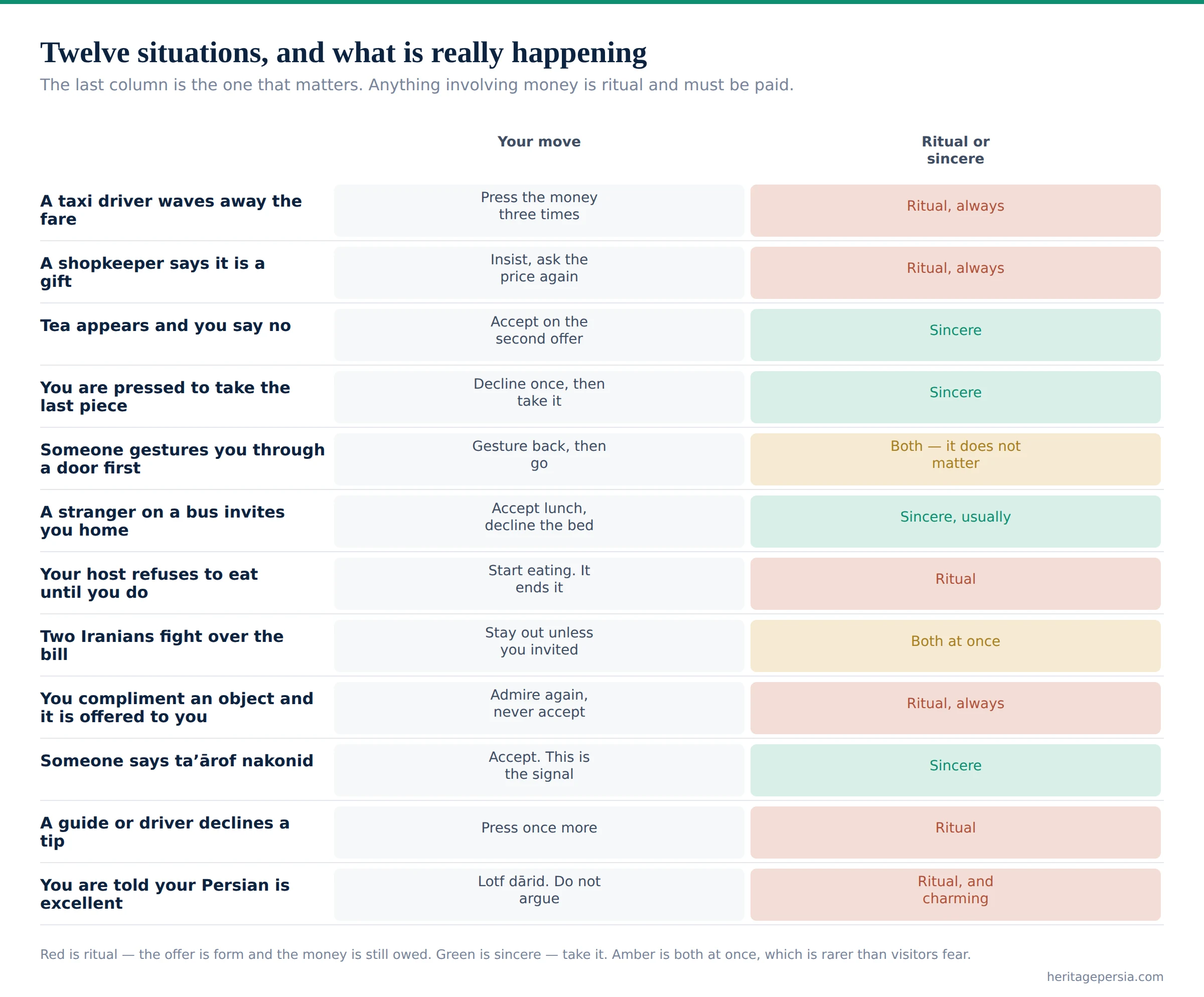
Twelve Situations, and What Is Actually Happening
These are the exchanges our travellers actually meet, ordered roughly by how early in a trip they occur.
| The situation | What is happening | Your move | Ritual or sincere |
|---|---|---|---|
| A taxi driver waves away the fare | A formal refusal that is not a refusal. He expects to be paid and has a family to feed | Say khāhesh mikonam, then press the money a second and a third time | Ritual, always |
| A shopkeeper says it is a gift | The same move, and the price is coming next | Smile, insist, ask the price again | Ritual, always |
| Tea appears and you say no | It will be offered again. Refusing tea is nearly impossible and rarely worth trying | Accept on the second offer. It is free, it is good, and it is the social unit of the country | Sincere |
| You are pressed to take the last piece | Your host will refuse it themselves regardless of whether they want it | Decline once. If pressed twice, take it — refusing a third time reads as rejecting the host | Sincere |
| Someone gestures you through a door first | Befarmāid. The lowest-stakes taarof there is | A brief gesture back, then go. Do not turn it into a negotiation | Both, and it does not matter |
| A stranger on a bus invites you home | Usually entirely real. Iranian hospitality to visitors is not a performance | Accept lunch or tea if you want to. Decline overnight stays — registration rules make it a problem for the host | Sincere, usually |
| Your host refuses to eat until you do | Ritual precedence. Nobody is going hungry | Start eating. It ends the standoff and is what they want | Ritual |
| Two Iranians fight over the bill | A real contest with real stakes, conducted as theatre | Stay out of it unless you are the host. If you invited, fight hard and win | Both at once |
| You compliment an object and it is offered to you | Pishkesh — the object is now formally yours and is absolutely not | Admire it again and decline warmly. Never accept | Ritual, always |
| Someone says ta’ārof nakonid | The ritual is being closed explicitly. This is the signal | Accept. Continuing to decline after this is the actual rudeness | Sincere |
| A guide or driver declines a tip | Form. Tipping is normal and expected | Press it once more and it will be taken | Ritual |
| You are told your Persian is excellent | You said four words. It is generosity, not assessment | Lotf dārid — you are kind. Do not agree and do not argue | Ritual, and charming |
Notice the pattern in the last column. Anything involving money is ritual and must be paid; anything involving hospitality in a home is usually sincere and can be accepted. That single heuristic resolves most cases correctly.
The Mistake Almost Every English Guide Makes
Search for taarof in English and you will find the phrase ghābeli nadāre translated as “it’s free” or “take it, it’s nothing”. That gloss is wrong, and it is wrong in the direction that costs a traveller money and a shopkeeper his afternoon.
What it means is closer to “it is not worthy of you” — a statement about the smallness of the thing relative to the guest rather than about the price. It is the formal language of refusing payment, and refusing payment is a move in a sequence rather than a decision. The correct reply is khāhesh mikonam and then the money, offered again.
We had the same error on this blog until recently, in a sentence advising visitors to say ghābeli nadāre back to the shopkeeper. An Iranian would not say that; it is the seller’s line, not the buyer’s. We corrected it, and mention it here because the error is common enough that you will meet it elsewhere.
How to Tell Sincere From Ritual
There is no single tell, but there are four reliable signals, and they agree with each other more often than not.
Repetition with detail. A ritual offer is generic and repeats itself unchanged. A sincere one acquires specifics — a day, a time, a dish they will cook, a person they want you to meet. Detail is the strongest signal there is.
Who bears the cost. Offers that cost the offerer nothing are usually sincere; offers that would cost them their day’s takings are usually form. This is why a fare waived by a driver is ritual and an invitation to lunch by a family is not.
The explicit release. Ta’ārof nakonid — do not taarof — closes the ritual and means the offer is real. So does jeddi migam, I am being serious. When either appears, stop declining.
Setting. Commerce is ritual; home is sincere. A bazaar, a taxi and a restaurant bill are performances with a known ending. A living room usually is not.
Taarof and Money
This is where a visitor can actually go wrong, so it deserves its own section rather than a line.
Iran is a cash economy — no foreign card works anywhere in the country, which our money guide covers in full — and that changes the texture of every payment. Money is counted out by hand, in notes, in front of the person receiving it, which is precisely the moment taarof appears.
The rule is simple and has no exceptions: a refusal of payment in a commercial setting is never a refusal of payment. The taxi driver who waves you away, the shopkeeper who calls the carpet a gift, the guide who says it was his pleasure — all of them are paid, every day, by Iranians who perform the identical exchange and then hand over the money.
What a visitor should do is press three times, warmly, and not treat it as awkward. If it helps, remember that failing to pay is not generous to anyone: it embarrasses the person who cannot now ask, and it teaches the next foreigner the wrong lesson.
The one genuine exception is a private host. A family that feeds you in their home is not conducting commerce and will be offended by cash. Bring flowers, sweets from a good confectioner, or something from your own country instead.
If You Are Invited Home
Take the invitation. It is the part of Iran that no monument competes with, and our travellers who have been inside an Iranian home talk about that afternoon for years afterwards.
A few things make it go well. Bring something — pastries, fruit or flowers, and hand it over with a deflecting phrase rather than a presentation. Take your shoes off at the door without being asked. Accept the tea, always, and the second glass too. Eat more than you think you should, because the quantity cooked is a statement and leaving it untouched answers it badly. And say dast-e shomā dard nakone — may your hand not ache — to whoever cooked, which is the phrase for exactly this and lands every time.
When you leave, expect to be pressed to stay, twice. Expect leftovers to be packed for you. And expect the invitation to be renewed for tomorrow, which is the point at which a polite triple refusal is genuinely needed if your itinerary has other plans. The phrasebook has the words for all of this.
Should You Do Taarof Yourself?
A little, and badly, and that is fine.
Nobody expects a foreign visitor to perform the system fluently, and attempting the elaborate version reads as parody rather than politeness. What is worth doing is the minimum that shows you understand the shape: offering first, insisting twice, deflecting a compliment rather than accepting it, and reaching for the bill even when you expect to lose.
Three phrases carry almost all of it. Befarmāid — after you, please, help yourself. Khāhesh mikonam — please, don’t mention it, and the polite way to insist. Lotf dārid — you are kind, which is the correct answer to any compliment you do not deserve. Say those three at the right moments and you are doing taarof adequately.
What you should not do is out-taarof an Iranian. You will lose, it takes time neither of you has, and the warmth you are trying to return is better expressed by accepting gracefully than by refusing at length.
What Taarof Is Not
It is not deceit, and describing it as such misreads what everyone in the room knows. Both parties understand the form; nothing is concealed and nobody is deceived. It is closer to the English habit of saying “we must have dinner sometime” — a statement of goodwill in a fixed phrase — except that Iranian practice is more elaborate, more consistent, and more likely to turn out to have been sincere.
It is not only politeness either. Taarof does real social work: it establishes relative status, gives both parties room to retreat without loss of face, and converts transactions into relationships. A society that runs on personal connection needs a protocol for opening one, and this is it.
And it is not universally loved. Iranians complain about taarof constantly — about the time it takes, about the ambiguity, about younger people abandoning it and older people insisting on it. If you find it exhausting by the second week, you are having a common Iranian experience rather than failing to appreciate the culture.
The most useful attitude is the one most Iranians take: treat it as a courtesy with known rules, play the first two moves properly, and get to the real answer on the third.
✉️ Worried about getting it wrong? Every one of our guides will tell you in the moment whether an offer is form or real — it is one of the quietly useful things a local guide does. Talk to our team →
Continue reading
Frequently Asked Questions
What travellers ask our guides, answered on the ground.
Never Sure If It Is Real?
Our guides read the room for you — one of the quietly useful things a local guide does.
See Our Guided Routes →