
The rule that governs a visitor’s Ramadan in Iran is narrower than most people fear and firmer than most people expect. Non-Muslims are not required to fast. Eating, drinking or smoking in public during daylight is a different matter, and it is the one thing to get right.
Everything else — what is open, what a day looks like, whether to come at all — follows from that single distinction, and this page works through it in order. Two calendars run in Iran at once, and Ramadan belongs to the one that moves.
Before you plan anything: this is a cultural guide, written to be useful whenever you are able to use it. Whether to travel to Iran at present is a separate question with a different answer — see our current situation report, reviewed 12 September 2026.
The One Rule
The fast runs from first light to sunset, and observant Muslims take neither food nor water in that window. A non-Muslim visitor is under no obligation to join it and nobody will ask you to.
What is expected is restraint in public. Do not eat, drink or smoke on the street, in a bazaar, on public transport or at a site during daylight hours. This is a matter of law as well as courtesy, and although enforcement against foreigners is rare, the offence people actually take is real and immediate.
The practical translation is simple. Eat in your hotel, in your room, or in a restaurant that is serving. Carry water and drink it out of sight — a parked car, a hotel lobby, a lavatory. Nobody objects to a foreigner who is discreet, and Iranians are, in our experience, more relaxed about this than visitors expect and more offended by open disregard than visitors expect.
The exemptions Iranians themselves use: travellers, the ill, the pregnant, the elderly and children are all exempt from fasting, which is why you will see Iranians eating during the day too. Their exemption is not a licence for public eating either, and they observe the same discretion.
What Is Open, and When
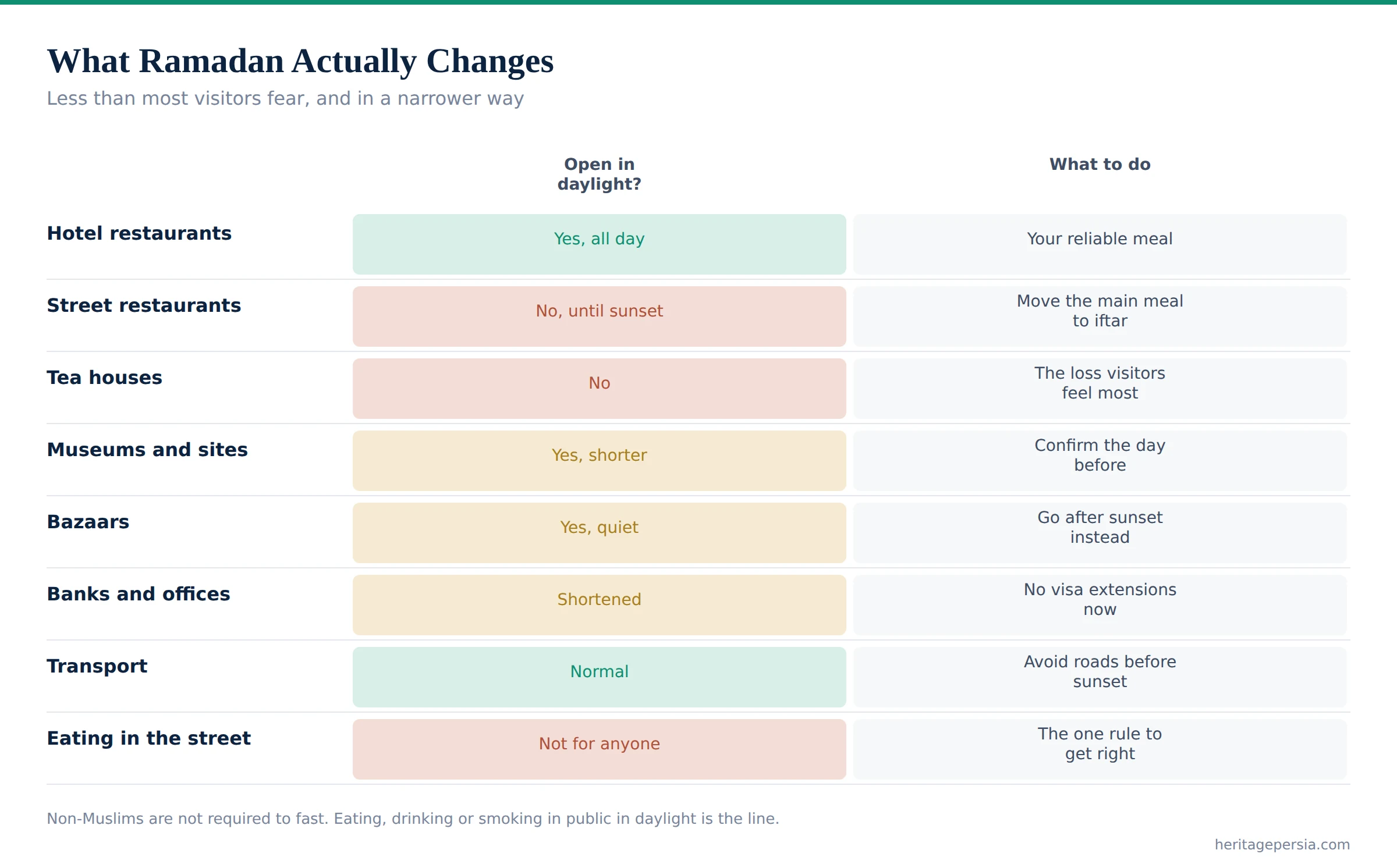
| What | During Ramadan | What to do |
|---|---|---|
| Hotel restaurants | Open, all day | Your reliable meal. Breakfast runs as normal and lunch is usually served to guests |
| Street restaurants and kebab houses | Mostly shut until sunset | They reopen for iftar and then run late. Lunch out is the meal you lose |
| Bakeries and food shops | Open | Selling is permitted; eating on the spot is not. Buy in the morning for the room |
| Tea houses | Shut in daylight | The loss that visitors feel most, because the tea house is where the day usually slows down |
| Museums and historic sites | Open, often shorter | Hours contract, sometimes closing in the early afternoon. Check the day before rather than the week before |
| Bazaars | Open, quieter, shifted late | Mornings are slow and the evening after iftar is the busy, good hour |
| Mosques and shrines | Open and busier | Fuller than usual, particularly at night. Dress expectations are unchanged and the atmosphere is worth seeing |
| Offices and banks | Shortened hours | Anything administrative takes longer. Do not plan a visa extension for this month |
| Long-distance transport | Normal | Trains, buses and flights run. Drivers are fasting, which is worth a thought on a long road day |
| Alcohol | Not available | It is not available in Iran at any time of year, so this changes nothing |
The single scheduling change worth making is to move your main meal to the evening. Iftar at sunset is when the country eats, and a restaurant that was shut at two is full and excellent at seven.
Iftar Is the Reason to Come
If there is an argument for travelling during Ramadan rather than despite it, this is it.
At sunset the fast breaks, and it breaks everywhere at once. Streets that were empty at five are full at seven. Restaurants that were shuttered all day are serving. Families set out food in parks and on the verges of roads, and mosques and charitable foundations distribute meals to anyone who is there, foreigners included.
The food itself is particular to the month: āsh and halim, dates and tea to break the fast, zoolbia and bamieh — sweet fried pastries in syrup — sold from stalls that appear only now. Our food guide covers the year-round map; these are the dishes that are not on it.
Being invited to an iftar is likely rather than possible, and the taarof guide is the page to read before you answer, because the first invitation may be a courtesy and the third is real.
The Dates, and Why They Move
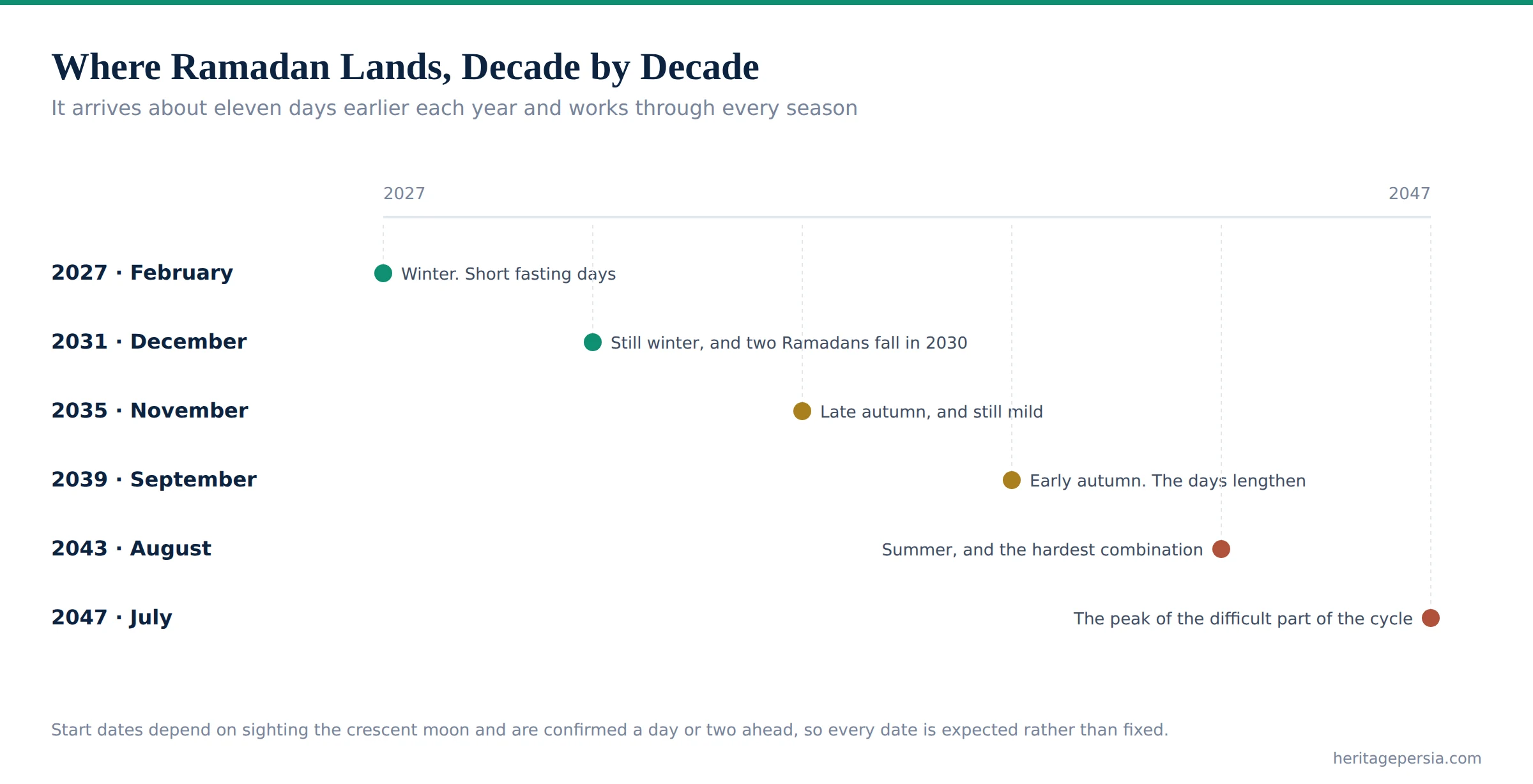
Ramadan follows the Islamic lunar calendar, which is about eleven days shorter than the solar year, so it arrives eleven days earlier each year and works its way through all four seasons over roughly thirty-three years.
| Year | Ramadan begins | Ends, approximately | What else is near it |
|---|---|---|---|
| 2027 | 8 February | 9 March | Eid al-Fitr around 10 March, then Nowruz on 21 March. February and most of March are affected |
| 2028 | 28 January | 26 February | Clear of Nowruz. A winter Ramadan with short fasting days |
| 2029 | Mid-January | Mid-February | The shortest and mildest fasting days of the cycle |
| The 2030s | December, then autumn | — | Two Ramadans fall in 2030 as it crosses the year boundary, then it drifts back through November and September |
| The early 2040s | August, then July | — | Summer again, which is the hardest combination in the calendar — the longest fasting day against the worst heat |
Start dates depend on the sighting of the crescent moon and are confirmed only a day or two ahead, so every date above is expected rather than fixed. Iran occasionally begins a day later than its neighbours for this reason.
The 2027 point is worth drawing out. Ramadan ends on about 9 March and Nowruz begins on 21 March, so a traveller in that window meets a month of shortened hours followed almost immediately by the fortnight in which the entire country is on holiday and rates double. February to late March 2027 is the single most complicated stretch in the Iranian travel calendar for some years.
Should You Come During Ramadan?
Yes, if you want the country rather than the sights. Ramadan is the month in which Iranian social life is most visible to an outsider, and the evenings are extraordinary.
Yes, if you are travelling in winter anyway. A winter Ramadan has a short fasting day — sunset around six — so the disruption is a few hours rather than most of a day.
Probably not on a first visit of under a week. A five-day trip loses its lunches, some of its opening hours and all of its tea houses, which is a large proportion of a short trip. Our short-trip guide is built on hours you will not have.
Not with young children, for the same reason in a sharper form.
Not if it falls in summer, which it will again. A fifteen-hour fast in forty-degree heat is hard on everyone around you and the country slows accordingly.
Practical Notes
Carry water and a packed lunch from breakfast. This solves ninety per cent of the problem, and hotels will make one up if asked the night before.
Book restaurants for iftar. The good ones fill, and they fill at a single moment rather than across an evening.
Expect traffic to be dangerous just before sunset. Everyone is hungry and going home at once. It is the worst twenty minutes of the day to be on a road, and we schedule around it — our transport guide covers driving in general.
Do not congratulate anyone on fasting in the middle of the day. The greeting people use is Ramazan mobārak and it is a greeting rather than a comment on hunger.
Confirm site hours the day before, not the week before. They shorten unpredictably and locally.
✉️ Your dates fall in Ramadan? Tell us when, and we will say what it costs you in hours and what it gives you back in the evenings. Talk to our team →
Continue reading
Frequently Asked Questions
What travellers ask our guides, answered on the ground.
Travelling During Ramadan?
Tell us your dates and we will say what it costs you in hours and what it gives back in the evenings.
Ask a Question →