
Iran is easier than you expect as a vegetarian and harder than you expect as a vegan, and almost every guide to this subject gets both halves slightly wrong. The lists of “vegetarian Persian dishes” you will find elsewhere are largely accurate about the recipes and largely silent about how those dishes are actually cooked in a restaurant, which is where the problem lives.
So this page has two jobs. The first is the list of things you can eat, which is longer and better than the reputation suggests. The second is the list of things that look safe and are not — the rice cooked in meat stock, the soup built on a lamb base, the dairy hiding in the dish everyone recommends to vegetarians.
Before you plan anything: this is a food guide, written to be useful whenever you are able to use it. Whether to travel to Iran at present is a separate question with a different answer — see our current situation report, reviewed 10 September 2026.
The Word Is the Problem
Vegetarianism is not a widely held category in Iran. It exists — Tehran has dedicated vegetarian restaurants and a young urban following — but a waiter in a provincial kebab house has probably never had to think about it, and the English word will not help you.
What does help is being concrete. Bedun-e gusht — without meat — is understood instantly and universally, because it describes an absence rather than an identity. Giyāh-khāram, I am a vegetarian, is correct Persian and is understood in cities, but it is the weaker tool because it invites interpretation and the interpretation is often generous. Chicken is frequently not counted as meat. Nor, in some kitchens, is the stock the rice was cooked in.
The second thing that helps is asking about the method rather than the ingredients. “Does it have meat in it” gets you an honest no about a dish whose base is lamb broth. “What is it cooked with” gets you the truth. Our phrasebook has both phrasings, and writing them on a card is worth more than pronouncing them well.
What to Actually Order
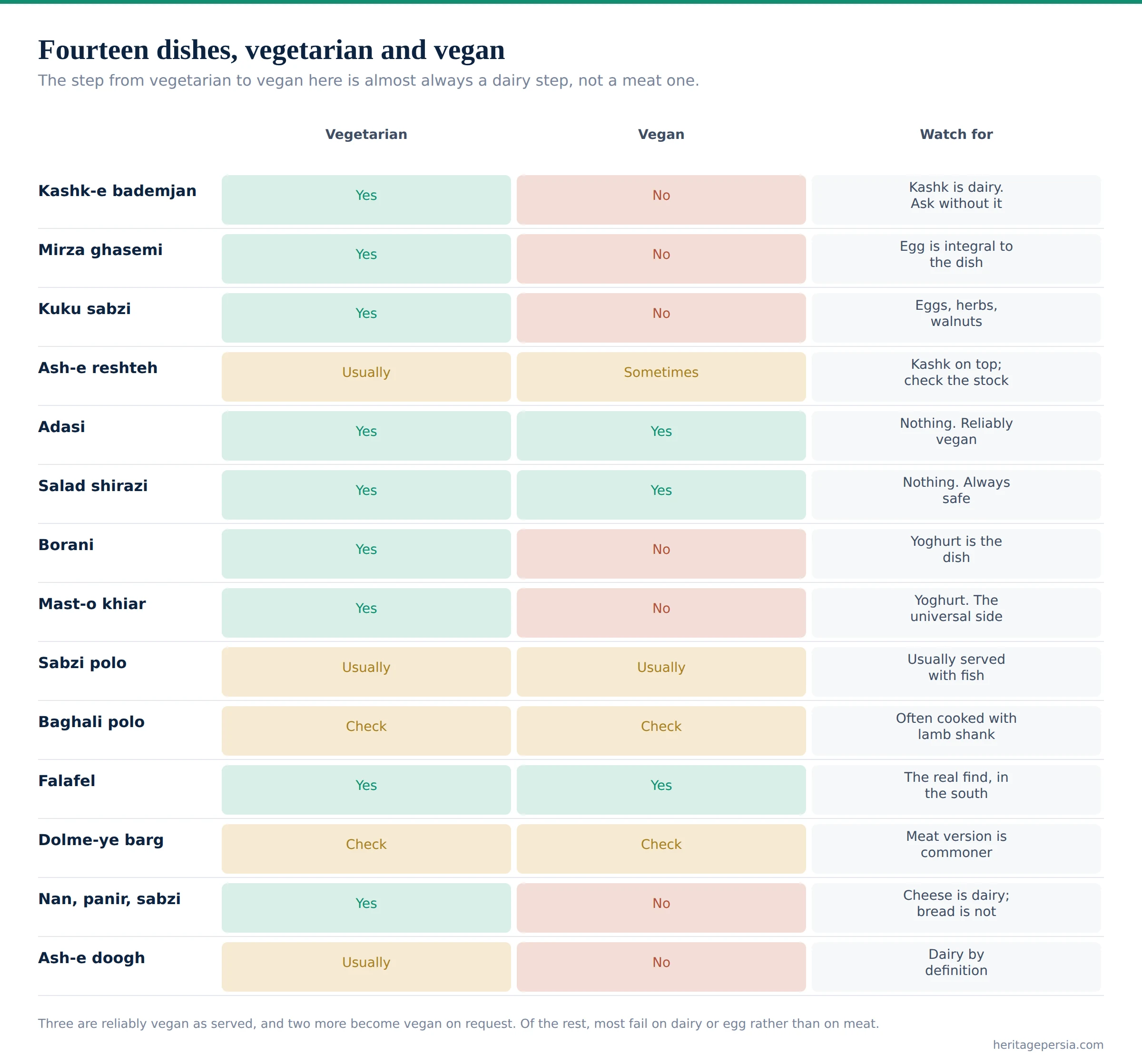
Three columns matter here: whether it is vegetarian as normally served, whether it can be made vegan, and what to watch. This is the table we would hand a traveller.
| Dish | Vegetarian | Vegan | Watch for |
|---|---|---|---|
| Kashk-e bademjan fried aubergine, whey | Yes | No | Kashk is dairy. Ask for it bedun-e kashk and it becomes a good vegan aubergine dish |
| Mirza ghasemi smoked aubergine, garlic, egg | Yes | No | Egg is integral. Gilani, from the Caspian, and one of the best things in the country |
| Kuku sabzi herb frittata | Yes | No | Eggs. Enormous quantities of herbs, walnuts and barberries |
| Ash-e reshteh noodle and legume soup | Usually | Sometimes | Traditionally meat-free, but kashk is spooned on top and some kitchens build it on stock. Ask both questions |
| Adasi lentil stew | Yes | Yes | A breakfast dish in much of the country. Reliably vegan and reliably available |
| Salad shirazi cucumber, tomato, onion, lime | Yes | Yes | Nothing. It is on every table in Iran and it is always safe |
| Borani yoghurt with spinach or beetroot | Yes | No | Yoghurt is the dish. Not adaptable |
| Mast-o khiar yoghurt and cucumber | Yes | No | As above. The universal side dish |
| Sabzi polo herbed rice | Usually | Usually | The rice itself is fine; it is normally served with fish. Order it alone and check the butter |
| Baghali polo rice with broad beans and dill | Check | Check | Vegetarian as a rice, but it is the standard accompaniment to lamb shank and is often cooked with it |
| Falafel southern street food | Yes | Yes | The real find. Ahvaz, Bushehr and the Gulf coast do it properly — see Khuzestan |
| Dolme-ye barg stuffed vine leaves | Check | Check | Exists in both forms and the meat version is more common in restaurants. Always ask |
| Nan, panir, sabzi bread, cheese, herbs | Yes | No | The national breakfast and the national snack. Cheese is dairy; the bread and herb plate alone are vegan |
| Ash-e doogh yoghurt soup | Usually | No | Dairy-based by definition, and meatballs appear in some regional versions |
The pattern worth noticing: the vegetarian options are mostly aubergine, herbs, legumes and dairy, and the step from vegetarian to vegan is almost always a dairy step rather than a meat one. That is the opposite of most cuisines and it is why vegans need to plan here and vegetarians do not.
Where the Meat Hides
This is the section other guides leave out, and it is the one that matters.
Stock. The single biggest issue. Soups, ash, and some rice dishes are built on a base that was made with lamb or chicken, and a kitchen asked whether a dish “has meat” will answer honestly about the visible pieces. The question that works is what the base is made from — bā chi dorost shode?, what is it made with.
Rice. Iranian rice is often finished with butter, and in some kitchens with the fat from the accompanying meat. Plain chelo is normally safe; the flavoured polo dishes are the ones to ask about.
The word for meat. Gusht means red meat to many speakers. Chicken is morgh and fish is māhi, and neither is automatically included when you exclude gusht. Say all three if you mean all three.
Dishes that sound vegetable. Halim bademjan is an aubergine dish with shredded lamb in it. Abgusht, sometimes translated as a bean stew, is mutton and the beans are incidental. Khoresh-e gheymeh is a split-pea stew that is built around meat.
Fasting is not vegetarianism. Iranian religious observance involves fasting from all food during daylight rather than abstaining from meat, so a restaurant that mentions fasting is telling you about its hours rather than its menu. There is no equivalent of the meat-free fasting tradition that exists in some other cultures, and assuming there is leads people astray.
The card that solves it. Write, or have written, a short line in Persian saying you eat no meat, chicken, fish or stock, and show it rather than explain it. Kitchens respond far better to a written request than to a conversation in a language nobody shares, and it removes the chicken ambiguity entirely.
Vegan, Specifically
Workable, but it needs planning, and the reason is dairy rather than meat. Yoghurt, kashk, butter and cheese are structural in Persian cooking in the way olive oil is in Italian, so the vegetarian dishes that are easiest to find are frequently the ones a vegan cannot eat.
What does work reliably: adasi for breakfast, salad shirazi anywhere, plain chelo rice, falafel in the south, aubergine dishes ordered without kashk, bread with the herb plate, and the enormous range of nuts and dried fruit that every bazaar sells. Iranian pistachios, dates, dried mulberries, figs and walnuts are not a fallback so much as one of the best things about the country — our shopping guide covers what to look for.
Two phrases carry it. Bedun-e kashk — without kashk. Bedun-e labaniyāt — without dairy. The first is more useful because it names a specific thing; the second invites a conversation about whether butter counts.
Realistically, a vegan on a two-week trip should expect to eat well in Tehran and the big cities, to eat repetitively in the small towns, and to carry nuts. That is a fair description rather than a discouraging one, and it is a better position than most travellers assume before they arrive.
Where It Is Easiest
| Place | How easy | Why |
|---|---|---|
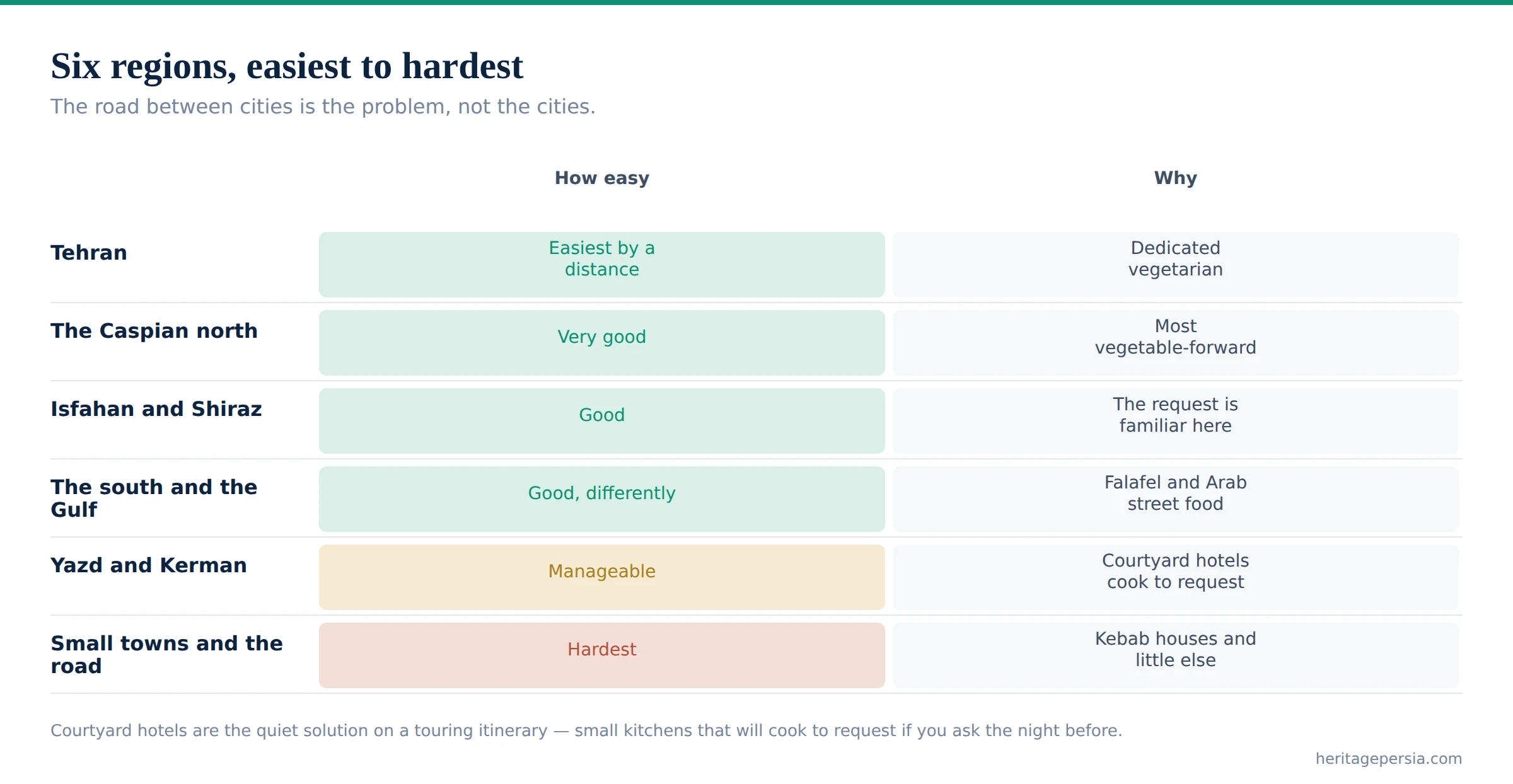
| Tehran | Easiest by a distance | Dedicated vegetarian and vegan restaurants, every regional cuisine in the country, and a young urban clientele that understands the request |
| The Caspian north Gilan, Mazandaran | Very good | The most vegetable-forward cooking in Iran. Mirza ghasemi, garlic, herbs, olives and rice rather than kebab |
| Isfahan and Shiraz | Good | Enough tourist infrastructure that the request is familiar, and good aubergine and herb dishes on most menus |
| The south and the Gulf Ahvaz, Bushehr, Qeshm | Good, differently | Falafel and Arab-influenced street food make this the best region in Iran for a vegan specifically |
| Yazd and Kerman | Manageable | Fewer options, but courtyard hotels will cook to request if you ask the night before |
| Small towns and the road | Hardest | Kebab houses and not much else. This is where the bread, cheese, herbs and nuts strategy earns its place |
Courtyard hotels are the quiet solution on a touring itinerary: they are small, they cook properly, and told the night before they will make you something rather than hand you a salad. The accommodation guide explains why those are worth booking anyway.
The Hospitality Problem
The genuine difficulty is not restaurants. It is being fed in someone’s home, which will happen, and where the food has been cooked for hours specifically for you.
Meat in an Iranian home is a statement of respect for a guest, and declining it can read as declining the gesture rather than the lamb. The way through is to say it early and warmly — before the invitation is accepted if possible, and certainly before anyone starts cooking — and to be enthusiastic about everything else on the table, which will be most of it.
Say it as a fact about you rather than a rule about the food: man gusht nemikhoram, I don’t eat meat. Iranian hosts are practised at accommodating guests and will produce three vegetable dishes without visible effort. What creates awkwardness is discovering it at the table, and our taarof guide explains why declining at that point is harder than it should be.
Practical Notes
Breakfast is solved everywhere. Flatbread, feta, walnuts, honey, jam, cucumber, tomato and tea, with eggs to order in better places. It is the same everywhere in the country and it is naturally meat-free.
The herb plate is free and unlimited. Sabzi khordan — a plate of raw tarragon, basil, mint, radish and spring onion — comes with almost every meal and is not charged for. It is also, on a thin day, most of a meal.
Bazaars are the reliable fallback. Nuts, dates, dried fruit, fresh bread, cheese and fruit, in every town in Iran, at prices that make a picnic cheaper than a restaurant.
Tap water is safe in every city on the standard route, which removes one worry — the health guide covers the rest.
Tell your operator in advance. Any competent Iranian operator will brief the hotels and choose restaurants accordingly, and it costs nothing to say at booking. Discovering the requirement on day three means eating salad in a kebab house in Meybod, which is nobody’s idea of Persian food.
✉️ Travelling vegetarian or vegan? Tell us which, and we will brief the hotels, pick the restaurants and send you a written card in Persian that removes the chicken problem entirely. Talk to our team →
Continue reading
Frequently Asked Questions
What travellers ask our guides, answered on the ground.
A Card That Removes the Problem
Tell us vegetarian or vegan and we will brief the hotels and send you the written Persian card.
See Our Routes →